
Quiver Quantitative Review 2026: Data, Pricing, Limits


Contents
- Quiver Quantitative in 30 seconds
- What is Quiver Quantitative?
- What data do you get for free?
- Congress trades: what the tracker shows and what it does not
- Quiver Strategies: why you should not take the backtests at face value
- Can you copy the strategies?
- What does Quiver Quantitative cost?
- API and AI connection: who it is for
- Is Quiver Quantitative legit?
- What are the alternatives to Quiver Quantitative?
- Pros and cons of Quiver Quantitative
- Conclusion: who Quiver Quantitative is for
- Frequently asked questions about Quiver Quantitative
- About the author
Quiver Quantitative shows a gain of 3,349% for its Insider Purchases strategy, and most of it comes from a single day. That is why you should check this popular data site before you pay for it. The raw data on Congress and insiders is free and genuinely useful.
This review is based on Quiver’s public pages, not on an account. We recalculated the price series in the page source of the strategy pages, read the terms and went through the studies on congressional trading. We did not test the Premium features behind the login, and this is not investment advice.
Quiver Quantitative in 30 seconds
- What it is: a US platform for alternative stock market data. Trades by members of Congress, insider purchases, lobbying and government contracts are free to view.
- Premium: $30 a month or $300 a year, with strategies, alerts, a screener and backtesters.
- The data arrives late: trades in Congress often appear weeks later. The deadline is 30 days after learning of a trade, and no later than 45 days after the trade.
- Read backtests critically: removing one single day cuts the yearly return of Insider Purchases from 31.89% to 17.4%.
- Copying: in the US Quiver points to Quantbase, which charges its own fee and shares it with Quiver.
What is Quiver Quantitative?
Quiver Quantitative is a US platform for alternative stock market data that collects public filings on trades by politicians, insider purchases, lobbying and government contracts, shows them for free and turns them into strategies and backtests in a Premium plan.
Alternative data means information outside of prices and financial statements, for example patents, layoffs or app ratings. According to its own account, Quiver was founded in February 2020 by two college students. The goal: retail investors should get this kind of data too, not just professionals.
The operator is Quiver Quantitative, Inc., based in Wisconsin according to its terms of use. Its CEO and co-founder is James Kardatzke, according to Quiver. FinTech Global reported a $2 million funding round led by Allos Ventures in March 2022.
| Feature | Details |
|---|---|
| Operator | Quiver Quantitative, Inc., Wisconsin |
| Founded | February 2020 (own statement) |
| Plans | Visitor (free), Premium, separate API plans |
| Core data | Congress trades, insiders, lobbying, government contracts, funds, patents |
| Markets | US stocks |
| Apps | iOS and Android |
| Trading | not a broker, copying only through partners |
What data do you get for free?
For most readers the free Visitor plan is enough. It includes Congress Trading, Insider Trading, government contracts, lobbying and institutional holdings. There are also oddities such as corporate flights, Google search trends and the stock picks on CNBC, including a Jim Cramer tracker.
The strength is bringing it all together. Most of the raw data is public but scattered. Quiver puts it on one surface and makes it searchable by stock or person. That saves time, but it does not replace the source: in its disclaimers Quiver itself warns that content may be lagged, outdated or inaccurate.
If you want to filter more broadly, a general stock screener covers fundamentals and technicals that Quiver’s datasets do not focus on. For chart and news screening on a budget, see our Finviz review.
Congress trades: what the tracker shows and what it does not
The STOCK Act is a 2012 US law that requires members of Congress to disclose their stock trades.
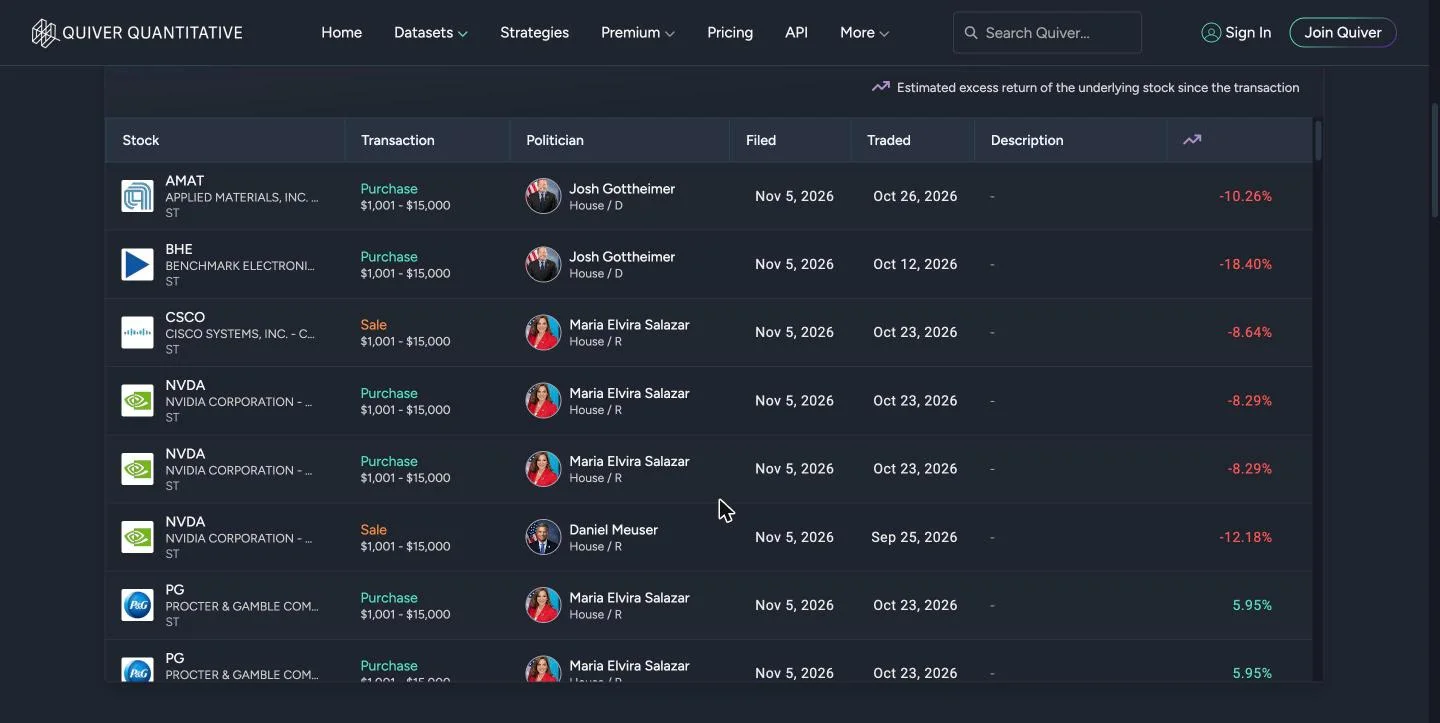
The deadline is shorter than many people think. According to the House Committee on Ethics, the earlier of two limits applies: 30 days after learning of the trade or 45 days after the trade. The Congress dashboard parses these filings and calculates how the stock has moved since. Background on the STOCK Act is on Wikipedia.
 Click to enlarge
The main problem is the delay. The list of November 8, 2026 shows a sale by Daniel Meuser with a trade date of September 25 and a filing on November 5: a gap of 41 days. By the time you see the trade, the market has long moved.
The second problem is size. Filings give no exact amounts, only ranges such as $1,001 to $15,000. A purchase like that says little about conviction. As a discretionary price action trader, I treat such a filing as a reason to look at the chart at most, not as an entry signal.
Research dampens the expectation. Eggers and Hainmueller found for 2004 to 2008 that the average member of Congress would have earned more in a passive index fund. An NBER paper shows for senators from 2012 to March 2020: the stocks they bought came in slightly below comparable stocks of the same industry and size.
There is one important exception. A CEPR column reports clearly higher returns for congressional leaders such as the Speaker, whips and floor leaders after they took office. Only 20 of them traded both before and after, though. The authors say explicitly that this does not apply to the typical member. “Copy Congress” is not a proven shortcut.
Quiver Strategies: why you should not take the backtests at face value
A backtest applies a fixed trading rule to past prices and shows what it would have earned in theory.
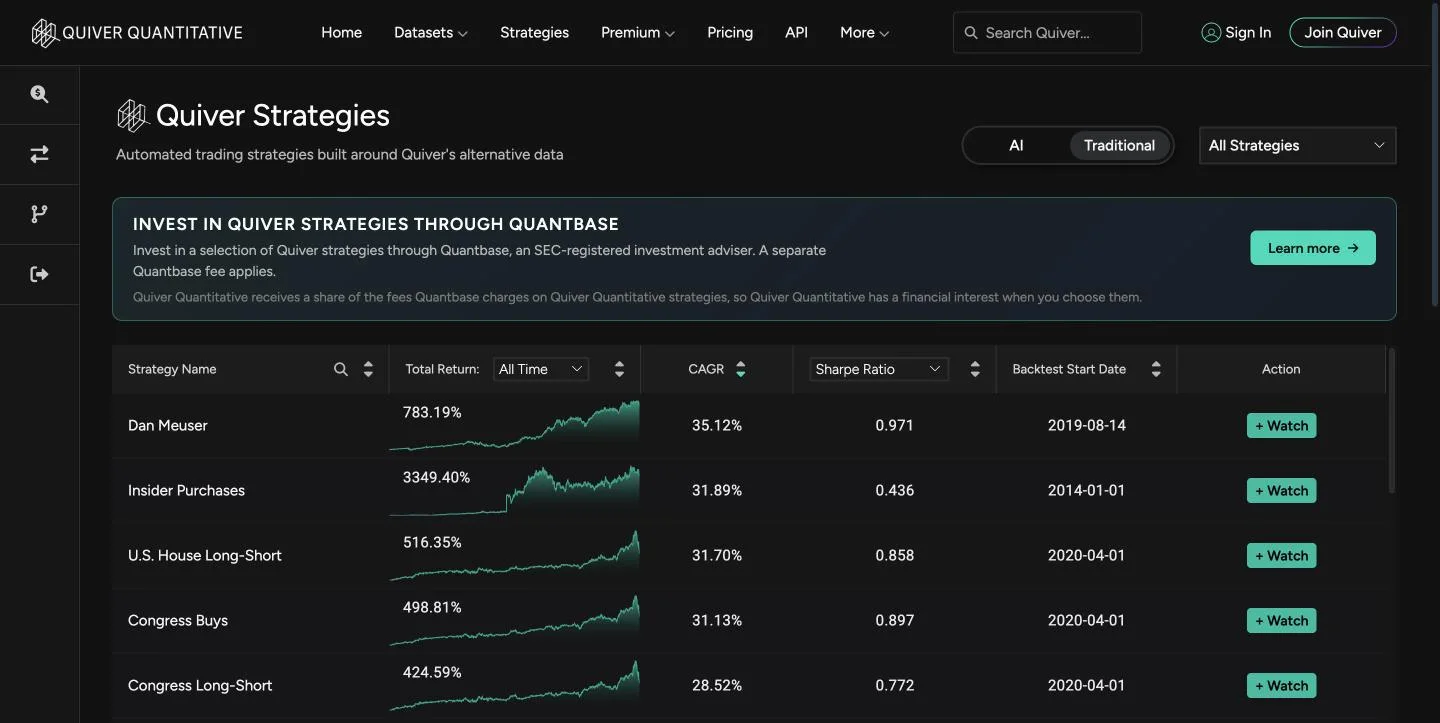
Quiver Strategies are model portfolios built from the datasets. How to read such calculations is covered in our guide to backtesting. The leaderboard below shows the top of the list. Further down are names such as Nancy Pelosi, Michael Burry and Congress Buys, plus AI portfolios.
 Click to enlarge
One single day carries the insider strategy
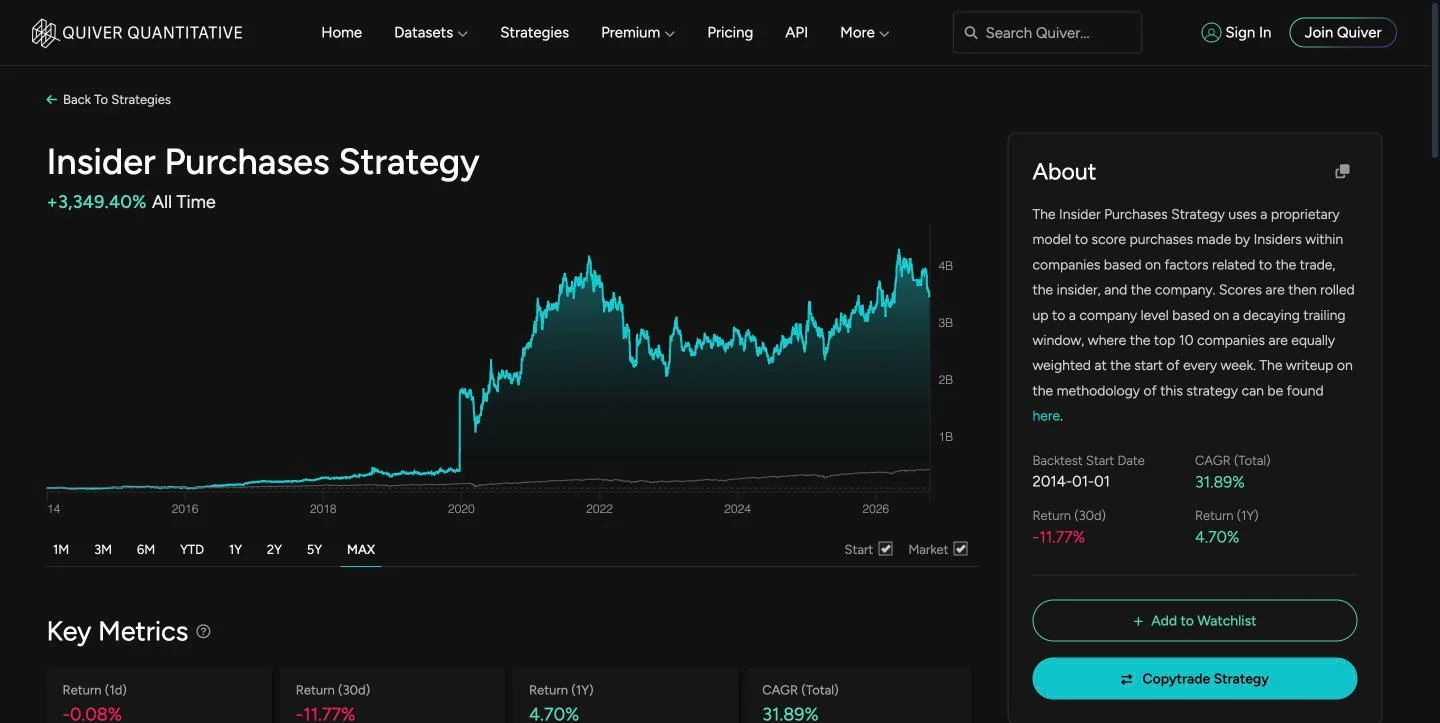
Insider Purchases shows a gain of 3,349.40% since 2014. The price series sits in the source of the strategy page, so we recalculated it. On December 27, 2019 the value jumps 343.7% in one day. The second-best day in the entire series brings 18.8%. The series we retrieved ends on October 15, 2026.
Remove only this one day and 677% remains instead of 3,349%. The average yearly return falls from 31.89% to 17.4%. This is a pure sensitivity calculation in which all other days stay unchanged, not a tradable result. Whether a real hit or a data error lies behind it, we cannot say from the outside. The screenshot below shows the jump clearly.
 Click to enlarge
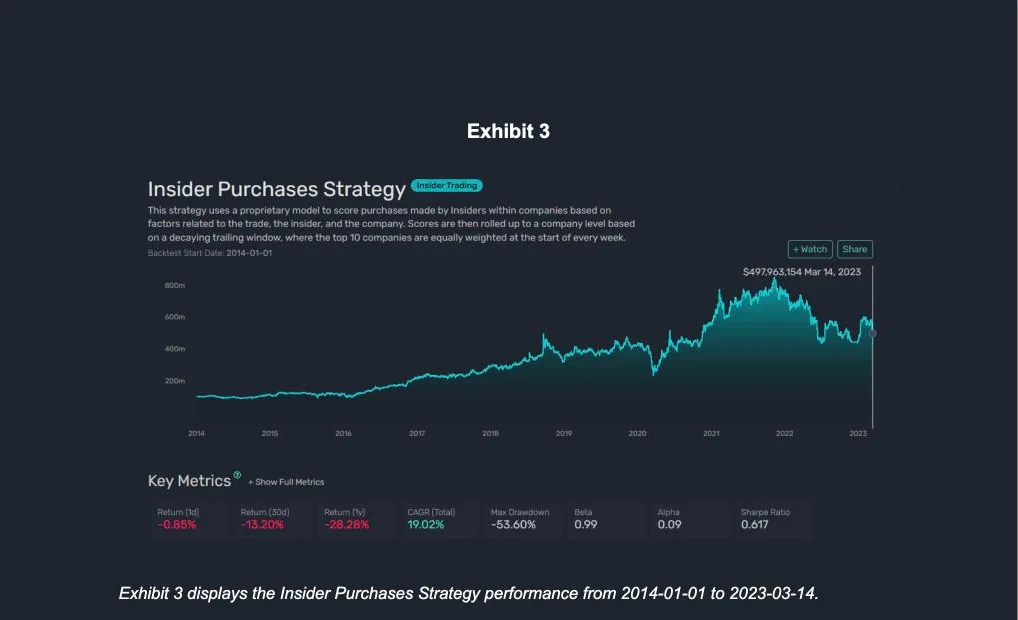
In Quiver’s own methodology paper the same strategy looks very different. The paper shows the state of March 14, 2023 as an exhibit: a model portfolio of about $498 million, a 19.02% CAGR and no jump at the end of 2019. Today’s series gives about $2.6 billion for the same day, 5.2 times as much. We found no explanation for this change, neither in the text of the paper nor on the strategy page.
 Click to enlarge
Source: Quiver Quantitative, Insider Purchases methodology paper.
The paper reveals one more thing: the health care sector was removed from the model because it was volatile and hurt accuracy in the other sectors. That may be sensible model maintenance. When you read a backtest, though, it means the rules were tightened with a view of the past.
Congress Buys: strong in the backtest, with a deep recent drop
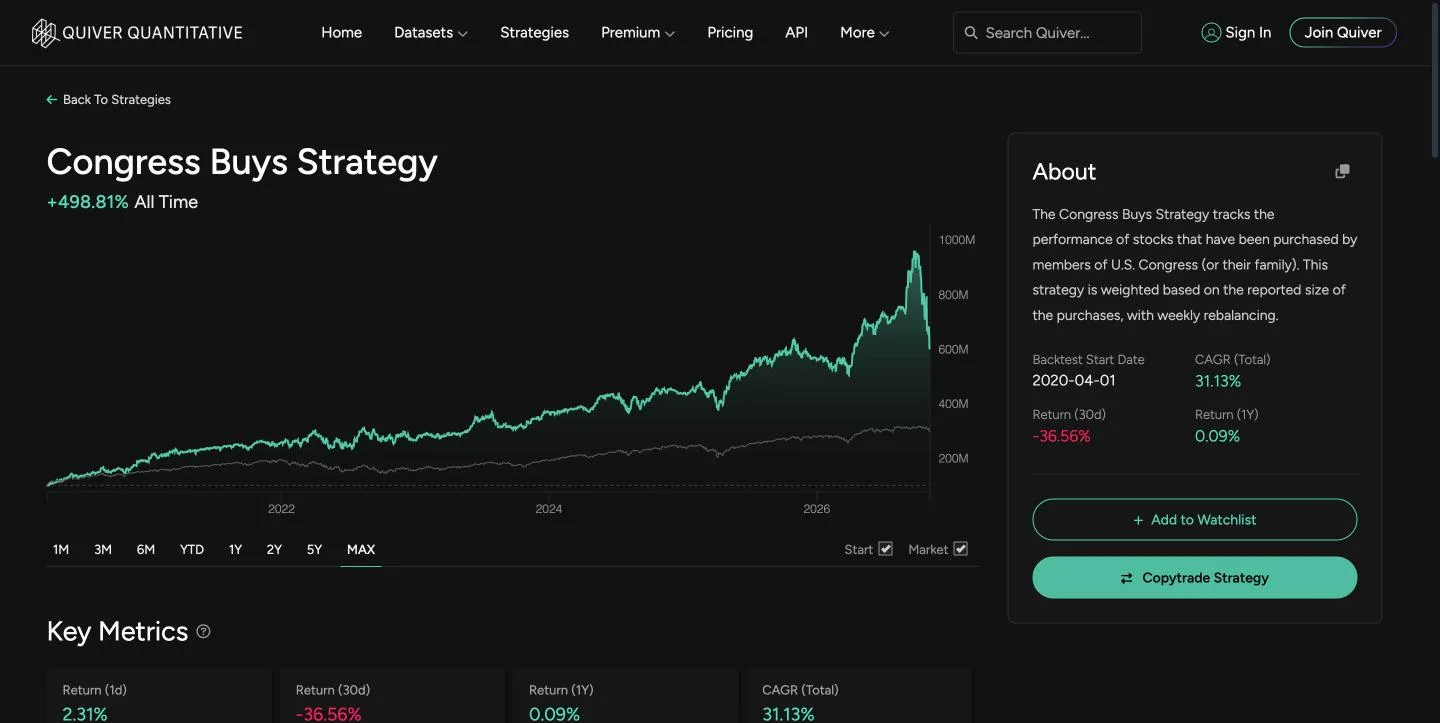
Congress Buys stands at plus 498.81% since April 2020, against plus 198.7% for the page’s market line (SPY, an ETF on the S&P 500). That looks superior. Yet the strategy lost 36.56% within 30 days, including 16.2% on October 30, 2026 alone.
 Click to enlarge
An eToro Smart Portfolio is a ready-made basket of stocks that follows fixed rules and is bought as a whole.
A tradable product runs under the same name. The Congress Buys Smart Portfolio has traded since June 2024 according to eToro and holds the ten largest purchases. Quiver weights all reported purchases by size and rebalances weekly. The table therefore compares two products, not a backtest and its implementation:
| Year | Quiver (backtest) | eToro |
|---|---|---|
| 2024 | +18.2% | +32.9% (partly back-tested) |
| 2025 | +30.0% | +17.1% |
| 2026 | +5.6% (to Nov 6) | -18.6% (as of Nov 8) |
We calculated the Quiver yearly figures from the price series, and the eToro figures are on its page. According to the same Quiver page, SPY returned 23.3% in 2024, 16.4% in 2025 and 7.8% in 2026 through November 6. The eToro version was slightly ahead of SPY in 2025 and is clearly behind in 2026 so far. These are past figures, not a forecast.
Three more things to keep in mind
- Annualizing: the strategy built on Claude with Quiver data has a backtest start of March 27, 2026. It reports a 46.96% CAGR; cumulatively that is 26.74% in just over seven months.
- A fair point: according to the strategy FAQ, Quiver calculates from the disclosure date, not the trade date. That avoids a typical calculation error.
- An open warning: Quiver itself names optimization bias and survivorship bias as risks. Optimization bias means a rule fits the past too well.
Can you copy the strategies?
Quiver itself does not execute orders. In the US it points to Quantbase, an SEC-registered investment adviser according to Quiver. Quantbase is a subsidiary of Surmount, and custody for its advisory accounts is with Alpaca Securities.
Copying costs more than the Quiver subscription. Quantbase charges its own advisory fee, which is described in its Form ADV brochure, and Quiver receives a share of it. Quiver says openly that this gives it a financial interest when you choose its strategies. Check the current fee in the brochure before you sign up.
Outside the US, Quiver named eToro in August 2024. It launched three Smart Portfolios there: Congress Buys, DC Insider and Lobby Spending Growth. Quiver’s note said those portfolios were available only to non-US traders. On November 8, 2026, Congress Buys had 455 investors.
You can also rebuild the purchases yourself. Then the selection is yours, and you carry the same delay as everyone else. For rule-based execution, see our guide to algo trading.
What does Quiver Quantitative cost?
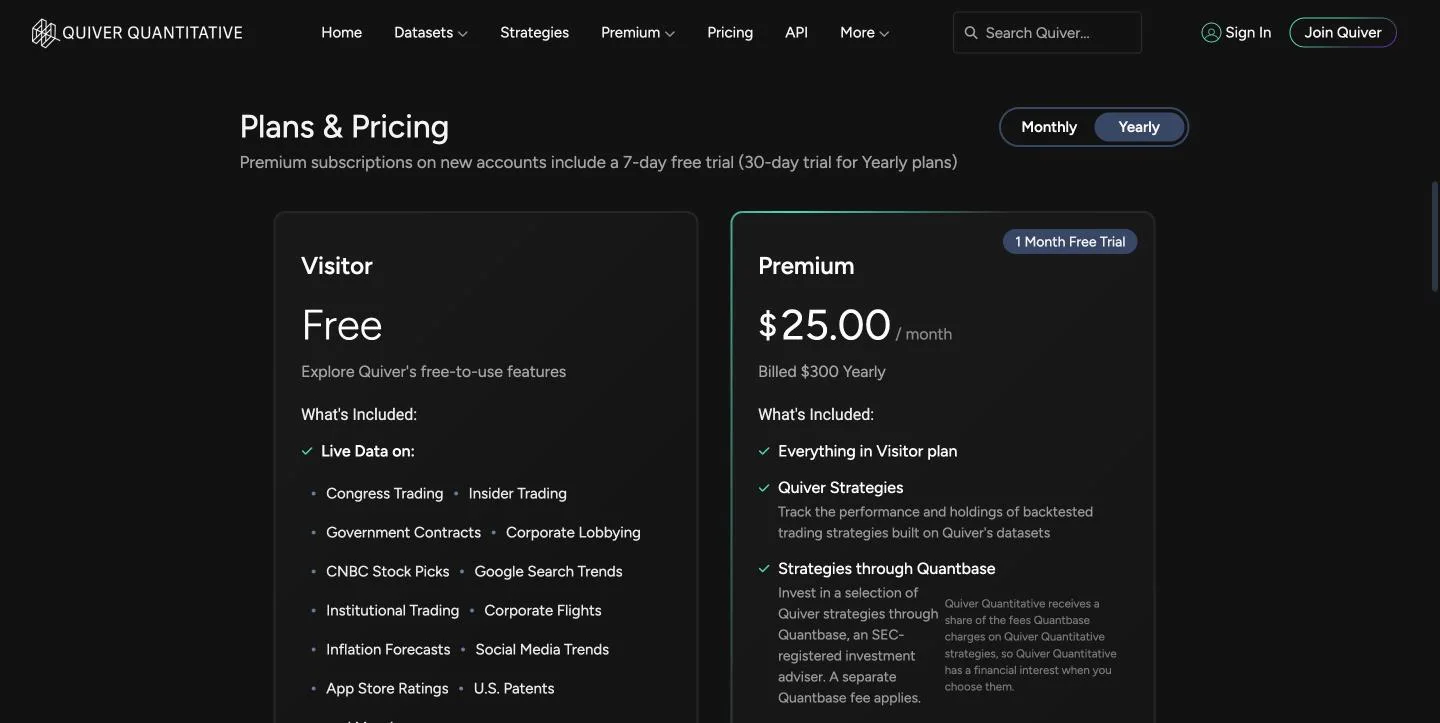
Access to the live dashboards is free. Premium costs $30 billed monthly or $300 billed yearly, which works out to $25 a month. Those figures are in the pricing section of the home page. The comparison page, however, says “$25/month or $300/year”, which sounds like a cheaper monthly plan. Prices checked November 8, 2026.
 Click to enlarge
| Plan | Price | Includes |
|---|---|---|
| Visitor | free | live datasets |
| Premium | $30 a month, $300 a year | strategies, alerts, backtesters |
| API Hobbyist | $30 a month, $300 a year | data feed, 10 AI tools |
| API Trader | $75 a month, $750 a year | more data, 18 AI tools |
Premium and the API are two separate subscriptions. The comparison page says so: Premium has no API key, and an API key does not unlock Premium. Both API plans above are for non-commercial use; companies use the Startup plan or Enterprise.
The site contradicts itself on the free trial. It lists 7 days for monthly plans and 30 days for yearly plans, while the strategy FAQ gives one month across the board. The discount code LABOR26 was also still visible on November 8, although the offer ended on September 7 according to the site. Subscriptions renew automatically; you can cancel for the end of the term.
Competitors price this differently: Unusual Whales starts at $42 a month billed yearly according to its pricing page, with a focus on options data. Quiver’s Congress dataset costs $5 a month at QuantConnect if you program there yourself; see our QuantConnect review.
API and AI connection: who it is for
The API is a data feed for your own programs. Your code fetches the raw data directly instead of reading it on the website. That suits algo traders who build their own rules, for example with a Python trading bot. Without programming skills, the route is through an AI assistant.
MCP is a standard that lets AI assistants access external data.
The API key can be connected this way. According to Quiver this costs nothing extra, but it stays tied to the API plan. Check AI answers against the source before you act on them.
Is Quiver Quantitative legit?
Quiver is a real data business. The company is named, and the raw data can be viewed for free and checked against the sources. QuantConnect also lists Quiver’s Congress data as a dataset in its own marketplace. None of this says anything about the quality of individual strategies.
The conflicts of interest are stated openly on the site. The same disclaimers name partnerships with Autopilot, Quantbase and Polymarket and a share of the Quantbase fees on its own strategies. There are also broker links to Interactive Brokers and Lightspeed. So whoever shows you a strategy partly earns when you buy it.
Independent voices are thin. Trustpilot showed zero reviews on November 8, 2026, and the profile is unclaimed. In the US App Store the app has 4.4 out of 5 points from 292 ratings. The latest iOS update dates from April 2026.
Legally it is a US matter. The terms name Wisconsin law and courts in Wisconsin. Quiver says it gives no recommendation to buy or sell, and past results are no guarantee. A filing says nothing about legality: illegal insider trading generally means trading on material, nonpublic information in breach of a duty of trust, according to the SEC’s investor site.
What are the alternatives to Quiver Quantitative?
For pure Congress data you do not necessarily need Quiver. The main sources and alternatives at a glance:
| Offer | Strength and limit |
|---|---|
| Capitol Trades | Congress trades with the filing delay in days, no strategies |
| OpenInsider | SEC insider filings, easy to filter, nothing else |
| House Clerk | original filings of House members, tedious raw documents |
| Unusual Whales | options flow plus Congress data, focus on options |
Never rely on one source alone: check a striking Congress trade in two sources. Capitol Trades shows the filing delay directly in its own column, while Quiver only gives the two dates.
Pros and cons of Quiver Quantitative
After checking the public pages and price series, this is the picture: the bundled raw data saves time, and the backtests we checked call for caution. We did not systematically check the accuracy of individual datasets.
Pros
- Plenty for free: Congress, insiders, lobbying and more without a subscription.
- Everything in one place: data is searchable by stock and person.
- Open figures: returns and drawdown are visible on the strategy pages.
- Conflicts of interest stated: partners and the fee share are on the site.
- For programmers: an API and an AI connection exist.
Cons
- Delay: Congress trades often appear only weeks later.
- Tempting backtests: large figures partly hang on a few days.
- US only: the data centers on US stocks and US politics.
- Copying through third parties: with separate fees.
- Contradictions on the site: trial and monthly price are inconsistent.
Conclusion: who Quiver Quantitative is for
Quiver Quantitative is worth using as a free research source for US stocks. If you want to know who in Washington just bought what, you get it here quickly and clearly. The subscription only pays off if you really use the screener, alerts and backtesters regularly.
In our view it is not suitable as a signal service. The data comes too late, the research is too mixed and the backtests are too exposed to outliers. Use a filing as a hint, then check trend and levels on the chart and decide according to your own risk plan.
Quiver does not suit traders without a US focus. Start with the free access and decide on a subscription only after that.
Frequently asked questions about Quiver Quantitative
Is Quiver Quantitative legit?
It is a real company with public data. Trustpilot showed no reviews on November 8, 2026, and the US App Store shows 4.4 out of 5 points from 292 ratings. Our assessment rests on the public pages and our own calculations, not on an account.
Is Quiver Quantitative free?
Yes, the basic access costs nothing. It includes Congress trades, insider purchases, lobbying and government contracts. Premium costs $30 a month or $300 a year and adds strategies, alerts and backtesters.
How current are the Congress trades?
They arrive with a delay. Members of Congress must report within 30 days of learning of a trade, and no later than 45 days after it. Quiver shows the trade date and the filing date side by side, so you can see the gap yourself.
Can I copy Nancy Pelosi’s portfolio with Quiver?
Quiver only approximates it. The strategy attempts to mirror the stock portfolio of Pelosi and family and adjusts when new filings arrive. Because the filings come late, you never get the same entries.
Is Quiver Quantitative worth it?
The free plan is, the subscription depends on your use. If you regularly work with alerts and backtesters, the price is modest. If you only look up trades now and then, the free dashboards are enough.
This US edition is based on our German edition on kagels-trading.de and has been adapted for US readers.
More Trading Software guides
- Choose software for your trading
Trading Software: Charts, Platforms and Research Tools
A task-based guide to charting, screening, seasonality, order flow, execution, backtesting, automation and journals, with dated US dollar prices.
- Check QuantConnect
QuantConnect Review 2026: Pricing, LEAN and Who It Suits
The LEAN engine and cloud platform: tier prices checked 8 November 2026, what the free plan leaves out, and who it suits.
- Check Deepcharts
Deepcharts Review: Order Flow, Pricing, and IQ Capital Access
Deepchart footprint, profile and DOM for futures: bundle prices checked 7 November 2026, data costs, the narrow refund terms and access through IQ Capital.
- Check Seasonax
Seasonax Review: Pricing, Screener and Limitations
Seasonax seasonal charts and screener: Basic and Professional prices checked 25 October 2026, the 30-day trial, the annualization pitfall and four alternatives.