
dxFeed Review 2026: Market Data Prices and Platforms


Contents
- dxFeed in 30 seconds (as of November 19, 2026)
- What is dxFeed?
- Level 1 and Level 2: what you are paying for
- What does dxFeed cost?
- Which platforms use dxFeed?
- dxFeed or Rithmic?
- Support and trials
- Pros and cons of dxFeed
- Our verdict: the data layer behind many order flow tools
- Frequently asked questions about dxFeed
- About the author
If you trade with ATAS, Quantower or Bookmap, your prices may come from dxFeed without you noticing. dxFeed is a market data provider: it collects prices from exchanges such as the CME Group and Nasdaq and passes them on to trading platforms. For order flow traders, the quality and depth of that data decide what the footprint or heatmap on the screen can show.
All prices in this review are as of November 19, 2026. We read dxFeed’s retail order portal and its home page in the browser. We did not buy a subscription for this review and have no business relationship with dxFeed. How we research and write is described on our editorial policy page.
dxFeed in 30 seconds (as of November 19, 2026)
- What it is: a market data provider, not a broker. It sells real-time and historical exchange data to platforms, brokers and prop firms.
- How traders get it: through a trading platform, booked in dxFeed’s retail portal or in the platform’s own store.
- Cost: from $19 a month for top-of-book data from the CME alone to $99 for market depth on all four CME Group exchanges, for non-professional traders.
- Who it fits: order flow and volume traders who need full market depth for CME futures or US stocks.
- Alternatives: Rithmic for futures through a broker, or the platform’s own data offer.
What is dxFeed?
dxFeed is a market data provider that collects, normalises and redistributes real-time and historical exchange data. It belongs to the Devexperts group; the portal’s footer names dxFeed Solutions IE Limited as the rights holder and states that Devexperts “does not provide any investment advice or brokerage services”. dxFeed does not execute trades.
The main customers are businesses. The home page addresses “online brokerages, exchanges, benchmarking agencies, prop traders, financial websites and startups”. Private traders usually meet dxFeed as the data source behind a trading platform.
Historical data is a large part of the offer. According to the home page, dxFeed parses and stores “up to 10Tb of raw data every day” as millisecond time-stamped tick data. Platforms use this history for replay and backtesting.
Tick data records every single trade and price change of a market instead of summarising prices in bars. That level of detail is what footprint charts, volume profiles and order book heatmaps need.
dxFeed at a glance
| Type | Market data provider, no brokerage |
| Group | Devexperts (dxFeed Solutions IE Limited) |
| Retail booking | get.dxfeed.com or in the platform |
| Platforms in the portal | ATAS, Quantower, NinjaTrader, MotiveWave and others |
| Cheapest package | $19 a month, CME top of book |
| CME Group depth | $99 a month (four exchanges) |
dxFeed retail portal and home page, read November 19, 2026. Non-professional prices.
Level 1 and Level 2: what you are paying for
Level 1 data shows the best bid, the best ask and the last trade. dxFeed calls this top of book. It is enough for chart trading on candles and indicators.
Level 2 data adds the market depth: the orders waiting at several price levels in the order book. dxFeed calls it market depth. You need it if you want to read the order book, for example in a heatmap or a depth of market ladder, as described in our guide to order flow trading.
On the CME alone, depth costs $20 more than top of book. On the CME Group package with four exchanges, the step is larger: $39 for top of book, $99 for market depth.
What does dxFeed cost?
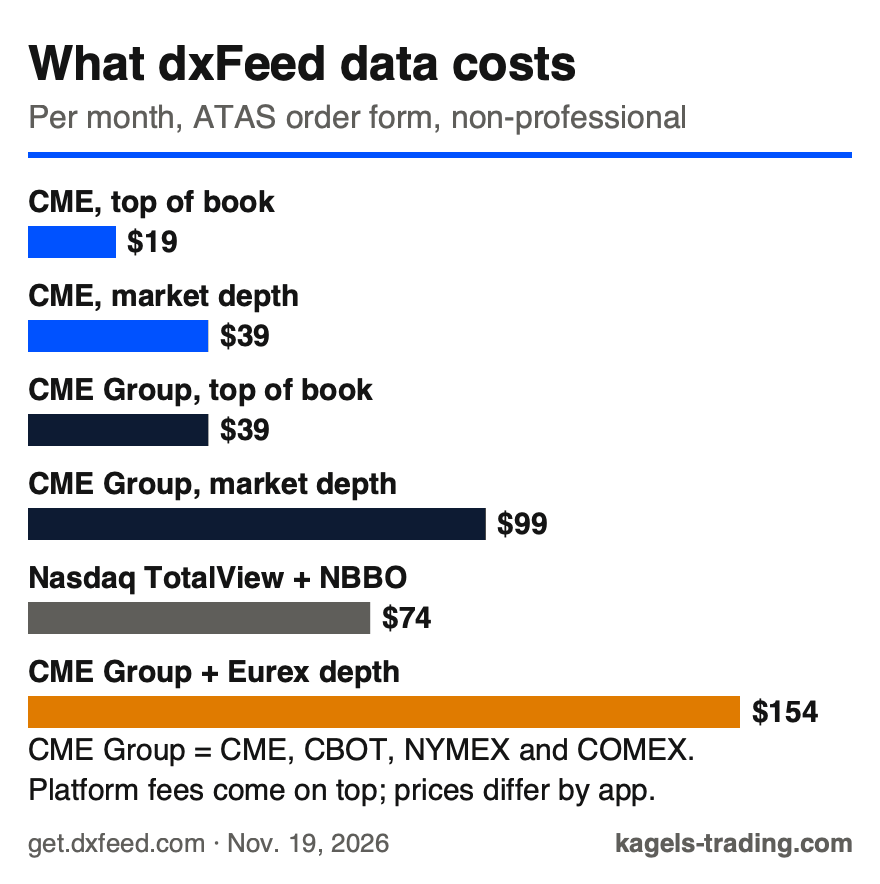
dxFeed sells retail data per exchange and per depth, as a monthly subscription. The order form first asks for your subscriber status. Eligibility follows each exchange’s self-certification rules; check these before you select your status. For CME Group data, dxFeed’s CME help article says a non-professional must, among other things, have an active futures trading account and use the data solely for personal use and their own assets. The prices below are for non-professional subscribers, the option the form preselects; a preselected option does not mean you qualify.
 Click to enlarge
Source: Kagels Trading, own graphic from the dxFeed retail order form.
| Package | Depth | Per month |
|---|---|---|
| CME | Top of book | $19 |
| CME | Market depth | $39 |
| CME Group (4 exchanges) | Top of book | $39 |
| CME Group (4 exchanges) | Market depth | $99 |
| Eurex futures | Top of book | $39 |
| Eurex futures | Level 2 | $65 |
| Nasdaq TotalView + NBBO | Market depth | $74 |
| US equities Level 1 (NBBO) | Top of book | $49 |
ATAS order form on get.dxfeed.com, non-professional, November 19, 2026. CME Group = CME, CBOT, NYMEX and COMEX.
Bundles can save money, but check what they are compared with. The Futures Market Depth Bundle (CME Group depth plus Eurex Level 2) costs $154 a month. The portal says this saves $67, which matches the four CME Group exchanges booked singly at $39 each plus Eurex at $65 ($221); compared with the CME Group package at $99 plus Eurex at $65 ($164), the saving is $10. The Futures Top of Book Bundle costs $78, the same as CME Group top of book plus Eurex top of book booked separately ($39 + $39). The US Equities Ultimate Bundle with three depth feeds for US stocks costs $179.
The costs add up faster than the entry price suggests. CME Group market depth plus Nasdaq TotalView comes to $173 a month, before the licence of the trading platform. For an occasional trader, that is a high fixed cost.
Prices differ by platform. The portal lists its own order forms for platforms such as ATAS, Quantower and NinjaTrader, while Bookmap and MultiCharts link to their own offers. In our Bookmap review, Bookmap charged $37 per futures exchange for dxFeed data. Check the price in the order form for your platform.
Which platforms use dxFeed?
The retail portal lists more than ten platforms. These include ATAS, Volumetrica Trading, Exocharts, MotiveWave, NinjaTrader, Optimus Flow, Overcharts, Quantower and Tickblaze; Bookmap and MultiCharts link to their own offers. The list in the portal is the most reliable check before you buy.
The platform decides what you see, dxFeed decides what is in the data. A footprint chart can only show volume at each price if the feed delivers every trade, and a heatmap needs the full order book. Our Deepcharts review shows how one order flow platform presents such data.
dxFeed or Rithmic?
Both deliver futures data for order flow platforms, but they are sold differently. Rithmic combines market data with order routing to the exchange and is usually billed through your futures broker, as our Rithmic guide explains. dxFeed sells data only, for futures and stocks, in its own portal or through the platform. Rithmic also covers Eurex through selected brokers and Nasdaq at top-of-book level.
| dxFeed | Rithmic | |
|---|---|---|
| Data | Futures, Eurex, US stock depth | Futures; Eurex via some brokers |
| Orders | No | Yes, through the broker |
| Billing | Portal or platform | Usually the broker |
dxFeed portal and our Rithmic guide, November 19, 2026.
If you trade CME futures through a broker that offers Rithmic, a separate dxFeed subscription is often not needed. dxFeed is more useful if you need market depth for US stocks, if your Rithmic provider does not offer Eurex, or if your platform sells its data through dxFeed.
Support and trials
Retail customers get help through the portal’s help centre and through their platform. The portal links to a help centre for orders and subscriptions. dxFeed offers a free demo connection in NinjaTrader with 15-minute delayed and historical data for CME Group and Nasdaq symbols, with “a limited number of symbols and a limited amount of historical data”, according to its demo instructions. That is not a live-data trial: to test real-time depth, you need a paid subscription or a platform trial that includes live data.
Pros and cons of dxFeed
Pros
- Full market depth for CME futures, Eurex and US stocks from one provider.
- Low entry price: $19 a month for one exchange.
- Bundles for several markets.
- Many platforms supported.
- Tick history for replay and backtesting.
Cons
- Costs add up: depth for futures and stocks costs well over $150 a month.
- Prices differ by platform, which makes comparison harder.
- Higher fees for professional subscribers.
- No order routing: you still need a broker.
Our verdict: the data layer behind many order flow tools
dxFeed is a solid choice if your platform supports it and you need market depth beyond the CME. The portal shows clear monthly prices, and the bundles make sense for traders who follow futures and US stocks together.
For pure CME futures traders, the broker’s data is often enough. If your broker offers Rithmic or another feed with full depth, compare that cost before you add a dxFeed subscription. To learn what the order book data can show, start with our guide to volume profile.
Frequently asked questions about dxFeed
What is dxFeed?
dxFeed is a market data provider in the Devexperts group. It collects real-time and historical exchange data and sells it to trading platforms, brokers and prop firms. It does not execute trades.
How much does dxFeed cost?
Retail data starts at $19 a month, as of November 19, 2026. That buys top of book for the CME alone. Market depth for all four CME Group exchanges costs $99, Nasdaq TotalView $74, for non-professional traders.
Is dxFeed a broker?
No, dxFeed only delivers data. To place trades, you need a broker; your platform connects the dxFeed data with your broker account.
Which platforms work with dxFeed?
The retail portal lists ATAS, Quantower, NinjaTrader, MotiveWave and others. Bookmap and MultiCharts sell dxFeed data through their own offers. Check the order form for your platform.
What is the difference between top of book and market depth?
Top of book shows the best bid, the best ask and the last trade. Market depth adds the orders at several price levels. You need depth for order book heatmaps and depth of market ladders.
Is dxFeed better than Rithmic?
It depends on what you trade. Rithmic fits futures traders whose broker offers it, with data and order routing together. dxFeed fits traders who also need depth for US stocks, or Eurex data their Rithmic provider does not offer.
This English edition is based on our German edition on kagels-trading.de and has been adapted for international readers.
More Trading Software guides
- Choose software for your trading
Trading Software: Charts, Platforms and Research Tools
A task-based guide to charting, screening, seasonality, order flow, execution, backtesting, automation and journals, with dated US dollar prices.
- Check Quiver Quantitative
Quiver Quantitative Review 2026: Data, Pricing, Limits
Free Congress and insider data, Premium prices checked 8 November 2026, and why we recalculated its backtests before trusting them.
- Check Kavout
Kavout Review 2026: Kai Score, InvestGPT, Pricing
Kavout InvestGPT and Kai Score: Pro and Premium prices checked 10 November 2026, the strict cancellation terms and why its "Live" sample raises questions about data freshness.
- Check QuantConnect
QuantConnect Review 2026: Pricing, LEAN and Who It Suits
The LEAN engine and cloud platform: tier prices checked 8 November 2026, what the free plan leaves out, and who it suits.
- Check Deepcharts
Deepcharts Review: Order Flow, Pricing, and IQ Capital Access
Deepchart footprint, profile and DOM for futures: bundle prices checked 7 November 2026, data costs, the narrow refund terms and access through IQ Capital.
- Understand the Rithmic feed
Rithmic Explained: Costs, Platforms and Who It Suits
What the futures data feed and order routing cost through a broker, R | Trader Pro, the 35 listed platforms, the APIs and the limits.
- Check Quantower
Quantower Review 2026: Prices, Free Version and Limits
The Windows order flow platform: license prices checked 19 November 2026, the limits of the free version, broker routes without a license fee and the Mac question.
- Check LuxAlgo
LuxAlgo Review 2026: Plans, Prices, Free Tools and Limits
Vela, Quant, the indicator library and the TradingView toolkits: four plans checked 10 November 2026, what is free, and the first-payment-only refund.
- Check Seasonax
Seasonax Review: Pricing, Screener and Limitations
Seasonax seasonal charts and screener: Basic and Professional prices checked 25 October 2026, the 30-day trial, the annualization pitfall and four alternatives.