
Kavout Review 2026: Kai Score, InvestGPT, Pricing


Contents
- Kavout in 30 seconds
- What is Kavout?
- InvestGPT: what the AI chat can and cannot do
- Kai Score: what the grade means and what is missing
- AI Stock Picker: how the rankings are built
- Smart Signals and Smart Money: how current is the data?
- How much does Kavout cost?
- Is Kavout legit?
- What are the alternatives to Kavout?
- Pros and cons of Kavout
- Conclusion: who Kavout is for
- Frequently asked questions about Kavout
- About the author
Kavout sells an agent called “Buy or Sell Oracle”, and its disclaimer says the company makes no recommendations. That contradiction runs through the whole platform. The tool itself is cheap and versatile, but the public pages offer no solid evidence of its hit rate.
This review is based on Kavout’s public pages, not on an account of our own. We read the pricing, terms of use and Academy and checked several advertising claims against independent price data. We did not test features behind the login, and this is not investment advice.
Kavout in 30 seconds
- AI stock research platform from the US: you ask about a stock in a chat, and language models from OpenAI, Anthropic and Google write the answer from Kavout’s data.
- Pro costs $20 a month or $192 a year, Premium $49 or $468. The free plan gives you 10 credits a month.
- Kai Score is the in-house grade from 1 to 9. We found no continuous public track record for it.
- “Live” does not always mean current: on November 8, the sample on the signals page showed Nvidia at $235.75. The close on November 6 was $186.64.
- For traders, a second opinion at most: check the entry yourself on a chart, for example on TradingView, not in the chat answer.
What is Kavout?
Kavout is a US platform for AI-assisted stock research that condenses price data, fundamentals and sentiment into rankings and answers questions about stocks, ETFs, crypto and forex in a chat.
The company behind it is Kavout Corporation. The privacy policy gives an address in Bellevue, Washington. The company page lists Seattle, Los Angeles and Shanghai as locations. According to Kavout, the founder is Alex Lu, who previously worked at Google and Microsoft, among others. The awards listed there date from 2016 and 2017.
The core product is called InvestGPT. It is a chat that steers several AI agents. Agents here are specialized programs, for example for financial statements, chart analysis or news. If you want to read up yourself, the Academy describes every function in detail, and that is a real strength of the provider.
| Feature | Details |
|---|---|
| Operator | Kavout Corporation, Washington (USA) |
| Plans | Free, Pro, Premium, separate data API |
| Core functions | InvestGPT, AI Stock Picker, Smart Signals, Smart Money |
| Markets | 30+ markets, ETFs, crypto, forex (Kavout’s own claim) |
| Languages | answers in 13 languages (Kavout’s own claim) |
| Apps | iOS since November 5, 2026, version 0.9.0 |
| Trading | not a broker, no order execution |
InvestGPT: what the AI chat can and cannot do
InvestGPT is Kavout’s AI chat that answers questions about stocks and markets using specialized agents and Kavout’s own market data.
InvestGPT is not a language model of its own. According to the privacy policy, Kavout sends your question and the relevant market data to OpenAI, Anthropic or Google. Kavout says these providers may not use the content for training. They should not receive your name and email address, but personal details still do not belong in a question.
The benefit lies in the data access. A general chatbot does not automatically know the current financial metrics of a stock. With Kavout, the answer is meant to build on in-house data. Right below the input field, however, the provider warns that the AI can make mistakes.
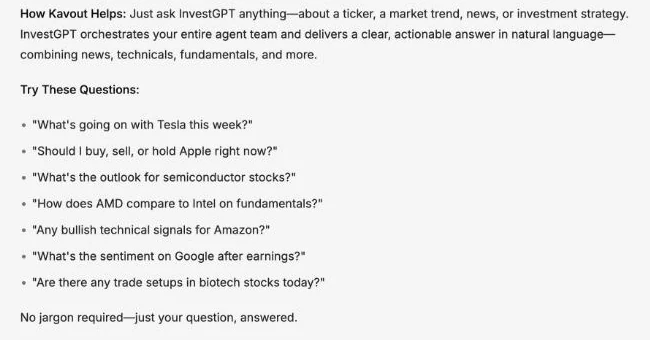
The sample questions still aim at an action. The Academy suggests asking whether you should buy, sell or hold Apple right now. According to Kavout, the “Buy or Sell Oracle” agent delivers a clear call, a confidence score and a time frame. The “Trade Spotter” agent adds stop-loss suggestions, meaning price levels for exiting at a loss. The screenshot below shows the sample questions.
 Click to enlarge
Source: Kavout Academy.
The fine print says the opposite. The disclaimer states that Kavout is not an investment adviser and makes no recommendation. For you this means: the answer sounds like advice, but the responsibility stays entirely with you. Check every number at the source, just as with the TradingView AI Copilot, and check price levels and trend on the chart yourself.
Kai Score: what the grade means and what is missing
The Kai Score is Kavout’s AI grade from 1 to 9 that condenses technical data, fundamentals and market sentiment into one value for the chance of outperforming.
Kai Score and the K Score API are described separately. The AI Stock Picker guide rates a Kai Score from 6.0 as “Outperform”, a grade for stocks expected to beat the market. The separate K Score API highlights values from 7 to 9. Whether both use the same calculation and the same bands remains open.
The calculation remains a black box. Kavout names the ingredients, but not the weighting. So you cannot trace a grade yourself. That is not unusual for AI scores, but it makes the evidence about the results all the more important.
That evidence is exactly what we could not find. On the free public pages we checked, there is no continuous track record of the Kai Score, only short single examples. Danelfin takes a different route with its grade from 1 to 10 and publishes historical evaluations. Even such backtests, tests on past prices, need a critical reading, as our Quiver Quantitative review shows.
AI Stock Picker: how the rankings are built
The AI Stock Picker is Kavout’s ranking tool that sorts stocks daily by fixed strategies, the Stock Rank and the Kai Score.
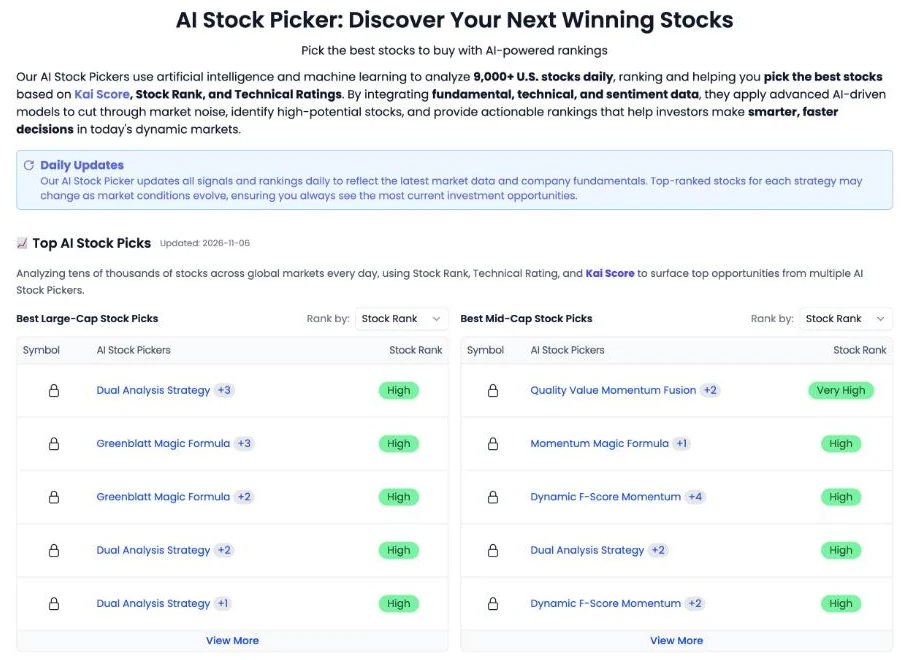
The AI Stock Picker combines well-known rules with AI grades. These include models after Joel Greenblatt, Peter Lynch and Joseph Piotroski, rule-based filters on valuation, growth and balance sheet quality. When several rules agree on the same stock, it rises in the consensus list. Without a paid plan you will not see most of the ticker symbols, as the screenshot below shows.
 Click to enlarge
Source: Kavout AI Stock Picker.
Percentages in the marketing sound bigger than they are. The page links three posts with headlines such as “68% higher return”. Behind the 68 percent are 5.32 against 3.16 percent in about five weeks, so 2.16 percentage points. In a second post, 7.38 against 3.83 percent become the “over 90%” of the headline. Periods this short say little about a strategy.
The comparison figures cannot be recalculated either. The posts give no year; Kavout only dates them “2 years ago”. A third post also counts only up to an unnamed day of the month. Without the year, the end date and the return calculation, it remains open whether the numbers are right.
Penny stocks are shares with a very low price and usually a small market capitalization.
Some of the posts are about penny stocks. Trading there is often thin, and a model return can look good on paper and fail in real trading because of wide bid-ask spreads. If you prefer to filter yourself, our overview of stock screeners shows the tools for it.
Smart Signals and Smart Money: how current is the data?
Smart Signals is Kavout’s scanner that searches markets for technical patterns and returns the matching symbols as a list.
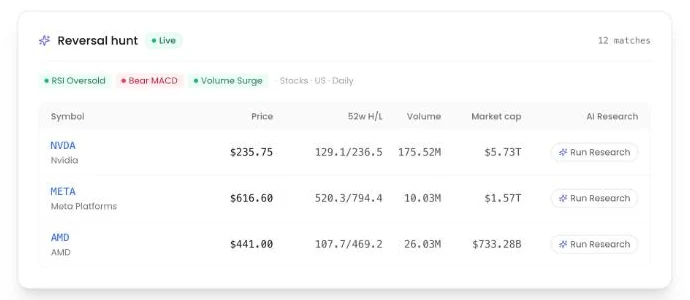
Smart Signals scans for technical patterns. According to Kavout, more than 100 signals such as RSI, MACD or Bollinger Bands run across stocks, ETFs, crypto and forex. The RSI measures whether a market was recently overbought or oversold. For day traders this sounds attractive, and the page advertises a “real-time scanner”. The image below shows its sample.
 Click to enlarge
Source: Kavout Smart Signals.
The sample in the ad gives no data date. The table labeled “Live” showed Nvidia at $235.75 on November 8. According to Twelve Data, the stock closed at $186.64 on November 6. It is probably just a static illustration, but there is no note saying so. The real scanner may work differently; we did not test it.
The comparison page we checked was not current either. The comparison of SPY and VOO, two ETFs on the S&P 500, says “refreshed every trading day”, but showed the stamp October 26 on November 8 and again on November 10. As today’s SPY price it gave $759.97, the close of October 23. On November 6 the ETF closed at $735.29. Check current prices on a live chart before you trade.
Smart Money is Kavout’s section for reported trades by insiders, members of Congress and large investors, plus analyst ratings.
The marketing promises more than the filing deadlines allow. The pricing page promises that you can follow insiders, Congress and billionaires before the market reacts. Members of the House report trades up to 45 days after the transaction, according to the Committee on Ethics. Most insider transactions must be reported on Form 4 within two business days. Large asset managers report certain holdings on Form 13F quarterly, up to 45 days after the quarter ends. The Academy itself admits that a purchase by a member of Congress can simply be private wealth management.
How much does Kavout cost?
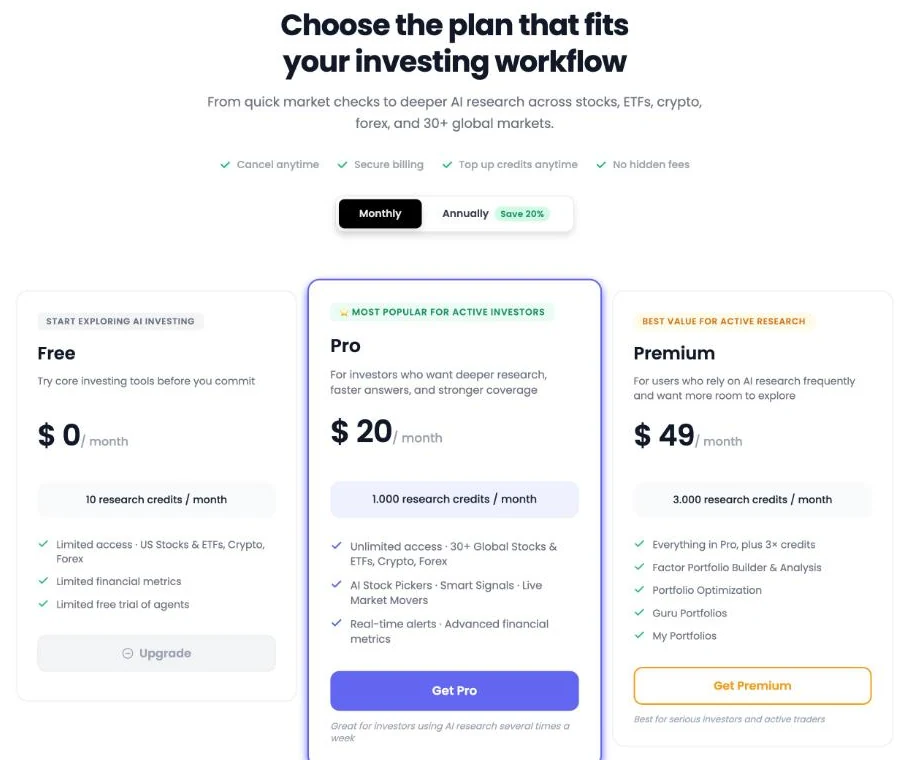
Kavout has three plans, and the pricing page opens with the annual price. We checked the pricing page and AppSumo on November 8 and 10, 2026. It first shows $16 and $39 a month. Both apply only if you pay twelve months in advance. On monthly billing it is $20 and $49, as the screenshot below shows.
 Click to enlarge
Source: Kavout pricing.
| Plan | Price | What you get |
|---|---|---|
| Free | $0 | 10 credits, US stocks, crypto, forex, limited |
| Pro | $20 a month, $192 a year | 1,000 credits, agents, stock picker, signals |
| Premium | $49 a month, $468 a year | 3,000 credits, portfolio tools |
| AppSumo | sold out, previously from $69 once | lifetime license, up to 1,500 credits a month |
Research credits are Kavout’s balance for AI research, refilled monthly depending on the plan and used up with every analysis.
Credits are the real currency. Every research request uses some, and Kavout says the pricing page shows the amount in advance. Unused credits are valid for 90 days, and you can buy more.
The lifetime license could not be bought on November 8 or 10. The AppSumo page shows tiers of $69, $149 and $299, but with the note “Sold out”. If the offer returns, keep in mind that the terms of use expressly allow Kavout to discontinue subscription products.
The published terms contain a 30-day rule for cancellation. The pricing page advertises “Cancel anytime”. The published terms, dated July 2019, require written notice and a 30-day rule after the initial term, monthly plans included. Kavout generally rules out refunds there, the plan renews automatically, and prices may rise with 30 days’ notice. We did not check how the current checkout applies these terms.
The data API is a separate product. Single factor signals cost $39 a month, the bundle $199, and the K Score for the 500 largest US stocks from $1,500. The factor bundle is also on QuantConnect for $39 a month, if you write your own code there. Our QuantConnect review explains the platform.
Is Kavout legit?
Kavout is a real software product. The company and the leadership team are named, and the terms are openly on the site. QuantConnect also lists Kavout’s dataset in its own marketplace. We do not see grounds for a fraud allegation in our findings. None of this says anything about the quality of the signals, though.
Kavout Corporation does not present itself as an investment adviser. It says itself that it is neither an investment adviser nor a broker. In the SEC’s adviser database, however, there is an active Kavout Algo Financial LLC in Seattle, and two more entries with the Kavout name are inactive. Whether and how they relate to the subscription is not shown by the records.
Independent voices are thin. On Trustpilot there was one single review on November 8, and the profile is unclaimed. On AppSumo the score is 4.6 out of 5 from about 50 reviews, written by buyers of a discount deal. The AppSumo summary names occasionally outdated stock information as a weakness. The iOS app only came out on November 5 and had no rating yet.
Put the customer quotes on the pricing page into context. They carry only first names with an initial and the label “Verified Purchaser”. Who verified the purchases is not stated. For a legal dispute, the terms name only courts in the state of Washington. So do not rely on quotes; test an idea on your own chart first.
What are the alternatives to Kavout?
Which tool fits depends on how you work. Some alternatives give you AI grades, others classic screeners or real-time scanners:
| Product | Strength and limit |
|---|---|
| Danelfin | AI grade from 1 to 10 for a three-month horizon, with published history |
| InvestingPro | fundamentals with an AI chat, not a pure signal service |
| Finviz | fast US stock screener and heat map, no AI grade |
| Trade Ideas | real-time scanner for active US day traders |
| TrendSpider | charting software with pattern recognition and backtests |
Our tip: keep the search for ideas apart from the trading decision. A ranking or a chat may suggest a stock to you; you set the entry and the stop yourself afterwards. Our guide to AI trading explains the limits of AI in trading as a whole.
Pros and cons of Kavout
After checking the public pages, this is the picture: many features at a low price, set against marketing that promises more than it proves. We did not systematically check the quality of the chat answers.
Pros
- Low entry point: the free plan gives you a first look.
- Many tools: chat, rankings, scanner and portfolio checks in one place.
- Many languages: InvestGPT answers in 13 languages, according to Kavout.
- Good documentation: the Academy explains the functions and names limits too.
- Open about the technology: the language models used are named in the privacy policy.
Cons
- Public evidence missing: on the free pages we checked, there is no continuous record of the Kai Score.
- Mixed message: calls to action in the marketing, “no recommendation” in the disclaimer.
- Outdated displays: a “Live” sample without a data date, a comparison page with an old price.
- Strict contract terms: a cancellation rule and no refunds in the terms.
- Few independent reviews: hardly any ratings outside AppSumo.
Conclusion: who Kavout is for
Based on the functions described, Kavout can work as a low-cost research assistant for presorting US stocks. The chat is meant to bundle metrics, news and analyst opinions. We did not test whether the answers reliably save time. So start with the free plan and compare the answers with the source.
As a signal service it does not fit, in our view. For that, we are missing public evidence over longer periods, and several advertising claims could not be traced. Take a grade as a reason to look closer, check trend and levels on the chart and decide according to your own risk plan.
Kavout does not suit beginners who want a ready-made buy list. A confident AI answer does not replace trading knowledge. And if you are a day trader who needs real-time data, test the scanner thoroughly before you pay for it.
Frequently asked questions about Kavout
Is Kavout legit?
Kavout is a real software product with a named company. We do not see grounds for a fraud allegation. What we criticize is the gap between marketing and evidence and the strict cancellation rules in the terms of use.
What is the Kai Score?
It is Kavout’s in-house AI grade from 1 to 9. High values are meant to signal a better chance of outperformance. Kavout does not disclose the exact weighting, and we found no continuous public track record.
How much does Kavout cost?
The entry is free, with 10 credits a month. Pro costs $20 a month or $192 a year, Premium $49 or $468. The lifetime license on AppSumo was sold out on November 8 and 10, 2026.
What do Kavout users say?
Independent user reviews are rare. Trustpilot showed only one review on November 8, 2026, and AppSumo shows 4.6 out of 5 from about 50 reviews. Our assessment rests on the public pages and our own price checks, not on an account of our own.
Does Kavout cover stocks outside the US?
Partly, according to Kavout. The pricing page names 30+ markets, including Canada, the UK, Europe and Asia, on the paid plans, and answers in 13 languages. The free plan is limited to US stocks, crypto and forex, and we did not check coverage of single non-US stocks.
This US edition is based on our German edition on kagels-trading.de and has been adapted for US readers.
More Trading Software guides
- Choose software for your trading
Trading Software: Charts, Platforms and Research Tools
A task-based guide to charting, screening, seasonality, order flow, execution, backtesting, automation and journals, with dated US dollar prices.
- Check Quiver Quantitative
Quiver Quantitative Review 2026: Data, Pricing, Limits
Free Congress and insider data, Premium prices checked 8 November 2026, and why we recalculated its backtests before trusting them.
- Check QuantConnect
QuantConnect Review 2026: Pricing, LEAN and Who It Suits
The LEAN engine and cloud platform: tier prices checked 8 November 2026, what the free plan leaves out, and who it suits.
- Check Deepcharts
Deepcharts Review: Order Flow, Pricing, and IQ Capital Access
Deepchart footprint, profile and DOM for futures: bundle prices checked 7 November 2026, data costs, the narrow refund terms and access through IQ Capital.
- Check LuxAlgo
LuxAlgo Review 2026: Plans, Prices, Free Tools and Limits
Vela, Quant, the indicator library and the TradingView toolkits: four plans checked 10 November 2026, what is free, and the first-payment-only refund.
- Check Seasonax
Seasonax Review: Pricing, Screener and Limitations
Seasonax seasonal charts and screener: Basic and Professional prices checked 25 October 2026, the 30-day trial, the annualization pitfall and four alternatives.