
Trading Sessions: Asian, London and New York Hours in ET


Contents
- Trading sessions in 30 seconds
- What is a trading session?
- Session times in ET, London and India time
- The Asian session: quiet, but not irrelevant
- The London session: the centre of currency trading
- The New York session: stocks, indices and the daily close
- What do RTH and ETH mean?
- What is the RTH gap, and why does it matter?
- Common mistakes with trading sessions
- Daylight saving time: when the session times shift
- How to switch between RTH and ETH in TradingView
- Conclusion: to understand the market, understand when it trades
- Frequently asked questions about trading sessions
- About the author
Not every price move carries the same weight. A breakout in the London session has far more orders behind it than a spike in the quiet Asian night. The time of day shapes how much liquidity is in the market, and that changes how much a move can tell you.
The global trading day is usually split into three sessions: Asia, London and New York. Each has its own participants, its own volume and its own typical behaviour. On top of that come two terms that decide which prices you see in your chart: RTH and ETH.
This guide gives the session times in US Eastern Time (ET), London time and India Standard Time (IST). It explains where the sessions overlap, how daylight saving shifts them, what killzones are and how to set up your chart. This article follows our editorial policy.
Trading sessions in 30 seconds
- Three main sessions: by common convention, each session follows the local business hours of its centre: Tokyo 9:00 to 18:00, London and New York 8:00 to 17:00 local time. There are no official exchange hours for these sessions.
- In ET: London runs from about 3:00 a.m. to 12:00 p.m. ET, New York from 8:00 a.m. to 5:00 p.m. ET. Tokyo runs from 7:00 p.m. to 4:00 a.m. ET in US winter and from 8:00 p.m. to 5:00 a.m. ET in US summer.
- The busiest window: London and New York overlap from about 8:00 a.m. to noon ET, which is 13:00 to 17:00 London time. That is usually the most liquid part of the forex day.
- London leads in currencies: about 38 percent of global foreign exchange turnover runs through UK trading desks, 37.8 percent in the BIS survey of April 2025.
- RTH and ETH differ by market: for US stocks, RTH means 9:30 a.m. to 4:00 p.m. ET and the rest is extended hours. For CME futures, TradingView shows RTH from 9:30 a.m. to 4:15 p.m. ET, and ETH is the full electronic session.
- Daylight saving: the US and Europe change their clocks on different dates. For a few weeks in spring and autumn, London is four hours ahead of New York instead of five.
What is a trading session?
A trading session is the part of the day in which one of the big financial centres is at work and much of the order flow comes from there.
The three sessions are named after the financial centres Tokyo, London and New York. Some traders add Sydney as a fourth session at the start of the week. What matters is not only when a session starts and ends, but where two sessions overlap. In those windows, liquidity is usually highest and spreads are often tightest.
There are no official start and end times for the forex sessions. Unlike a stock exchange, the currency market has no opening bell, so brokers and data providers use slightly different windows. forex.com, for example, gives the London session as 3:00 a.m. to 12:00 p.m. ET on one page and the London and New York overlap as 1:00 to 4:00 p.m. GMT on another. In this guide, each session follows the local business hours of its centre, so the times move with each city’s own clock.
Session times in ET, London and India time
The tables convert the local business hours of Tokyo, London and New York into ET and India Standard Time (IST). India does not use daylight saving time, so the IST times move when London and New York change their clocks. The first table applies in US winter, the second in US summer; the row Both shows the London and New York overlap.
For UK time, add five hours to ET in both tables. Tokyo then runs from 0:00 to 9:00 UK time in winter and 1:00 to 10:00 in summer, London from 8:00 to 17:00 and New York from 13:00 to 22:00. The overlap is 13:00 to 17:00 UK time all year, apart from the weeks described below.
US winter (early November to early March)
| Centre | ET | IST |
|---|---|---|
| Tokyo | 19:00–4:00 | 5:30–14:30 |
| London | 3:00–12:00 | 13:30–22:30 |
| New York | 8:00–17:00 | 18:30–3:30 |
| Both | 8:00–12:00 | 18:30–22:30 |
US summer (late March to late October)
| Centre | ET | IST |
|---|---|---|
| Tokyo | 20:00–5:00 | 5:30–14:30 |
| London | 3:00–12:00 | 12:30–21:30 |
| New York | 8:00–17:00 | 17:30–2:30 |
| Both | 8:00–12:00 | 17:30–21:30 |
In the weeks between the US and the European clock changes, only the London session moves in ET. In 2026 these weeks ran from 8 to 29 March and run from 25 October to 1 November. The London session then runs from 4:00 a.m. to 1:00 p.m. ET, and the overlap with New York lasts from 8:00 a.m. to 1:00 p.m. ET. In UK time, New York then starts at 12:00, so the overlap runs from 12:00 to 17:00.
Clock-change weeks (US on summer time, UK and Europe not yet or no longer)
| Centre | ET | IST |
|---|---|---|
| Tokyo | 20:00–5:00 | 5:30–14:30 |
| London | 4:00–13:00 | 13:30–22:30 |
| New York | 8:00–17:00 | 17:30–2:30 |
| Both | 8:00–13:00 | 17:30–22:30 |
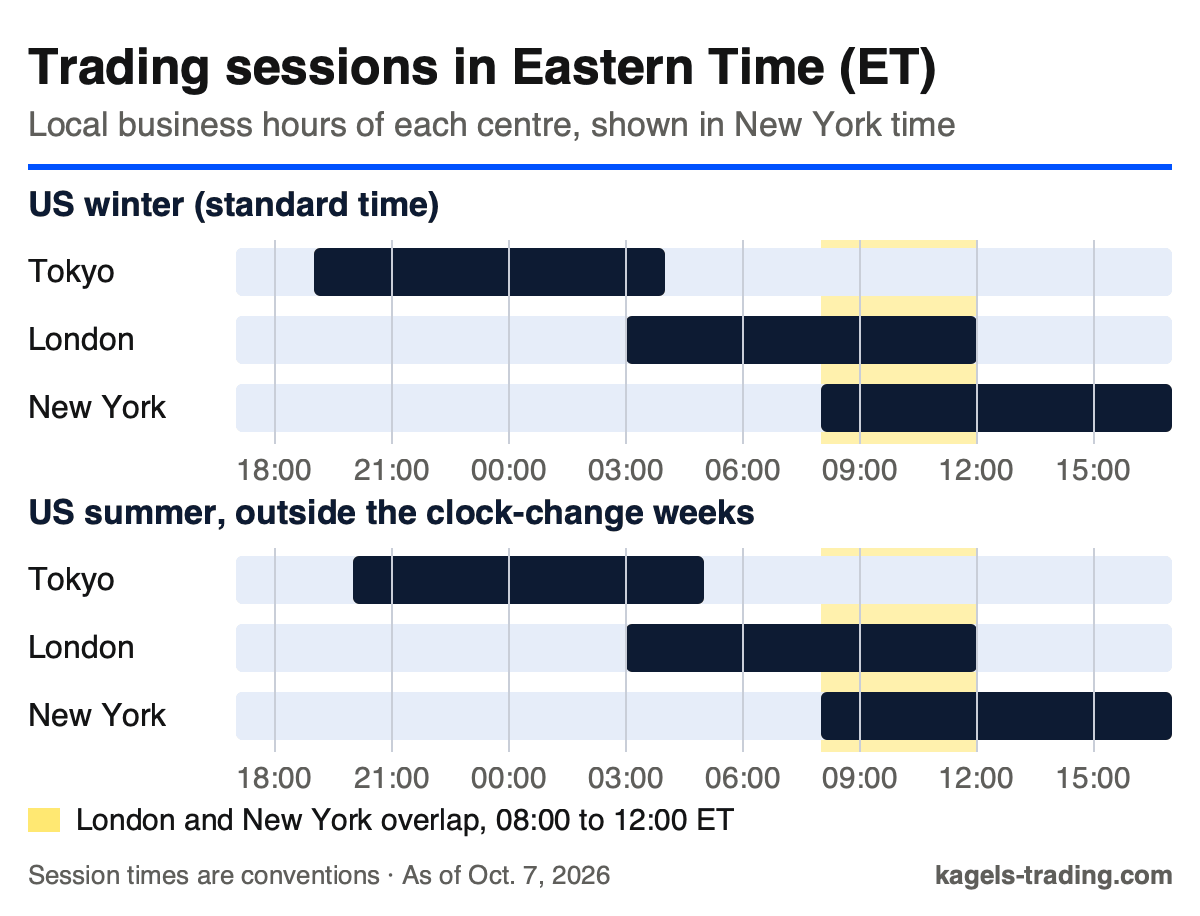 Click to enlarge
Source: Kagels Trading, own conversion, as of 7 October 2026.
The Asian session: quiet, but not irrelevant
The Asian session is the first part of the global trading day; it starts with Sydney and runs through Tokyo, Hong Kong and Singapore. It is usually the calmest session, with Asian banks, exporters and central banks among the main participants.
While Asia trades, Europe and America are asleep, so volume is usually thin. The session is still useful: many traders mark the Asian high and low, because London often tests one of these levels in its first hours.
Pairs like USD/JPY, AUD/USD and NZD/USD are most active in this session. Gold can also react to news from Asia, for example political tension or central bank decisions. Our USD/JPY forecast and AUD/USD forecast cover two of these currency pairs.
Thin liquidity is the main problem in this session. A comparatively small order can move the price more than it would in London or New York. Highs and lows from Asia are often taken out later in the day, so many traders treat them as reference levels rather than as signals.
Low liquidity does not mean low impact, as January 2025 showed. The Chinese AI company DeepSeek released its R1 model on 20 January 2025. The market reaction came a week later. A morning report on Monday, 27 January said that Nasdaq futures had opened the week down 2.5 percent and that Nvidia was down 13 percent in pre-market trading. The futures week opens on Sunday evening in New York, which is Monday morning in Asia.
The London session: the centre of currency trading
The London session is usually the most liquid forex session of the day, because the UK is the largest centre for currency trading. It runs from about 8:00 to 17:00 London time, which is 3:00 a.m. to 12:00 p.m. ET.
When Europe wakes up, volume arrives. In the BIS Triennial Survey of April 2025, the UK’s share of global foreign exchange turnover was 37.8 percent, ahead of the United States, Singapore and Hong Kong, according to the Bank of England’s summary. The figure measures where trades are booked, not which hours they fall into.
Besides European banks and funds, international players adjust their overnight positions in this session. Algorithmic traders and early US traders are active as well. The London session often brings the first clear impulse of the day, for example a breakout from the Asian range.
London tends to move faster than Asia. If you misjudge the first move, your stop can be hit before the main move begins. That is why many traders limit themselves to fixed time windows.
The London killzone is a time window, often given as about 2:00 to 5:00 a.m. ET (07:00 to 10:00 London time), in which ICT traders expect large players to target liquidity above or below the Asian range. The term comes from the ICT (Inner Circle Trader) teaching, not from the exchanges, and the exact windows differ between teachers. Whether such a pattern holds in your market is something to test in your own data, for example with a backtest.
The overlap of London and New York, from about 8:00 a.m. to noon ET, is usually the most liquid window of the forex day. Both European and American participants are active. In EUR/USD and GBP/USD this is often when the largest ranges of the day form.
The New York session: stocks, indices and the daily close
The New York session is the last main session of the day, and it is the one in which US stocks and the S&P 500, Nasdaq and Dow Jones trade their main volume. It runs from about 8:00 a.m. to 5:00 p.m. ET in forex terms.
Stock trading has a narrower window than the session itself. The NYSE and Nasdaq open at 9:30 a.m. ET and close at 4:00 p.m. ET, while the forex session already starts at about 8:00 a.m. ET. If you trade index futures, our guide to futures market hours lists the exact contract hours.
For many professional traders, the New York day starts well before the opening bell. From about 8:00 a.m. ET, volatility often rises: US desks are staffed, and major US economic data is often released at 8:30 a.m. ET. In this phase, many traders watch for sweeps or gaps that form before the open.
The New York killzone is a window often given as about 8:00 to 10:00 a.m. ET, in which ICT traders expect the main move of the day to start. Some ICT teachers start the window at 7:00 a.m. ET. Treat the window as an idea to test, not as an established pattern.
The regular stock session ends at 4:00 p.m. ET, followed by after-hours trading until 8:00 p.m. ET. Volume after the close is usually low. The New York close is also the basis for many daily pivot points of the next day; see our guide to pivot points.
What do RTH and ETH mean?
RTH (regular trading hours) are the main hours of a market; what ETH means depends on whether you trade stocks or futures.
For US stocks, RTH runs from 9:30 a.m. to 4:00 p.m. ET, and trading outside it is called extended hours. Pre-market trading before the open and after-hours trading after the close are usually much thinner; the exact hours and risks are in our guide to pre-market and after-hours trading. Nasdaq plans to add an overnight session from 9:00 p.m. to 4:00 a.m. ET, expected as of 7 October 2026 to start on 6 December 2026.
For CME futures, ETH stands for electronic trading hours, and it is the full session, including RTH. TradingView defines RTH for CME futures as 8:30 a.m. to 3:15 p.m. CT, which is 9:30 a.m. to 4:15 p.m. ET, according to its help page. The full E-mini S&P 500 session runs from Sunday 6:00 p.m. to Friday 5:00 p.m. ET, with a one-hour daily break.
Many traders work with RTH-only charts. Hiding the overnight bars makes the levels of the main session easier to see. A full-session chart, on the other hand, shows how the price got from one session to the next, so both views have their use.
What is the RTH gap, and why does it matter?
The RTH gap is the difference between the close of one regular session and the open of the next one, as it appears in an RTH-only chart.
Between those two prices, trading often continues in the extended or electronic hours. An RTH-only chart hides that path, so the price seems to jump from the close straight to the next open. A full-session chart shows the same difference as a path rather than a gap.
Many traders use the RTH gap as a reference for the following session. They watch whether the market returns to the gap, closes it or reacts there. Three common ways to read it:
- Open gap: seen as a zone the price may return to.
- Gap close: often watched for a reaction or a turning point.
- Gap high or low: used as a target or a defence zone, similar to support and resistance.
An RTH-only view makes the close-to-open difference easier to see; a full-session view also shows the overnight path. For tested numbers on how often stock gaps fill, see our guide to gap trading, which measures them on SPY data.
Common mistakes with trading sessions
Many traders underestimate how much the time of day can shape a move. They trade moves without asking when the move happened, and so miss whether there was enough volume behind it.
A common mistake is to treat every hour of the day as equal. A break of market structure in a thin phase deserves more caution than the same break in the London and New York overlap. How much this matters depends on the instrument, the strategy and the news of the day.
24-hour charts can also mislead. Swing highs and lows from the pre-market can look like important structure points while only little volume traded there. That is why many traders also check an RTH-only view.
Another misunderstanding concerns the timing of the US session. Many traders focus only on the 9:30 a.m. ET open, although activity often picks up from 8:00 a.m. ET, when US desks open and data is released.
Finally, the transitions between sessions are often misjudged. Asia, London and New York are not fixed blocks. The changes of hands, at the London open or at the start of New York, are times many traders watch for breaks and reversals. A typical case is a liquidity sweep of the Asian high around the London open.
Daylight saving time: when the session times shift
The US and Europe change their clocks on different dates, and that shifts session times for a few weeks a year. In 2026, US daylight saving time ran from 8 March to 1 November. The UK and the European Union switched on 29 March and switch back on 25 October.
In those weeks, London is four hours ahead of New York instead of five. In ET, the London session then starts at 4:00 a.m. instead of 3:00 a.m., and the overlap with New York lasts until 1:00 p.m. ET. A setup built around a fixed local time, such as an opening range breakout or a killzone, can shift by an hour if you miss this.
Asian centres like Tokyo, and India, do not use daylight saving time at all. Seen from New York, the Tokyo session therefore starts at 7:00 p.m. ET in US winter and at 8:00 p.m. ET in US summer, while its local hours stay the same.
How to switch between RTH and ETH in TradingView
In TradingView you switch the session with the session control in the bottom right corner of the chart, or under Settings, Symbol, Session. This is how TradingView describes it in its help page on extended hours. The setting works on intraday charts only, not on daily charts.
- US stocks: switch between regular hours and extended hours, which add the pre-market and after-hours trading.
- CME futures: switch between RTH (8:30 a.m. to 3:15 p.m. CT) and ETH, the full electronic session, for example on ES1! or NQ1!.
- Daily charts: the daily candle stays the same in both modes, according to TradingView’s help page on CME sessions.
Labels and menus in TradingView can change with updates, so check the help pages if the control looks different. Our TradingView guide explains which plan you need for real-time futures data.
Conclusion: to understand the market, understand when it trades
If you want to understand how markets move, it helps to know when they move. The split of the trading day into sessions is more than a clock. It tells you when liquidity and volume are likely to be high.
Each session has its own character. The quiet Asian session often sets reference levels, the London session often brings the first impulse, and the New York session brings the main volume in US stocks. Each has its traps and its chances.
RTH and ETH are not cosmetic settings, they are a filter. They decide which part of the price history you look at. As a discretionary trader since 1980, I have learned to read every move in the context of time, structure and liquidity.
Frequently asked questions about trading sessions
What is the difference between RTH and ETH?
RTH (regular trading hours) are the main hours of a market, for US stocks 9:30 a.m. to 4:00 p.m. ET. For stocks, the hours outside RTH are called extended hours. For CME futures on TradingView, ETH means electronic trading hours, the full session including RTH.
What are the three trading sessions?
The trading day is split into the Asian, London and New York sessions. By common convention they follow local business hours: Tokyo 9:00 to 18:00, London and New York 8:00 to 17:00 local time.
What time is the London session in ET?
The London session runs from about 3:00 a.m. to 12:00 p.m. ET, which is 08:00 to 17:00 London time. Brokers use slightly different windows, because the forex market has no official opening bell. In the weeks when only the US has changed its clocks, it starts at 4:00 a.m. ET.
What time is the Asian session in ET?
The Asian session runs from about 7:00 p.m. to 4:00 a.m. ET in US winter and from 8:00 p.m. to 5:00 a.m. ET in US summer. It is based on Tokyo business hours, 9:00 to 18:00, and Japan does not use daylight saving time.
What time are the sessions in India?
In IST, the London session runs from 13:30 to 22:30 in US winter and from 12:30 to 21:30 in US summer, outside the clock-change weeks. The New York session follows at 18:30 or 17:30 IST, and the London and New York overlap runs from 18:30 to 22:30 IST in winter and from 17:30 to 21:30 IST in summer. In the clock-change weeks of March and October, London runs from 13:30 to 22:30 IST and the overlap from 17:30 to 22:30 IST. The Tokyo session stays at 05:30 to 14:30 IST all year.
When do the London and New York sessions overlap?
London and New York overlap from about 8:00 a.m. to noon ET, which is 13:00 to 17:00 London time. In the clock-change weeks of March and October, the overlap runs until 1:00 p.m. ET. In this window both European and American participants are active, and liquidity is usually at its peak. Pairs like EUR/USD often show their biggest moves of the day here.
What is the RTH gap?
The RTH gap is the difference between the regular close and the next regular open, as it appears in an RTH-only chart. For US stocks that is the gap between 4:00 p.m. and 9:30 a.m. ET. Many intraday traders use it as a reference zone for reactions and targets.
What is a killzone in trading?
A killzone is a time window inside a session in which, according to the ICT approach, large traders target liquidity. Windows often given are the London killzone at about 2:00 to 5:00 a.m. ET and the New York killzone at about 8:00 to 10:00 a.m. ET. The term comes from the ICT teaching, not from the exchanges.
This article is market education, not investment advice. Session patterns describe tendencies, not rules, and they do not guarantee any result.
This English edition is based on our German edition on kagels-trading.de and has been adapted for international readers.
More Market Hours guides
- Check futures hours
Futures Market Hours: CME Trading Times for ES, Oil and Gold
Weekly and daily hours of ES, crude oil, gold, Treasuries, grains and bitcoin futures in ET, CT and London time.
- Plan around expiry
Triple Witching 2026 and 2027: Dates and What Happens
Triple witching dates for 2026 and 2027, settlement times, and what 25 years of SPY data show about volume and the week after.
- Trade before the open
Pre-Market and After-Hours Trading: Hours, Risks, Brokers
Pre-market, after-hours and overnight hours at the exchanges and at Schwab and Interactive Brokers, the risks, and what SPY data show about the overnight move.
- Check exchange hours
Stock Exchange Hours Worldwide: Opening Times in ET
Opening and closing times of the major exchanges in the Americas, Europe and Asia-Pacific, in local and New York time, with lunch breaks.
- Trade the opening range
Opening Range Breakout: Rules, Charts and Common Mistakes
How 5, 15 and 30-minute opening windows differ, with a worked SPY example at a 15-minute window, entry at the next bar’s open and a 2R target.