
Kraken Review 2026: Fees and Safety in the US and EU


Contents
- Kraken review in 30 seconds
- Is Kraken right for you? A decision guide
- Pros and cons of Kraken at a glance
- What is Kraken?
- Is Kraken regulated in the US?
- Is Kraken regulated in the EU?
- Kraken or Kraken Pro: the expensive difference
- Kraken fees: what trading really costs
- Products and markets on Kraken
- Why Kraken withdrawals get blocked
- Is Kraken safe?
- Kraken reviews: what users report
- Kraken vs Coinbase: the short version
- Alternatives to Kraken
- Conclusion: who Kraken suits in 2026
- Frequently asked questions about Kraken
- Sources
- About the author
Kraken is one of the oldest crypto exchanges still in business, and it serves the US and the EU through different companies. In the US, your contract partner is Payward Interactive, Inc., a money services business registered with FinCEN and licensed state by state; Kraken does not serve residents of New York and Maine. In the EU, you deal with Payward Europe Solutions Limited in Dublin, licensed under MiCA, the EU crypto law, by the Central Bank of Ireland since June 25, 2025.
The licences are the good news; the fees are the part to check. In the simple Kraken app, a buy costs a 1 percent fee plus a spread in the price, and a custom order 1.5 percent. On Kraken Pro, the same account pays 0.40 percent as a maker and 0.80 percent as a taker at the entry tier. This review sets out both with sources, keeps US and EU rules apart and follows our editorial policy.
Kraken review in 30 seconds
- Who you deal with: in the US Payward Interactive, Inc. (FinCEN, state licences), in the EU Payward Europe Solutions Limited (Central Bank of Ireland, MiCA).
- Where it is not available in the US: New York and Maine; staking and some features only in selected states.
- Fees in the app: 1 percent per instant buy or sell, 1.5 percent for custom orders, plus a spread that Kraken does not publish.
- Fees on Kraken Pro: 0.40 percent maker and 0.80 percent taker below $2,500 of 30-day volume, 0.22 and 0.38 percent from $10,000.
- Safety: a proof of reserves for eight coins with an external accountant (snapshot June 30, 2026), but no FDIC, SIPC or deposit guarantee for crypto.
- Regulatory history: a $30 million SEC settlement over staking in 2023; the SEC’s 2023 lawsuit was dismissed in March 2025.
Is Kraken right for you? A decision guide
What do you want to do first?
- Buy bitcoin now and thenKraken or Kraken Pro: the expensive difference
- Trade often or in larger amountsKraken Pro fees by volume
- Check whether Kraken is safeSecurity, proof of reserves and the SEC history
- Live in New York or MaineWho can open a Kraken account in the US
- Compare Kraken with CoinbaseKraken vs Coinbase
- Look at other exchangesAlternatives to Kraken
A starting point, not a ranking. Check the fee and the price in the order preview before every trade.
Pros and cons of Kraken at a glance
These are the points that matter before you open an account; the sections below explain each one. The overview is based on Kraken’s own fee schedule and help articles and on the pages of the regulators, checked on October 8, 2026.
Pros
- Regulated in both regions: state licences in the US, a MiCA licence in the EU.
- Low fees for active traders: Kraken Pro falls from 0.80 to 0.38 percent taker above $10,000 of monthly volume.
- Free bank deposits: ACH and FedWire in the US, SEPA in the EU.
- Proof of reserves: reserve ratios above 100 percent for bitcoin and the seven other listed coins in the June 2026 snapshot.
- Broad offer: spot, margin, futures, staking and, in the US, stocks.
Cons
- Expensive simple app: 1 percent per buy plus a spread, 1.5 percent for custom orders.
- High entry tier on Pro: 0.80 percent taker fee below $2,500 of 30-day volume.
- Not everywhere in the US: no service in New York and Maine, staking only in listed states.
- Mixed user reviews: 50 percent of Trustpilot reviews give one star; complaints include support and frozen transactions.
- No deposit protection: crypto is not covered by FDIC, SIPC or EU deposit guarantees.
What is Kraken?
Kraken is a crypto trading platform that belongs to Payward, Inc. and was founded in 2011. According to Kraken, more than 13 million people use it. Since May 1, 2025, the group also owns NinjaTrader, a US futures broker it agreed to buy for $1.5 billion, subject to price adjustments; Kraken called it the largest deal combining traditional finance and crypto.
| United States | European Union | |
|---|---|---|
| Company you deal with | Payward Interactive, Inc. | Payward Europe Solutions Limited |
| Regulator | FinCEN (federal), state regulators | Central Bank of Ireland |
| Licence | money services business, state money transmitter licences | MiCA crypto-asset service provider (C468360) |
| Cash balances | Payward Interactive, Inc. | Payward Ireland Limited, e-money institution (C453020) |
| Derivatives | Kraken Derivatives US (NinjaTrader Clearing, LLC) | Payward Europe Digital Solutions (CY) Limited, CySEC |
| Not available in | New York, Maine | (all 30 EEA countries listed) |
Sources: Kraken legal disclosures (August 11, 2026), Kraken help article on licences (September 30, 2026), ESMA MiCA register file of October 7, 2026.
Two apps, one account: Kraken and Kraken Pro. The Kraken app is built for simple buying at a quoted price. Kraken Pro shows the order book, charts and order types, and it costs much less per trade. Both use the same verification and the same balances.
Is Kraken regulated in the US?
Yes: in the US, Kraken works through Payward Interactive, Inc., a money services business registered with FinCEN. FinCEN is the anti-money-laundering bureau of the US Treasury; the registration number is 31000270997766. Separately, Payward Interactive holds money transmitter licences in numerous states, which you can look up in the NMLS consumer access database under ID 1843762.
Kraken does not serve residents of New York and Maine. Its help article of September 30, 2026 names both states. In Maine, Kraken stopped its service on June 1, 2024. For California, Kraken says it has applied for a licence under the state’s Digital Financial Assets Law and may operate while the application is pending. Coinbase, by comparison, has held a New York BitLicense since January 2017.
Other Kraken products sit in separate US companies with their own regulators. Stocks and ETFs run through Kraken Securities LLC, a broker-dealer registered with the SEC and a member of FINRA and SIPC. Futures run through Kraken Derivatives US, the trading name of NinjaTrader Clearing, LLC, a futures commission merchant registered with the CFTC (NFA ID 0309379). Custody for eligible clients is offered by Kraken Financial, a Wyoming special purpose depository institution.
Some features are limited by state. On-chain staking is available only in the states Kraken lists; California, Texas, New Jersey, Illinois and Washington are not on that list (as of March 30, 2026). Fiat transfers through Kraken’s payment app Krak are not available in Indiana, Louisiana, Massachusetts and Utah. Check the list for your state before you sign up.
Is Kraken regulated in the EU?
Yes: since June 25, 2025, Kraken holds a MiCA licence from the Central Bank of Ireland. The licence was granted to Payward Europe Solutions Limited and covers custody, exchange, order execution, transfers and portfolio management for crypto-assets. ESMA’s register lists it for all 30 countries of the European Economic Area, the EU plus Iceland, Liechtenstein and Norway.
A second Irish company runs the trading platform itself. Payward Global Solutions Limited is licensed by the same regulator, on the same day, to operate a trading platform for crypto-assets. Euro balances are held by Payward Ireland Limited, an e-money institution. Derivatives are offered by a Cyprus company under a MiFID II licence from CySEC, and you need to pass a questionnaire before you can trade them.
Kraken was not the first large exchange with a MiCA licence, contrary to some reports. Germany’s BaFin licensed a Bitpanda company in January 2025, and ESMA lists OKX and Crypto.com in Malta from January 27, 2025. What sets Kraken apart is that its contract partner and its regulator are named clearly, with registration numbers you can check. Our comparison of crypto exchanges in Europe, linked under alternatives below, puts Kraken next to Bitvavo, Bitpanda, Coinbase and Bitstamp.
UK residents deal with Payward Limited, which is registered with the FCA for anti-money-laundering purposes. That registration is not a full authorisation, and Kraken states that the Financial Ombudsman Service and the FSCS do not cover its crypto services. UK retail accounts have a 24-hour cooling-off period before the first trade.
What a licence protects, and what it does not
A licence does not protect you from falling prices. It sets rules for custody, capital, complaints and the separation of client assets. Kraken’s legal disclosures state that digital assets are not covered by insurance against losses and not protected by the FDIC or SIPC. Stocks held through the US broker-dealer Kraken Securities LLC are a separate case, because it is a SIPC member. In the EU, crypto is not covered by deposit guarantee schemes either.
What a licence gives you is an address for complaints. In the US, every state licence comes with the state regulator you can turn to if Kraken does not solve your complaint. In the EU, the Central Bank of Ireland supervises the company you contract with. Before you use any exchange, check whether it holds a licence for your country.
Kraken or Kraken Pro: the expensive difference
Kraken Pro is the same account with a trading screen and much lower fees. It costs nothing extra and needs no new verification. The difference in cost is large, because the app fee is 1 percent and comes with a spread on top.
| Route | Fee | On a $1,000 buy |
|---|---|---|
| Kraken app, instant buy | 1.00% plus spread | $10.00 plus spread |
| Kraken app, custom order | 1.50% plus spread | $15.00 plus spread |
| Kraken Pro, taker (entry tier) | 0.80% | $8.00 |
| Kraken Pro, maker (entry tier) | 0.40% | $4.00 |
Source: Kraken fee schedule, checked October 8, 2026. Scope: the public schedule names no region. Crypto services are provided by Payward Interactive, Inc. for US customers and by the Irish MiCA companies Payward Europe Solutions Limited and Payward Global Solutions Limited for EU customers. The rate that applies to you is the one in your order form.
Maker or taker depends on whether your order waits or fills at once. An order that fills immediately takes liquidity from the order book, so you pay the taker fee. An order that waits in the book adds liquidity, so you pay the lower maker fee. A limit order is not enough on its own: if its price matches an existing order, it fills at once and pays the taker fee. Kraken’s post-only option cancels the order instead, so it either waits as a maker or is not placed at all. At the entry tier, that halves the cost; our guide to the market maker explains who stands on the other side.
Kraken fees: what trading really costs
Kraken’s public fee schedule does not split its trading fees by region. We read the English and the German version on October 8, 2026, and both showed the same percentages; Kraken adds that fees shown may be inaccurate if you use a VPN. The tier limits are in US dollars. Payment fees and deposit options differ by region, so they get their own tables below.
Fees in the Kraken app
 Click to enlarge
Source: Kraken fee schedule.
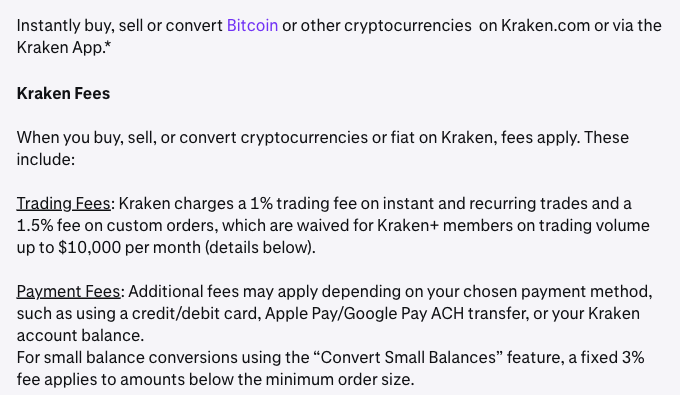
In the Kraken app, each instant buy or sell costs 1 percent, and the price includes a spread. Kraken says the spread is the difference between the market rate and the rate you receive, that it varies with volatility, asset and order size, and that Kraken may keep any excess spread. Kraken does not publish the size of that spread, so the total cost is only visible in the order preview.
Kraken+ removes the app fee, but not the spread. The subscription costs $4.99 a month after a 30-day trial, or the local equivalent, and waives the trading fee on up to $10,000 of monthly volume in the app. It does not apply to Kraken Pro, and spread and card fees still apply.
Kraken Pro fee tiers
On Kraken Pro, the fee falls with your 30-day volume. Your tier is set by the best of three values: spot volume, futures volume or assets held on the platform. Volume from instant buys in the app does not count. These are the first five of the 17 tiers:
| 30-day spot volume | Maker | Taker |
|---|---|---|
| below $2,500 | 0.40% | 0.80% |
| $2,500 to $9,999 | 0.30% | 0.60% |
| $10,000 to $24,999 | 0.22% | 0.38% |
| $25,000 to $49,999 | 0.20% | 0.35% |
| from $50,000 | 0.15% | 0.30% |
Source: Kraken fee schedule, Spot Crypto and Cross-platform Fee Tiers, checked October 8, 2026. Scope: Kraken Pro spot trading; the schedule names no region. Stablecoin and FX pairs have their own, lower table.
Published trading fees on a trade value of $1,000, entry tier, as of October 8, 2026, from Kraken's public fee schedule, which names no region. The maker rate applies only if the order adds liquidity to the book (post-only limit order). The app routes also include a spread that Kraken does not publish.
If you read an older review, check its date. Fee tables change, and the entry tier we checked on October 8, 2026 starts at 0.40 percent maker and 0.80 percent taker. At those rates, small traders pay more on Kraken Pro than on some EU exchanges; our exchange comparison shows the published charges side by side.
Margin trading costs
Margin trading on Kraken has an opening fee and a rollover fee every four hours. The rate depends on the currency Kraken lends you, not on the coin you trade: the fee schedule lists 0.025 to 0.05 percent for US dollars, 0.02 to 0.04 percent for euros and 0.01 to 0.02 percent for bitcoin. In Kraken’s own example, a long BTC/USD position borrows dollars, a short borrows bitcoin. The normal trading fee applies on top when you open and close; a forced liquidation costs 2 percent instead of the trading fee.
The small percentage adds up because it repeats. A position held for a week pays the rollover fee 42 times (six times a day). At 0.025 percent each, that is 1.05 percent of the borrowed amount, before the trading fees. Kraken locks your rollover rate when the order is filled and shows it in the order form. These rates come from Kraken’s public fee schedule and help article of July 28, 2026; the separate US retail margin product may differ, so check the order form.
Deposits and withdrawals in the US
For US customers, bank transfers by ACH are free in both directions. The table shows Kraken’s published fees for US dollars; card and PayPal payments cost more.
| Method | Deposit | Withdrawal |
|---|---|---|
| ACH (Plaid for deposits) | free, 7-day withdrawal hold | free, 0 to 2 business days |
| FedWire | free (Dart Bank) | $4 |
| RTP instant payout | not offered | 1.50%, at most $50 |
| Debit card | $0.25 plus 3.75% | not possible |
Sources: Kraken help articles on cash deposits (October 1, 2026) and cash withdrawals (September 28, 2026). Scope: US dollar accounts of US customers, provided by Payward Interactive, Inc.
Deposits and withdrawals in the EU
For EU customers, SEPA deposits are free and a SEPA withdrawal costs 1 euro. SEPA Instant through ClearJunction costs 0.90 euros where available. A debit card deposit costs 0.25 euros plus 3.75 percent.
| Method | Deposit | Withdrawal |
|---|---|---|
| SEPA and SEPA Instant | free | 1 euro |
| SEPA Instant (ClearJunction) | not listed | 0.90 euros |
| Debit card | 0.25 euros plus 3.75% | not possible |
| SWIFT (Bank Frick) | 3 euros | 5 euros |
Sources: Kraken help articles on cash deposits (October 1, 2026) and cash withdrawals (September 28, 2026). Scope: euro accounts of EEA customers; Kraken’s legal disclosures name Payward Ireland Limited as the provider of fiat services.
Products and markets on Kraken
Spot trading is the core: you buy the coin and own it, without leverage and without an expiry date. Kraken’s lists of restricted coins differ by region, so not every coin is available everywhere; the US and the EU each have their own list. Our bitcoin forecast shows the price levels we watch for the largest coin.
Margin and futures
Margin trading means buying with money you borrow from Kraken. For international clients, Kraken lists leverage of up to 10x on bitcoin and some large coins and lower limits on smaller ones. In the US, the full product is open only to clients who certify as an eligible contract participant, which for individuals means more than $10 million invested; since April 2026, a separate margin product is open to eligible US retail clients.
Leverage multiplies gains and losses alike. Kraken itself warns that margin can wipe out an account quickly and recommends a stop and a profit target for every position. If you are new to this, start with our guides to position sizing and risk management before you use borrowed money.
Futures run through separate companies in each region. In the US, that is Kraken Derivatives US, a CFTC-registered futures commission merchant. In the EU, it is a Cyprus investment firm with a CySEC licence, and you have to complete an appropriateness questionnaire first. Our guide to futures market hours explains when the regulated US futures trade.
Staking: rewards with conditions
Staking means committing or delegating coins to support a blockchain’s validation, in return for possible rewards. According to its public fee schedule, Kraken takes a 20 percent commission on rewards from flexible staking of coins with an unbonding period and from its rewards programme. The rewards are paid in the same coin, so a falling price can outweigh them.
Staking on Kraken has a history with the SEC in the US. In February 2023, Kraken settled SEC charges over its staking-as-a-service programme for $30 million and agreed to stop offering or selling securities through such staking services. Today, on-chain staking is again offered in the US, but only in the states Kraken lists.
Stocks for US customers
In the US, Kraken offers commission-free trading in more than 11,000 stocks and ETFs. The service runs through Kraken Securities LLC and is available only in selected states. Regulatory fees can be passed on to you, so commission-free does not mean free of all costs.
Why Kraken withdrawals get blocked
Kraken’s help articles name several reasons for a withdrawal hold. Certain purchases by card, Apple Pay, Google Pay or PayPal can trigger a hold of 72 hours on the purchased amount, and purchases through ACH Plaid a hold of 7 days. Trading continues during the hold. Separately, an incomplete verification or a payment from someone else’s account can stop a withdrawal.
Regulated providers have to check where money comes from. The same rules that give you a regulator to complain to also allow an account to be frozen while a review runs. Keeping your verification up to date and paying in only from a bank account in your own name removes two of the documented triggers.
Crypto withdrawals to your own wallet cost a network fee. It depends on the blockchain and Kraken shows it before you confirm. A wrong address cannot be reversed, so send a small test amount first and wait until it arrives.
Is Kraken safe?
On security, Kraken publishes more than many exchanges. It states that it holds the ISO/IEC 27001:2022 certification for information security and has completed a SOC 2 Type 1 examination. It keeps funds in cold storage and hot wallets, supports security keys and passkeys for two-factor login, and does not allow account recovery by phone or SMS.
Kraken also publishes a proof of reserves. An independent accountant compares client balances with the coins Kraken controls on the blockchain. In the snapshot of June 30, 2026, the reserve ratio was 102.9 percent for bitcoin and 100.5 percent for ether; all eight listed coins, including SOL, XRP, ADA and three stablecoins, were at or above 100 percent. Each client can check in the account whether their own balance was included. A proof of reserves is a snapshot: it covers only the listed coins on one day, not all liabilities of the company.
The SEC cases against Kraken
The SEC brought two cases against Kraken; the second was dismissed in 2025. In November 2023, the SEC sued Payward Inc. and Payward Ventures Inc., claiming Kraken operated as an unregistered securities exchange, broker, dealer and clearing agency. The complaint also alleged that Kraken commingled customer cash and crypto with its own, including paying operating expenses from accounts holding customer cash. These were allegations, not findings: on March 27, 2025, the SEC dismissed the case with prejudice and said the decision was not based on an assessment of the merits of its claims.
The first case ended with a settlement in February 2023. It concerned the unregistered offer of Kraken’s staking programme, and the two Kraken companies agreed to pay $30 million in disgorgement, prejudgment interest and civil penalties.
How you protect your Kraken account
Your own setup matters as much as Kraken’s. Switch on two-factor authentication before your first deposit, ideally with a security key or passkey. Kraken also offers a global settings lock and e-mail confirmations for new withdrawal addresses. No exchange can protect an account if someone else knows your password and your second factor.
Kraken reviews: what users report
User reviews of Kraken are split into two camps. On Trustpilot, Kraken scores 3.2 out of 5 from 9,109 reviews; 50 percent give one star and 32 percent give five, with few in between. Checked on October 8, 2026.
The latest reviews on the page show both sides. Positive reviews we read mention the desktop app and quick help; negative ones mention AI replies in support, a frozen transaction and bank wires. A handful of reviews says nothing about how often such problems occur, but it shows what to check before you deposit larger amounts.
Read the numbers with care. Review sites attract unhappy customers more than happy ones, and Kraken has a paid Trustpilot profile and invites its customers to leave reviews. What the reviews show is the pattern of complaints, not how common the problems are.
Kraken vs Coinbase: the short version
Kraken and Coinbase are the two best-known US exchanges, and they differ most in New York, in fee transparency and in the EU entity. The table compares what we could check in primary sources; Coinbase says its fees can depend on the payment method, order size, market conditions and jurisdiction.
| Kraken | Coinbase | |
|---|---|---|
| New York residents | not served | served (NYDFS BitLicense since January 2017) |
| Advanced trading fees | public table, from 0.40% / 0.80% | current rates and tier criteria after login |
| Simple buy | 1% plus spread | variable fee shown in the preview, plus spread |
| EU licence | Central Bank of Ireland, June 25, 2025 | Luxembourg CSSF, June 20, 2025 |
Sources: Kraken fee schedule and help articles, NYDFS press release of January 17, 2017, ESMA MiCA register, Coinbase pricing and fees and Coinbase Advanced fees, checked October 7 and 8, 2026.
Our view: Kraken suits traders who want to see the fee table before signing up. If you live in New York, Kraken is not an option. If you only buy now and then through a simple app, compare the order preview on both platforms, because both add a spread to simple buys.
Alternatives to Kraken
Under MiCA, the first question for any EU alternative is the licence. All four below are listed in the MiCA register of ESMA; we compare them in detail in our guide to crypto exchanges in Europe:
- Bitpanda: an Austrian investment app with crypto, stocks and ETFs in one account; see our Bitpanda review.
- Bitvavo: a Dutch exchange licensed by the AFM, with low published fees on euro markets.
- Coinbase: serves the EU from Luxembourg and the US from Coinbase, Inc. Our Coinbase review covers its custody, insurance and fees.
- Bitstamp: a Luxembourg exchange with a fully published price list in the EU.
Conclusion: who Kraken suits in 2026
Kraken is a regulated exchange with clear companies in the US and the EU and a fee table that rewards volume. Its licences, the named contract partners and the proof of reserves are its strongest arguments. The SEC history is part of the picture, but the 2025 dismissal closed the larger case.
Whether Kraken is cheap depends on how you use it. In the simple app, you pay 1 percent plus a spread, which is expensive for regular buys. On Kraken Pro, the entry tier is still 0.80 percent for market orders, orders that wait in the book as a maker cost half, and above $10,000 of monthly volume the taker fee falls to 0.38 percent.
My recommendation is in two parts. If you value regulation and a published fee table, Kraken is a solid choice, as long as you trade through Kraken Pro with post-only limit orders. If you only invest small amounts now and then, compare the total cost in the order preview with other providers before you decide.
Frequently asked questions about Kraken
Is Kraken safe?
Kraken is regulated in the US and the EU and publishes a proof of reserves, but crypto on Kraken is not insured. It holds state licences in the US and a MiCA licence in the EU, and its June 2026 snapshot showed reserves of at least 100 percent for all eight listed coins. Crypto is not covered by the FDIC or SIPC, and the price risk stays with you.
How high are Kraken’s fees?
On Kraken Pro, the entry tier is 0.40 percent for makers and 0.80 percent for takers. Above $10,000 of 30-day volume, it falls to 0.22 and 0.38 percent. In the Kraken app, an instant buy costs 1 percent plus a spread, and a custom order 1.5 percent.
Is Kraken available in all US states?
No: Kraken does not serve residents of New York and Maine. In the other states, some features are limited; on-chain staking, for example, is available only in the states Kraken lists. In California, Kraken operates while its application under the state’s Digital Financial Assets Law is pending.
What is the difference between Kraken and Kraken Pro?
Kraken Pro is the same account with a trading screen and lower fees. It shows the order book, charts and order types instead of a simple buy button. It costs nothing extra, and a post-only limit order on Pro costs 0.40 percent at the entry tier instead of 1 percent plus spread in the app.
Which company do I deal with in the EU?
In the EU, you deal with Payward Europe Solutions Limited in Dublin. It holds a MiCA licence from the Central Bank of Ireland since June 25, 2025, valid in all 30 EEA countries. Euro balances are held by Payward Ireland Limited, an e-money institution.
Why is my Kraken withdrawal on hold?
Kraken places withdrawal holds for security reasons and after certain purchases. Certain card, digital wallet and PayPal purchases can trigger a hold of 72 hours, and purchases through ACH Plaid a hold of 7 days. Incomplete verification or a payment from someone else’s account can also block a withdrawal.
Is Kraken cheaper than Coinbase?
Kraken publishes its advanced trading fees openly; Coinbase shows current rates and tier criteria after login. On Kraken Pro, a $1,000 market buy costs $8 at the entry tier. For simple buys, both platforms add a spread, so compare the order preview on both.
Sources
Every figure in this review comes from these pages, checked on October 7 and 8, 2026. Fees and products change, so check the current version and the order preview before you trade.
- Kraken fees and products: fee schedule, Kraken+, cash deposit fees, cash withdrawal fees, margin pairs and leverage, margin eligibility, US margin and ECP, quick start for US clients, maker and taker fees, margin fees, withdrawal holds.
- Kraken licences and company: legal disclosures, where Kraken is licensed, changes for US clients (Maine), security, proof of reserves, NinjaTrader agreement, NinjaTrader completion.
- Regulators: ESMA interim MiCA register, NMLS Consumer Access, SEC staking settlement, February 9, 2023, SEC lawsuit, November 20, 2023, SEC dismissal, March 27, 2025, NYDFS licence for Coinbase, January 17, 2017.
- User reviews: Trustpilot page for Kraken.
This review was written by Karsten Kagels. It is based on Kraken’s own pages and help articles and on the registers and notices of ESMA, the SEC and the NYDFS, checked on October 7 and 8, 2026. We did not open an account for this English edition. Crypto-assets can lose value sharply, and leverage can cost more than you invest. This is not investment advice.
This US edition is based on our German edition on kagels-trading.de and has been adapted for US readers.
More Crypto guides
- Choose an exchange
Crypto Exchanges in Europe: 5 MiCA Platforms Compared
Bitvavo, Bitpanda, Kraken, Coinbase and Bitstamp: licence, fees and the published charges on a 1,000 euro bitcoin buy.
- Check one provider in depth
Bitpanda Review 2026: Fees, MiCA Licences and Who It Suits
Bitpanda: two MiCA licences, the 2026 FMA fine, fees per coin, Fusion, margin costs and who can open an account.
- Check if an exchange is safe
Coinbase Review 2026: Is It Safe? Fees and Licences
Coinbase for US and EU customers: licences, custody, insurance, the 2025 data theft, fees and Coinbase One.