
High-Frequency Trading: Strategies, Risks and Rules


Contents
- High-frequency trading in 30 seconds
- What is high-frequency trading?
- HFT history: from decimal prices to the Flash Crash
- HFT strategies: how the firms make money
- Illegal HFT practices: where manipulation begins
- The technology: what HFT really demands
- Regulation of high-frequency trading
- Pros and cons of high-frequency trading
- High-frequency trading for retail traders: what is realistic
- Leading HFT firms
- The future of high-frequency trading
- Conclusion: understand HFT and put it in context
- Frequently asked questions about high-frequency trading
- About the author
While you read this sentence, a high-frequency system can send thousands of orders to an exchange and cancel most of them before anyone trades against them. That is high-frequency trading (HFT): a business that runs in microseconds and still helps decide which price you get the next time you click “buy”.
This guide shows which strategies the big firms run, where legal speed ends and market manipulation begins, and what the technology really demands. You will see what the Flash Crash of 2010 and the Knight Capital loss of 2012 changed, how the US and Europe regulate HFT, and what a retail trader can realistically do with the same ideas.
High-frequency trading in 30 seconds
- What it is: a form of algo trading in which computers place, change and cancel orders in microseconds to profit from tiny price differences.
- How big it is: a 2014 SEC staff review reported estimates typically above 50 percent of US equity volume. HFT cannot be observed directly in market data, so every figure is an estimate.
- What it costs: servers inside the exchange data center, the fastest network links, market data and specialist staff. That puts professional HFT out of reach for private traders.
- Why it is controversial: HFT narrows spreads in normal markets but can pull back when markets are stressed, as the Flash Crash of May 6, 2010 showed.
- Where the line is: spoofing, layering, quote stuffing and wash trading are illegal. Spoofing has led to prison sentences and fines of tens of millions of dollars.
- What you can do: trade your own rules with an API broker or a backtesting platform. You will never reach HFT speed, and you do not need to.
What is high-frequency trading?
High-frequency trading is fully automated trading in which algorithms place, modify and cancel large numbers of orders within milliseconds or less. Speed is the core of the business: a few microseconds can decide whether a firm earns the spread or loses money to a faster rival. The programs read market data, spot price differences and trade before a human could even react.
How large HFT’s share of trading really is depends on the market and the definition. A 2014 literature review by SEC staff found that estimates of HFT typically exceeded 50 percent of volume in US-listed stocks. These are estimates: HFT cannot be seen directly in market data, so researchers use proxies such as message rates and cancellation patterns.
The three pillars of HFT
- Speed: reaction times are measured in microseconds. A blink of an eye takes about 300,000 microseconds, an eternity in this business.
- Volume: large firms trade millions of shares, ETFs and derivatives every day. The Dutch firm Flow Traders reported net trading income of €485.8 million for 2025, up 4 percent from the year before.
- Automation: no person intervenes while the system trades. The algorithms decide on their own, based on fixed rules and statistical models.
High-frequency trading vs. algorithmic trading
Many people confuse high-frequency trading with algorithmic trading, but HFT is only one corner of it. In algorithmic trading, a program makes trading decisions, but not necessarily at high speed. A script that rebalances your portfolio once a day is algo trading too, as is a Python trading bot that checks a moving average once a day.
High-frequency trading is the subset defined by extreme speed and a very high number of orders. Its strategies hold positions for seconds or less and depend on latency, the delay between a market event and the firm’s reaction. A retail trading system does not compete on that.
HFT history: from decimal prices to the Flash Crash
High-frequency trading grew out of the move from trading floors to electronic order books. Three rule changes and two disasters shaped it more than anything else.
The early years: electronic markets (1990s to 2000s)
HFT became possible once orders could be matched by computers instead of people. Nasdaq and new electronic trading venues led the way in the US, and European exchanges followed. Firms such as Citadel Securities and Virtu Financial built their market making businesses on this technology.
Two US rule changes turned speed into money. In 2001 US exchanges switched to decimal prices, the NYSE on January 29 and Nasdaq by April 9. The smallest price step fell from one-sixteenth of a dollar (6.25 cents) to 1 cent, which made trading for fractions of a cent worthwhile. In 2007, Regulation NMS took full effect and pushed orders across many competing venues, which created price gaps between them for fast traders to exploit.
In 2014, Michael Lewis made the topic famous with his book “Flash Boys”. It describes HFT firms as legalized front-runners and set off a public debate about whether the stock market is rigged against ordinary investors.
The Flash Crash of May 6, 2010
On May 6, 2010, US stock indices fell another 5 to 6 percent within minutes and recovered almost as quickly. According to the joint SEC and CFTC staff report, the broad market had already lost about 3 percent by early afternoon on negative sentiment. At the low, index products were 9 to 10 percent below the previous close. The Dow Jones saw one of the sharpest intraday drops in its history.
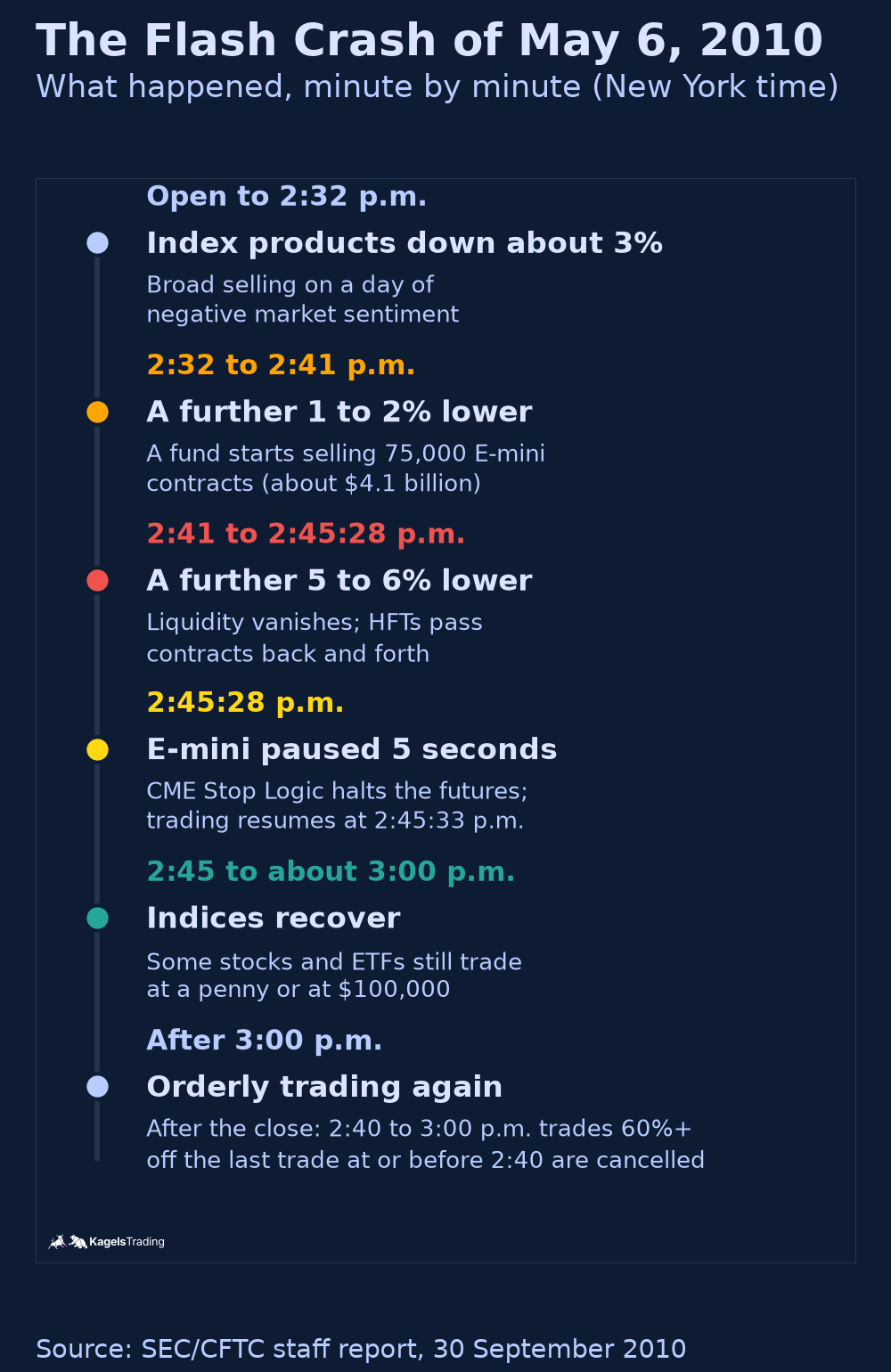 Click to enlarge
Source: SEC/CFTC staff report.
The trigger was a single large sell order in the E-mini S&P 500 futures. At 2:32 p.m. New York time, a mutual fund complex started an algorithm to sell 75,000 E-mini contracts, worth about $4.1 billion, as a hedge. The algorithm was told to sell a share of volume without regard to price or time, so it sped up as volume rose.
HFT firms first bought the contracts and then passed them back and forth among themselves. Between 2:45:13 and 2:45:27 p.m., HFTs traded more than 27,000 contracts, about 49 percent of all volume, while adding only about 200 contracts to their net position. The report calls this the “hot potato” effect. Buy orders in the order book fell to less than 1 percent of their morning level.
At 2:45:28 p.m., the CME’s Stop Logic function paused E-mini trading for five seconds. When trading resumed at 2:45:33 p.m., prices stabilized and the futures began to recover. Many single stocks and ETFs still traded at absurd prices for several minutes, some at one penny, others at $100,000. After the close, the exchanges and FINRA cancelled the trades executed between 2:40 and 3:00 p.m. at prices 60 percent or more away from the last trade at or before 2:40 p.m.
Knight Capital: more than $460 million lost in 45 minutes (2012)
On August 1, 2012, a software error at Knight Capital turned into one of the costliest trading accidents ever. Knight was then one of the largest US market makers. The firm had installed new trading software without fully retiring its old code.
In the first 45 minutes after the open, the router sent more than 4 million orders while trying to fill just 212 customer orders. According to the SEC, Knight traded more than 397 million shares and lost more than $460 million. The SEC later fined the firm $12 million for violating the Market Access Rule, which requires risk controls before orders reach the market.
Knight survived only because outside investors stepped in within days. A group including Jefferies, Blackstone and the trading firm Getco put in $400 million and received more than 70 percent of the company. In December 2012, Knight agreed to merge with Getco in a deal valued at about $1.4 billion.
HFT strategies: how the firms make money
HFT firms earn small amounts per trade and make it up through enormous volume. Four strategies account for most of the business: market making, statistical arbitrage, latency arbitrage and news-based trading.
Market making: liquidity for the spread
Market making is the most common HFT strategy and works like a digital dealer. The system constantly shows a bid and an ask price and earns the difference, the spread. Our guide to market makers explains the business in detail.
A simple example shows the idea. Suppose a stock is quoted at $100.00 bid and $100.01 ask. The market maker buys from a seller at $100.00 and sells to a buyer at $100.01. One cent per share sounds like nothing, but over millions of trades a day it adds up.
The benefit for the market is more liquidity and tighter spreads. The drawback: HFT market makers can pull their quotes in an instant when the market turns, exactly when other traders need a counterparty most.
Statistical arbitrage: trading relationships between prices
Statistical arbitrage trades on prices that usually move together and have drifted apart. The algorithm spots a deviation from the normal relationship and bets that it will close again. It is a numbers game: many small wins with thin margins per trade.
Example: two large oil companies often move in step. If one rises 2 percent and the other does not move, the algorithm buys the laggard and sells the leader short, expecting the gap to close. The best-known fund built on statistical patterns is the Medallion Fund of Jim Simons, although Renaissance Technologies never disclosed its models.
Latency arbitrage: speed as the edge
Latency arbitrage uses a speed advantage to trade on price differences between venues. A large US stock such as Apple trades on the NYSE, Nasdaq, Cboe and many other venues, plus dark pools, at the same time.
When the price moves on one venue, the fastest firms trade on the slower ones before their quotes update. The profit per share is tiny and lasts microseconds, which is why firms spend so much on network links between exchange data centers.
News-based trading
Modern HFT systems read news and data releases in real time and trade within milliseconds. Natural language processing (NLP) classifies a headline as good or bad and triggers orders automatically. For scheduled data such as an earnings release or the jobs report, the reaction comes before a human has finished the first line.
Illegal HFT practices: where manipulation begins
Not every fast trading practice is legal. Some cross the line into market manipulation and are prosecuted by the SEC, the CFTC and the Department of Justice in the US and by regulators worldwide.
Spoofing: fake signals in the order book
Spoofing means placing orders you intend to cancel before they can be filled, in order to mislead other traders. To an observer, such an order looks like any other limit order. That is why order flow analysis always reads intentions, not commitments.
The pattern is simple. A trader places a large buy order below the market to suggest strong demand. Others see the demand and buy, the price rises, and the spoofer cancels the large order and sells at the higher price. Since the Dodd-Frank Act of 2010, spoofing is explicitly banned in US futures markets.
The best-known case is Navinder Sarao, who spoofed E-mini S&P 500 futures from his parents’ home in west London. Prosecutors attributed about $12.8 million to his scheme, which ran from 2009 to 2014. In January 2020 a Chicago court sentenced him to one year of home confinement, after prosecutors praised his cooperation. Michael Coscia, a high-frequency trader, fared worse: in 2016 he became the first person sentenced under the Dodd-Frank spoofing ban and received three years in prison.
Layering: manipulation spread over several price levels
Layering is spoofing in stages: fake orders at several price levels on one side, real trades on the other. Suppose a trader wants to sell 10,000 shares at $150. First, he places many large buy orders between $149 and $148 that he never intends to fill.
Other traders see the apparent support and buy at $150. Meanwhile, the manipulator sells his real 10,000 shares at that inflated price. As soon as his sales are done, he cancels all the fake buy orders. He sold at an artificially high price, and the other traders were deceived.
Quote stuffing: flooding the market with data
Quote stuffing means sending and cancelling thousands of orders in seconds to slow down competitors. While other algorithms are busy processing the fake orders, they react later and miss real opportunities. The practice burdens the entire market data system, not only the target.
Wash trading: fake activity
In wash trading, the same party buys and sells the same securities between accounts it controls. The aim is to create artificial volume and apparent liquidity. Other traders read the volume as real interest and trade on it.
Front-running: the big dispute
In the HFT debate, front-running means trading ahead of other investors’ orders by being faster. An algorithm detects a large order arriving at one venue and trades on the other venues milliseconds earlier.
An example makes it concrete. You want to buy 100,000 shares of Apple, and your broker routes the order to several venues. HFT systems see the first part fill at one exchange, buy on the others and sell the shares to you at a higher price.
The dispute is about how to judge this. HFT firms use public information, and that is not illegal. Critics such as Michael Lewis still call it legalized front-running, because ordinary investors systematically lose out. Classic front-running, where a broker trades ahead of its own client’s order, is illegal; the speed race on public data is not.
Fines and enforcement
Enforcement against trading algorithms has become more frequent. In 2017, Citadel Securities paid $22.6 million to the SEC because two of its algorithms did not give retail orders the best price it had promised clients. In January 2018, the CFTC settled spoofing charges with Deutsche Bank ($30 million), UBS ($15 million) and HSBC ($1.6 million).
Regulators now search the data for these patterns automatically. The SEC, the CFTC and European supervisors use surveillance software that flags suspicious order and cancellation patterns. Cases can end in prison sentences, fines and trading bans.
The technology: what HFT really demands
High-frequency trading is an arms race in technology, in which every microsecond can be worth money. Firms rarely publish what they spend, but the cost blocks are well known.
Hardware and infrastructure
The foundation is servers placed right next to the exchange’s matching engine, known as co-location. Exchanges rent space in their own data centers so that the cable to the matching engine is as short as possible. Many HFT firms use FPGA chips, programmable hardware that reacts faster than normal software.
Between exchanges, the fastest links matter more than the shortest cable. Firms pay for dedicated fiber lines and microwave networks, because radio signals through the air travel faster than light in glass fiber. Global trading needs the same setup in New York, Chicago, London and other centers.
| Cost block | What it pays for |
|---|---|
| Co-location | rack space inside the exchange data center |
| Hardware | low-latency servers, FPGA chips, network cards |
| Network links | fiber and microwave routes between venues |
| Market data | direct exchange feeds, often from many venues |
| Staff | quantitative researchers and low-latency developers |
| Risk systems | real-time limits and kill switches |
Software and staff
The scarcest resource is people. Firms compete for quantitative researchers who find the patterns and low-latency developers who make the code fast. On top come licenses for direct market data from every venue they trade.
Risk management: preventing the next Knight Capital
Knight Capital showed how quickly a faulty algorithm can destroy a firm. That is why HFT firms invest in real-time risk limits and kill switches that stop trading at once. In the US, the Market Access Rule (SEC Rule 15c3-5) requires brokers to have such checks before any order reaches an exchange.
Regulation of high-frequency trading
The US and Europe regulate HFT differently. Europe puts more weight on upfront requirements such as licenses and algorithm tests. The US relies more on market-wide safeguards, supervision and enforcement after the fact.
United States: SEC, CFTC and FINRA
Most US rules for HFT came as a reaction to the Flash Crash. In May 2012 the SEC approved the Limit Up-Limit Down mechanism, which stops trades in single stocks outside a price band, and new market-wide circuit breakers at 7, 13 and 20 percent declines in the S&P 500. In futures, the Dodd-Frank Act of 2010 banned spoofing.
The people who build trading algorithms are now regulated too. Since January 30, 2017, FINRA requires associated persons primarily responsible for designing, developing or significantly modifying algorithmic trading strategies in equity, preferred and convertible debt securities, and those who supervise that work day to day, to register as Securities Traders. It is not a registration duty for every algorithm developer or every asset class; firms must also supervise their algorithms under FINRA’s general supervision rules.
Europe: MiFID II
Since January 3, 2018, the EU’s MiFID II directive sets common rules for algorithmic and high-frequency trading. Article 17 requires firms to test their algorithms, to have effective risk controls and to notify their supervisor. HFT firms must keep detailed records of their orders. Firms that run an algorithmic market-making strategy must post quotes continuously during a specified share of trading hours, except in exceptional circumstances.
Germany: the first HFT law in the world
Germany was the first country with a dedicated law against the excesses of high-frequency trading. The High-Frequency Trading Act (Hochfrequenzhandelsgesetz) of May 7, 2013 took effect on May 15, 2013, almost five years before MiFID II.
Three changes hit the industry directly. First, anyone who trades on their own account with a high-frequency technique as a direct or indirect participant of a German exchange or trading platform needs a license from the German regulator BaFin, unless an EU passport or another exemption applies. Indirect access through a broker does not by itself take a firm out of the rule. Second, orders from algorithms must be flagged, so the supervisor can see which algorithm sent which order. Third, the law introduced an order-to-trade ratio, a limit on how many orders a firm may send relative to its executed trades, aimed squarely at quote stuffing.
Pros and cons of high-frequency trading
HFT is rarely discussed calmly. The points below separate what it demonstrably brings to the market from what it costs in stability and fairness.
Advantages
- More liquidity: HFT firms constantly quote bid and ask prices. You can usually trade faster and often at better prices.
- Faster price discovery: new information reaches prices almost at once, and arbitrage gaps close quickly.
- Lower trading costs: tighter spreads reduce costs for all market participants in normal conditions.
Disadvantages
- Flash crashes: algorithms can amplify market stress, as May 6, 2010 showed.
- Unequal speed: private and traditional investors cannot match HFT speed, which can undermine trust in markets.
- System risk: dependence on complex technology creates new risks; a software error can cost hundreds of millions.
- Fleeting liquidity: HFT quotes can disappear in stress, when they are needed most.
High-frequency trading for retail traders: what is realistic
Can you take part in high-frequency trading as a private trader? The honest answer: professional HFT is out of reach, because the costs and the infrastructure are far too high. But the underlying idea, rule-based trading, is open to you.
Algorithmic trading for retail traders
Without millions to spend, you can still trade your own rules automatically. For technically minded traders, Interactive Brokers offers an API for your own trading programs. The broker requires no minimum deposit for a cash account and $2,000 for a margin account. What you really need is development time.
If you want to learn to code strategies, cloud platforms such as QuantConnect are a good start. In our QuantConnect review we show how you write strategies in Python or C# and test them on historical data before you risk real money. For ready-made products and their risks, see our guide to trading bots.
Practical tips for getting started
Start small and keep your expectations realistic. Use money you can afford to lose and simple strategies to gain experience. You need programming skills, ideally in Python, plus a solid grasp of statistics and backtesting methods.
Never put too much of your capital on a single automated strategy. Clear risk management rules matter more here than in manual trading, because a program repeats its mistakes without hesitation. Professional HFT firms have hundreds of staff and large budgets; as a private trader you will not earn their returns, but you can still benefit from systematic, rule-based trading.
Leading HFT firms
A small number of very well funded firms dominate high-frequency trading worldwide. They trade billions every day and treat technology as their main competitive edge.
US firms
Citadel Securities is the largest market maker in US stocks. On its company website, it states that it handles more than 23 percent of all US equity volume and around 35 percent of retail volume. It is a leading firm in the payment for order flow business, in which brokers route retail orders to market makers.
Virtu Financial is another global market maker built on HFT technology. According to its website, it provides bids and offers in more than 25,000 securities on over 235 venues in more than 50 countries (company figures, checked November 2026).
European firms
Flow Traders from Amsterdam is one of Europe’s best-known HFT firms and specializes in market making in ETFs. The listed company reported net trading income of €485.8 million for 2025, up 4 percent. IMC Trading, also from the Netherlands, focuses on derivatives and options.
The future of high-frequency trading
Where is high-frequency trading heading? Four trends stand out: artificial intelligence, quantum computing, new markets and tighter regulation.
- AI and machine learning: adaptive models adjust to changing markets, and NLP reads news faster than any news desk.
- Quantum computing: it may one day speed up portfolio optimization and risk calculations. When that becomes practical is open.
- New markets: HFT is expanding into cryptocurrencies, which trade around the clock, and other asset classes. Decentralized exchanges challenge the traditional model.
- Regulation: rules keep tightening, transparency requirements rise, and some countries debate financial transaction taxes.
Conclusion: understand HFT and put it in context
High-frequency trading is fascinating but out of reach for almost every private trader. The costs, the technical hurdles and the regulatory requirements reserve it for a small group of professional firms. Still, you feel its effects every day: tighter spreads, more liquidity and faster price adjustment make your trades cheaper in normal markets.
You do not have to fight HFT algorithms; you can benefit from them. See HFT as part of today’s market infrastructure and focus on what you control: your own strategy, careful risk management and continuous learning.
If the topic interests you, algo trading is the realistic next step. Our algo trading guide covers the same idea without the race for microseconds. Systematic, rule-based strategies will never reach professional speed, but they take emotion out of your trading, and that is the edge a private trader can really use.
This article is market analysis and education, not investment advice.
Frequently asked questions about high-frequency trading
What is high-frequency trading in simple terms?
High-frequency trading is fully automated trading at extreme speed. Algorithms buy and sell within milliseconds or less to profit from tiny price differences, mostly as market makers or arbitrageurs.
Is high-frequency trading legal?
Yes, high-frequency trading is legal in the US and Europe, but regulated. In the US, firms must follow SEC, CFTC and FINRA rules, including the Market Access Rule. In Germany, high-frequency trading on your own account on German venues, directly or through a broker, generally needs a BaFin license. Manipulative practices such as spoofing remain illegal everywhere.
Can retail traders do high-frequency trading?
Professional HFT is practically impossible for private traders. The costs for co-location, network links, market data and staff are far too high. A realistic alternative is algorithmic trading with your own rules on a smaller budget.
Which brokers and platforms offer HFT-like tools for retail traders?
Interactive Brokers offers an API for algorithmic trading, and QuantConnect offers cloud-based strategy development and backtesting. Platforms such as MetaTrader 5 run automated strategies for forex and CFDs. None of them comes close to real HFT speed.
What happens in an HFT flash crash?
When liquidity disappears, algorithms can amplify a sell-off within minutes. On May 6, 2010, US indices fell 9 to 10 percent before recovering. Today, Limit Up-Limit Down, market-wide circuit breakers and firms’ own kill switches are meant to stop such moves earlier.
This English edition is based on our German edition on kagels-trading.de and has been adapted for international readers.
More Algo Trading guides
- Get started
Algo Trading: How It Works, Platforms and Risks
What algo trading is, the six stages of a trading system, platforms and languages, risks and US rules.
- Choose an API broker
Alpaca Trading Review 2026: API Broker Tested
Alpaca tested with paper-trading orders: fees, data plans, the API and AI connector, regulation and fines.
- Compare an options API broker
Tradier Review 2026: Pricing, API and MCP Server
Tradier from its own documents: the three plans, the API and sandbox, the MCP server for AI assistants and two fines.
- Code your first bot
Python Trading Bot: Step-by-Step SMA200 Backtest
A four-block SMA200 backtest in Python on the Nasdaq 100, with honest results and the path to paper trading.
- Pick a trading bot
Trading Bots: How They Work, Costs and Risks
Six common bot approaches, provider desk research, costs with billing basis, legal checks and what to verify before you connect an account.
- Build a bot with AI
AI Trading Bots: Build One with Claude and TradingView
A semi-automated bot with Claude and TradingView, tested on Bitcoin with costs, open-trade drawdown, out-of-sample and buy and hold.