
Crypto Exchanges in Europe: 5 MiCA Platforms Compared


Contents
- Crypto exchanges in Europe in 30 seconds
- Which exchange fits you? A decision guide
- Comparison table: licence and regulator
- Cost example: published charges on a 1,000 euro bitcoin buy
- Euro deposits and withdrawals
- How we compared the exchanges
- The five exchanges in detail
- Is a MiCA licence enough? What it protects and what it does not
- Four checks before your first purchase
- Conclusion: the cheapest route is rarely the default button
- Frequently asked questions about crypto exchanges in Europe
- Sources
- About the author
In Europe, the first question about a crypto exchange is no longer “is it allowed?” but “what does it really cost?” Since MiCA, the EU’s crypto law, providers that serve EU customers generally need an authorisation. The five we compare here each hold a MiCA licence. Where they differ a lot is in the fees, and above all in the gap between the simple buy button and the advanced mode of the same provider.
We compared five providers with a MiCA licence: Bitvavo, Bitpanda, Kraken, Coinbase and Bitstamp. On October 7, 2026 we checked each licence in the official ESMA register and each fee in the provider’s own price list and help center; the links are at the end of this article. This is a documentation comparison, not a hands-on test: we did not open accounts or buy anything. This article follows our editorial policy.
Crypto exchanges in Europe in 30 seconds
- All five hold a MiCA licence: each is listed in ESMA’s register for 30 countries of the EU and the European Economic Area.
- The simple buy button is often the expensive way: the published charges on a 1,000 euro bitcoin buy are 2.50 euros at Bitvavo, but 18 euros or more in Bitstamp’s Basic mode.
- Advanced modes cost less: Bitpanda Fusion, Bitstamp’s exchange and Kraken Pro charge 0.25 to 0.80 percent on a market buy at the entry tier.
- Euro bank transfers: SEPA deposits are free at all five; withdrawals cost 1 euro at Kraken and 3 euros at Bitstamp.
- A licence is not a guarantee: crypto-assets are not covered by deposit guarantee or investor compensation schemes.
Which exchange fits you? A decision guide
What matters most to you right now?
- A low published fee on a bitcoin market order in eurosBitvavo
- Crypto, stocks, ETFs and metals in one appBitpanda
- Fee tiers that fall with larger volumesKraken
- The exact fee shown before you confirm each tradeCoinbase
- A fully published price list, including the Basic mode spreadBitstamp
A starting point, not a ranking. Check the fee preview before every trade.
Comparison table: licence and regulator
| Exchange | Licensed company (regulator) | Since |
|---|---|---|
| Bitvavo | Bitvavo B.V., Netherlands (AFM) | June 26, 2025 |
| Bitpanda | Bitpanda GmbH, Austria (FMA) | April 9, 2025 |
| Kraken | Payward Europe Solutions Limited, Ireland (Central Bank of Ireland) | June 25, 2025 |
| Coinbase | Coinbase Luxembourg S.A. (CSSF) | June 20, 2025 |
| Bitstamp | Bitstamp Europe S.A., Luxembourg (CSSF) | May 15, 2025 |
Source: ESMA interim MiCA register, file of October 7, 2026. For each company, the register lists 30 countries of the EU and the European Economic Area where it provides its services.
The licence comes from one country but works across the EU. Under MiCA, a provider licensed in its home country notifies its regulator of the other countries it wants to serve, and can then offer its services there (Article 65). That is why a Dutch, an Austrian, an Irish and two Luxembourg companies can all serve customers in Germany, France or Spain.
Cost example: published charges on a 1,000 euro bitcoin buy
The published charges on the same purchase differ by a factor of more than seven. The bars show the fees and published spreads for a first-time customer with no trading volume, on a market order with a value of 1,000 euros before charges. They are not the full cost of a trade: the market spread between buy and sell prices and slippage come on top everywhere, and Bitpanda and Kraken’s app quote their own prices. Deposit costs are not included.
Fees and published spreads as of October 7, 2026, entry tier. Not included: market spread, slippage, deposit costs. Coinbase has no fixed public rate for simple trades; its Advanced rates are shown after sign-in.
Limit orders that wait in the order book carry lower fees. As a maker, the same 1,000 euros cost 1.50 euros at Bitvavo, 3 euros at Bitstamp and 4 euros at Kraken Pro.
Watch out for the spread, not only the fee. Kraken’s app, Coinbase’s simple trades and Bitstamp Basic build a spread into the price you see, so you buy above the market price. Kraken and Coinbase do not publish its size; Bitstamp does. Bitvavo states that there are “no hidden costs or spreads beyond those published”, which does not remove the normal bid and ask spread of the order book.
 Click to enlarge
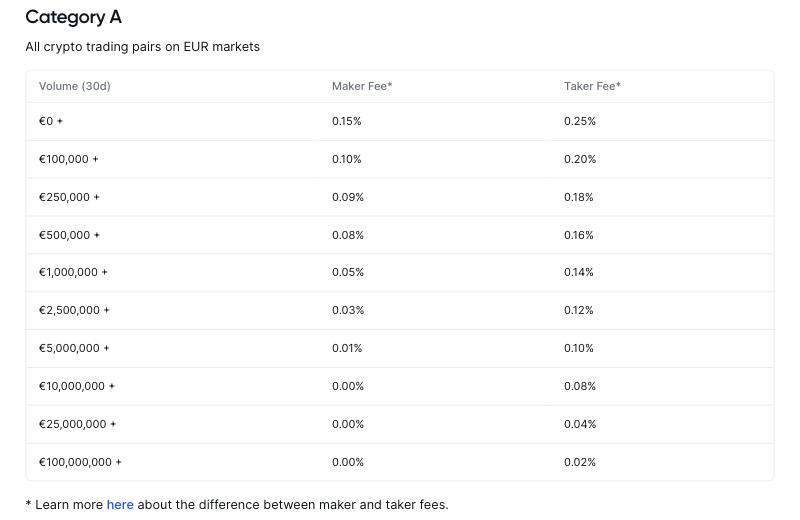
Source: Bitvavo fees.
Euro deposits and withdrawals
| Exchange | SEPA deposit | SEPA withdrawal |
|---|---|---|
| Bitvavo | free | free |
| Bitpanda | free | free |
| Kraken | free | 1 euro (0.90 euro by ClearJunction SEPA Instant) |
| Coinbase | free | free |
| Bitstamp | free | 3 euros |
Sources: each provider’s fee page or help center, checked October 7, 2026, linked at the end of this article. Your own bank may charge for transfers.
For a buy-and-hold investor, the bank transfer costs matter as much as the trading fee. If you move money in and out often, 3 euros per withdrawal at Bitstamp adds up. Paying by card or PayPal is convenient but often costs more: 1 percent at Bitvavo and 0.25 euro plus 3.75 percent for a debit card at Kraken. Coinbase shows the fee for each payment method before you pay.
How we compared the exchanges
We used the same four questions for every exchange, all answered from primary sources. That means the register, the law and the provider’s own documents.
- Licence: is the company in ESMA’s MiCA register, with which regulator and for which countries?
- Trading costs: what does a beginner pay with the simple buy button and in the advanced mode?
- Euro transfers: what do SEPA deposits and withdrawals cost?
- Evidence: what is in the provider’s own documents, and what is not published?
We did not rank the exchanges or give stars, and we did not count coins. The number of listed coins changes every week, and a long list says nothing about safety or costs.
The five exchanges in detail
Bitvavo: the same fee table in the app and Pro mode
Bitvavo has the lowest published fee for a bitcoin market order in euros in this comparison. The Dutch exchange charges 0.25 percent as a taker and 0.15 percent as a maker on crypto pairs in euros, falling to 0.20 and 0.10 percent from 100,000 euros of volume in 30 days; stablecoin pairs have their own table. According to Bitvavo’s help center, the taker fee “applies to all market orders”. It is licensed by the Dutch regulator AFM.
- Spread: Bitvavo’s pricing policy says there are “no hidden costs or spreads beyond those published”.
- Euros: SEPA deposits and withdrawals are free; card, PayPal, Apple Pay and Google Pay cost 1 percent.
- Bitcoin withdrawal: 0.000017 BTC on October 7, 2026; crypto deposits are free.
- Extras: staking and margin trading; a forced margin close costs a 2 percent liquidation fee.
Our view: the lowest published charge on a simple bitcoin market order in euros. That makes Bitvavo a sensible first look for buy-and-hold investors who mainly buy well-known coins with euros.
Bitpanda: broker app and Fusion
Bitpanda offers stocks, ETFs and precious metals in the same app as crypto. The Austrian company is licensed by the FMA, and it is your default contracting party unless the applicable product terms name another Bitpanda company, according to Bitpanda’s user agreement of July 8, 2026. Its Berlin subsidiary, Bitpanda Asset Management GmbH, holds a second MiCA licence from Germany’s BaFin, granted on January 24, 2025. In the app, Bitpanda charges a fixed fee per coin: 0.99 percent for bitcoin and most stablecoins (EURCV is listed at 0 percent), 1.49 percent for most other coins and 2.49 percent for coins with a market value below 100 million euros and its Spotlight coins, according to its cost document of July 8, 2026.
- Fusion: Bitpanda Fusion is an advanced trading platform that pools prices from more than 12 venues. Its fee starts at 0.25 percent up to 100,000 euros of volume. Bitpanda is your only counterparty there and “does not operate a multilateral trading system”, so Fusion is not an exchange in the usual sense.
- Price display: the trade summary shows the offer price and the fee separately; the quoted price is valid for 20 seconds for most assets.
- Euros: Bitpanda does not charge for SEPA transfers in euros.
- Staking: Bitpanda keeps a 20 percent commission on staking rewards.
Our view: one app for several asset classes, with a cheaper route for crypto. At the entry tier, Fusion’s published fee for bitcoin is about a quarter of the 0.99 percent in the broker app. Our Bitpanda review covers the licences, the 2026 FMA fine and margin trading in detail.
Kraken: lower rates only at higher tiers
Kraken’s entry tier is the most expensive advanced mode in this comparison. On Kraken Pro, a new trader pays 0.80 percent as a taker and 0.40 percent as a maker. The rate drops to 0.38 and 0.22 percent above 10,000 US dollars of volume in 30 days, and further at higher tiers. Kraken serves EU customers through an Irish company licensed by the Central Bank of Ireland.
- App: instant buys cost 1 percent, custom orders 1.5 percent, and the price includes a spread. The paid Kraken+ plan removes the trading fee up to 10,000 US dollars a month, but not the spread.
- Euros: SEPA deposits are free; the listed SEPA withdrawal routes cost 1 euro, SEPA Instant through ClearJunction 0.90 euro where available.
- Staking: a 20 percent commission on flexible staking of assets with an unbonding period and on the rewards program.
Our view: Kraken’s published rates only become competitive at higher tiers. For a small first purchase, Bitvavo and Bitpanda Fusion have lower published charges. Our Kraken review covers margin, the US company and Kraken’s SEC history.
Coinbase: transaction-specific fees shown before you confirm
Coinbase does not publish a fixed fee rate for its simple trades. Its help center says the fee depends on payment method, order size, market conditions and location, and that the price includes a spread. A simple limit order costs an extra 1 percent execution fee. Coinbase serves the EU through Coinbase Luxembourg S.A., licensed by the CSSF.
- Coinbase Advanced: Coinbase adds no spread there and charges maker and taker fees by tier; your current rates are shown after you sign in on the website or in the app.
- Euros: SEPA transfers “have no fees”, according to Coinbase; card, iDEAL, PayPal, Apple Pay and Google Pay are also available in the EU.
- Transparency: the exact fee is shown in the trade preview before you confirm.
Our view: without an account, Coinbase cannot be put on the same scale. Compare the trade preview with the published charges above before your first purchase. Our Coinbase review covers custody, insurance, the 2025 data theft and the fees for US and EU customers.
Bitstamp: low exchange fees, a fixed spread in Basic mode
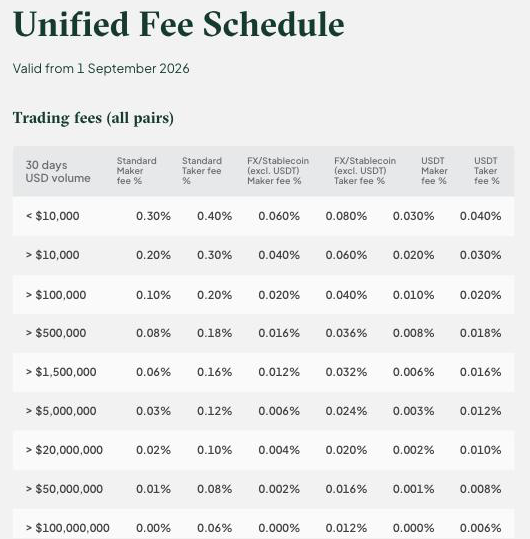
Bitstamp publishes both its exchange fees and the spread of its simple mode. On the exchange, a beginner pays 0.40 percent as a taker and 0.30 percent as a maker under the fee schedule valid since September 1, 2026. The page calls it a “Unified Fee Schedule” and names Bitstamp Europe S.A. as one of the companies providing the services, depending on where the client lives. In Basic Trading, Bitstamp adds a fixed spread of 1.8 percent for most coins, plus up to 0.5 percent in volatile markets. Its EU company in Luxembourg is licensed by the CSSF; its website uses the name “Bitstamp by Robinhood”.
- Euros: SEPA deposits are free, SEPA withdrawals cost 3 euros, the highest in this comparison.
- Staking: Bitstamp keeps 15 percent of ETH rewards and 25 percent of ADA rewards.
 Click to enlarge
Source: Bitstamp fee schedule.
Our view: use the exchange view, not Basic Trading. On a 1,000 euro buy, the published difference is at least 14 euros, the largest among the documented examples here.
Is a MiCA licence enough? What it protects and what it does not
A MiCA licence sets rules for how a provider handles your assets, but it does not guarantee their value. The regulation requires providers that hold client crypto to keep it legally separate from their own estate, so that their creditors “have no recourse” to it, in particular in an insolvency (Article 75). Client money in euros must generally be placed with a bank or central bank by the end of the next business day, in an account kept apart from the provider’s own money (Article 70). This rule does not apply to providers that are themselves banks, payment or e-money institutions.
What MiCA does not do: protect you against losses. For crypto white papers, the law requires a statement that the crypto-asset is not covered by investor compensation schemes or deposit guarantee schemes (Article 6). If bitcoin falls by half, a licence changes nothing.
The transition period is over. Providers that worked under national rules before December 30, 2024 could continue until July 1, 2026 at the latest without a MiCA licence (Article 143). Since then, crypto services in the EU generally need a MiCA authorisation. Exceptions are banks, investment firms and similar institutions that may offer crypto services under Article 60, and services from a non-EU firm that the client requested at its own exclusive initiative, without any solicitation or promotion by that firm (Article 61).
Check the register yourself before you open an account. ESMA publishes the list of licensed crypto companies as files on its MiCA page, updated weekly, so new decisions can appear with a delay. Other providers with a MiCA licence include OKX, Crypto.com and Gemini (all Malta) and Bybit EU (Austria). We found no entry with the name Binance in the register files of October 7, 2026.
Four checks before your first purchase
- Licence: find the company in ESMA’s MiCA register and compare the name with the one in the provider’s terms.
- Mode: use the advanced mode with a limit order if you are comfortable with it; the simple buy button is often the expensive way.
- Preview: read the fee and spread in the trade preview before you confirm.
- Exit costs: check what a euro withdrawal costs before you deposit.
Conclusion: the cheapest route is rarely the default button
All five providers hold a MiCA licence, so the choice comes down to costs and features. On published charges for a 1,000 euro bitcoin market buy, Bitvavo and Bitpanda Fusion are lowest at 2.50 euros, followed by Bitstamp’s exchange at 4 euros. The simple modes of Kraken and Bitstamp start at 10 and 18 euros, and Coinbase shows its fee in the trade preview.
Our suggestion: decide first whether you need more than crypto. If not, compare Bitvavo with the advanced modes of the others. If you want stocks and ETFs in the same app as your crypto, look at Bitpanda. Whatever you choose, crypto prices can fall sharply and no licence protects you from that. If you trade bitcoin, our bitcoin forecast shows the price levels we watch.
Frequently asked questions about crypto exchanges in Europe
Which crypto exchange is the cheapest in Europe?
On published charges for a 1,000 euro bitcoin market buy, Bitvavo and Bitpanda Fusion are lowest in our comparison, at 2.50 euros each. Bitstamp’s exchange costs 4 euros and Kraken Pro 8 euros. Coinbase has no fixed public rate for simple trades, and market spreads come on top everywhere.
Is my money safe on a MiCA-licensed exchange?
MiCA generally requires providers to keep client crypto separate from their own assets and client euros at a bank. Providers that are themselves banks, payment or e-money institutions follow their own rules for client money. This protects you better if the provider fails. It does not protect you against falling prices, and crypto-assets are not covered by deposit guarantee or investor compensation schemes.
How do I check if a crypto exchange has a MiCA licence?
Open the MiCA page of ESMA, the EU securities authority, and download the list of crypto-asset service providers. Search for the company name in the provider’s terms, not only the brand. The file shows the regulator, the date of the licence and the countries.
Is Binance licensed under MiCA?
We found no entry with the name Binance in ESMA’s MiCA register files of October 7, 2026. We searched both the list of licensed providers and the list of non-compliant entities. ESMA updates the files weekly and companies can appear under other names, so check the current register before you rely on this.
What is the difference between the simple buy button and the advanced mode?
With the simple buy button you usually buy at a price the provider quotes; in the advanced mode you place your own orders. The simple route is easier but often more expensive, with a spread in the price at some providers. On an order-book exchange such as Bitvavo, Kraken Pro or Bitstamp you pay a maker or taker fee and can use limit orders. Bitpanda Fusion works differently: Bitpanda itself is your counterparty and charges a single published fee, 0.25 percent at the entry tier.
Sources
Every figure in this comparison comes from these pages, checked on October 7, 2026. Fees change, so check the current version and the trade preview before you buy.
- Licences: ESMA interim MiCA register; the law: MiCA, Regulation (EU) 2023/1114, Articles 6, 59 to 61, 65, 70, 75 and 143.
- Bitvavo: fees, pricing policy, trading fee explained, euro withdrawals.
- Bitpanda: cost document, version 4.0.0, user agreement, version 2.0.1, BaFin company database, Fusion, fees and premiums, trade summary.
- Kraken: fee schedule, cash deposits, cash withdrawals.
- Coinbase: pricing and fees, Advanced fees, funding in EMEA, payment methods.
- Bitstamp: fee schedule.
This comparison was written by Karsten Kagels. It is based on ESMA’s MiCA register, the MiCA regulation and the providers’ own pages, checked on October 7, 2026. We did not open accounts or trade. This is not investment advice.
More Crypto guides
- Check one provider in depth
Bitpanda Review 2026: Fees, MiCA Licences and Who It Suits
Bitpanda: two MiCA licences, the 2026 FMA fine, fees per coin, Fusion, margin costs and who can open an account.
- Check one provider in depth
Kraken Review 2026: Fees and Safety in the US and EU
Kraken for US and EU customers: which company you deal with, Kraken Pro fees from 0.40 percent, the app fee, licences and the SEC history.
- Check if an exchange is safe
Coinbase Review 2026: Is It Safe? Fees and Licences
Coinbase for US and EU customers: licences, custody, insurance, the 2025 data theft, fees and Coinbase One.