
Defense Stocks 2026: US and European Stocks Compared


Contents
- Defense stocks in 30 seconds
- What are defense stocks?
- US against Europe: price moves since 2025
- The US big four
- The large European defense stocks
- Defense ETFs: what is really inside
- What drives defense stocks in the long run
- How to judge a defense stock
- Updating this comparison: when the numbers go out of date
- Conclusion: same budgets, different stocks
- Frequently asked questions about defense stocks
- About the author
Defense stocks are not one trade in 2026. Rheinmetall closed on November 6 almost 48% below its level at the start of the year, while Lockheed Martin was up 17% and Saab 12%. All of them sell to governments that are raising their defense budgets. The difference lies in what each company makes, how much of its backlog it can deliver, and how much was already in the price.
This guide compares the large US and European defense stocks for English-speaking investors. You get the latest order backlogs from the companies’ own reports, price moves since the start of 2025, what the main US and European defense ETFs actually hold, and the risks that differ between the two regions. Prices are closes of November 6, 2026. This article follows our editorial policy.
Defense stocks in 30 seconds
- What they are: shares of listed companies that earn a large part of their revenue from weapons, ammunition, military vehicles, ships, aircraft or defense electronics.
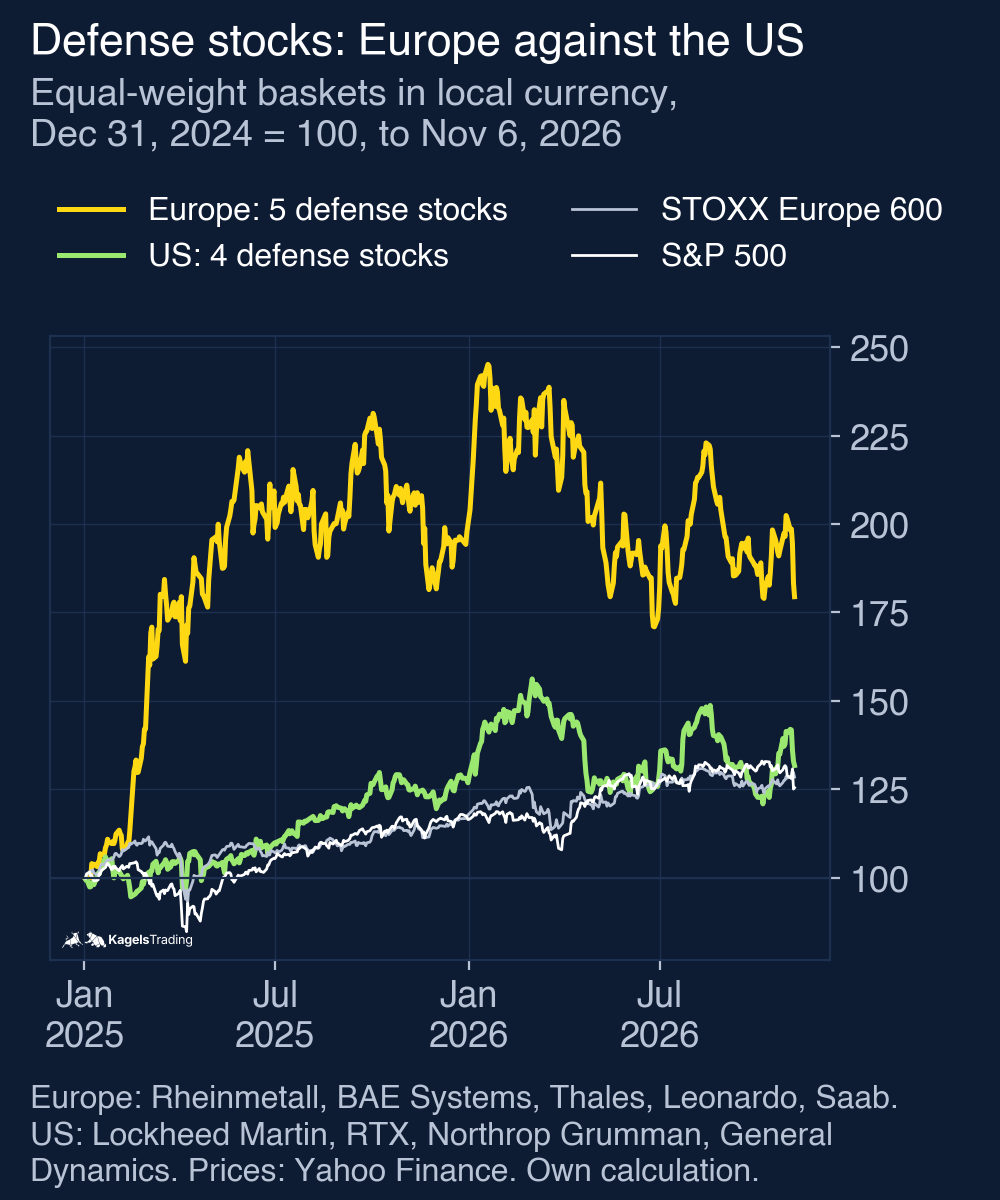
- Two regions, two stories: five European defense stocks rose about 145% from the end of 2024 to January 2026, then gave back part of it; four US peers rose far less and moved more steadily.
- Record backlogs on both sides: Lockheed Martin reported $292.0 billion, RTX $340 billion (of which $164 billion defense), Rheinmetall €78.0 billion including framework contracts.
- Backlogs are not comparable one to one: each company counts differently, and a backlog says nothing about delivery speed or margins.
- ETFs differ widely: the largest US fund holds about a fifth in GE Aerospace, an engine maker; a Europe-focused fund holds Rheinmetall at about 10%.
- The main driver: NATO members agreed in June 2025 to spend 5% of GDP by 2035, at least 3.5% on core defense, with a review in 2029.
What are defense stocks?
Defense stocks are shares of listed companies that earn a substantial part of their revenue from weapons, ammunition, military vehicles, ships, aircraft, defense electronics or other goods and services for armed forces.
The share of defense revenue decides how strongly a stock reacts to defense news. A defense-focused company such as TKMS or Renk depends mainly on military orders, although Renk also serves civil markets. A mixed group such as RTX or Airbus earns much of its money in civil aviation, so a new missile contract moves its share price less, and an airline crisis moves it more.
The order backlog is the most quoted number in the sector, and the most misunderstood. It is the value of orders a company has received but not yet delivered and booked as revenue. It shows how much work is already contracted for the next years. It does not show whether the company delivers on time or at what margin, and in 2026 those two questions moved the share prices more than the size of the backlog.
US against Europe: price moves since 2025
 Click to enlarge
European defense stocks had the bigger rally and the deeper fall. An equal-weight basket of Rheinmetall, BAE Systems, Thales, Leonardo and Saab rose from 100 at the end of 2024 to 245 in January 2026 and stood at 179 on November 6. Four US peers ended at 132, against 125 for the S&P 500 and 128 for the STOXX Europe 600, all in their home currencies.
Within Europe, the spread in 2026 is wider than between the regions. The table shows each stock’s close on November 6, its change since the last close of 2025 and its distance from the highest close since January 2025. Rheinmetall and Renk are down about 60% from their highs of autumn 2025; BAE Systems, Saab and TKMS are up for the year.
| Stock | Close Nov 6, 2026 | Since Dec 31, 2025 | Below highest close since 2025 |
|---|---|---|---|
| Lockheed Martin | $567.08 | +17.2% | −16.2% |
| RTX | $189.53 | +3.3% | −15.9% |
| Northrop Grumman | $525.01 | −7.9% | −31.6% |
| General Dynamics | $354.06 | +5.2% | −10.6% |
| Rheinmetall | €812.70 | −47.9% | −59.1% |
| BAE Systems | 1,846p | +7.7% | −20.8% |
| Thales | €221.70 | −3.5% | −18.8% |
| Leonardo | €48.07 | −2.2% | −25.2% |
| Saab | SEK 605.00 | +12.5% | −17.1% |
| Hensoldt | €77.44 | +5.5% | −32.0% |
| Renk | €34.20 | −36.2% | −61.3% |
| TKMS | €78.20 | +18.3% | −24.8% |
For a dollar-based investor, currency moves add to or subtract from these numbers. The table uses home-market prices in euros, pounds and Swedish kronor. If you buy European shares or their ADRs in dollars, a weaker or stronger euro changes your return, independent of the company.
The US big four
The US companies depend above all on the US defense budget and on programs that run for decades. Lockheed Martin builds the F-35 fighter and the PAC-3 interceptor for Patriot; RTX makes Patriot through Raytheon and jet engines through Pratt & Whitney; Northrop Grumman builds the B-21 bomber; General Dynamics builds the Abrams tank, Virginia-class submarines and Gulfstream business jets.
| Company | Backlog Q3 2026 | Q3 2026 sales | Backlog in years of sales (rough) |
|---|---|---|---|
| Lockheed Martin | $292.0 bn | $20.7 bn | 3.5 |
| RTX | $340 bn (defense $164 bn) | $25.0 bn | 3.4 |
| Northrop Grumman | $109.6 bn | $11.1 bn | 2.5 |
| General Dynamics | $220.3 bn | $14.6 bn | 3.8 |
The last column is a rough guide, not a forecast. It divides the backlog by four times the third-quarter sales; quarters vary, so treat it as an order of magnitude. Lockheed Martin’s backlog jumped 27% in one quarter, mainly because of a multi-year PAC-3 award of $52.5 billion, according to its third-quarter release. RTX’s figure includes $176 billion of commercial aerospace backlog, so only about half of it is defense (RTX release).
General Dynamics and Northrop Grumman show how program timing drives the numbers. General Dynamics booked $93.8 billion of defense orders in the quarter, led by Virginia-class submarines, for a company-wide book-to-bill of 6.8 (GD release). Northrop Grumman’s backlog of $109.6 billion is a record for the company, but its shares are still almost a third below their March high (Northrop release). A record backlog and a falling share price can exist at the same time.
The large European defense stocks
European defense companies are smaller than the US leaders, but many of them grew faster from a lower base. Their customers are spread over more countries, and much of the demand since 2022 has come from European governments rebuilding stocks and air defense. The figures below come from each company’s latest report; the dates differ, because not all of them report quarterly.
| Company (country) | Order backlog | Date | Backlog in years of sales (rough) |
|---|---|---|---|
| Rheinmetall (Germany) | €78.0 bn incl. frameworks; €54.3 bn firm | Sep 30, 2026 | 7.0 (firm 4.9) |
| BAE Systems (UK) | £84.0 bn | Jun 30, 2026 | 2.7 |
| Leonardo (Italy) | about €60.4 bn | Sep 30, 2026 | 3.0 |
| Saab (Sweden) | SEK 364.2 bn | Sep 30, 2026 | 4.2 |
| Hensoldt (Germany) | €10.4 bn | Sep 30, 2026 | 4.2 |
| Renk (Germany) | €7.6 bn | Sep 30, 2026 | 5.8 |
| TKMS (Germany) | €20.1 bn | Jun 30, 2026 | 8.0 |
Rheinmetall’s headline backlog needs a footnote. The €78.0 billion “Rheinmetall Backlog” includes expected calls under framework agreements; the firm order backlog was €54.3 billion. On November 5, 2026 the company cut its sales guidance for 2026 to about €13.2 billion, from €13.7 to €14.2 billion, according to its third-quarter statement. The share fell to €812.70, about 59% below its record close of September 29, 2025.
The other European names show that the sector does not move as one block. BAE Systems builds combat aircraft, submarines and armored vehicles and has a large business in the United States. Thales is mainly a defense electronics, radar and cyber company; its nine-month release gives no order book, but defense made up €9,358 million of €16,422 million in sales, about 57% (Thales release of October 22, 2026). Saab builds the Gripen fighter, Hensoldt radars and optronics, Renk transmissions for tanks, and TKMS submarines and frigates for the German navy and export customers.
The “years of sales” column is less comparable than it looks. Nine-month sales were scaled up to a year, BAE’s half-year sales doubled, and many European companies earn a large part of their revenue in the fourth quarter. TKMS’s fiscal year ends on September 30. Use the column to see that some companies have many years of work booked, not to rank them precisely.
Each figure links back to the company’s own report. Sources: Rheinmetall Q3 statement, BAE Systems half-year report (backlog and sales are company performance measures), Leonardo nine-month results, Saab Q3 report, Hensoldt nine-month release, Renk nine-month release and TKMS nine-month release. Read the definitions there before you compare two backlogs.
Defense ETFs: what is really inside
A defense ETF can hold something very different from what its name suggests. The largest US fund is dominated by civil aerospace, while a Europe-focused fund holds the German and British defense companies directly. The figures come from the issuers’ own holdings files and pages; each fund’s date is given in the table.
| Fund (where listed) | Annual expense ratio | Largest positions (holdings date) |
|---|---|---|
| iShares U.S. Aerospace & Defense, ITA (US) | 0.37% | GE Aerospace 21.4%, RTX 17.0%, Boeing 7.1% (Nov 5, 2026) |
| SPDR S&P Aerospace & Defense, XAR (US) | 0.35% | modified equal weight; Lockheed Martin 3.6% (Nov 5, 2026) |
| WisdomTree Europe Defence, WDEF (Europe) | 0.40% | BAE Systems 12.8%, Thales 12.7%, Rheinmetall 10.5% (Nov 5, 2026) |
| HANetf Future of Defence, NATO (Europe) | 0.49% | BAE Systems 5.2%, Safran 5.0%, Lockheed Martin 4.8%, Rheinmetall 4.2% (Nov 5, 2026) |
The two US funds follow very different rules. ITA weights its 50 holdings mainly by size, so GE Aerospace and RTX, both large civil aviation suppliers, make up almost 40% of it. XAR spreads its money almost evenly, so smaller suppliers weigh about as much as Lockheed Martin.
Other well-known funds need a fresh look at their own pages. The largest European-listed defense fund, the VanEck Defense UCITS ETF, charges 0.55% a year and held 44 stocks according to its fact sheet of October 31, 2026. The US-listed Select STOXX Europe Aerospace & Defense ETF (EUAD) holds European aerospace and defense companies, largely through ADRs. Check their current holdings before you buy them for a specific company.
Where you live affects which funds your broker offers. US investors normally buy US-listed ETFs. In the EU, many brokers do not offer US-listed ETFs to private clients, because those funds usually do not provide the key information document that the EU’s PRIIPs regulation requires; UCITS funds such as the WisdomTree, HANetf or VanEck products are the usual route. In the UK, a new disclosure regime for consumer investments began on April 6, 2026 with an optional transition, under which fund makers can produce a product summary or keep the previous disclosures, according to the FCA’s final rules; whether a US-listed fund is offered still depends on your broker. Single shares remain widely available; how a US account works is explained in our guide to brokerage accounts.
What drives defense stocks in the long run
The strongest driver is NATO’s new spending target. At the Hague summit on June 25, 2025, NATO members committed to spend 5% of GDP a year on defense and security by 2035, with at least 3.5% for core defense and up to 1.5% for related areas such as infrastructure and the defense industrial base. The path will be reviewed in 2029, according to the Hague Summit Declaration.
For investors the question has moved from demand to delivery. The orders are signed, as the backlogs show. What counts now is who can expand production capacity, deliver on schedule and keep margins. Lockheed Martin’s backlog jump (October 22, 2026) and Rheinmetall’s guidance cut (November 5, 2026) came within two weeks of each other; both are about timing, not about demand.
Politics works in both directions. Budgets can be cut, programs stopped and priorities shifted after elections, and any credible ceasefire in Ukraine lowers the perceived urgency. A single program decision can create winners and losers in the same sector, depending on who loses and who wins the contract.
How to judge a defense stock
Treat each company as its own case, not as a ticket on rising budgets. Four questions help with every name, from a pure play to a large conglomerate.
- How large is the defense share? A pure play reacts to defense news; a mixed group also depends on airlines, energy or business jets.
- How does the company count its backlog? Firm orders, framework calls, unfunded options and commercial orders are not the same; read the definition in the report.
- Does it deliver? Compare sales growth with backlog growth over several quarters; a backlog that grows much faster than sales can mean bottlenecks.
- How much depends on one program? A single frigate, fighter or tank contract can decide a year; check how concentrated the order book is.
Holding several defense stocks is not real diversification. They depend on the same budgets and the same political events, so they often fall together. If the sector becomes a large part of your portfolio, size each position with that cluster risk in mind; our guide to risk management shows how. Whether the sector leads or lags the market can be tracked with relative strength and is part of sector rotation.
Updating this comparison: when the numbers go out of date
Backlogs and guidance change with every report, so this comparison has a short shelf life. Confirmed dates so far: Saab publishes its full-year 2026 results on February 5, 2027, Hensoldt expects to publish preliminary results on February 24, 2027, and Leonardo’s board meets on March 3, 2027 to approve the draft annual report. For the other companies, check their financial calendars. The US companies usually report their fourth quarter in late January.
ETF holdings change daily and their indexes rebalance regularly. Before you buy a fund for a specific company, check its current holdings file on the issuer’s site rather than an older article. Fees can change too, and a fund’s size moves with flows and prices.
Conclusion: same budgets, different stocks
The demand for defense equipment is not in doubt; which stock benefits from it is. NATO’s 5% target and record backlogs on both sides of the Atlantic support the sector. Yet from January to November 2026, Rheinmetall lost almost half its value while Lockheed Martin gained 17%.
In my reading, European stocks had run further and so fell further, while US stocks moved more steadily. Backlogs are large almost everywhere, so the differences come from delivery, margins, single programs and politics. For an ETF, read the holdings before the name: some defense funds are largely civil aviation.
I look less at new budget headlines than at one plain question: which company delivers what it has sold? In my view it explains many of the price moves in 2026, though the charts alone cannot prove that. This overview is a basis for your own decision, not a recommendation, and it is market analysis, not investment advice.
Frequently asked questions about defense stocks
Which are the largest defense stocks?
In the US, Lockheed Martin, RTX, Northrop Grumman and General Dynamics are the largest defense contractors. In Europe, BAE Systems, Thales, Leonardo, Rheinmetall and Saab lead. RTX and Airbus also have large civil businesses, so their defense share is smaller than the headline size suggests.
Are defense stocks still worth buying?
That depends on the single company and your time horizon, not on the sector label. Record backlogs and NATO’s 5% target support demand. Delivery problems, program stops, political change and high valuations in parts of Europe are the risks; no general recommendation follows from that.
Why did Rheinmetall stock fall so much?
Rheinmetall closed on November 6, 2026 about 59% below its record close of September 29, 2025. On November 5 the company cut its 2026 sales guidance to about €13.2 billion, from €13.7 to €14.2 billion, and expectations had been very high after the rally of 2025. Its backlog still stood at €78.0 billion including framework agreements.
Which defense ETF holds Rheinmetall?
Among the funds in our table, the WisdomTree Europe Defence UCITS ETF holds the most, 10.5% on November 5, 2026. The HANetf Future of Defence ETF held 4.2% on the same day. For other funds, check the current holdings file on the issuer’s site.
Can US investors buy European defense stocks?
Yes, through brokers with access to European exchanges or through ADRs, and through US-listed funds such as EUAD. EUAD holds European aerospace and defense companies, largely through ADRs; check on the issuer’s page how much of it is civil aviation. Currency moves between the euro, pound or krona and the dollar affect your return.
What is an order backlog?
An order backlog is the value of orders a company has received but not yet delivered and booked as revenue. Definitions differ: some companies include framework agreements or unexercised options, others only firm orders. Always compare the backlog with sales and read how the company defines it.
This US edition is based on our German edition on kagels-trading.de and has been adapted for US readers.
More Stocks & Commodities guides
- Choose a silver stock
Best Silver Stocks 2026: 10 Companies Compared
Ten silver producers, streamers and explorers compared on 2025 output, costs, dividends and chart levels after the record highs of early 2026.
- Choose a gold stock
Best Gold Stocks 2026: Miners and Royalty Companies
Eleven gold producers, royalty companies and developers compared on output, costs, dividends and 2026 takeovers, plus gold miner ETFs.
- Choose an oil stock
Best Oil Stocks 2026: Majors, Pipelines and Refiners
The largest oil producers, pipelines and refiners by market value and dividend, the MLP tax traps and the main energy ETFs.
- Choose a chip stock
Semiconductor Stocks 2026: AI Chips, Memory and Equipment
Chip designers, foundries, memory and equipment makers by market value, revenue and guidance, plus how the main semiconductor ETFs differ.
- Track sector rotation
Sector Rotation: How to Spot Shifts in Market Leadership
Read an XLE/SPY ratio chart, check the business-cycle model against three recessions and see our 27-year sector momentum backtest.