
Semiconductor Stocks 2026: AI Chips, Memory and Equipment


Contents
- Semiconductor stocks in 30 seconds
- What are semiconductor stocks?
- The 10 largest semiconductor stocks by market value
- Chip designers: Nvidia, Broadcom, AMD and Qualcomm
- Foundry: TSMC (TSM)
- Memory: Micron, SK hynix and Samsung
- Intel: the turnaround that broke on 30 October 2026
- Equipment makers: ASML, Applied Materials, Lam Research and KLA
- European semiconductor stocks
- The chip market in numbers
- Risks of semiconductor stocks
- Semiconductor ETFs
- Outlook: what to watch in the coming months
- Conclusion: semiconductor stocks reward the right link of the chain
- Frequently asked questions about semiconductor stocks
- Sources
- About the author
Semiconductor stocks are the most important industry group of this market cycle, and one of the most dangerous. Without chips there is no data center, no smartphone and no car. In 2026 the demand for AI hardware has turned the chip market upside down: the World Semiconductor Trade Statistics now expect sales to roughly double this year. At the same time a single quarterly report can wipe out a quarter of a company’s value in one day, as Intel showed on 30 October 2026.
The chip industry is not one business but a chain of very different businesses. Some companies only design chips, others only manufacture them, a few do both, and a fourth group builds the machines without which no factory runs. Memory makers follow their own price cycle. Which link of the chain you buy decides how your stock reacts to the next boom or bust.
This guide compares the largest semiconductor stocks by business model, revenue and outlook. All company figures come from the companies’ own reports and filings, checked on 30 October 2026. Prices and market values are from the close on 30 October 2026, a day when the whole sector fell sharply. AMD, Qualcomm and Nvidia report again in November, so check the latest numbers before you buy.
Semiconductor stocks in 30 seconds
- The market has exploded. Global chip sales reached $795.6 billion in 2025. The industry statistics body WSTS calculates about $1.66 trillion for 2026, driven above all by memory prices.
- Nvidia is still the largest chip company with a market value of $4.94 trillion, followed by TSMC and Broadcom. Micron joined the trillion-dollar club in 2026 and stood at about $1.0 trillion on 30 October.
- Memory was the biggest winner. Micron’s revenue rose 256 percent to $133 billion in its fiscal year 2026, and SK hynix and Samsung earned record profits in the third quarter.
- The risks are just as large. Intel lost 28.6 percent on 30 October 2026 after a weak outlook, the steepest one-day fall in its price history since 1980. Export rules for China and Taiwan’s concentration remain open risks.
- ETFs bundle the sector but differ widely. The VanEck SMH holds almost 20 percent Nvidia, while the Invesco SOXQ caps its largest stock at about 12 percent.
What are semiconductor stocks?
Semiconductor stocks are shares of companies that design, manufacture or sell chips, or that supply the equipment to make them. The term chip stocks means the same thing. It covers processor designers such as Nvidia, contract manufacturers such as TSMC, memory makers and equipment suppliers such as ASML.
Five business models dominate the industry, and each carries a different risk. The table shows them with examples from this guide. The business model matters more than the label, because a memory maker and a chip designer can move in opposite directions in the same year.
| Business model | What it does | Examples |
|---|---|---|
| Fabless designer | designs chips, has no factories, outsources production | Nvidia, Broadcom, AMD, Qualcomm |
| Foundry | manufactures chips designed by its customers | TSMC |
| Integrated device manufacturer (IDM) | designs and manufactures its own chips | Intel, Texas Instruments, Infineon |
| Memory maker | produces DRAM, high-bandwidth memory (HBM) and NAND flash in its own fabs | Micron, SK hynix, Samsung |
| Equipment maker | builds the machines for chip factories | ASML, Applied Materials, Lam Research, KLA |
Fabless designers need little capital but depend completely on a few foundries. Nvidia, AMD, Broadcom and Qualcomm let TSMC produce most of their chips. That keeps their margins high and their factories off the balance sheet. The price is a concentration risk: if TSMC’s plants in Taiwan stop, almost the entire industry stops with them.
Memory makers live from a commodity price. DRAM and NAND are standardized products, so their price swings with supply and demand. In shortages such as 2026, profits multiply within months. In a glut, as in 2023, prices and earnings collapse just as fast.
The 10 largest semiconductor stocks by market value
Market value shows where investors put their money, not which company has the best future. Nine of the ten largest chip companies are listed in the United States, either directly or through American depositary shares. Samsung’s ordinary shares trade in Seoul and its global depositary receipts in London, but there is no US ADR.
| Company | Business model | Market value | Change on 30 Oct 2026 |
|---|---|---|---|
| Nvidia (NVDA) | fabless designer | $4.94 trn | −4.2% |
| TSMC (TSM) | foundry | about $2.11 trn | −6.0% |
| Broadcom (AVGO) | fabless designer, software | $1.56 trn | −5.5% |
| Samsung Electronics (Seoul) | memory, foundry, devices | about $1.08 trn | −3.0% |
| Micron (MU) | memory | $1.00 trn | −5.3% |
| AMD (AMD) | fabless designer | $824 bn | −10.9% |
| SK hynix (Seoul, Nasdaq SKHY) | memory | about $775 bn | −7.1% |
| ASML (ASML) | equipment | $564 bn | −6.6% |
| Intel (INTC) | IDM and foundry | $349 bn | −28.6% |
| Applied Materials (AMAT) | equipment | $310 bn | −7.5% |
Market values at the close on 30 October 2026 per stockanalysis.com. TSMC calculated from the New York close of $406.13 and about 25.93 billion ordinary shares at five shares per ADR; some data sites show a lower value of $1.77 trillion. Samsung and SK hynix converted from the Seoul close at 1,332.92 won per dollar. The Chinese memory maker CXMT, listed in Shanghai, would rank about ninth with roughly $443 billion according to companiesmarketcap.com; that value carries no date, so it is not in the table. Lam Research ($299 bn) follows in place 11.
SK hynix shows why you should check which line of a stock you buy. Since July 2026 the company also trades on Nasdaq under SKHY, with one share representing a tenth of a Seoul share. On 30 October the Nasdaq line traded about 40 percent above the price implied by Seoul. If you pay that premium, you carry an extra risk on top of the memory cycle.
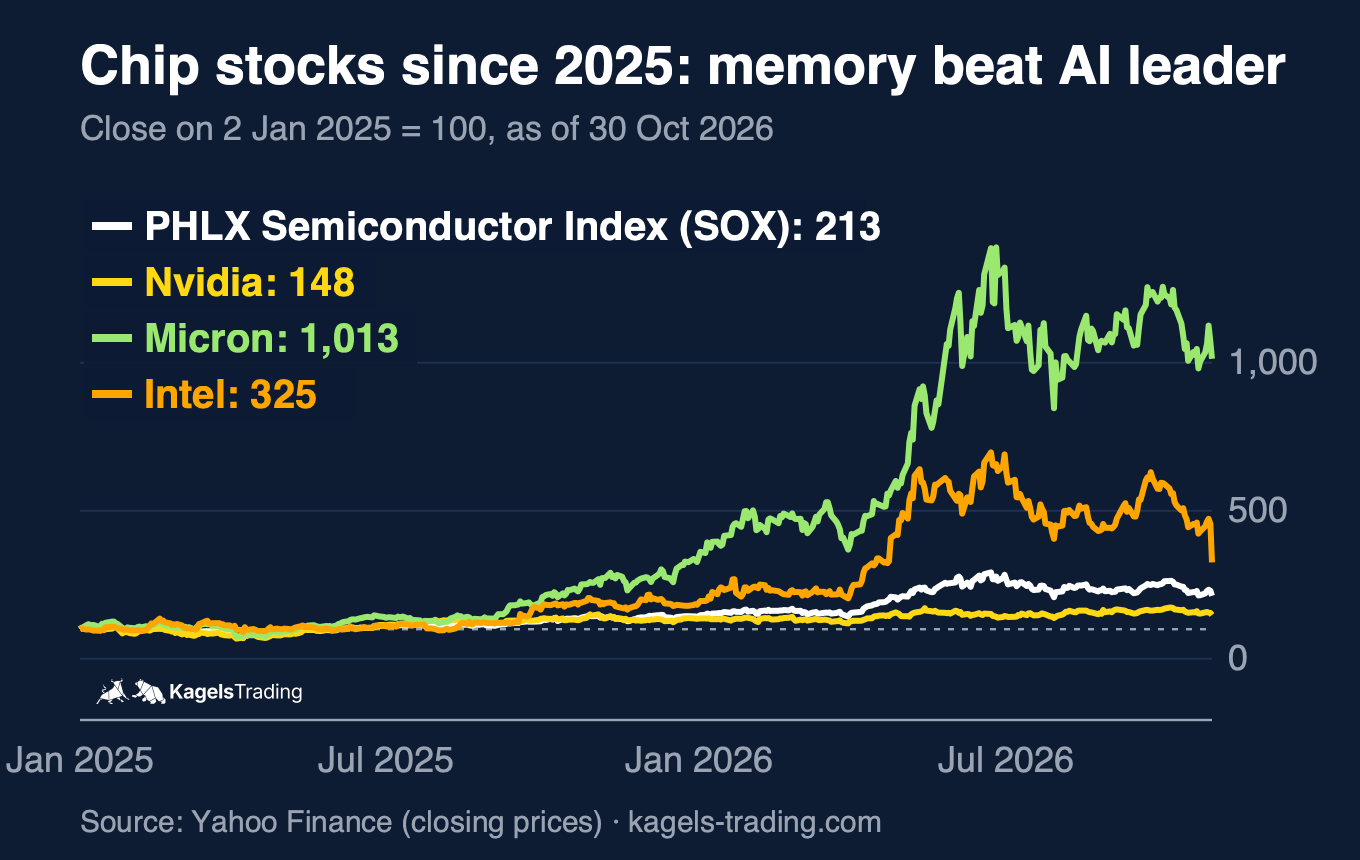
Chart check: memory beat the AI leader
 Click to enlarge
Source: Yahoo Finance.
Since 2025 the biggest gains in chips came from memory, not from Nvidia. From the close on 2 January 2025 to 30 October 2026, Micron rose about tenfold, Intel more than tripled even after its crash, and the SOX index doubled. Nvidia gained 48 percent, less than the index. The chart also shows how much air there is below these prices: Micron and Intel trade far under their summer highs.
Chip designers: Nvidia, Broadcom, AMD and Qualcomm
The four largest fabless designers have one thing in common and little else. All of them outsource production, most of it to TSMC. Their markets differ completely: Nvidia sells AI accelerators, Broadcom custom chips and network technology, AMD processors and GPUs, and Qualcomm smartphone chips and patent licenses.
Nvidia (NVDA)
 Click to enlarge
Source: Twelve Data.
Nvidia is the largest semiconductor company in the world and the benchmark for the AI trade. In fiscal 2026, which ended on 25 January 2026, revenue rose 65 percent to $215.9 billion and net income to $120.1 billion. The data center business delivered almost 90 percent. Since spring 2026 Nvidia only reports two areas, Data Center and Edge Computing, which now includes gaming.
Growth has accelerated again in 2026. In the quarter to 26 July 2026 revenue reached $96.2 billion, up 106 percent, with a gross margin of 75 percent. For the quarter to late October Nvidia guided $108 billion, plus or minus 2 percent, without any data center sales to China. The next report is due on 17 November 2026.
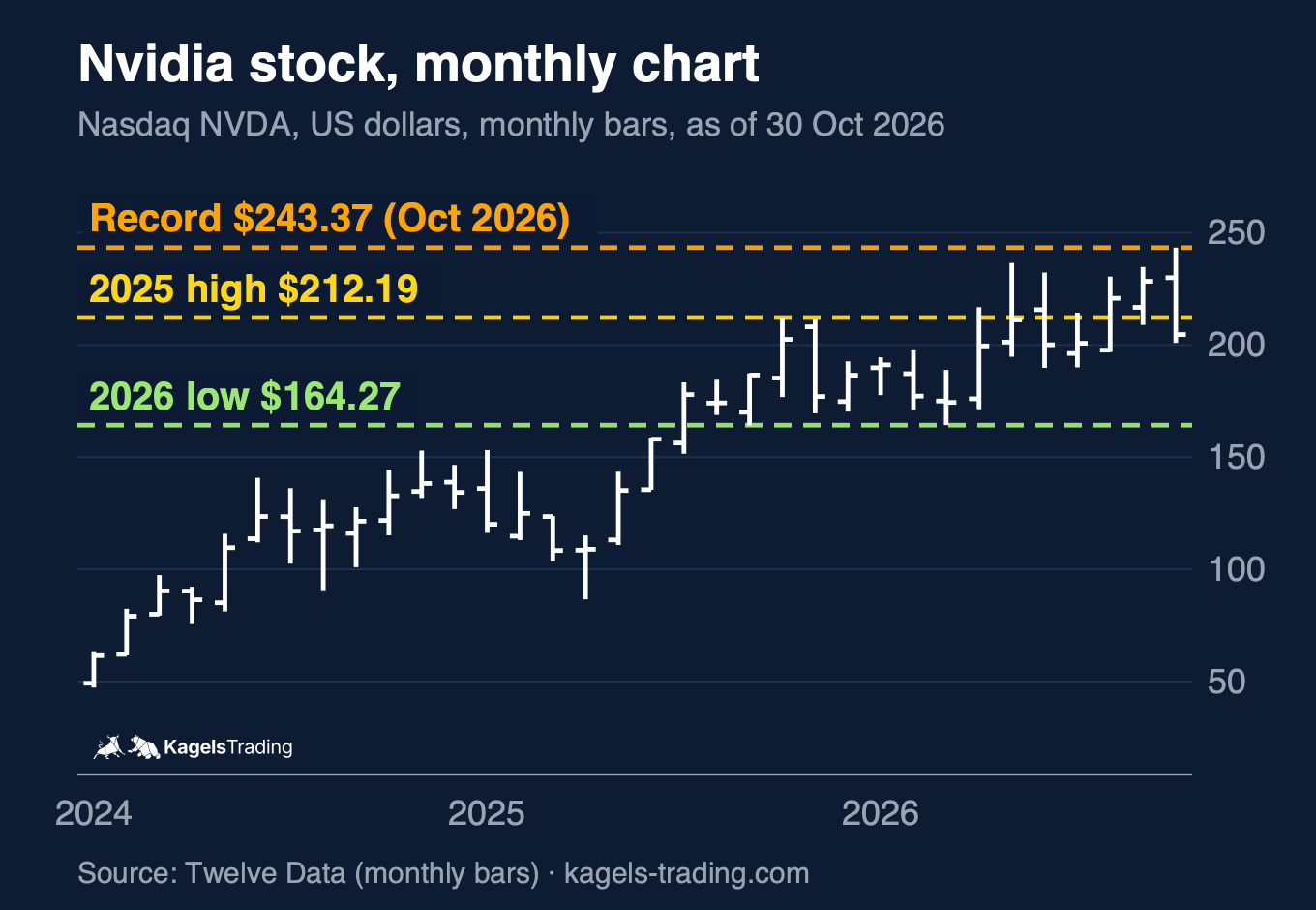
Nvidia now pays a dividend that is more than symbolic. In May 2026 the company raised its quarterly dividend from one cent to $0.25 and added an $80 billion buyback. In September it agreed to buy Hugging Face for about $11.9 billion. The chart shows the record high of $243.37 in October and a close of $204.64, already below the 2025 high at $212.19. That level is now the first resistance on any recovery, and the 2026 low at $164.27 is the next support. Prices before June 2024 are adjusted for Nvidia’s 10-for-1 stock split.
Broadcom (AVGO)
 Click to enlarge
Source: Twelve Data.
Broadcom earns its AI money with custom chips instead of standard GPUs. The company designs accelerators for single customers, above all Google’s TPUs, plus the network chips that connect AI clusters. In its third fiscal quarter to 2 August 2026, revenue rose 86 percent to $29.6 billion, and AI chip revenue more than tripled to $16.7 billion. For the quarter to 1 November Broadcom guided $34.8 billion.
Broadcom also owns a large software business. Since the VMware takeover in 2023, infrastructure software delivered 42 percent of revenue in fiscal 2025 and 30 percent in the latest quarter. The quarterly dividend is $0.65. In 2026 Broadcom signed supply agreements with Google, Apple and, through Google’s TPUs, Anthropic; on 26 October it also guaranteed the residual value of leased AI racks up to about $43 billion.
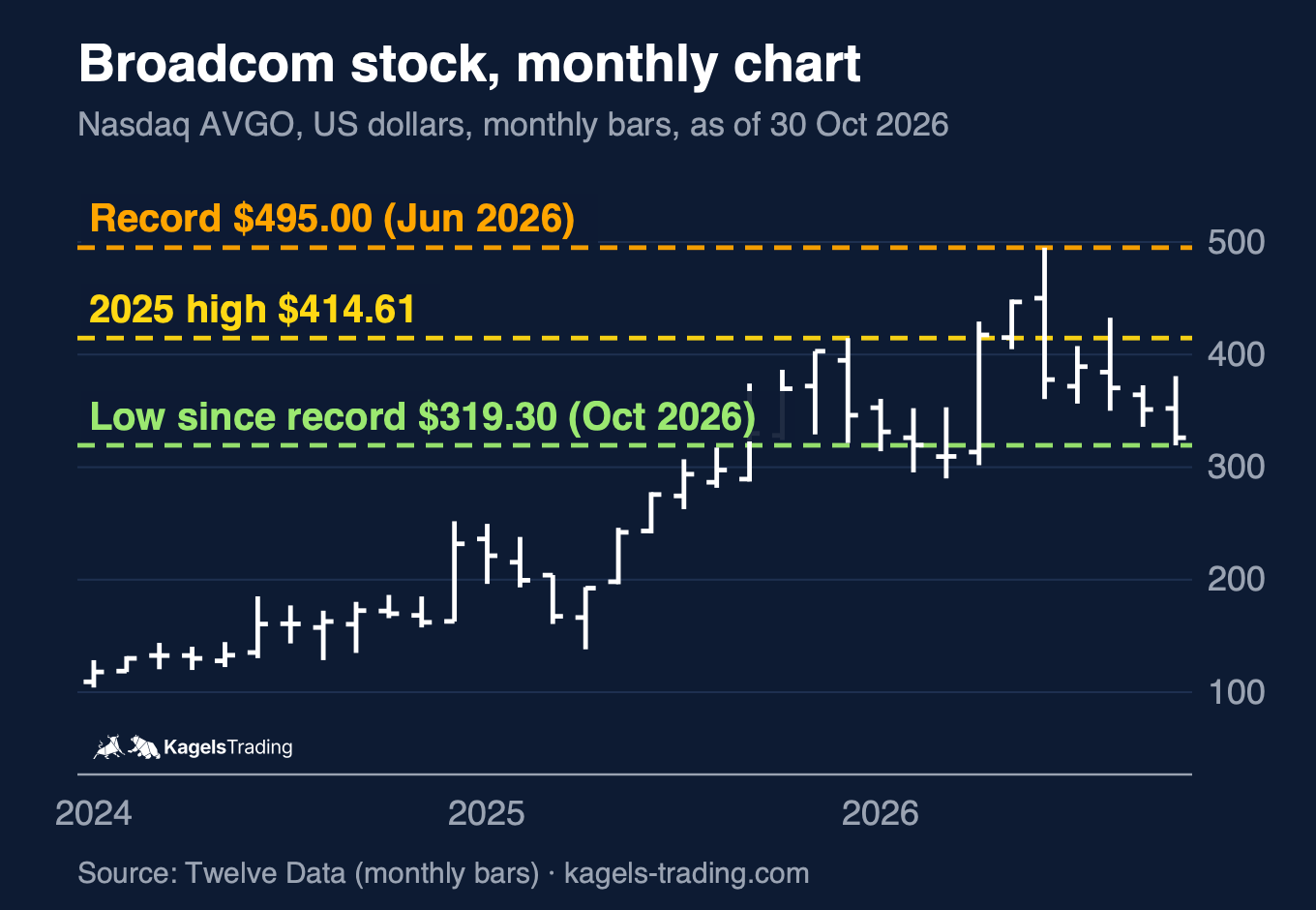
The chart shows a stock that has already lost a third. From the all-time high of $495 in June 2026, Broadcom fell to a low of $319.30 in October and closed at $326.08. The 2025 high at $414.61 is now resistance. Below the October low, the 2026 low at $289.96 from March is the next support.
AMD (AMD)
AMD is the main challenger to Nvidia in AI accelerators and to Intel in processors. Revenue rose 34 percent to $34.6 billion in 2025, with the data center segment at about half. In the second quarter of 2026 revenue grew 50 percent to $11.5 billion, and the data center share rose to 58 percent. For the third quarter AMD guided about $13.0 billion; the report follows on 3 November 2026.
AMD wins large AI customers by offering them a share in its success. OpenAI and Meta each plan up to six gigawatts of AMD GPUs and received warrants for up to 160 million AMD shares. With Anthropic AMD agreed in July 2026 on up to two gigawatts of MI450 chips from 2027 and committed to an equity investment of up to $5 billion “in the future”. AMD pays no dividend, and the stock lost 10.9 percent on 30 October.
Qualcomm (QCOM)
Qualcomm is the smartphone chip leader that is trying to leave the smartphone behind. In fiscal 2025, which ended in September 2025, revenue rose 14 percent to $44.3 billion: handsets $27.8 billion, automotive $4.0 billion, IoT $6.6 billion and licensing $5.6 billion. In the quarter to June 2026 revenue fell 4 percent, because handset sales dropped 20 percent amid high memory costs.
The new growth story is data centers and cars. Automotive revenue rose 61 percent in the latest quarter. In September 2026 Amazon received a warrant tied to purchases of Qualcomm server chips of up to $60 billion. The quarterly dividend is $0.92, the highest yield among the large chip designers at about 2.2 percent. Full-year results follow on 4 November 2026.
Foundry: TSMC (TSM)
 Click to enlarge
Source: Twelve Data.
TSMC manufactures the most advanced chips in the world for almost every major designer. In 2025 revenue rose 31.6 percent in Taiwan dollars to about $122 billion, with a gross margin of 59.9 percent. High-performance computing, mainly AI and data center chips, made up 58 percent, smartphones 29 percent. North American customers accounted for 75 percent of revenue.
2026 is turning into TSMC’s strongest year. In the third quarter revenue rose 41 percent to $46.7 billion, and the gross margin reached 66.4 percent. The newest 2-nanometer process already delivered 8 percent of wafer revenue. For the fourth quarter TSMC guided $52.3 to 54.3 billion and for the full year growth of about 44 percent in dollars.
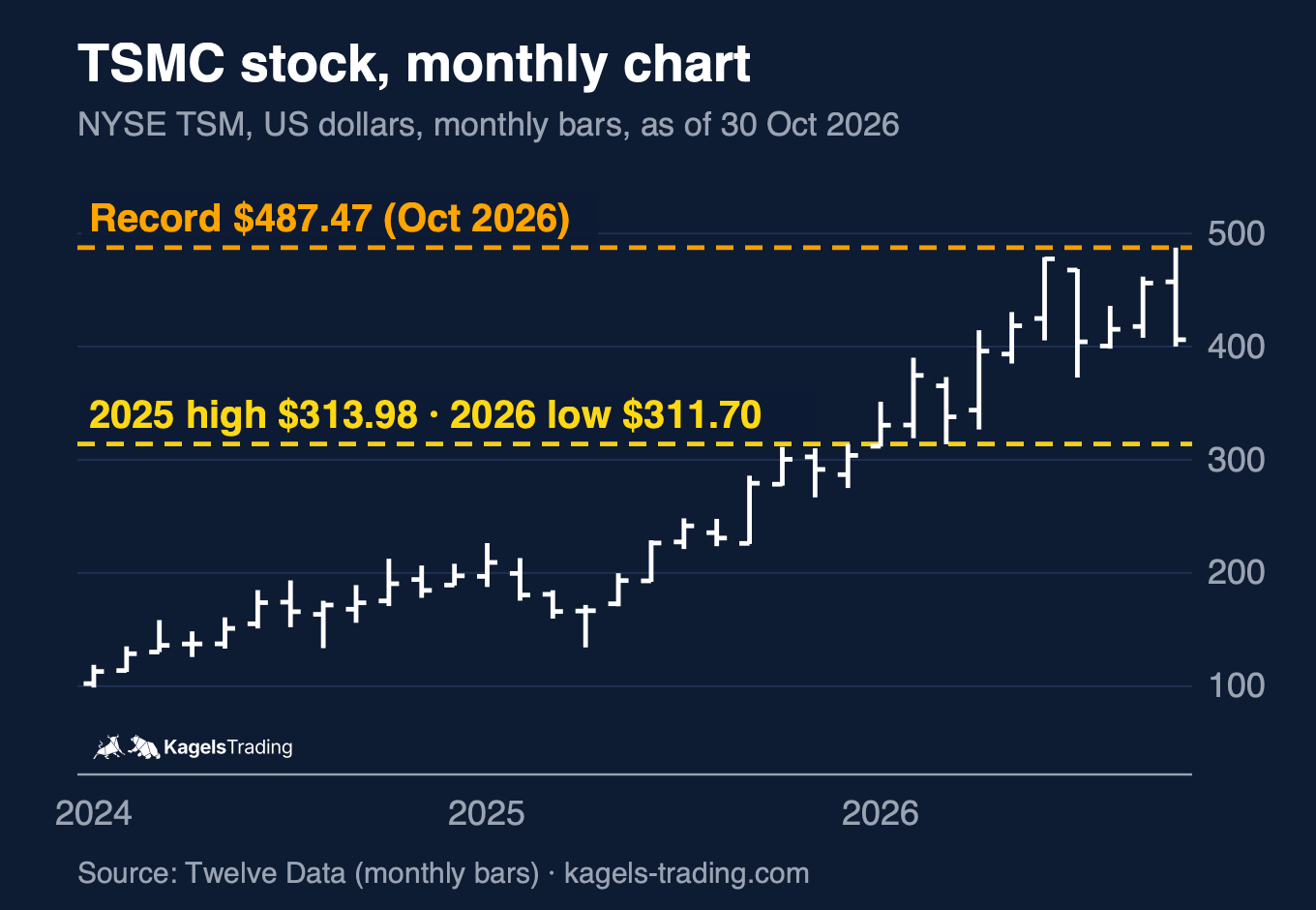
TSMC is building abroad, but its core remains in Taiwan. The first fab in Arizona has been in volume production since late 2024, the first in Kumamoto, Japan, since December 2024. The fab in Dresden, Germany, is planned for mature 28 to 12 nanometer processes and production by the end of 2027. The latest declared quarterly dividend is NT$7.00 per share, and the chart shows a record of $487.47 in October.
Memory: Micron, SK hynix and Samsung
Memory chips are the bottleneck of the AI build-out. Every AI accelerator needs high-bandwidth memory (HBM), stacked DRAM chips that only three companies can produce in volume. In 2026 demand far exceeds supply, so memory prices and margins have reached levels the industry has never seen before.
Micron (MU)
 Click to enlarge
Source: Twelve Data.
Micron’s fiscal 2026 is one of the most extreme years any large company has reported. In the 53 weeks to 3 September 2026 revenue rose 256 percent to $133.2 billion, and net income reached $85.0 billion with a gross margin of 80.7 percent. DRAM contributed $100.7 billion, NAND $31.8 billion. For the quarter to November Micron guided $61.5 billion, plus or minus $1.5 billion.
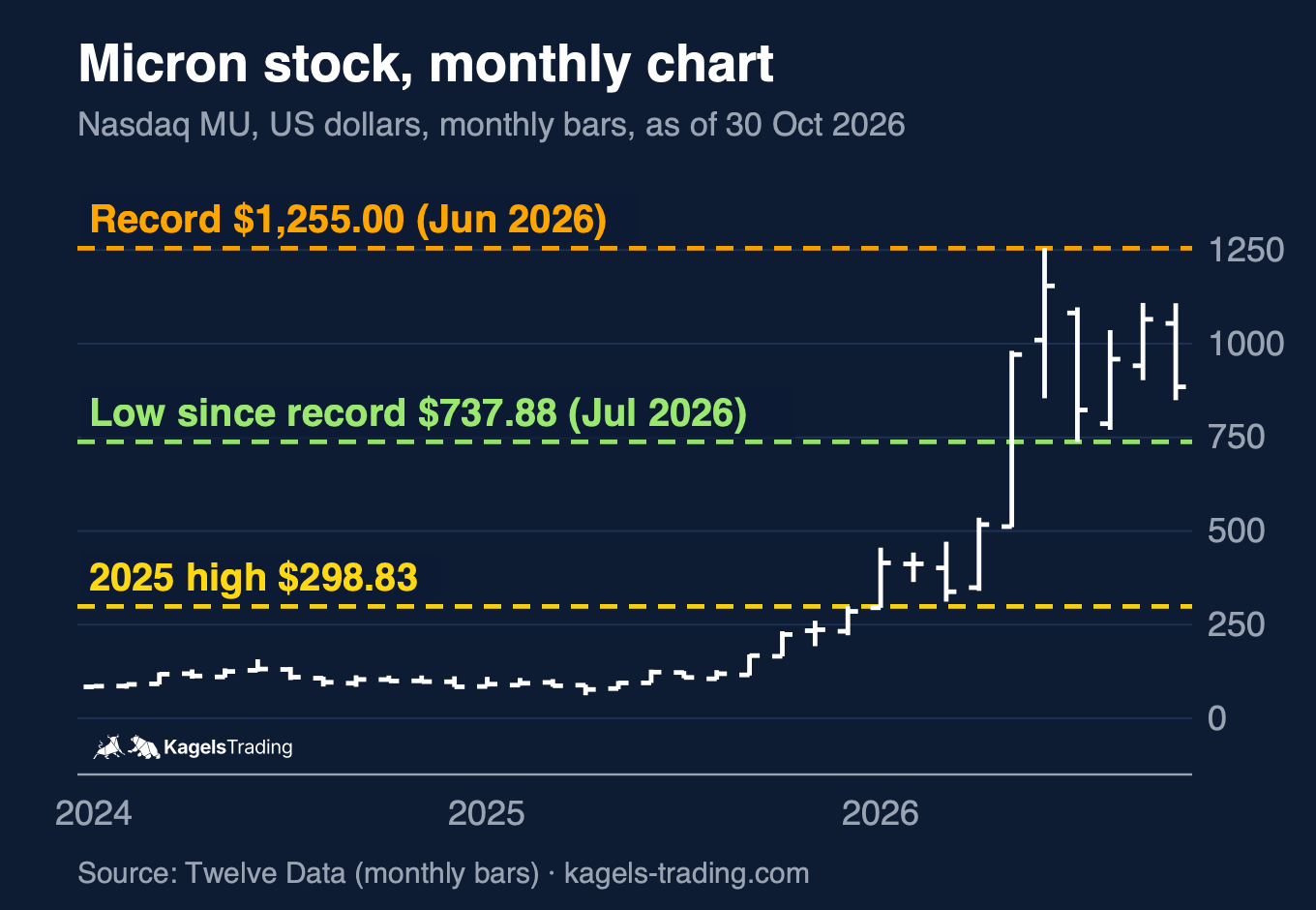
The stock shows how fast a supercycle can turn into a sell-off. Micron rose from $84 at the end of 2024 to an all-time high of $1,255 in June 2026, then fell to $737.88 in July. At $884.74 on 30 October it was worth about $1.0 trillion. The dividend of $0.15 per quarter is tiny compared with the profit, so this is a stock for cycle traders, not for income investors.
SK hynix and Samsung
SK hynix is the market leader in high-bandwidth memory. According to IDC data quoted in its US prospectus, it held 56.4 percent of HBM revenue in the first quarter of 2026. In the third quarter revenue reached KRW 104.6 trillion, more than four times the prior year, with an operating margin of 80 percent. For that quarter SK hynix pays a dividend of KRW 20,000 per share, half of it a special dividend.
Samsung is the largest memory maker and much more than that. The group also builds smartphones, TVs and displays and runs its own foundry. In the third quarter of 2026 Samsung earned an operating profit of KRW 107.4 trillion, of which KRW 106.5 trillion came from the chip division. The quarterly dividend is KRW 4,601 per share. Samsung shares trade in Seoul; in the US there is no ADR, only a thinly traded over-the-counter line.
Intel: the turnaround that broke on 30 October 2026
 Click to enlarge
Source: Twelve Data.
Intel is the last large US company that designs and manufactures its own leading-edge chips. Revenue was flat at $52.9 billion in 2025, and the foundry division lost $10.3 billion, after $13.3 billion in 2024. Under CEO Lip-Bu Tan Intel cut its core workforce by about 15 percent, cancelled the planned fab in Germany and the assembly plant in Poland, and suspended its dividend.
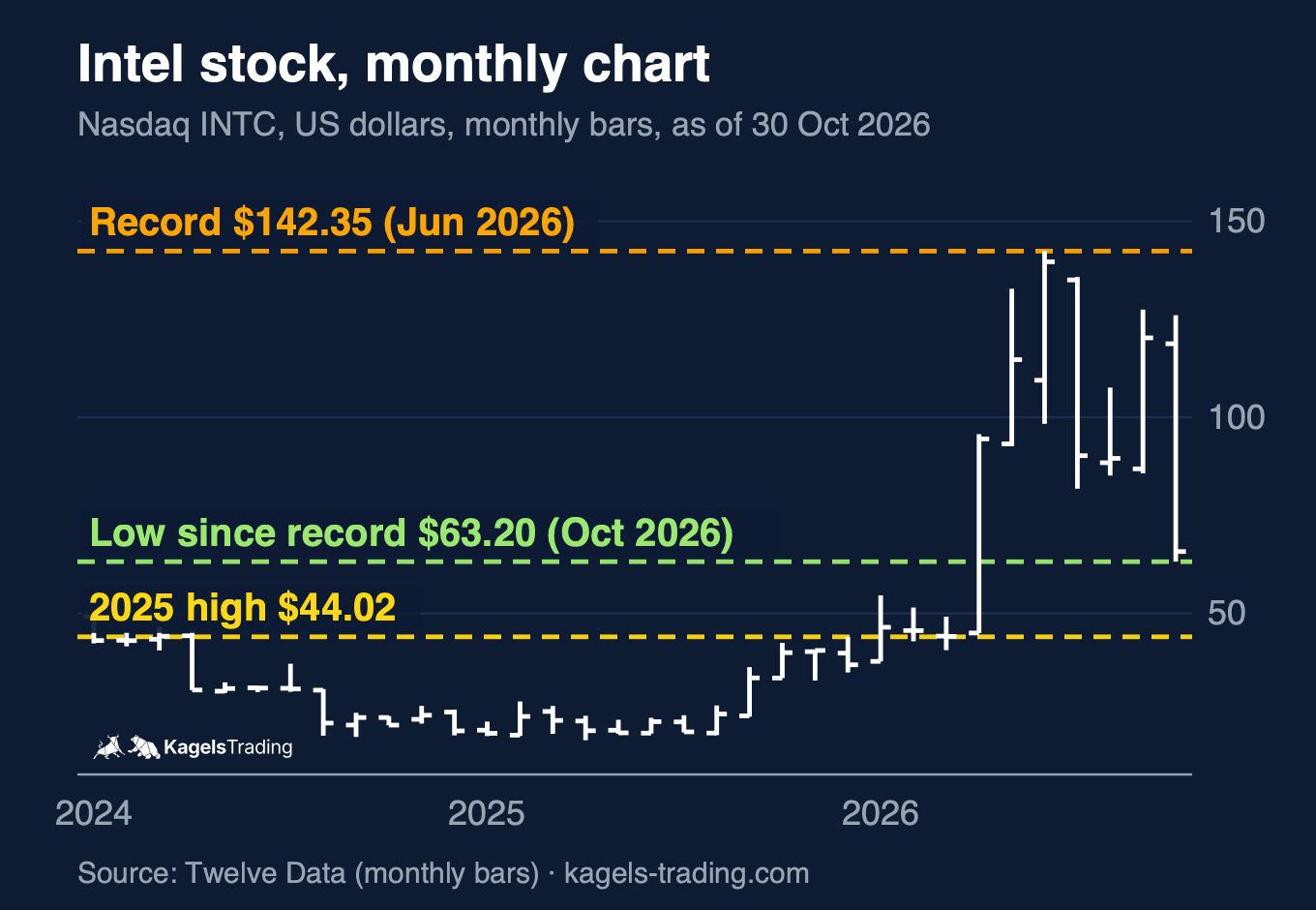
2026 started like a comeback. The new 18A process went into volume production, the US government, SoftBank and Nvidia became shareholders, and in August Intel sold new shares worth $23 billion at $95. The stock rose from $20 at the end of 2024 to an all-time high of $142.35 in June 2026. Third-quarter revenue grew 21 percent to $16.5 billion.
Then the outlook broke the trend. For the fourth quarter Intel guided revenue of $15.0 to 16.0 billion, below the quarter just reported, and a gross margin of 37.1 percent after 43.0 percent. On 30 October the stock fell 28.6 percent to $65.76, the largest one-day loss in its price history since 1980. The chart shows how close the price now trades to the October low of $63.20; the 2025 high at $44.02 is the next major level below.
Equipment makers: ASML, Applied Materials, Lam Research and KLA
Equipment makers earn when chipmakers invest, no matter which chip wins. Every new fab needs lithography, deposition, etching and inspection machines. These companies are therefore a bet on the capital spending of TSMC, Samsung, SK hynix, Micron and Intel, not on a single end product.
| Company (ticker) | Specialty | Last full year | Latest quarter | China share |
|---|---|---|---|---|
| ASML (ASML) | lithography, sole supplier of EUV | €32.7 bn (2025, +15.6%) | €11.7 bn (Q3 2026) | 23% of system sales |
| Applied Materials (AMAT) | deposition, etching, services | $28.4 bn (FY Oct 2025, +4%) | $9.1 bn (Jul 2026, +25%) | 28% |
| Lam Research (LRCX) | etching and deposition | $23.2 bn (FY Jun 2026, +26%) | $8.2 bn (Sep 2026, +54%) | 35% |
| KLA (KLAC) | process control and inspection | $13.6 bn (FY Jun 2026, +12%) | $4.1 bn (Sep 2026, +29%) | not stated |
Sources: results releases of each company, checked on 30 October 2026. China share of the latest quarter’s revenue; at ASML of system sales.
ASML is the only company in the world that sells extreme ultraviolet (EUV) lithography systems. Without them, no chip on the most advanced processes can be made. ASML shipped 48 EUV systems in 2025 and raised its 2026 guidance to €44 to 45 billion, after €34 to 39 billion in January. That already reaches the bottom of its 2030 target of €44 to 60 billion, which ASML will update in June 2027.
Export rules are the main risk for the equipment makers. EUV systems may not be sold to China, and the most advanced immersion systems need a Dutch export license. Even so, China still made up 23 percent of ASML’s system sales in the third quarter and 35 percent of Lam Research’s revenue. Tighter rules would hit these companies directly.
European semiconductor stocks
Europe has one global champion and several specialists in power and automotive chips. ASML in the Netherlands is the largest European tech company. The others earn most of their money with power semiconductors, sensors and microcontrollers for cars and industry, and they have far less exposure to the AI boom.
- Infineon (Germany) is Europe’s largest chipmaker by revenue with €14.66 billion in its fiscal year to September 2025. AI data center power supplies now drive growth, and for fiscal 2026 Infineon expects about €16.3 billion.
- STMicroelectronics (headquartered in Geneva, listed in Paris, Milan and New York) had $11.8 billion of revenue in 2025 and expects about $14.5 billion for 2026.
- NXP Semiconductors (Netherlands, Nasdaq NXPI) earns more than half of its revenue with automotive chips; third-quarter 2026 revenue was $3.8 billion, up 19 percent.
The chip market in numbers
The semiconductor market is on course to roughly double in 2026. According to WSTS, global sales reached $795.6 billion in 2025, up 26 percent, and grew 102 percent in the first half of 2026. In June WSTS forecast $1.51 trillion for 2026. In August it replaced its second-quarter estimate with actual figures and kept the earlier growth rates for the rest of the year, which gives $1.66 trillion; that is a calculation, not a new forecast. The industry association SIA reported that sales passed $1 trillion by August.
Memory explains most of this jump. On the August calculation the memory segment reaches about four times its 2025 size in 2026, while logic chips grow by about a third. Such a jump comes from prices more than from volumes. That is why the memory cycle is the biggest question for 2027: the same calculation gives about $2.1 trillion, but every memory boom so far has ended in a glut. The next full WSTS forecast is due in late November.
Risks of semiconductor stocks
Chip stocks fall harder than the market when the cycle turns. The sector moves with inventories, capital spending and memory prices. In 2023 global sales fell 8.2 percent, and in 2026 several leading stocks lost a third or more from their summer highs within weeks. These are the main risks.
- Cycle and valuation: record margins such as Micron’s 80 percent rarely last. A lower outlook can cost a quarter of the market value in a day, as Intel showed.
- China and export rules: Nvidia is, in its own words, effectively shut out of China’s data center market. ASML and Lam Research still earn a large share there.
- Taiwan: most of the world’s advanced chips come from TSMC’s plants in Taiwan. A conflict there would hit almost every stock in this guide.
- Customer concentration: a handful of cloud and AI companies buy most AI chips. If they cut spending, designers, memory makers and equipment makers all suffer.
- Financing deals: warrants for OpenAI, Meta and Amazon, Nvidia’s residual value guarantees of up to $105 billion and Broadcom’s backstop of up to about $43 billion tie chipmakers more closely to their customers’ finances.
Semiconductor ETFs
A chip ETF spreads the company risk, not the sector risk. All semiconductor ETFs move with the cycle. What differs is the index and its weighting caps, and therefore how much Nvidia, TSMC or memory you actually hold. Our SOX index guide explains the weighting rules of the PHLX Semiconductor Index in detail.
| ETF (ticker) | Index | Expense ratio | Holdings | Largest weights |
|---|---|---|---|---|
| VanEck Semiconductor (SMH) | MVIS US Listed Semiconductor 25 | 0.35% | 25 | Nvidia 19.6%, TSMC 9.5%, AMD 5.6% |
| iShares Semiconductor (SOXX) | NYSE Semiconductor Index | 0.33% | 30 | AMD 9.5%, Intel 8.1%, Micron 7.7% |
| Invesco PHLX Semiconductor (SOXQ) | PHLX Semiconductor (SOX) | 0.19% | 30 | Nvidia 11.6%, Broadcom 9.3%, Micron 7.8% |
| VanEck Semiconductor UCITS | MarketVector US Listed Semiconductor 10% Capped Screened | 0.35% | about 25 | not verified for this guide |
| iShares MSCI Global Semiconductors UCITS (SEMI) | MSCI ACWI IMI Semiconductors & Semiconductor Equipment ESG Screened Capped | 0.35% | 258 | AMD 9.2%, TSMC 7.6%, Micron 7.5% |
Issuer pages, weights as of 29 October 2026. The two UCITS funds are domiciled in Ireland and available to retail investors in the European Union, where US-domiciled ETFs usually are not.
The same label can hide very different portfolios. SMH holds almost a fifth Nvidia, while the capped SOXQ and SOXX spread the money more evenly and hold more memory and Intel. The global SEMI fund also includes Asian and European stocks. Look at the top ten before you buy, not at the name.
Outlook: what to watch in the coming months
The next three weeks bring a stress test for the AI trade. AMD reports on 3 November, Qualcomm on 4 November and Nvidia on 17 November 2026. After Intel’s weak outlook, the market will look less at the past quarter than at the guidance. The new WSTS forecast in late November will show whether the memory boom is expected to last into 2027.
As a trader I watch the levels, not the headlines. Nvidia closed below its 2025 high at $212.19, which now acts as resistance; a recovery above it would neutralize the October break. For Micron the July low at $737.88 is the support, for Broadcom the October low at $319.30. Breaks below these levels would extend the correction in the charts; whether the business cycle turns, the coming reports will show.
Conclusion: semiconductor stocks reward the right link of the chain
Semiconductor stocks remain the core of the AI build-out, but not every chip stock profits in the same way. Since 2025 memory makers have gained far more than Nvidia, equipment makers profit from every new fab, and Intel shows how quickly a turnaround story can break. The business model matters more than the brand name.
Size your positions for the cycle, not for the headlines. Chip stocks can lose a third of their value in weeks, even when the industry is growing. If you do not want to pick single names, a capped ETF spreads the company risk; for the timing, the chart levels in this guide and our Nasdaq 100 forecast help you see when the sector turns. For the cloud and software companies that buy these chips, see our AI stocks guide; for one of the AI labs behind the demand, our Anthropic stock guide.
Frequently asked questions about semiconductor stocks
What are the biggest semiconductor stocks?
By market value, the largest semiconductor stocks are Nvidia, TSMC and Broadcom. At the close on 30 October 2026 Nvidia was worth $4.94 trillion, TSMC about $2.11 trillion and Broadcom $1.56 trillion. Samsung and Micron followed at about $1 trillion each.
Which semiconductor stocks pay a dividend?
Most large chip stocks pay a dividend, but the yields are low. Qualcomm pays $0.92 per quarter, about 2.2 percent a year, Broadcom $0.65 and Nvidia $0.25 since May 2026. AMD pays no dividend, and Intel has suspended its dividend.
Are semiconductor stocks a good investment?
Semiconductor stocks offer strong growth with large swings. The market is expected to double in 2026, but the sector is cyclical, and single stocks can lose a third or more within weeks. A position size that you can hold through such a drop matters more than the choice of the perfect stock.
What is the difference between fabless and foundry?
A fabless company designs chips, a foundry manufactures them. Nvidia, AMD, Broadcom and Qualcomm are fabless and let others produce their chips. TSMC is the largest foundry and makes chips for almost all of them.
Which semiconductor ETF is the best?
There is no best chip ETF, only one that fits the weighting you want. SMH concentrates on Nvidia, while SOXQ and SOXX spread the weight more evenly; SOXQ is the cheapest at 0.19 percent. Investors in the European Union usually need a UCITS fund such as the VanEck Semiconductor UCITS or the iShares MSCI Global Semiconductors UCITS ETF.
Why did Intel stock fall so sharply on 30 October 2026?
Intel fell 28.6 percent because its outlook for the fourth quarter disappointed. The company guided revenue of $15.0 to 16.0 billion, below the $16.5 billion it had just reported, and a much lower gross margin. The chief financial officer expects the PC slowdown to continue at least through the first half of 2027.
Sources
Every company figure comes from the companies’ own filings and releases, checked on 30 October 2026. Market values are from stockanalysis.com at the close on 30 October 2026 unless stated otherwise. Several companies report again in November, so check the latest release before you act.
- Chip designers: Nvidia fiscal 2026 results, Nvidia second quarter fiscal 2027, Nvidia first quarter fiscal 2027 (dividend), Broadcom fiscal 2025 results, Broadcom third quarter fiscal 2026, AMD 2025 results, AMD second quarter 2026, AMD and Anthropic, Qualcomm fiscal 2025 results, Qualcomm third quarter fiscal 2026.
- Manufacturers and memory: TSMC 20-F for 2025, TSMC third quarter 2026, Intel third quarter 2026, Intel 10-K for 2025, Micron fiscal 2026 results, SK hynix third quarter 2026, SK hynix US prospectus, Samsung third quarter 2026.
- Equipment and Europe: ASML 2025 results, ASML third quarter 2026, Applied Materials third quarter fiscal 2026, Lam Research fiscal 2026, Lam Research September quarter 2026, KLA fiscal 2026, KLA September quarter 2026, STMicroelectronics third quarter 2026, NXP third quarter 2026.
- Market data and ETFs: WSTS forecast of June 2026, WSTS update of August 2026, SIA sales through August 2026, SMH, SOXX, SOXQ, VanEck Semiconductor UCITS, iShares MSCI Global Semiconductors UCITS, largest chip companies at companiesmarketcap.com.
This article is market information, not investment advice. Prices and company figures change quickly; check them before you act.
This English edition is based on our German edition on kagels-trading.de and has been adapted for international readers.
More Stocks & Commodities guides
- Choose a silver stock
Best Silver Stocks 2026: 10 Companies Compared
Ten silver producers, streamers and explorers compared on 2025 output, costs, dividends and chart levels after the record highs of early 2026.
- Choose a gold stock
Best Gold Stocks 2026: Miners and Royalty Companies
Eleven gold producers, royalty companies and developers compared on output, costs, dividends and 2026 takeovers, plus gold miner ETFs.
- Choose an oil stock
Best Oil Stocks 2026: Majors, Pipelines and Refiners
The largest oil producers, pipelines and refiners by market value and dividend, the MLP tax traps and the main energy ETFs.