
Take Profit Trader Review: Rules, Costs and Payouts


Contents
- Take Profit Trader in 30 seconds
- What is Take Profit Trader?
- Take Profit Trader rules: the test and its profit targets
- Costs: what Take Profit Trader really costs
- PRO and PRO+: how good are the payouts really?
- Take Profit Trader reviews: Trustpilot, Reddit and trader reports
- Is Take Profit Trader legit?
- Pros and cons of Take Profit Trader
- Alternatives to Take Profit Trader
- Our verdict on Take Profit Trader
- Frequently asked questions about Take Profit Trader
- About the author
Take Profit Trader advertises payouts from the first day of your funded account. That is the firm’s main selling point, and promises like this deserve a sober look at the rules behind them.
For this review I checked the full rulebook and the prices directly at the source. That means the help center and the website of Take Profit Trader, plus more than 10,000 Trustpilot reviews and reports from traders. I have not run a long-term test myself, and we have no business relationship with the firm. How we research and write is described on our editorial policy page.
Take Profit Trader in 30 seconds
- Overall: a US futures prop firm whose rules allow payouts from day one, and many user reports describe fast payouts. The test rules are fair, but the drawdown rule changes in the funded account, and that is the point to understand before you pay.
- Good fit for: disciplined futures day traders with a tested setup. Not for beginners: according to the firm, about 36% of all tests were passed in 2025.
- Cost: a test account costs $150 to $360 a month, depending on the size from $25,000 to $150,000, plus a one-time $130 PRO activation fee.
- Trust signals: Trustpilot 4.4 of 5 from 10,787 reviews, a company address in Florida, a founder who appears in public. Checked on October 3, 2026.
What is Take Profit Trader?
Take Profit Trader is a US prop trading firm from Florida that gives futures traders a simulated funded account from $25,000 to $150,000 after a paid test, pays out 80 percent of its profits, and may later move them to a live account with a 90 percent split.
The business model follows the classic prop trading pattern. You pay a monthly fee for a test account, prove your skill there, and then get a funded account from which you can withdraw real profit shares. Traders with little capital avoid the high margin of their own futures account this way.
A prop trading firm provides traders with firm capital, or a simulation of it, and shares the profits they make.
Only futures on the CME Group exchanges can be traded. That covers CME, CBOT, COMEX and NYMEX, so index futures like the E-mini S&P 500, commodities, interest rates and currency futures. Stocks, options, spot forex, crypto and CFDs are not offered. You trade on one of 14 platforms listed in the help center, including NinjaTrader, Tradovate and TradingView, with a CQG or Rithmic data feed that you choose when you buy the test.
The founder tells his own story openly. James Sixsmith was a minor-league ice hockey player who, by his own account, lost nearly $150,000 at the start of his trading career and later built the education company Trade Context. The story is on the firm’s About page.
Do not confuse the firm with two similar names. A take-profit order is an order type that closes a trade at a profit target. TakeProfit (takeprofit.com, without “Trader”) is a charting platform that has nothing to do with the prop firm; we cover it among the TradingView alternatives.
Take Profit Trader at a glance
| Company | TakeProfitTrader LLC, Windermere, Florida |
| Founder and CEO | James Sixsmith |
| Offer | Futures funding, $25,000 to $150,000 |
| Markets | Futures on CME, CBOT, COMEX, NYMEX |
| Platforms | 14, incl. NinjaTrader, Tradovate, TradingView |
| Profit split | 80/20 (PRO), 90/10 (PRO+) |
| Trustpilot | 4.4 of 5, 10,787 reviews (Oct 3, 2026) |
Take Profit Trader rules: the test and its profit targets
You start with a test account that you pay for as a subscription. The firm calls it a “Trading Test”. To pass, you reach the profit target, stay above the drawdown limit and trade on at least three days. There is no time limit: the subscription simply renews each month until you pass or cancel.
| Account | Profit target | EOD drawdown |
|---|---|---|
| $25K | $1,500 | $1,500 |
| $50K | $3,000 | $2,000 |
| $75K | $4,500 | $2,500 |
| $100K | $6,000 | $3,000 |
| $150K | $9,000 | $4,500 |
Source: Take Profit Trader help center, Rule 1, Rule 2 and Rule 3, checked October 3, 2026.
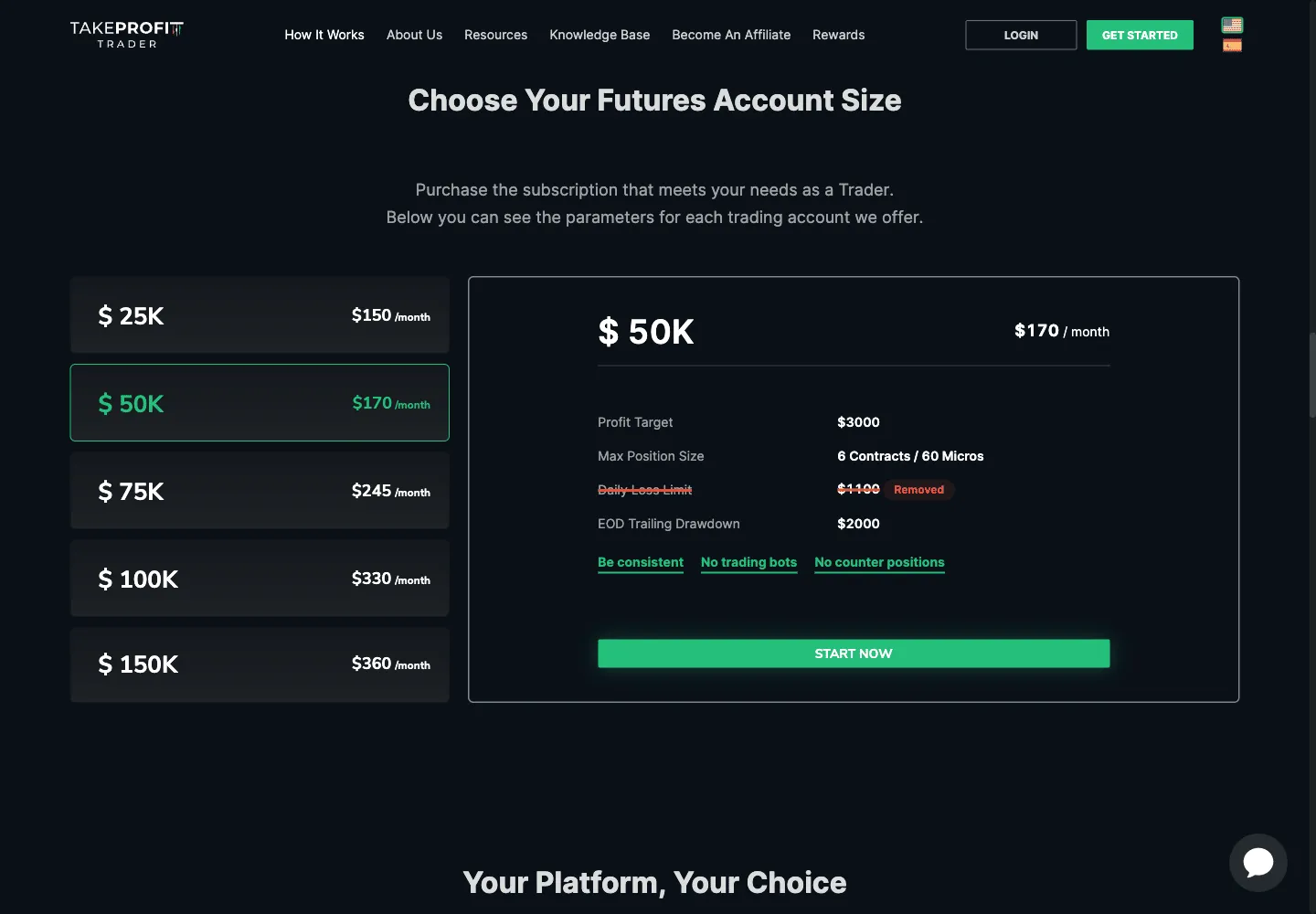 The five test account sizes on the Take Profit Trader website. Screenshot from July 7, 2026; prices and limits were unchanged on October 3, 2026. Click the image to enlarge it.
The three-day minimum is new. It applies to tests bought from August 17, 2026; older tests and their resets still need five days, according to the consistency rule. The position limit is 3, 6, 9, 12 or 15 contracts by account size, or ten times as many micro contracts, so 60 micros on the $50,000 account. The firm has removed the old daily loss limit; the screenshot shows it crossed out as “Removed”.
An end-of-day (EOD) trailing drawdown is a loss floor that is moved up only at the close, to follow your highest end-of-day balance. Your balance, including open losses, must stay above that floor at every moment of the trading day.
This is less restrictive than an intraday trailing drawdown when open profits reverse. A strong day with large open profits does not pull the floor up while the trade is running. But if your balance touches the floor during the day, even through an open loss, the account is liquidated at once. Once the floor reaches your starting balance, it stops moving. On top of that comes the consistency rule, which is meant to filter out lucky streaks.
The consistency rule at Take Profit Trader requires that no single trading day makes up 50 percent or more of your total net profit in the test.
Breaking the 50 percent mark does not fail the test. Your profit target rises automatically until the ratio fits again. If your best day made $2,000, you need more than $4,000 in total. Also banned: trading bots, opposite positions in related products across your accounts (for example ES long and MES short) and overnight positions. The trading day ends at 5 p.m. ET, and at 4:55 p.m. ET the firm closes open positions automatically.
Costs: what Take Profit Trader really costs
The monthly fee is only the most visible part of the bill. To calculate the full cost, you need to know four items: subscription, activation, resets and commissions.
| Account | Monthly fee | Test reset |
|---|---|---|
| $25K | $150 | $79 |
| $50K | $170 | $99 |
| $75K | $245 | $139 |
| $100K | $330 | $169 |
| $150K | $360 | $199 |
Monthly fees from the takeprofittrader.com homepage, reset prices from the help center, both checked October 3, 2026.
When you pass the test, a one-time PRO activation fee of $130 is due. Promotions often waive it; on October 3, 2026, the homepage advertised the code NOFEE40 with 40 percent off the test for as long as it runs and no activation fee. Such promotions change often. A reset gives you a fresh test account after a rule break, but it does not move your renewal date.
Losing a funded PRO account is more expensive. If you want it back without taking the test again, a PRO reset costs between $449 and $1,499, depending on the account size, and you can do it up to three times per account. Commissions come on top: $4.50 per round trip and standard contract, $1.50 per micro contract, in the test and in the PRO account (commission rules). In PRO+ the broker’s prices apply.
A failed attempt on the $50,000 account followed by a reset costs about $270. That is one month of subscription and one optional reset. It is small compared with losing a real account, but it adds up if you take the test several times. Before you start, it helps to know how a setup performed over many trades; our guide to backtesting a trading strategy shows how to test one honestly. A backtest cannot show how the setup copes with this firm’s drawdown rules, though.
PRO and PRO+: how good are the payouts really?
After you pass, you get the funded account. This is where the day-one promise is tested, and the short answer is that the rules allow it, with two limits you need to know.
The PRO account is the funded account after the test. It runs in a simulated trading environment, and the trader keeps 80 percent of the profits.
Withdrawals are possible from the first trading day in PRO. You move profits from the account into a wallet, and from there to your bank: through Plaid for US bank accounts, or through PayPal or Wise. The firm charges no withdrawal fee above $250 and $50 for $250 or less; PayPal may deduct its own fees (withdrawal fees).
Fast processing is not the same as money on the same day. You can only request a withdrawal with no open positions or working orders, and the dashboard updates balances in the evening, around 8 to 9 p.m. ET. Since August 2026 the step from a Tradovate PRO account to the wallet is automated and takes seconds after a valid request; Rithmic PRO accounts, PRO+ and a few archived Tradovate accounts are still handled by hand. The payout from the wallet is reviewed within up to 12 business hours, and the bank may need another one to two business days, so same-day receipt is not guaranteed (Speed of Payouts update).
Limit one: the buffer zone
The buffer zone at Take Profit Trader equals the maximum drawdown of the account. Only when you have built this profit cushion can you withdraw profits at the full 80 percent split.
On the $50,000 account you first need a balance of $52,000. Profits inside the buffer are paid out only when you close the account, at 50 percent within the first 60 trading days and 80 percent after that (withdrawal rules). “Payout from day one” is therefore true only for traders who are profitable right away and get past the cushion.
Limit two: the drawdown switch in PRO
This limit matters more than the buffer. In the PRO account the drawdown switches from end-of-day to intraday trailing. Our guide to trailing drawdown at prop firms compares end-of-day and intraday trailing limits using the same closed trades.
An intraday trailing drawdown moves the loss limit up in real time with your highest account balance, and unrealized open profits count.
A winner that turns around still moves your limit. If a trade runs $1,000 into profit and then reverses, your loss limit has moved up by those $1,000 anyway. In my view this switch is the main trap for traders who keep their test strategy unchanged. The drawdown stops moving once it reaches your starting balance. If you know the switch, you can manage it, for example with earlier partial profits. If your balance reaches the loss floor, you lose the account; a paid PRO reset is one optional way to start again.
Two more rules can end a PRO or PRO+ account in one move. If a market hits its daily price limit while you hold a position, you lose the account; the current limits are on the CME Group price limits page. And in PRO and PRO+ you must be flat, with no working orders, from one minute before to one minute after an FOMC statement, the jobs report (NFP) and the CPI release (PRO rules, PRO+ rules). If you trade around Fed days, our guide to the Fed interest rate decision lists the meeting dates.
PRO+: the live stage
The PRO+ account is the live stage at Take Profit Trader: real orders through the broker Tradovate, a 90/10 split in the trader’s favor and an end-of-day drawdown.
The firm promotes successful PRO traders to PRO+ after an internal review, and there the buffer requirement disappears. The drawdown floor is again moved only at the close, but your balance, including open positions, must stay above it during the day, and you keep 90 percent of the profits. The catch is the transition: the firm alone decides when you move up. According to the firm, setup usually takes several days once all requirements are met; one trader reported waiting almost three weeks, while the old PRO account is on hold. If you trade several accounts, a trade copier is allowed between your own accounts; Tradesyncer is on the approved list.
When you move to PRO+, $5,000 of profit stays frozen in the PRO account. The PRO+ account starts at $0 with the same drawdown as your PRO account, and from then on you count as a professional market data user. If you lose the PRO+ account with a negative balance, that amount is deducted from the frozen $5,000, and only the rest can be withdrawn under the PRO split (upgrade rules). Traders whose risk the firm sees as too aggressive can be placed in a PRO+ Development account with fewer contracts, a smaller drawdown and a daily loss limit that pauses you instead of failing you.
Take Profit Trader reviews: Trustpilot, Reddit and trader reports
On Trustpilot the firm scores 4.4 of 5 from 10,787 reviews. That was on October 3, 2026; 80 percent of the reviews give five stars and 12 percent give one star. The profile is claimed by the firm and runs on a paid Trustpilot subscription. Customers praise the live support strikingly often, and many reviews mention fast payouts (Trustpilot profile).
Detailed reports say more than star averages. In July 2026 one trader documented his first six weeks on Reddit with numbers he reported himself: $360 in fees for two attempts at the $150,000 account, $8,500 in trading profit and $4,198.88 paid out after the split. We could not verify these figures. He rated the payout speed as solid and the live chat as fast; his main criticism was that the PRO+ upgrade took almost three weeks in his case.
There are also harsh posts. In one of the most visible Reddit threads in US search results, titled “How TPT robbed us”, the authors describe a dispute over an additional PRO account they say was created in error, and compensation they say was refused. These are unverified allegations, and we cannot check individual cases. Separately, the firm’s rulebook names the grounds on which it closes accounts and keeps profits, such as counter positions across accounts, coordinated trading with other people and its Sustainable Trading Policy; read them before you trade.
The firm publishes its own pass rates. Between January and August 2023, 20.37 percent of registered users had passed a test, and of all trading tests in 2025, 36.22 percent were passed, according to the notes on the homepage. The firm says its payouts come from a combination of test fees, tech fees and shared PRO+ profits where applicable. The pass rate says nothing about how many individual customers failed or about the firm’s finances.
Is Take Profit Trader legit?
The most important point first: Take Profit Trader is not a broker, and your test account is not a deposit account. You buy a service, the test with its data feed, not an investment. Take Profit Trader says it is not a broker and does not need NFA or CFTC registration for its funding program. This is the firm’s statement, not regulatory approval; whether registration is needed depends on the activity, as the NFA explains. Using a regulated broker does not give the evaluation service the protections of a customer brokerage account. PRO accounts run in a simulated environment; only in PRO+ do orders go to the market through Tradovate.
Several checkable facts speak for the firm. It has a fixed company address in Windermere, Florida, a founder with a traceable history, a detailed and public rulebook in its help center, and a high Trustpilot score over a very large number of reviews. Claims such as “best payout policy” and the media logos on the homepage come from the firm itself and are advertising.
Three points deserve to be taken seriously. First, the firm enforces CME compliance strictly: accessing an account from a restricted country, even through a VPN or a remote connection, can get it blocked at once. The United States is not on the list, but several EU countries are, among them Bulgaria, Croatia, Malta, Romania and Slovenia (restricted countries). Second, PRO and PRO+ accounts require activity: at least one trading day per calendar week, or the account lapses. Third, the Sustainable Trading Policy lets the firm end the relationship without notice if you mostly trade maximum size at fixed moments such as the open or major data, or exploit simulated fills.
Payouts are taxable income. Take Profit Trader is a US company, asks for a tax form before the first withdrawal and sends a summary of your earnings after each year (taxes on withdrawals). How you report it depends on your situation, so ask a tax professional.
Pros and cons of Take Profit Trader
The rulebook, the costs and the trader reports add up to a clear profile. Here are the main strengths and weaknesses in brief.
Pros
- Fast payouts: withdrawals from day one above the buffer, the account-to-wallet step in seconds for Tradovate PRO accounts, no fee from the firm over $250.
- Fair test: one stage, no time limit, no daily loss limit, end-of-day drawdown, and a consistency rule that raises the target instead of failing you.
- Public rulebook: rules, fees and reset prices are published in the help center.
- Strong support: live chat with fast answers, praised in many Trustpilot reviews and trader reports.
- Platform choice: 14 platforms with a CQG or Rithmic data feed, from NinjaTrader and Tradovate to TradingView.
Cons
- Drawdown switch in PRO: the end-of-day drawdown of the test becomes intraday trailing. In my view this is the most critical point of the model.
- Buffer rule limits day one: the full 80/20 split starts only above a cushion the size of the maximum drawdown.
- Expensive PRO resets: $449 to $1,499 if the funded account fails and you do not want to retake the test.
- US futures only, no news trading in PRO and PRO+: no stocks, spot forex or crypto, no overnight positions, and flat around FOMC, NFP and CPI.
- PRO+ upgrade at the firm’s discretion: the timing is up to the firm, one trader reported almost three weeks, and $5,000 stays frozen in PRO and can absorb live losses.
Alternatives to Take Profit Trader
Take Profit Trader competes in a crowded market. The names that come up most often in US comparisons are Topstep, Apex Trader Funding, My Funded Futures and Tradeify. Of these, our Topstep review covers Topstep; the others we have not reviewed yet. A firm without a monthly subscription is Bulenox, which charges a one-time fee; our Bulenox review explains its three account types. Our IQ Capital review looks at a firm that offers futures alongside crypto and CFDs, and our prop trading page also covers The Trading Pit. For crypto traders, our Bitfunded review looks at a prop firm that sells tests on coin pairs.
The key questions are the same for every firm. Which drawdown calculation applies in the funded account, and when can you get to your money? If you compare these two points instead of discount codes, you make the better choice.
Our verdict on Take Profit Trader
After going through the rulebook, the costs and the trader reports, I see Take Profit Trader as one of the more transparent futures prop firms. Its payout rules are clear and many reports describe fast payouts, the rulebook is unusually open, and the support has a good reputation in reviews. These are the points I check first with any prop firm.
My biggest criticism is the intraday trailing drawdown in the PRO account. Since I bought my first stocks in 1980, I have learned that rules which change in the middle of the game cost more than any fee. If you pass the test under a calm end-of-day drawdown and then trade the same strategy in the funded account, you suddenly trade under stricter conditions without noticing. Also be honest about the cost of the path: with a pass rate of about 36 percent per test in 2025, most attempts fail, and every attempt costs a monthly fee or a reset.
In short: Take Profit Trader suits experienced futures day traders who actively manage the drawdown switch in the PRO account. It is not a way to learn trading, and it does not fit traders who need overnight positions.
- Good fit for: disciplined day traders with a tested setup who want regular withdrawals and trade at least once a week.
- Not a fit for: beginners without a tested strategy, swing traders with overnight positions, news traders, and anyone looking for “fast money”.
Trading futures carries a high risk of loss. This review describes the firm’s rules and costs; it is not investment advice and not a recommendation to buy a test.
Frequently asked questions about Take Profit Trader
Is Take Profit Trader legit?
The facts we could check point to a legitimate firm. It has a company address in Florida, a founder who appears in public, a public rulebook and a Trustpilot score of 4.4 of 5 from about 10,800 reviews. It is not a regulated broker, though: it sells a test with simulated accounts.
Does Take Profit Trader pay out?
Yes, payouts are possible from the first day in the funded PRO account once the buffer is built. The buffer equals the maximum drawdown. For Tradovate PRO accounts the step into the wallet takes seconds after a valid request; the payout from the wallet is reviewed within up to 12 business hours, and your bank may take longer. The firm charges no fee above $250 and $50 for withdrawals of $250 or less; PayPal may charge additional fees.
How much does Take Profit Trader cost per month?
The test account costs $150 to $360 a month, depending on its size. On top come a one-time $130 PRO activation fee, test resets of $79 to $199 and commissions of $4.50 per standard and $1.50 per micro contract. A reset of the funded PRO account costs $449 to $1,499.
What is the difference between PRO and PRO+?
PRO is simulated and pays 80 percent of profits under an intraday trailing drawdown. PRO+ sends orders through Tradovate to the real market, pays 90 percent and moves the drawdown floor only at the close; your balance must still stay above it during the day. The firm decides when you move up, and $5,000 of PRO profit stays frozen while PRO+ is active and can absorb live losses.
How many accounts can I trade at the same time?
Test accounts have no limit. You can trade as many as you like in parallel. Funded accounts are limited to five active PRO and PRO+ accounts combined, and you can activate at most ten passed tests within 30 days.
Which countries are restricted at Take Profit Trader?
The United States is not restricted, but more than 100 countries and territories are. The list includes Russia, Turkey, South Africa, the Philippines and several EU countries such as Romania and Croatia. Accessing your account from a restricted country, even through a VPN, can get it blocked, so check the current list before you travel.
This US edition is based on our German edition on kagels-trading.de and has been adapted for US readers.
More Prop Trading guides
- Understand the drawdown rules
Trailing Drawdown at Prop Firms: The Math, With Real Trades
Static, end-of-day and intraday trailing limits, risk per trade and pass rates, tested with 61 real trades.
- Check Bulenox
Bulenox Review 2026: Rules, Costs and Payouts
Three account types for a one-time fee, drawdown options, payout rules and the open questions about the company.
- Check Bitfunded
Bitfunded Review 2026: Rules, Costs and Payouts
A crypto prop firm: four account types, loss limits with open positions, payout review and what the competition prize pool is made of.
- Check IQ Capital
IQ Capital Review 2026: Costs, Rules and Payouts
Crypto, CFD and futures accounts from $9, the strict per-trade loss limit, payout caps and the company in Saint Lucia.
- Check Topstep
Topstep Review 2026: Rules, Costs and Payouts
Three stages, two of them simulated: the monthly fee per attempt, the trailing loss limit and why the timing of the first payout matters.