
Options Trading With a Small Account: Capital, Risks, Limits


Contents
- Options trading with a small account in 30 seconds
- What counts as a small options account?
- US rules that matter for a small options account
- Four limits your account sets
- Contract size and multiplier: why “100” does not apply everywhere
- Five option positions compared by capital
- Two sample accounts: $2,000 and $5,000 worked through
- Spread example: credit spread and debit spread side by side
- Assignment, expiry and pin risk: what the spread limit does not cover
- Why costs hit small accounts harder
- Pros and cons of starting with a small account
- Checklist: when to skip the trade
- Trading from outside the US: EU and UK notes
- Conclusion: calculate the account first, then choose the strategy
- Frequently asked questions about options trading with a small account
- Sources
- About the author
One standard option contract on a $50 stock stands for $5,000 worth of shares. With a $2,000 account, you hit a limit on your first trade that no strategy list mentions. The real question is not which strategy is best. It is which position your account can actually carry.
This guide works through two sample accounts with $2,000 and $5,000. For five common positions you see the capital tied up, the maximum loss and the points where assignment, fees and margin overtake the theory. It also shows the result few providers mention: no trade.
Risk warning: options carry a high level of risk and are not suitable for all investors. This guide is education, not investment advice. All option prices in the examples are hypothetical assumptions, not market data.
Options trading with a small account in 30 seconds
- One contract, 100 shares: A standard option on a US stock or ETF usually covers 100 shares. At a stock price of $50, one contract stands for $5,000 of stock.
- Margin is not a loss limit: The margin requirement says how much money is tied up, not how much you can lose. An uncovered put on that stock needs about $880 under the FINRA minimum formula and can lose more than $4,700.
- Spreads fit the loss budget, not automatically daily life: With 2% risk per trade, two spreads with a $1 strike width fit the budget of a $5,000 account in our example chain. An early assignment can still demand $4,800 for the shares, and a plan to close early does not reliably prevent that.
- The payoff is limited, not every cash need: A complete spread has a fixed maximum loss. Cash needed after an assignment, costs of closing and an unprotected leg after the other one expires are separate risks.
- Costs weigh more: On a spread with a $25 premium, opening and closing cost $4 in the model fee schedule, which is 16% of the premium.
- No trade is a result: If no position fits both the budget and the reserve, waiting is the right decision, not a missed chance.
What counts as a small options account?
In this guide, a small options account holds $2,000 to $5,000, so that a single standard contract moves more stock value than the account itself holds.
There is no official threshold for “small”. Neither the options exchanges nor the Options Clearing Corporation (OCC) set a minimum account size for options. Your broker must approve the account for options before you trade, as FINRA Rule 2360 requires, and it can set its own hurdles. The range of $2,000 to $5,000 is therefore our assumption for the examples, not a broker limit.
The examples run in US dollars, because US options are settled in dollars. If your account is held in euros or pounds, currency conversion costs and exchange-rate moves come on top, while the option itself gains or loses in dollars.
US rules that matter for a small options account
Five rules decide what a small US account can do before any strategy question comes up. They concern approval, the margin account, spreads, day trading and settlement. All were checked on November 17, 2026.
- Options approval: Your broker approves a specific level of options trading. Spreads usually sit one level above buying calls and puts, and uncovered selling at the top. Our beginners’ guide shows Fidelity’s tiers as an example.
- $2,000 for a margin account: FINRA Rule 4210(b) requires equity of at least $2,000 in a margin account. Account A in this guide sits exactly at that line, so a single loss can push it below the minimum.
- Spreads and the account type: Under FINRA Rule 4210, spreads on stocks and ETFs need a margin account; in a cash account, only spreads on European-style, cash-settled index options such as XSP are allowed, and they must be paid in full. Brokers add their own minimums: Fidelity requires a margin agreement and $10,000 of equity for spreads in non-retirement accounts. At such a broker, neither sample account in this guide can trade a spread.
- Pattern day trader rule replaced: With Regulatory Notice 26-10, FINRA replaced the pattern day trader rule and its $25,000 minimum with intraday margin requirements, effective June 4, 2026. Firms may phase them in until October 20, 2027, and FINRA says a firm might keep the old day trading rules during that transition. The new rules apply to options in margin accounts, not to cash accounts.
- Settlement: Option trades settle on the next business day (T+1), and in a cash account options must be paid in full. If you buy using unsettled sale proceeds and sell the new position before those proceeds settle, you can incur a good faith violation, as Fidelity explains.
Four limits your account sets
An options account has not one limit, but four. If you only look at the cash balance, you miss the other three. In practice, the tightest limit applies.
- Available cash: The money that is really in the account. A cash-secured put, a sold put fully covered by cash, needs the full purchase price of 100 shares in cash.
- Buying power and margin: In a margin account, the broker calculates a requirement. It can be far below the risk, and the broker can raise it at any time.
- Actual position risk: The amount you lose in the bad case, fees included. The examples use a risk budget of 2% of the account per position.
- Cash reserve: Free money for assignments, margin calls and new chances. In the examples, at least half of the account stays free.
Margin is the collateral a broker holds against an open position. It is not a loss limit.
The uncovered put shows the difference. For a sold put with a 48 strike on a $50 stock, the minimum formula for listed equity options in FINRA Rule 4210 is the premium plus 20% of the stock value, minus the amount by which the option is out of the money. In our example that is $880, and your broker may ask for more. If the stock falls to zero, the loss is still $4,721. Our guide to the margin call explains what happens when the collateral is no longer enough.
Contract size and multiplier: why “100” does not apply everywhere
The multiplier decides how much money stands behind an option price. A quote of 0.45 in the option chain means $45 per contract for standard options, because the price is multiplied by 100. The OCC’s disclosure document, Characteristics and Risks of Standardized Options (June 2024), names 100 shares as the unit of trading for most stock options.
The multiplier of an option is the factor that turns the quoted price into the dollar amount per contract. For standard options on US stocks and ETFs, it is 100.
In this guide, SPY is the named example instrument. Options on the SPDR S&P 500 ETF Trust (SPY) follow the standard form: according to Cboe’s equity options specifications they usually cover 100 shares, are American-style, so they can be exercised on any business day until expiry, and are physically settled, so real ETF shares change hands on exercise. SPY closed at $739.95 on November 16, 2026, so one contract stands for about $74,000 of shares. A cash-secured put on SPY is out of reach for both sample accounts.
Three exceptions to the standard size are worth knowing.
- Adjusted contracts: After stock splits, mergers or special dividends, the OCC adjusts open contracts. One contract may then deliver 150 shares, or shares plus cash. Check the contract details at your broker.
- Cash-settled index options: Mini-SPX options (XSP) on one tenth of the S&P 500 also have a multiplier of 100, according to Cboe’s specifications, but they are European-style, so they can only be exercised at expiry, and they settle in cash. According to Cboe, XSP strikes are usually $1 or more apart up to a strike of 200 and $5 or more above it, and weekly series may use $0.50. How wide a spread can be, and what it costs, depends on the specific series.
- Other exchanges: Options on European exchanges such as Eurex follow their own contract specifications. The US figure of 100 does not carry over.
For a small account, the exercise style is more than a detail. With American-style options and physical delivery, a sold put can turn into a stock purchase overnight. With European-style, cash-settled options, that risk does not exist before expiry. At expiry, the cash settlement amount is due instead of a block of shares.
Five option positions compared by capital
The three tables below compare five common positions on the same sample stock. The basis is a hypothetical stock XYZ at $50, standard contracts with a multiplier of 100 and 30 days to expiry. The option prices are assumed mid prices, not market data.
Fees follow a model schedule based on the Interactive Brokers price list. Interactive Brokers lists $0.65 per contract for US stock and ETF options with premiums of $0.10 or more, a $1.00 minimum per order, applied to each leg of a combination order, and no commission on exercise or assignment (price list checked November 17, 2026). Exchange, clearing and regulatory fees come on top and are not included in the model. A spread with one contract per leg thus costs $2.00 to open. Stock orders are assumed at $1.00. Regulatory fees are not included.
Setup and opening fees:
| Position (1 contract) | Setup | Opening fees |
|---|---|---|
| Long call | Buy the 53 call at 0.70 | $1.00 |
| Debit spread (bull call) | Buy the 50 call at 1.80, sell the 51 call at 1.35 | $2.00 |
| Credit spread (bull put) | Sell the 48 put at 0.80, buy the 47 put at 0.55 | $2.00 |
| Cash-secured put | Sell the 48 put at 0.80, $4,800 cash as cover (premium counted) | $1.00 |
| Covered call | Buy 100 shares at $50, sell the 53 call at 0.70 | $2.00 |
Capital tied up and maximum loss:
| Position | Capital tied up | Maximum loss |
|---|---|---|
| Long call | $71.00 | $71.00 |
| Debit spread (bull call) | $47.00 | $47.00 |
| Credit spread (bull put) | $77.00 | $77.00 |
| Cash-secured put | $4,721.00 | $4,721.00 (stock at zero) |
| Covered call | $4,932.00 | $4,932.00 (stock at zero) |
Exercise and assignment risk:
| Position | Exercise and assignment risk |
|---|---|
| Long call | None before expiry; in the money at expiry, automatic exercise means buying stock for $5,300 |
| Debit spread (bull call) | The short 51 call can be assigned early, especially before an ex-dividend date: then you are short 100 shares |
| Credit spread (bull put) | The short 48 put can be assigned early: you must buy shares for $4,800 |
| Cash-secured put | Assignment possible at any time, then 100 shares at $48 |
| Covered call | Assignment possible at any time, the shares are sold at $53 |
The column “capital tied up” is not the same as “maximum loss”, even when the numbers match here. For the credit spread, the margin rule limits the requirement to the strike width of $100. If the broker counts the $25 premium received, $77.00 stays tied up. Whether and how it does that is the broker’s own choice.
In the covered call, almost all of the capital sits in the stock. The theoretical maximum loss is a total loss of the stock, a rare case, but not an impossible one. The tables are not a ranking. There is no safest strategy, only positions that fit an account or do not.
With SPY, the same tables would look very different. A covered call needs 100 SPY shares, and a cash-secured put needs the full strike value in cash. Our options strategies guide explains spreads, covered calls and cash-secured puts in detail, with payoff diagrams.
Uncovered short options: not a way to more room
An uncovered short put ties up only a fraction of the capital a cash-secured put needs. In our example it is $880 of minimum margin instead of $4,800 of cash. The risk of loss stays the same: up to $4,721 if the stock falls to zero.
With an uncovered call, the loss has no upper limit. The OCC calls the potential loss of an uncovered call unlimited and the risk of writing puts substantial. It also notes that the broker may close such positions with little or no notice.
For a small account, the low margin is therefore not an advantage. It is the reason why one bad day can wipe out the account. Brokers usually also allow uncovered selling only at the highest approval level.
Two sample accounts: $2,000 and $5,000 worked through
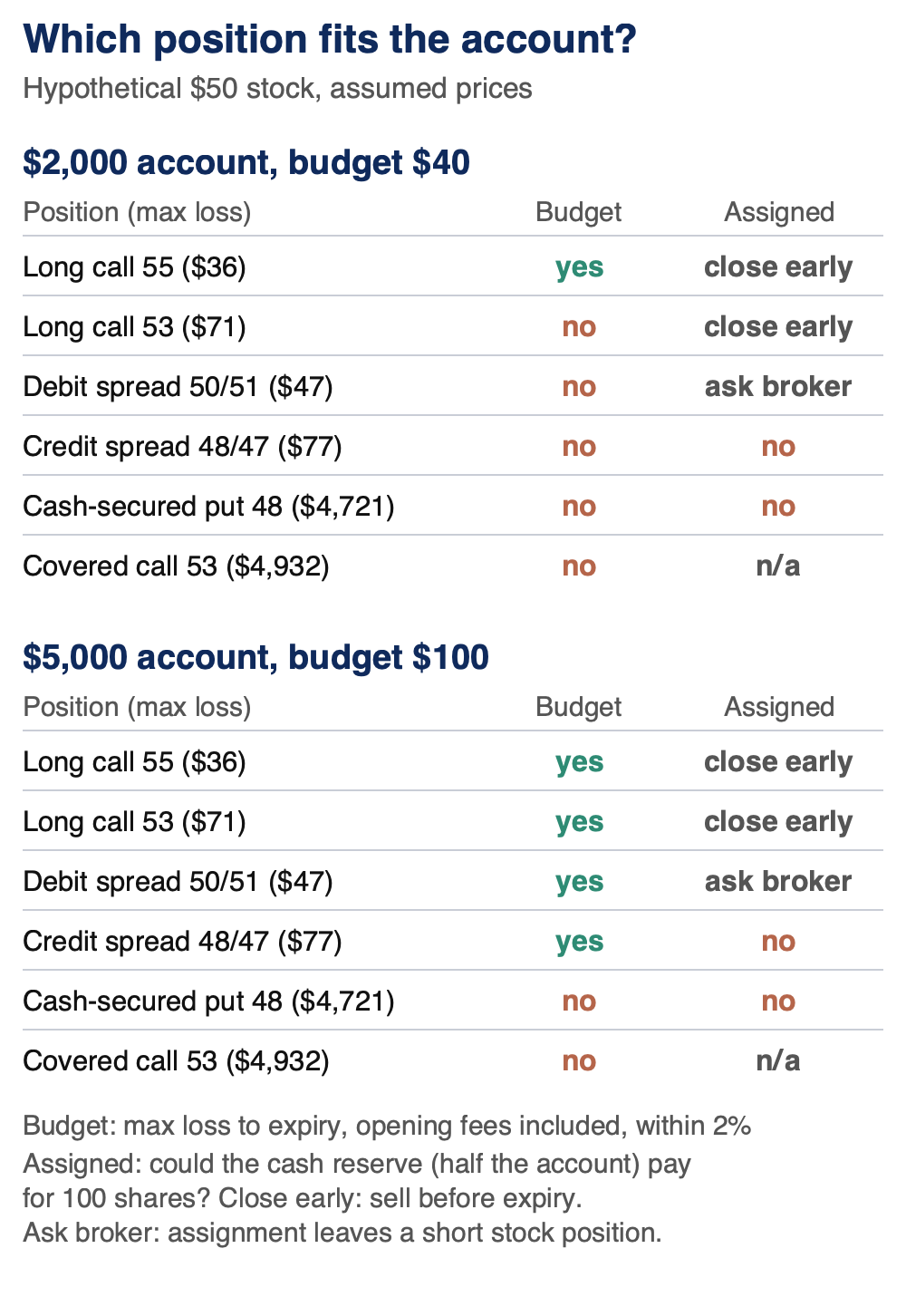
Both accounts use the same two checks. The first asks whether the maximum loss including opening fees is at most 2% of the account, counted from opening to expiry. The budget is therefore $40 for account A and $100 for account B.
Closing before expiry adds fees in the model. That is $2 per spread and $1 per single option, so the spreads come to $49 and $79, and the long 55 call to $37. The results in the tables do not change, before the bid-ask spread and third-party costs.
The second, stricter check asks whether an exercise or assignment could be paid from the reserve. That reserve is at most half of the account. Our guide to position sizing shows how to derive a position size in general.
 Click to enlarge
Source: Kagels Trading, own graphic.
Account A with $2,000:
| Position (max loss to expiry) | Loss budget $40 | Assignment from reserve ($1,000) |
|---|---|---|
| Long call 53 ($71.00) | no | only by closing before expiry |
| Long call 55 ($36.00) | yes | only by closing before expiry |
| Debit spread 50/51 ($47.00) | no | depends on the broker (short shares) |
| Credit spread 48/47 ($77.00) | no | no: $4,800 is more than the account |
| Cash-secured put 48 ($4,721.00) | no | no |
| Covered call 53 ($4,932.00) | no | not applicable (shares held) |
| Uncovered short put 48 ($4,721.00) | no | no |
Account B with $5,000:
| Position (max loss to expiry) | Loss budget $100 | Assignment from reserve ($2,500) |
|---|---|---|
| Long call 53 ($71.00) | yes | only by closing before expiry |
| Long call 55 ($36.00) | yes | only by closing before expiry |
| Debit spread 50/51 ($47.00) | yes | depends on the broker (short shares) |
| Credit spread 48/47 ($77.00) | yes | no: $4,800 is more than the reserve |
| Cash-secured put 48 ($4,721.00) | no | no |
| Covered call 53 ($4,932.00) | no | not applicable (shares held) |
| Uncovered short put 48 ($4,721.00) | no | no |
The two checks separate “fits the loss budget” from “can be traded in daily life”. A position can pass the first and fail the second. A closing plan then helps only so far: you close before an assignment becomes more likely, usually before an ex-dividend date and before expiry if the sold option is in the money.
A closing plan lowers the risk, but it does not remove it. According to the Options Industry Council (OIC), American-style short options can be assigned on any business day, and a planned buy-back then comes too late.
A position like this becomes tradable only once you know your broker’s rule for an unexpected assignment. That means whether it grants a margin loan, allows a short stock position or closes the position at once. Without that answer, the question stays open for the account.
Account A with $2,000: almost everything fails
In the smaller account, only one position in our example chain passes the budget check, and it is the weakest. The long 55 call costs $36.00 including the minimum fee and so stays just under the budget. The stock would have to rise more than 10% in 30 days for the call to be worth anything at expiry.
Fitting the budget is no argument for the trade. A cheap call is usually cheap because it will probably expire worthless. A position that only exists because it is small is not a trading idea.
Account A has three honest ways forward. You can raise the risk budget on purpose: the debit spread at $47.00 fits a 2% budget from an account of $2,350, counted from opening to expiry. If you close early, $2 more raises the threshold to $2,450, so account A needs about 2.4% to 2.5% risk, and the account then shrinks faster in a losing streak.
The other two ways are a cheaper underlying or no trade at all. Stocks with lower prices and narrower strike intervals allow smaller spreads. Or you do not trade yet and keep adding to the account. All three are defensible, as long as the decision is deliberate.
Account B with $5,000: spreads fit the budget, assignment stays open
In the larger account, both spreads and both long calls pass the budget check. The credit spread uses $77 of the $100 budget, or $79 with the closing fee. That leaves only a little over $20 for a second position if the budget applies to all open trades. More is possible per position, but then the total risk of the account grows.
Neither spread passes the stricter check without a reservation. An early assignment of the short 48 put demands $4,800. The account could pay it, but the reserve would be gone.
With the debit spread, an assignment of the short call would briefly create a short stock position. The OIC describes that exercising the long call closes this position only on the following business day. What collateral the broker requires for it, and whether it closes the position itself, depends on the broker.
A closing plan before the ex-dividend date and expiry lowers this risk, but does not exclude it. Whether spreads with physical delivery are tradable in account B therefore depends on your broker’s assignment rule and stays open in this calculation. Cash-settled XSP spreads avoid that question, but cost what the specific series costs.
The cash-secured put fails both checks in account B. Its maximum loss is far above the budget, and $4,800 of cover would tie up 96% of the account. An assignment would turn the account into a single stock position.
No general minimum account size follows from these numbers. It depends on the price of the underlying and the strike width. With a $50 stock and $1 strikes, about $2,350 is the lower edge for the first spread at 2% risk. A pricier stock or wider strikes need their own calculation, because premiums change and fixed fees do not scale with the price.
Spread example: credit spread and debit spread side by side
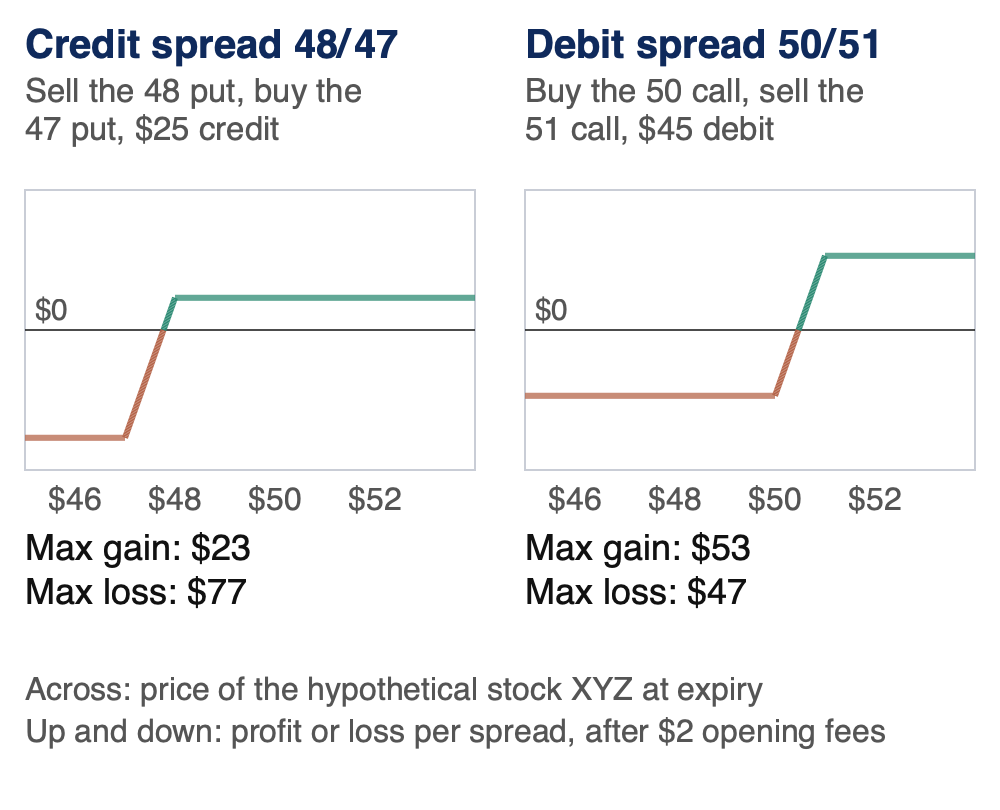
Both spreads use the same stock, the same expiry, the same multiplier and one contract each. The strike width is $1 for both, so $100 per contract. The difference lies in the direction of the cash flow: with the credit spread you receive money when you open, with the debit spread you pay.
A credit spread combines a sold and a bought option of the same type and expiry, for which you receive a net premium. A debit spread is the same construction with a net payment.
| Figure (1 contract) | Credit spread 48/47 | Debit spread 50/51 |
|---|---|---|
| Setup | Sell the 48 put at 0.80, buy the 47 put at 0.55 | Buy the 50 call at 1.80, sell the 51 call at 1.35 |
| Net premium | 0.25 received = $25.00 | 0.45 paid = $45.00 |
| Strike width | 1.00 = $100.00 | 1.00 = $100.00 |
| Opening fees (2 legs × $1.00) | $2.00 | $2.00 |
| Best case at expiry | $25.00 − $2.00 = $23.00 (XYZ at $48 or higher) | $100.00 − $45.00 − $2.00 = $53.00 (XYZ at $51 or higher) |
| Worst case at expiry | $100.00 − $25.00 + $2.00 = $77.00 loss (XYZ at $47 or lower) | $45.00 + $2.00 = $47.00 loss (XYZ at $50 or lower) |
| Break-even at expiry (before fees) | $47.75 | $50.45 |
| Tied up at opening | $77.00 | $47.00 |
 Click to enlarge
Source: Kagels Trading, own diagram.
The expiry values apply to the complete spread, if both legs stay together until expiry and expire or are exercised cleanly. If you close earlier, another $2.00 of fees in the model and the bid-ask spread come on top. In the model, the worst case of the credit spread is then $79.00 instead of $77.00, before the spread and third-party costs.
Between opening and expiry, the market reprices the spread all the time. Suppose XYZ falls to $47 after ten days and implied volatility rises to 40%. The credit spread is then worth about 0.55 in the model.
Closing at that price turns a $25 credit into a realized loss of $34. The price loss is $30, and $2.00 to open plus $2.00 to close bring the realized result to −$34. If you hold until expiry and XYZ stays below $47, $77 are gone. The interim value and the payoff at expiry are two different numbers, and both belong in the plan.
Assignment, expiry and pin risk: what the spread limit does not cover
The payoff of a spread is limited as long as both legs stay together. Three other risks sit next to it: the cash needed after an assignment, the execution when closing, and an unprotected leg if the protective option expires or is closed while the other side stays open. The OCC’s disclosure document points out the higher risk when one side of a combination is exercised or closed while the other remains open.
Assignment is the obligation of an option seller to deliver or buy shares after a buyer exercises. The OCC assigns exercises at random to its clearing members, and brokers then allocate them to their customers.
- Early assignment of a put: If the short 48 put of the credit spread is assigned before expiry, you must buy 100 shares for $4,800. Account B can pay that but loses its reserve. Account A cannot. The long 47 put still protects against lower prices until it expires or is sold, but it does not pay for the shares.
- Dividend and short call: If a sold call is deep in the money and an ex-dividend date is near, exercise becomes more likely. According to the OIC’s assignment FAQ, the risk rises just before the ex-date for short calls and just after it for short puts. In the 50/51 debit spread, that would hit the short 51 call, and you would have to deliver 100 shares you do not own.
- Pin risk on expiry day: If the stock closes right at the strike of the sold option, it is unclear until after the close whether you will be assigned. You often learn it only on the next trading day, with a stock position that has no protection, because the bought option expired worthless. Brokers set their own deadlines, as the OIC stresses in a webinar summary on pin risk.
- Automatic exercise: At expiry, the OCC exercises equity options that are at least $0.01 in the money, unless other instructions are given. A long 53 call that expires just in the money thus becomes a stock purchase for $5,300.
- Forced closing by the broker: If the cash is not enough after an assignment, the broker can close positions without asking. It does not have to do this at the best moment, or in time.
A stop-loss order changes little here. A stop on a spread is executed at the market price, which can be far from the stop level after a price gap or in thin trading. It guarantees neither the planned loss nor protection against an overnight assignment.
European-style, cash-settled index options such as XSP have no early assignment and no share delivery. The expiry risk in cash remains. Whether an XSP spread fits the budget depends on the net premium, the strike width and the costs of the specific series, not on the index level.
Why costs hit small accounts harder
Fees are fixed amounts, while premiums in small accounts are small amounts. On a spread with a $25 premium, opening and closing cost $4 in the model schedule, which is 16% of the premium. The same $4 on a spread with a $250 premium is only 1.6%.
- Fees per contract and per order: Many brokers charge a fee per contract, some with a minimum per order. In the model, the minimum applies to each leg, and a spread has two legs, an iron condor four. With $0.65 per contract and no minimum, as on Charles Schwab’s pricing page, opening and closing the same spread costs $2.60, or 10.4% of the $25 premium.
- Zero-commission brokers: Robinhood charges no commission on stock and ETF options, but lists a $0.04 per contract regulatory and OCC fee in its fee schedule. A low commission does not remove the bid-ask spread, which is often the larger cost.
- Bid-ask spread: If the bid-ask spread of an option is 0.05, buying at the ask instead of the mid costs $2.50 per leg. With two legs, that is up to $5 when opening and again when closing.
- Exercise and assignment: Some brokers charge their own fees for exercise and assignment. Then the fees for selling the shares come on top.
Count the costs into the risk before the trade, not afterwards. The examples above do this for opening. For closing and the bid-ask spread, plan your own buffer. What your broker actually charges is in its current fee schedule, not in this guide.
Pros and cons of starting with a small account
A small account is no obstacle to learning, but a hard limit on the choice of strategy. The two lists sum up what the calculation shows for the sample accounts.
Arguments for starting small
- Limited cost of learning: Mistakes cost fewer dollars, as long as you keep to the budget and the reserve.
- Spreads are possible: In our example chain, a debit spread with a $1 strike width fits a 2% budget from $2,350, a credit spread from $3,850. With closing fees, it is $2,450 and $3,950, before the bid-ask spread and third-party costs.
- Real execution: You learn order types, the bid-ask spread and assignment under real conditions, which no simulator replaces.
Arguments against starting small
- Hardly any choice: With $2,000, only one cheap call far out of the money passes the 2% check in our example chain.
- Costs weigh heavily: Fixed fees and the bid-ask spread eat a large part of small premiums.
- Assignment can break the account: A single early assignment demands more cash than the account holds, or the whole reserve.
- Concentration: Two positions on similar stocks already use the entire risk budget.
Checklist: when to skip the trade
Before every order, five questions help, and you should be able to answer each with yes.
- Maximum loss including fees within the budget? Add up premium, strike width, multiplier and all fees for opening and closing.
- Assignment affordable or avoidable? For every sold option with delivery, check whether the account could buy or deliver 100 shares at the strike. If not, ask your broker first what happens after an unexpected assignment. A plan to close early lowers the risk, but does not replace that answer.
- Reserve kept? After the trade, enough should stay free to absorb a margin call or an assignment. A trade that uses the reserve is too large.
- Not the same risk twice? Two spreads on correlated stocks, such as two chip stocks or SPY and a Nasdaq ETF, often move together. They count as one larger position in the budget.
- Dividend and expiry in view? An ex-dividend date during the trade, or a price close to the short strike shortly before expiry, are reasons to close earlier.
If one answer is no, skipping the trade is the better decision. Other reasons not to trade are a wide bid-ask spread, an underlying with only coarse strike intervals, or a week with earnings.
Paper trading is a useful step, but no substitute for the capital calculation. In a simulator, orders are often filled at the mid or at once, and early assignment rarely happens. Our guide to paper trading on TradingView explains its limits. The basics are in our guide to options trading for beginners.
Trading from outside the US: EU and UK notes
Readers in Europe face the same contract math, plus rules on what they may buy. Under the EU PRIIPs Regulation, a product sold to retail investors needs a key information document (KID). US ETF issuers usually do not publish one, so brokers such as Interactive Brokers block retail clients in the EU from buying SPY. Options on US ETFs are separate products: whether you can trade them depends on your broker and its documents, and so does what happens if an assignment would deliver the ETF.
In the UK, the rules for retail product documents are changing. The FCA has replaced PRIIPs with the Consumer Composite Investments regime. The transition began on April 6, 2026, and the new regime applies in full from June 8, 2027. In its policy statement PS25/20 (paragraph 2.8), the FCA says its new rules do not themselves stop US ETFs, but that overseas funds can only be marketed to UK retail investors as recognised schemes, and that no US funds were recognised schemes when it published the statement. Whether your broker offers a US ETF such as SPY is a question to check with the broker.
Currency adds a cost the examples leave out. If you change euros or pounds into dollars, your broker charges a fee or a mark-up on the rate. The amount is in the broker’s fee schedule, and the exchange rate can move during the trade.
Conclusion: calculate the account first, then choose the strategy
For small options accounts, the capital calculation decides, not the strategy list. In our example chain, with $5,000 and 2% risk per trade, two spreads with a $1 strike width fit the loss budget. Cash-secured puts and covered calls do not fit with a $50 stock.
Whether the spreads can be traded in daily life stays open. A single assignment can use up the reserve or create a short stock position, on any business day. A closing plan lowers this risk, but only your broker’s assignment rule gives the answer.
With $2,000, hardly any position is sensibly tradable in this calculation. If you still start there, choose a higher risk per trade on purpose, or keep saving first.
For both accounts, the limited payoff of a spread is not the cash it can need along the way. Margin is not a loss limit either. If you calculate this before the order, you will skip some trades, and that is exactly the point of the calculation.
Frequently asked questions about options trading with a small account
How much money do you need to trade options?
There is no fixed minimum, because the amount depends on the position. A bought call can cost less than $100. A cash-secured put on a $50 stock ties up about $4,800. In our example chain, a debit spread with a $1 strike width fits a 2% risk budget from an account of $2,350, a credit spread from $3,850, counted to expiry, or $2,450 and $3,950 with closing fees. Your broker may also set its own account minimums: Fidelity, for example, requires $10,000 of equity for spreads.
Can you trade options with $500 or $1,000?
Technically yes, but only in a very limited way. With $1,000, a 2% budget is $20, and even with $2,000 it is only $40. In our example chain, only a cheap call far out of the money fits, and it will probably expire worthless. Many traders first save more or practise in a simulator.
Do I still need $25,000 to day trade options?
Not under FINRA’s new rule, but check your broker. With Regulatory Notice 26-10, FINRA replaced the pattern day trader rule and its $25,000 minimum with intraday margin requirements on June 4, 2026. Firms may phase in the change until October 20, 2027 and may keep the old rule until then. The new rules cover options in margin accounts; a margin account itself still needs at least $2,000 of equity.
Which options strategy suits a small account?
Positions with defined risk, meaning debit spreads and credit spreads, fit best. For them, the maximum loss of the complete spread at expiry is known in advance. That does not make them safe: early assignment, fees and the bid-ask spread can change the cash needed and the result a lot.
Why is the margin on uncovered options so low?
Margin reflects only part of the risk; it is not a loss limit. For an uncovered put with a 48 strike on a $50 stock, the FINRA minimum formula gives about $880. If the stock falls to zero, the loss is more than $4,700.
What happens if only one leg of a spread is assigned?
Then you suddenly hold a stock position plus the remaining option. In the 48/47 credit spread, assignment of the short put means buying 100 shares for $4,800. The long put limits further losses while it runs, but it does not pay for the shares. If the cash is not enough, the broker can close positions.
What does a spread cost in fees?
In this guide’s model schedule, a two-leg spread costs $2.00 to open and another $2.00 to close. The model assumes $0.65 per contract with a $1.00 minimum per leg. The bid-ask spread, possible exercise or assignment fees and currency costs come on top. The real fees are in your broker’s fee schedule.
Sources
- OCC: Characteristics and Risks of Standardized Options, June 2024.
- Options Industry Council: Options assignment FAQ, September 2026 webinar key takeaways (pin risk).
- FINRA: Rule 2360, Rule 4210, Regulatory Notice 26-10, Intraday margin requirements, Understanding settlement cycles.
- Cboe: Equity options specifications, Mini-SPX (XSP) specifications.
- Brokers, checked November 17, 2026: Interactive Brokers options commissions, Charles Schwab pricing, Robinhood fee schedule, Fidelity margin FAQ, Fidelity on cash account trading violations.
- EU and UK: Interactive Brokers on PRIIPs and KIDs, FCA on PRIIPs and the CCI regime, FCA PS25/20.
- Market data: SPY daily close of November 16, 2026, Alpha Vantage consolidated daily data.
- Calculation: the hypothetical option chain and every figure in this guide are reproduced by our script, with Black-Scholes mid prices at 30% implied volatility, 4% interest and 30 days, rounded to $0.05.
This US edition is based on our German edition on kagels-trading.de and has been adapted for US readers.
More Options Trading guides
- Learn how options work
Options Trading for Beginners: How Calls and Puts Work
Calls, puts, strike, expiry and premium with a worked example, exercise and assignment, the main risks, US broker approval and a first path.
- Read gamma exposure
Gamma Exposure (GEX): How Dealer Hedging Can Move Prices
What GEX measures, the formula with a worked example, gamma flip, call wall and put wall, data sources with prices, and the limits of the model.
- Read options flow
Options Flow Explained: Sweeps, Blocks and Dark Pool Prints
The OPRA tape, premium, sweeps and blocks, volume against open interest, dark pool prints, a worked example, scanner prices, and what a print cannot tell you.
- Choose a strategy
Options Strategies: How to Choose, With Payoffs and Risks
19 strategies compared by market view, maximum gain, maximum loss and break-even, with worked examples, assignment risk and options approval.
- Check MenthorQ
MenthorQ Review 2026: Gamma Levels, Pricing, Catches
Gamma levels for stocks and CME futures, Premium and Pro prices with the real-time futures add-on checked on November 10, 2026, and the 20-minute delay in third-party platforms.
- Check SensaMarket
SensaMarket Review 2026: GEX, Options Flow, Pricing
An options terminal with GEX, flow, dark pool and Congress data: plans and prices checked 10 November 2026, broker link and refund rules.