
0DTE Options: How Same-Day Expiry Trading Works


Contents
0DTE options are options traded on the day they expire, so a position is won or lost within hours. That speed makes them attractive for short-term traders and dangerous at the same time. Near the close, small moves in the index can double or wipe out the price of an option near the money, because its gamma and time decay are highest then.
This guide explains how 0DTE options work and what matters when you trade them. You will see which products exist, how cash settlement differs from ETF options, which strategies fit which market, and how to keep the position size small enough to survive bad days. How we research and write is described on our editorial policy page.
This guide is educational information, not investment advice. Options involve substantial risk and are not suitable for every investor; you can lose your whole stake quickly. Read your broker’s options risk disclosure before you trade.
0DTE options in 30 seconds
- Meaning: 0DTE stands for “zero days to expiration”: an option traded on the day it expires. For the daily SPX options, the last trading day and the expiry day are the same.
- Main products: S&P 500 index options (SPX), the smaller XSP, and options on large index ETFs such as SPY and QQQ.
- Size of the market: according to Cboe, 0DTE made up 59% of SPX options volume in 2025.
- Risk: losses can be fast and total. Buyers can lose the whole premium; sellers of uncovered options can lose far more.
- Approach: defined-risk spreads, small size, and an exit plan set before the trade.
What are 0DTE options?
A 0DTE option is not a special product but an option on its expiration day. Cboe describes it this way: a 0DTE position is opened on the day the contract expires, “even though that specific option may have already been listed for days, weeks or months”. What changed is the number of expiration dates.
Index options once expired monthly, then weekly, and today the S&P 500 has expirations every trading day. Cboe lists A.M. and P.M., standard, weekly and daily expirations for SPX. That is why traders can open a position with less than a day to run on any trading day.
The trading is fast and the risk is high. As expiration approaches, Cboe warns, options near the money are “extremely sensitive” to moves in the index. If you are new to options, start with our options trading guide for beginners before you trade same-day expiry.
How strongly the market is expected to move shows in volatility. The VIX index measures the implied volatility of S&P 500 options over the next 30 days; when it is high, option premiums are higher too.
Why do traders use 0DTE options?
The outcome of a 0DTE trade is known the same day. Cboe names this as the first benefit: very short-term positions and hedges, with less capital than the same strikes in later expirations. A cash-settled index option that expires today carries no overnight gap risk; with ETF options, exercise or assignment can leave you with shares after expiry.
0DTE options are liquid, but the speed cuts both ways. Cboe points to high volumes and tight bid-ask spreads in SPX. The same short time that makes premiums low leaves almost no time to repair a wrong trade.
The share of 0DTE trading has grown fast. According to Cboe, 0DTE contracts made up 59% of SPX options volume in 2025. How the hedging of this volume can move the index is explained in our guide to gamma exposure.
Pros and cons of 0DTE options
These points speak for 0DTE options:
- Small capital per trade compared with later expirations.
- Defined risk with spreads: the maximum loss is known at entry.
- Cash settlement and European exercise for SPX and XSP: no early assignment, no shares delivered.
- No overnight risk in a cash-settled index option that expires the same day.
These points speak against them:
- Fast losses: the price of a bought option can drop to zero within hours.
- Gamma risk of options near the money rises sharply in the last hours of the session.
- Little room to repair or adjust a wrong position.
- Assignment risk with ETF and stock options, which are American style.
- Pressure that tempts traders into overtrading.
How can you trade 0DTE options?
You need a broker with access to US options exchanges and the right options approval. Brokers in the US grant options levels that decide which strategies you may trade; spreads usually need a higher level than buying calls and puts. Our tastytrade review and Interactive Brokers review describe two brokers that offer US index options.
Index options and ETF options behave differently at expiration. The table shows the main differences, based on Cboe’s SPX and XSP pages and the OCC page on ETF options, which describes a standard contract as 100 shares, American-style exercise and delivery of ETF shares.
| Feature | SPX and XSP | SPY, QQQ and other ETFs |
|---|---|---|
| Exercise | European, only at expiry | American, any time |
| Settlement | Cash | Shares |
| Size | Index x $100 (XSP index = 1/10 of SPX) | Standard contract: 100 shares |
Cash settlement removes the risk of being left with shares. Cboe says SPX positions “settle directly to cash at expiration without the need to deliver or receive unwanted shares”, and European exercise eliminates early assignment. With American-style ETF options, a short leg can be assigned early, and after expiry you may hold shares you did not plan for. Our guide to options strategies explains assignment step by step.
Check the series, because the last trading day is not always the expiry day. According to Cboe’s SPX specifications, trading in P.M.-settled SPXW options “will ordinarily cease on the day of expiration, 4:00 pm ET”, and they settle on the index value at the close. Standard A.M.-settled SPX options stop trading on the business day before expiry and settle on opening prices, so they cannot be traded as 0DTE on their expiry day.
XSP is the smaller way into S&P 500 options. The Mini-SPX index is one tenth of the S&P 500, and both contracts use a $100 multiplier, so one XSP contract has a tenth of the notional value of one SPX contract. A spread 5 points wide still means $500 in either product; what changes is that 5 XSP points cover a much larger share of the index. Cboe’s 0DTE page showed, when checked on November 19, 2026, that 48% of XSP volume traded as 0DTE, without naming the period.
Strategies for 0DTE options
Which strategy fits depends on what you expect the market to do today. Some days the S&P 500 barely moves, other days it runs in one direction. That split shapes the two main approaches: buying options for direction and selling defined-risk spreads for a range.
Directional trades: buying calls or puts
If you expect a clear move, you can buy a call for rising prices or a put for falling prices. The loss is limited to the premium you pay. But the premium shrinks fast if the move does not come, and on expiry day there is no time left to wait. Cboe names buying calls or puts to trade around market events as a common use.
Selling defined-risk spreads
The most popular 0DTE strategies according to Cboe are selling call or put spreads and iron condors. A credit spread earns the premium if the index stays on the right side of the short strike; an iron condor combines a call spread and a put spread to profit from a range.
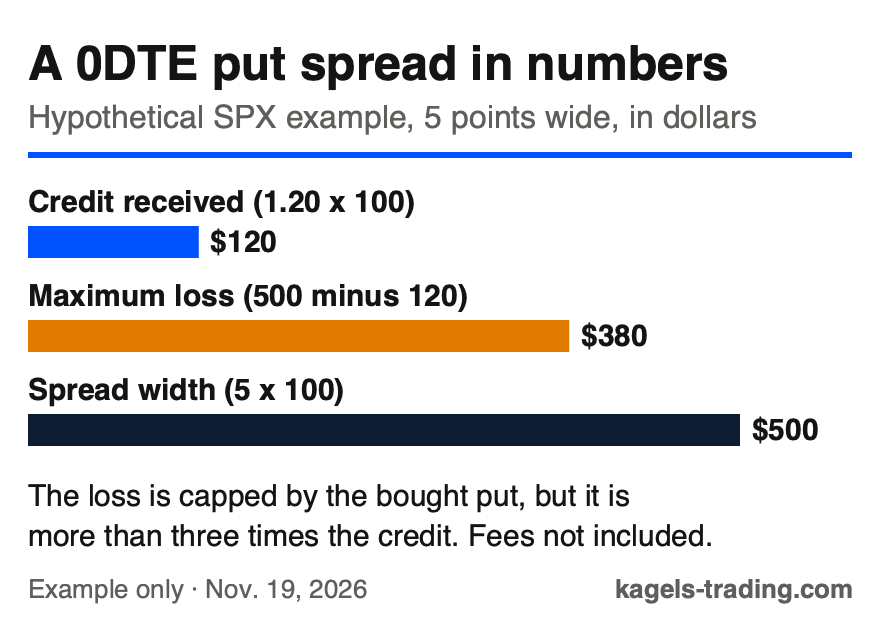 Click to enlarge
Source: Kagels Trading, own example based on the SPX contract multiplier.
A worked example shows why the risk must be defined. Suppose you sell a 0DTE SPX put spread 5 points wide for a credit of 1.20. You receive $120 (1.20 x $100). The bought put caps the loss at the width minus the credit: $500 minus $120 = $380, before fees. If the index falls through both strikes, you lose more than three times what you could earn.
Selling uncovered options on expiry day is the riskiest choice. The premium is small, the possible loss is large, and there is no repair once the index moves fast. Christian Möhrer, the author of this guide, advises explicitly against naked short options and trades 0DTE mainly with risk-defined positions.
Butterflies and iron condors need an exit plan. Because the gamma of options near the money rises in the last part of the session, some traders take profits early or close before the final hour; whether that helps depends on the premium, the timing and the fill. Decide your profit target and maximum loss before you open the position, not while the price moves.
How to limit the risk
Position size is the most important risk control. Size each trade so that the maximum loss of the spread is a small part of your account. A defined-risk spread tells you that loss at entry; a bought option tells you the premium you can lose.
Defined risk holds at expiry, not on the way there. If you close a spread early in a fast market, the fill can be worse than the theoretical value. With American-style ETF options, an early assignment of the short leg can break the spread apart. Cash-settled SPX and XSP avoid that second problem.
Use the market’s own estimate of the range. The expected move, derived from option prices, shows the range the market prices in for the day. Whether bought options or credit spreads do better on a given day depends on premiums, entry time and execution, not only on whether the day trends. Data services such as the one in our MenthorQ review show where option gamma is concentrated.
Plan the order before the market gives you the signal. On expiry day, seconds can matter. Prepare the option chain, the strikes and an order with a limit price, so you do not build the trade under pressure.
Conclusion: opportunities with clear limits
0DTE options can turn short market moves into trades with defined risk. Their short life and, for cash-settled index options, the lack of overnight risk set them apart from classic options. They are not a shortcut to fast profits.
You need to understand how options work and follow a clear plan. A careful look at the market and solid risk management are the minimum for any chance of long-term success.
Be honest about the risk. 0DTE options are among the riskiest instruments for private traders. Losses are part of it, and the position size decides whether you stay in the market.
Frequently asked questions about 0DTE options
What are 0DTE options?
0DTE means “zero days to expiration”: options traded on the day they expire. They are traded mainly on the S&P 500 (SPX, XSP) and on index ETFs such as SPY and QQQ. The option may have been listed for weeks; what makes it 0DTE is trading it on expiry day.
Can you make money with 0DTE options?
Yes, but there is no guarantee of quick profits. 0DTE options are highly speculative. Without solid knowledge, a clear strategy and strict risk management, you can lose the entire premium of a bought option within hours, and more than the premium with uncovered short options.
What is the difference between 0DTE and 1DTE?
A 0DTE option expires the same day, a 1DTE option the next trading day. A 1DTE position carries overnight risk, for example a gap at the next open. A cash-settled 0DTE index option ends that day; with ETF options, exercise or assignment can leave shares overnight.
When do 0DTE options expire?
Daily P.M.-settled SPX options expire at the close of their expiry day. Cboe says SPXW trading ordinarily stops at 4:00 p.m. ET on that day; standard A.M.-settled SPX options stop the business day before and settle on opening prices. For options near the money, time decay (theta) speeds up sharply in the last hours.
Which strategy fits 0DTE options?
It depends on your view of the market. With a clear direction, traders buy a call or put; in a range, they use defined-risk combinations such as an iron condor or butterfly. Uncovered short options are not recommended because of their large risk.
Can UK or European traders trade 0DTE options?
Yes, through brokers that give access to US options exchanges. You need the right options approval and, for US-listed products, the broker’s market data. Check what your broker offers and which costs apply before you start.
This English edition is based on our German edition on kagels-trading.de and has been adapted for international readers.
More Options Trading guides
- Learn how options work
Options Trading for Beginners: How Calls and Puts Work
Calls, puts, strike, expiry and premium with a worked example, exercise and assignment, the main risks, US broker approval and a first path.
- Read gamma exposure
Gamma Exposure (GEX): How Dealer Hedging Can Move Prices
What GEX measures, the formula with a worked example, gamma flip, call wall and put wall, data sources with prices, and the limits of the model.
- Read options flow
Options Flow Explained: Sweeps, Blocks and Dark Pool Prints
The OPRA tape, premium, sweeps and blocks, volume against open interest, dark pool prints, a worked example, scanner prices, and what a print cannot tell you.
- Choose a strategy
Options Strategies: How to Choose, With Payoffs and Risks
19 strategies compared by market view, maximum gain, maximum loss and break-even, with worked examples, assignment risk and options approval.
- Trade options with a small account
Options Trading With a Small Account: Capital, Risks, Limits
Two sample accounts with $2,000 and $5,000: capital tied up, maximum loss, assignment and fees for five positions, and when no trade is the answer.
- Check MenthorQ
MenthorQ Review 2026: Gamma Levels, Pricing, Catches
Gamma levels for stocks and CME futures, Premium and Pro prices with the real-time futures add-on checked on November 10, 2026, and the 20-minute delay in third-party platforms.
- Check SensaMarket
SensaMarket Review 2026: GEX, Options Flow, Pricing
An options terminal with GEX, flow, dark pool and Congress data: plans and prices checked 10 November 2026, broker link and refund rules.