
Triple Witching 2026 and 2027: Dates and What Happens


Contents
- Triple witching in 30 seconds
- Triple witching dates 2026 and 2027
- What is triple witching?
- When does what expire? Settlement times
- Why volume jumps on triple witching days
- What our data shows: higher volume, no consistently larger range
- Historical triple witching days
- How to trade around triple witching
- Myths about triple witching
- Conclusion: expect volume, not necessarily chaos
- Frequently asked questions about triple witching
- About the author
Four times a year, stock options, index options and index futures expire on the same day. Traders call it triple witching. Volume rises, and the day has a reputation for wild swings. The next triple witching day is Friday, 18 December 2026.
This guide gives you the dates for 2026 and 2027, explains what expires at which time and shows what really happened on these days. We measured 103 triple witching days in SPY since 2001. The result confirms the volume, but not consistently larger price swings. This article follows our editorial policy.
Triple witching in 30 seconds
- Four times a year: on the third Friday of March, June, September and December. If that Friday is a US market holiday, the last trading and settlement day of the main contracts moves to the Thursday before.
- Next date: Friday, 18 December 2026. In 2027: 19 March, Thursday 17 June, 17 September and 17 December.
- What expires: stock options, stock index options and stock index futures. “Quadruple witching” adds single-stock futures, which no longer trade in the US.
- Two key times: S&P 500 futures and standard SPX options are valued at the opening prices, but standard SPX options stop trading the business day before. SPXW trading ends at 4:00 p.m. ET; stock options usually stop then, but eligible classes on Cboe can trade until 4:15 p.m. ET.
- What our data shows: since 2014, SPY volume was above its 20-day average on 96 percent of triple witching days. The daily price range, however, was not consistently larger than usual.
- The week after: SPY was higher five trading days later in only 40 percent of cases, against 56 percent after comparison Fridays.
Triple witching dates 2026 and 2027
Triple witching falls on the third Friday of the last month of each quarter, unless the US market is closed that day. Then trading and settlement of the main contracts move to the preceding business day. Cboe states this rule for SPX options, its 2026 expiration calendar shows the June standard expiry on Thursday, 18 June, and the CME calendar shows 17 June 2027 for the futures. The NYSE is closed for Juneteenth on Friday, 19 June 2026 and on Friday, 18 June 2027, so both June dates move to a Thursday. The table shows this practical trading and settlement schedule. Holiday trading, valuation and processing rules differ by contract, so check the exchange or broker notice for the exact contract you hold.
An earlier processing day does not always change the contractual expiration date. According to OCC Info Memo 56694, affected existing contracts keep their expiration dates, while expiration processing took place on the business day before the holiday, Thursday, 18 June 2026.
| Quarter | 2026 | 2027 |
|---|---|---|
| March | Fri 20 Mar (past) | Fri 19 Mar |
| June | Thu 18 Jun (past) | Thu 17 Jun |
| September | Fri 18 Sep (past) | Fri 17 Sep |
| December | Fri 18 Dec | Fri 17 Dec |
Sources: NYSE holidays and trading hours and the Cboe 2026 expiration calendar, checked on 7 October 2026; the contract rows of the CME E-mini S&P 500 calendar, checked again on 17 October 2026.
The holiday shift is easy to miss. Many calendars simply list the third Friday. In June 2026 the main US trading and valuation events took place on Thursday, 18 June, and standard SPX options already stopped trading on Wednesday, 17 June, while Eurex in Europe still used Friday, 19 June, because European exchanges do not close for Juneteenth.
What is triple witching?
Triple witching is the quarterly day on which stock options, stock index options and stock index futures expire on the same day.
The name refers to the three types of contracts. All three are derivatives with a fixed end date. Before they expire, every holder has to decide: close the position, let it settle, or roll it into the next contract month. Because the quarterly futures expire only four times a year, these days concentrate more of this activity than ordinary monthly expiries.
Triple witching vs. quadruple witching
Quadruple witching, also called quad witching, is the older name from the time when single-stock futures also expired on these days. In the US they traded on OneChicago, which ceased trading on 18 September 2020, according to an SEC order. Since then, “triple witching” describes the day correctly again. Both terms are still used for the same dates.
Quarterly expiry vs. monthly expiry
Options on stocks and indices also expire on the third Friday of every other month, but without the quarterly index futures. These monthly expiries are often called “opex”. In our data, SPY volume on monthly opex days was only slightly above normal, with a median of 1.07 times the 20-day average. On triple witching days it was 1.28 times over the whole period.
When does what expire? Settlement times
Triple witching has two key moments, one at the open and one at the close. Which one matters depends on the contract and its settlement method.
| Contract | Final trading time | Settlement reference |
|---|---|---|
| E-mini S&P 500 futures (ES) | 9:30 a.m. ET on expiry day | Special opening quotation (SOQ) of the S&P 500 |
| Standard SPX options (A.M.-settled) | 5:00 p.m. ET on the business day before | SOQ: opening prices of the S&P 500 stocks on expiry day |
| SPXW options (P.M.-settled) | 4:00 p.m. ET on expiry day, 1:00 p.m. on half days | Closing value of the S&P 500 |
| Stock options | Usually 4:00 p.m. ET; eligible Cboe classes until 4:15 p.m. ET | Shares delivered if exercised; in-the-money status uses the stock’s 4:00 p.m. ET closing price |
Sources: CME E-mini S&P 500 contract specifications and Cboe SPX specifications, checked on 17 October 2026; Cboe’s extended trading hours FAQ for stock options, checked on 19 October 2026. Holidays can move each row to an earlier weekday.
S&P 500 index futures and standard SPX options are valued on the opening prices. E-mini S&P 500 futures stop trading at 9:30 a.m. ET on expiry day, according to the CME contract specifications. The final value is the special opening quotation (SOQ), assembled from the first trade of each S&P 500 stock after the open, so it is not a single price at 9:30 a.m. Cboe uses the same SOQ for the standard, A.M.-settled SPX options.
Standard SPX options ordinarily stop trading at 5:00 p.m. ET on the business day before their settlement value is calculated, according to the Cboe SPX specifications. If you want to close an expiring standard SPX option, Friday morning is too late. When a holiday moves the settlement to Thursday, the last trading day becomes Wednesday, as on 17 June 2026.
For stock options and the P.M.-settled SPXW options, the 4:00 p.m. ET close remains important. Expiring SPXW options stop trading then and use the S&P 500 closing value. Eligible stock options can keep trading until 4:15 p.m. ET in Cboe’s Curb session. They deliver shares if exercised, and whether they finish in the money depends on the stock’s 4:00 p.m. ET closing price, according to Cboe’s extended trading hours FAQ. Check your broker’s exercise deadline, which can be earlier. That makes the last hour, from 3:00 to 4:00 p.m. ET, the “triple witching hour”. The closing auctions of the NYSE and Nasdaq at 4:00 p.m. ET then carry unusually large volumes on these days.
On top of that, many S&P indices rebalance at the same close. According to the S&P U.S. Indices methodology, several index families, including the equal-weight and capped indices, normally rebalance after the close on the third Friday of March, June, September and December; holidays can shift the date. Funds that track them often seek to make their adjustments at the closing price.
In Europe, Eurex uses its own expiry schedule on the same third Friday. Index futures and options there settle at different times during the day. Check the Eurex product specifications, for example for DAX options, for the exact times of the contract you trade.
Why volume jumps on triple witching days
Position adjustments build around quarterly expiration, and several of them meet at the same opening or closing auctions.
- Closing and rolling: futures traders can roll a position into the next quarter at any time; the customary roll date is the Monday before the third Friday, according to CME. Others close options before they expire.
- Settlement: cash-settled contracts are paid out at the settlement value, and holders of stock options may receive or deliver shares.
- Index rebalancing: index funds often adjust their holdings at the closing price of the same day.
- Dividends in SPY: SPY usually goes ex-dividend on these Fridays. In our data, all 103 triple witching days were also SPY ex-dividend dates, which can add trading of its own.
Prices sometimes cluster near option strikes around expiry. Research by Ni, Pearson and Poteshman found such clustering in US stocks on expiration dates; traders call it pinning. Hedging flows are one possible explanation, but open interest alone does not predict the closing price.
A common claim is that large players push the settlement price on purpose. Manipulating a settlement price is illegal. For traders, the practical point is simpler: around the open and the close on expiry day, prices can jump on large orders that have nothing to do with news.
What our data shows: higher volume, no consistently larger range
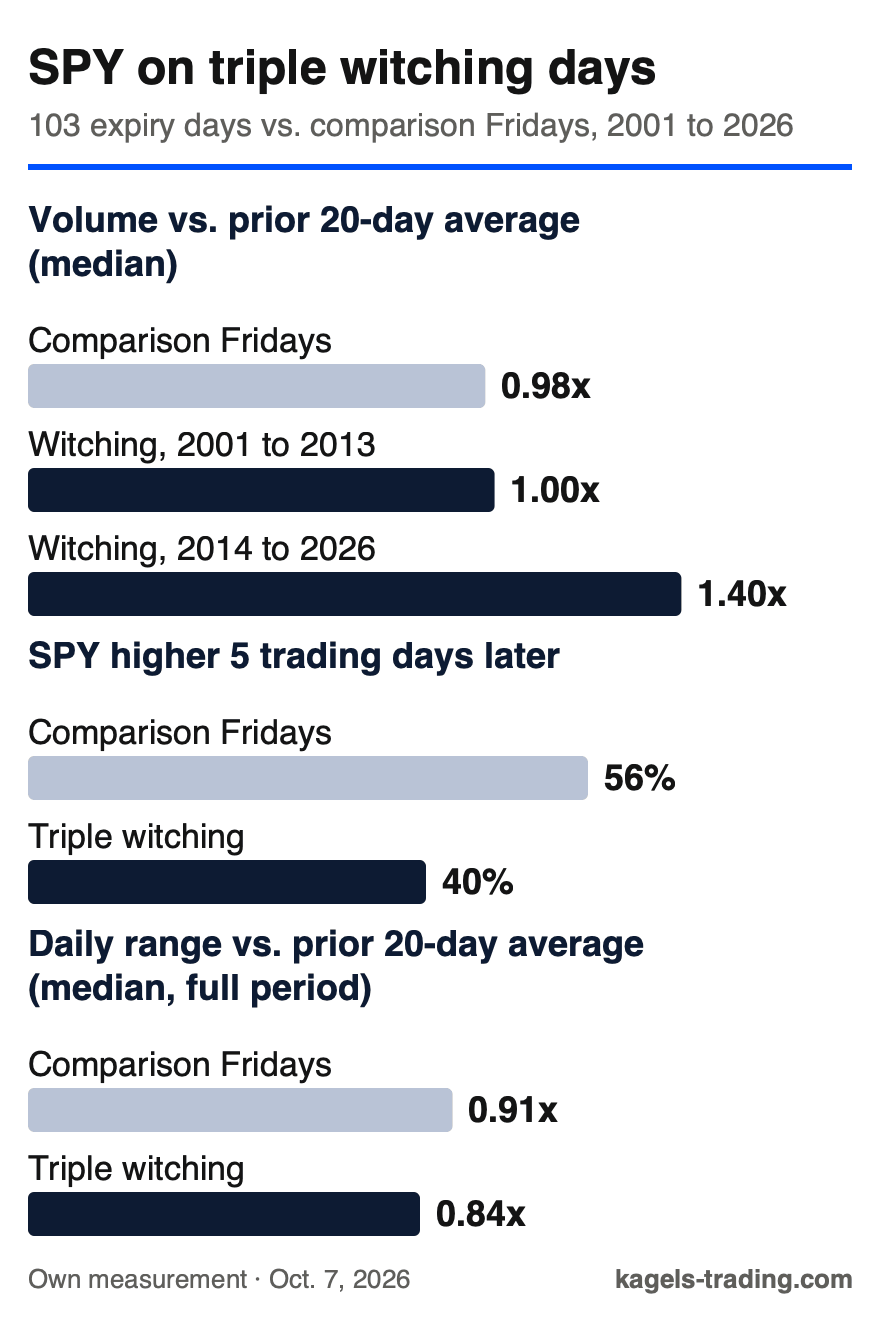
We compared every triple witching day since 2001 with comparison Fridays, using SPY daily data. The sample covers 103 quarterly expiry days from March 2001 to September 2026 and 992 comparison Fridays: Fridays excluding standard monthly and quarterly expirations. Weekly options may still expire on the comparison days. Volume and daily range are measured against the average of the 20 previous trading days, so the comparison adjusts for the market conditions of each period.
 Click to enlarge
Source: Kagels Trading, own measurement of SPY daily data, as of 7 October 2026.
| Measure | Triple witching | Comparison Fridays |
|---|---|---|
| Volume vs. 20-day average (median) | 1.28x | 0.98x |
| Volume above average | 74% | 47% |
| Range vs. 20-day average (median) | 0.84x | 0.91x |
| SPY up on the day | 49% | 55% |
| SPY up 5 days later | 40% | 56% |
The volume effect is real, and it has grown. From 2001 to 2013 the median volume ratio was 1.00, with 52 percent of witching days above average. From 2014 to 2026 it was 1.40, and volume was above average on 96 percent of the days.
The daily price range was not consistently larger. Over the full period, the distance between the day’s high and low was a median 0.84 times its 20-day average on triple witching days, against 0.91 times on comparison Fridays. From 2014 to 2026 it was 0.95 times against 0.92 times, slightly higher than on comparison Fridays but still below the 20-day average. The daily range does not capture opening gaps or what happens inside the last hour.
There is no stable direction on the day itself. From 2001 to 2013, SPY rose on 62 percent of triple witching days; from 2014 to 2026, on only 35 percent. Over the full period the result is close to a coin toss.
The week after triple witching was weaker than usual. SPY was higher five trading days later in only 40 percent of cases, against 56 percent after comparison Fridays. The difference appeared in both halves of the period, but it shrank: 33 percent in the first half, 47 percent in the second.
Treat these numbers as a description of the past, not as a trading signal. The sample is small, one ETF stands for the market, and the expiry cannot be separated from the ex-dividend date, index rebalancing and seasonal effects that fall on the same days. The expiry-day return is corrected by the dividend; without that correction, the day would look far weaker than it was.
Historical triple witching days
These four examples occurred against very different market backgrounds. The expiry-day return includes the dividend paid that day. The five-day return measures the price change from that day’s ex-dividend close to the close five trading days later.
| Date | SPY that day | SPY 5 days later |
|---|---|---|
| 19 Sep 2008 | +3.95% | −2.63% |
| 21 Dec 2018 | −2.04% | +3.83% |
| 20 Mar 2020 | −4.28% | +10.76% |
| 18 Sep 2026 | +0.13% | +1.27% |
September 2008 fell into the financial crisis, a few days after the collapse of Lehman Brothers. On the expiry day itself, SPY rose almost 4 percent, the day the US Treasury announced steps to stabilize the financial system. The daily range was close to 4 percent as well.
December 2018 and March 2020 were expiries in falling markets. On 21 December 2018, SPY fell 2.0 percent on almost twice its normal volume, during the December 2018 sell-off. On 20 March 2020, in the middle of the Covid crash, SPY lost 4.3 percent. In both cases the market was higher five trading days later.
September 2026 was a quiet example. On 18 September 2026, SPY volume was 1.64 times its 20-day average, but SPY closed only 0.13 percent higher, within a daily range of just 0.53 percent.
How to trade around triple witching
The most useful step is to know the date and the settlement time of what you trade. If you hold index futures, roll them before expiry unless you want the final settlement. If you trade around the open or the close, expect larger orders and possible price jumps at exactly those moments.
For day traders, the extra volume can help or hurt. More volume can mean tighter spreads, but large orders at the open and close can move the price through stop orders in seconds. Many traders reduce their size, avoid market-on-close orders and wait for the first minutes after the open to pass.
For long-term investors, triple witching is usually not a reason to act. Our data shows no reliable direction on the day. A long-term plan should not change because of an expiry date.
I trade on expiry days only with tight risk management and smaller positions. I bought my first shares in 1980 and have traded actively since 1986, and I have learned that moves on these days are easily mistaken for real trend changes. Most of the time, they are not. More on position size is in our guide to risk management.
Myths about triple witching
- “Triple witching always brings a crash”: wrong. In our data, SPY rose on about half of the days, and the daily range was not consistently larger than usual.
- “Triple witching is the most volatile day of the quarter”: not in the daily range. The volume is high, but the price range was below its 20-day average on about two thirds of these days.
- “You can reliably profit from triple witching”: there is no stable direction. The weaker week after is a tendency in past data, not a rule.
- “The effect lasts for weeks”: our data covers five trading days. After the big events in the table, the market moved on with the news of the time.
Conclusion: expect volume, not necessarily chaos
Triple witching is a day of high volume, concentrated at the open and the close. The expiry of futures and options, index rebalancing and SPY’s dividend date all fall on the same day. The day has no fixed direction.
For active traders the main risk is the timing, not the date. Know when your contract settles, keep your position size in check around the open and the close, and do not mistake an expiry move for a new trend. For the hours of the futures themselves, see our guide to futures market hours; for the US market sessions, see trading sessions.
Frequently asked questions about triple witching
When is the next triple witching day?
The next triple witching day is Friday, 18 December 2026. In 2027 the dates are 19 March, Thursday 17 June (because of the Juneteenth holiday), 17 September and 17 December.
What time is triple witching?
There are two key times: the open at 9:30 a.m. ET and the close at 4:00 p.m. ET. S&P 500 futures and standard SPX options are valued on the opening prices; standard SPX options stop trading at 5:00 p.m. ET on the business day before. Stock options usually stop trading at 4:00 p.m. ET, although eligible classes on Cboe can trade until 4:15 p.m. ET. The hour from 3:00 to 4:00 p.m. ET is known as the triple witching hour.
Is triple witching bullish or bearish?
Neither, according to our data. From 2001 to 2026, SPY rose on 49 percent of triple witching days, against 55 percent of comparison Fridays. In the five trading days after, SPY was higher in only 40 percent of cases, a weaker result than usual, but not a reliable signal.
What is the difference between triple and quadruple witching?
Quadruple witching included single-stock futures as a fourth contract type. These futures traded in the US on OneChicago, which closed in September 2020. Today both terms refer to the same quarterly expiry dates.
What happens if triple witching falls on a holiday?
If the US market is closed on the third Friday, trading and settlement of the main contracts move to the business day before. This happens in June when Juneteenth falls on a Friday or is observed on one, as on 19 June 2026 and 18 June 2027. In June 2026 the main trading, valuation and processing events moved to Thursday, while standard SPX options stopped trading on Wednesday; for June 2027 the CME lists Thursday, 17 June for the futures. Affected existing options can keep their contractual expiration date even when processing moves earlier. Check the exchange, OCC and broker notices for your contract.
Why is volume so high on triple witching days?
Futures are rolled or settled, options expire, and many index funds rebalance at the same closing price. In SPY, the quarterly ex-dividend date usually falls on the same day. Since 2014, SPY volume was above its 20-day average on 96 percent of triple witching days in our measurement.
This article is market education, not investment advice. The measurement describes past SPY data; it is not a forecast and not a trading signal.
This English edition is based on our German edition on kagels-trading.de and has been adapted for international readers.
More Market Hours guides
- Check futures hours
Futures Market Hours: CME Trading Times for ES, Oil and Gold
Weekly and daily hours of ES, crude oil, gold, Treasuries, grains and bitcoin futures in ET, CT and London time.
- Time your trades
Trading Sessions: Asian, London and New York Hours in ET
The Asian, London and New York sessions in ET, London and India time, their overlap, RTH and ETH, and how to set up your chart.
- Trade before the open
Pre-Market and After-Hours Trading: Hours, Risks, Brokers
Pre-market, after-hours and overnight hours at the exchanges and at Schwab and Interactive Brokers, the risks, and what SPY data show about the overnight move.
- Check exchange hours
Stock Exchange Hours Worldwide: Opening Times in ET
Opening and closing times of the major exchanges in the Americas, Europe and Asia-Pacific, in local and New York time, with lunch breaks.
- Trade the opening range
Opening Range Breakout: Rules, Charts and Common Mistakes
How 5, 15 and 30-minute opening windows differ, with a worked SPY example at a 15-minute window, entry at the next bar’s open and a 2R target.