
Earn2Trade Review 2026: New Rules, Prices and Payouts


Contents
- Earn2Trade in 30 seconds
- What changed on November 2, 2026?
- Who is behind Earn2Trade?
- Trader Career Path vs Gauntlet Mini
- What Earn2Trade costs
- Worked example: a 50K account from purchase to first payout
- How do Earn2Trade payouts work?
- Platforms and markets
- How many traders pass and get paid?
- Pros and cons of Earn2Trade
- Who Earn2Trade fits and who should avoid it
- Earn2Trade vs Topstep and Apex
- Our verdict: cleaner rules, a new payout hurdle
- Frequently asked questions about Earn2Trade
- About the author
Earn2Trade sells a monthly subscription to a simulated futures test, and the rules changed in November 2026. For new subscriptions, the old Progression Ladder is gone and every account has a fixed contract limit that the platform enforces. Before each withdrawal, funded traders now need five profitable days with a minimum daily profit. Older subscriptions keep their old rules.
For this review we read Earn2Trade’s own pages on November 7, 2026. That covers the rule announcement, the product pages, the checkout plan selector and the help center. We did not buy an account, so this is documentation research, not a first-hand test. Prices and rules change, so check them again before you pay.
Earn2Trade in 30 seconds
- What it is: a futures evaluation company. You pay a monthly subscription for a simulated test. If you pass, a partner prop firm offers you a simulated LiveSim account or a Live account with real capital.
- New since November 2, 2026: fixed contract limits instead of the Progression Ladder, and five profitable days before every withdrawal. This applies to new subscriptions; Earn2Trade’s pages name two different cutoff days, see below.
- Two programs: the Trader Career Path grows a funded account step by step up to $400,000. The Gauntlet Mini keeps the account size you passed with.
- Cost on a 50K account: $190 a month for the Trader Career Path, $170 for the Gauntlet Mini, before discount codes. A LiveSim account adds a one-time $139 fee from your first withdrawal for non-professional traders.
- Payout split: 50 percent below a threshold per withdrawal, 80 percent above it. On a 50K account the threshold is $2,250.
- Main caution: Earn2Trade’s own disclaimer says 8.89 percent of candidates passed in 2025, and about 18 percent of funded accounts made at least one withdrawal.
What changed on November 2, 2026?
Earn2Trade replaced its best-known rule and added a hurdle before each withdrawal. Both changes apply to the Trader Career Path and the Gauntlet Mini, in the evaluation and in the funded stage. The announcement dates them to November 2, 2026.
Fixed contract limits replace the Progression Ladder
You can no longer break the contract rule by accident, because the platform blocks the order. Under the old Progression Ladder, you had to watch your own position size as your balance changed, and one order too many failed the test. Now each account size has a fixed maximum that does not grow with profit. Ten micro contracts count as one standard contract.
| Account size | Max. standard contracts | Max. micro contracts |
|---|---|---|
| $25,000 (TCP) | 2 | 20 |
| $50,000 (TCP or GAU) | 4 | 40 |
| $100,000 (TCP or GAU) | 8 | 80 |
| $150,000 (TCP or GAU) | 12 | 120 |
| $200,000 (TCP or GAU) | 15 | 150 |
| $400,000 (TCP) | 20 | 200 |
Earn2Trade rule announcement and help center on contract limits, read November 7, 2026. Only MES, MNQ, MYM, M2K, MGC, MCL, M6B, M6E and MHG count as micros.
Five profitable days before each withdrawal
Every withdrawal now needs five fresh trading days that each clear a minimum profit. The days do not have to be consecutive, and a losing day in between does not reset the count. A trading day runs from 5:00 PM to 3:50 PM Central Time (CT), and the profit is measured after commissions and fees. After a withdrawal, the count starts again at zero.
| Account | Minimum daily profit |
|---|---|
| TCP25 | $100 |
| TCP50 or GAU50 | $150 |
| TCP100 or GAU100 | $200 |
| GAU150 | $250 |
| GAU200 | $350 |
Earn2Trade withdrawal policy, updated November 2, 2026, read November 7, 2026.
A qualifying day counts even if the account is below its starting balance. Earn2Trade’s own example is a $50,000 account that opens the day at $49,000 and closes at $49,150. That $150 day counts. What stays the same: there is still no buffer you must keep, no consistency rule once funded, and the minimum withdrawal remains $100 net.
Who keeps the old rules?
Subscriptions bought before the change stay under the rules from their purchase date. That includes their rebills, their resets and any funded account that results from them. So a trader who started in October still trades with the Progression Ladder, even after a reset in November. The withdrawal rule that applied before November 2 is no longer described in the current help center, so ask Earn2Trade support which terms your account has.
Earn2Trade’s pages do not agree on the exact cutoff day, and we cannot settle it. The announcement and the checkout say the new rules apply to purchases “on or after November 2”. Two help articles updated the same day say the old rule applies to purchases “before Nov 1” and the new one to purchases “after November 1”. By those pages, a purchase on November 1 falls under the old rules in one source and under neither group in the other. If you bought on November 1 or 2, get your rule set from Earn2Trade support in writing.
Who is behind Earn2Trade?
Earn2Trade calls itself an educational company, and the funded accounts come from partner prop firms. US visitors see Earn2Trade LLC with a registered office in Sheridan, Wyoming. Visitors outside the US see Bahia Education Services LLC in Dubai, which says it holds a UAE education licence. In October 2026 the company celebrated its tenth anniversary.
Earn2Trade says it is not licensed by a financial regulator. Its help center says that as an educational institution it does not need such a licence. After you pass, Earn2Trade forwards your result to a partner such as Helios Trading Partners, Appius Trading Limited or Kronos Proprietary Trading. That partner offers the LiveSim or Live account and decides which one you get. For how this business model works in general, see our prop trading guide.
Earn2Trade at a glance
| Programs | Trader Career Path (TCP25, TCP50, TCP100), Gauntlet Mini (GAU50 to GAU200) |
| Billing | monthly subscription until you pass or cancel, no refunds |
| Evaluation rules | profit goal, EOD drawdown, daily loss limit, 30% consistency, fixed contract limit |
| Minimum trading days | none, but the consistency rule means at least four profitable days |
| Funded stage | LiveSim (simulated) or Live (real capital) from a partner firm |
| Payout split | 50% below a threshold per withdrawal, 80% above, TCP400 fixed 60/40 |
| Markets | CME, CBOT, NYMEX and COMEX futures only |
| Trading day | flat from 3:50 PM to 5:00 PM CT, news trading allowed |
Earn2Trade product pages and help center, read November 7, 2026.
Trader Career Path vs Gauntlet Mini
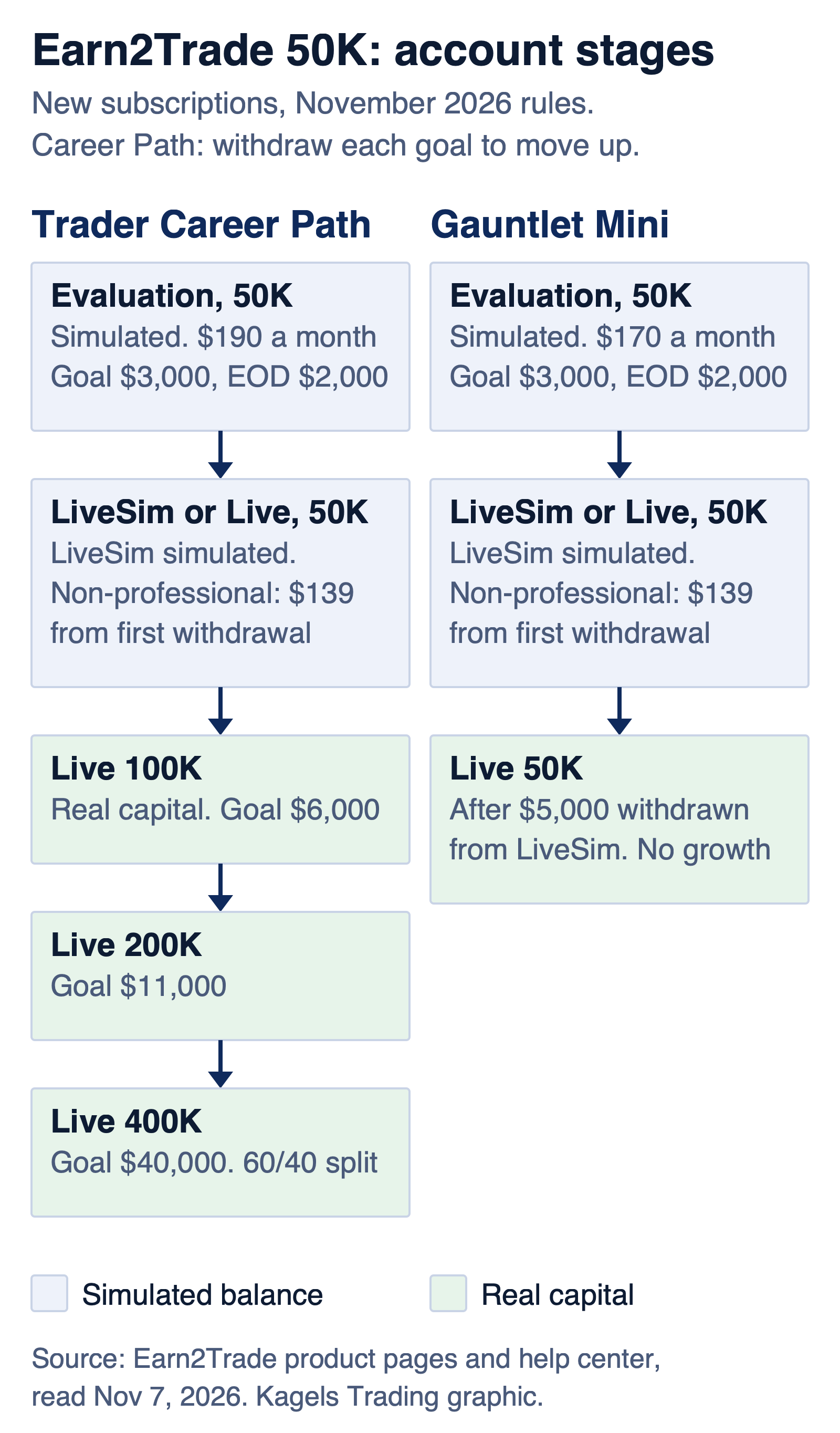
Both programs test you the same way on a 50K account, and they differ in resets and in what happens after you pass. The Trader Career Path (TCP) includes a free reset with each monthly rebill and a growth plan to larger Live accounts. The Gauntlet Mini (GAU) is cheaper per month, has no free reset and offers more account sizes, but your funded account stays at the size you passed with.
- Simulated, you pay monthlyEvaluationReach the profit goal with 30% consistency, without touching the EOD drawdown or the daily loss limit.
- Partner firm offers itLiveSim or LiveLiveSim is simulated; non-professionals pay a $139 fee from the first withdrawal. Live uses real capital and charges data fees.
- Live accounts, real capitalGrowth (TCP only)Withdraw the profit goal at each step to move to the next account size, up to $400,000.
Evaluation rules
| Plan | Price a month | Profit goal | EOD drawdown | Daily loss limit | Contracts |
|---|---|---|---|---|---|
| TCP25 | $150 | $1,750 | $1,500 | $550 | 2 |
| TCP50 | $190 | $3,000 | $2,000 | $1,100 | 4 |
| TCP100 | $350 | $6,000 | $3,500 | $2,200 | 8 |
| GAU50 | $170 | $3,000 | $2,000 | $1,100 | 4 |
| GAU100 | $315 | $6,000 | $3,500 | $2,200 | 8 |
| GAU150 | $375 | $9,000 | $4,500 | $3,300 | 12 |
| GAU200 | $550 | $11,000 | $6,000 | $4,400 | 15 |
Prices from the checkout plan selector, not checkout totals, before discount codes. Rules from the Trader Career Path and Gauntlet Mini pages, read November 7, 2026.
The 30 percent consistency rule sets the real minimum number of days. No single day may make up 30 percent or more of your total profit. A big day does not fail you, it only means you have to keep trading until it falls below that share. With a $3,000 goal, a best day of $1,200 means you need more than $4,000 in total profit to pass, since $1,200 divided by 0.3 is $4,000 and the day must stay below 30 percent.
The drawdown and the loss limit are hard limits. The end-of-day (EOD) drawdown rises with your highest closing balance and stops rising at the starting balance. The daily loss limit counts open losses as well, from 5:00 PM to 5:00 PM CT. Touching either one fails the evaluation, and you need a reset to go on. For the general math, see our prop firm drawdown guide.
 Click to enlarge
Source: Kagels Trading, own graphic from Earn2Trade's product pages and help center.
The growth plan of the Trader Career Path
On the Trader Career Path, each withdrawal of the profit goal moves you to a larger account. In the funded stage, the profit goal becomes the profit target to advance. Once you withdraw it, you move to the next Live account, which uses real capital. The drawdown rule changes on the way, as the next section shows.
| Start | Funded steps | Largest account |
|---|---|---|
| TCP25 | 25K, then Live 50K, 100K, 200K | $200,000, drawdown fixed at $194,000 |
| TCP50 | 50K, then Live 100K, 200K, 400K | $400,000, drawdown fixed at $388,000 |
| TCP100 | 100K, then Live 150K, 200K, 400K | $400,000, drawdown fixed at $388,000 |
Earn2Trade Trader Career Path growth plan and TCP sizes, read November 7, 2026.
LiveSim keeps EOD drawdown, Live trails in real time
The step from LiveSim to Live changes how the drawdown moves. A LiveSim account keeps the end-of-day drawdown of the evaluation, which only moves with your closing balance. A Live account uses a trailing drawdown that follows your balance during the day, including open profit. It stops trailing once it reaches the starting balance.
On a Live account, an open profit can raise your liquidation level before you close the trade. Earn2Trade’s own example is a $50,000 account with a $2,000 drawdown: the limit starts at $48,000, and $100 of profit lifts it to $48,100. If a trade runs $1,000 into profit and then turns, the limit has already moved up by $1,000, so you have $1,000 less room than at the start of that trade.
At the top of the growth plan the drawdown is fixed, but Earn2Trade’s pages differ on the 200K step. The $400,000 account has a fixed drawdown at $388,000, and the TCP25 path ends at $200,000 with a fixed drawdown at $194,000. The funded account rules say the $200K and $400K TCP accounts use a fixed drawdown, while the Trader Career Path page lists the 200K step of TCP50 and TCP100 with a trailing drawdown of $6,000. We cannot settle this; ask Earn2Trade before you trade that step.
The Gauntlet Mini has no growth plan. After you pass, you get a LiveSim or Live account with the same capital. A LiveSim account moves to a Live account once you have withdrawn $5,000 in total, at every Gauntlet Mini size.
What Earn2Trade costs
The subscription runs every 30 days until you pass or cancel, and Earn2Trade gives no refunds. You get an email three days before each charge. Renewal does not reset a failed evaluation, and a reset does not restart your billing period. Market data is included in the evaluation if your CME status is non-professional. Market depth costs extra.
| Cost item | Trader Career Path | Gauntlet Mini |
|---|---|---|
| Free reset | one per monthly rebill, can be saved | none |
| Paid reset, list | TCP25 and TCP50 dynamic, $100 shown; TCP100 $100 | GAU50 dynamic, $100 shown; GAU100 $100; GAU150 $130; GAU200 $155 |
| LiveSim activation | non-professional: $139 once, taken from the first withdrawal; professional: $140 per exchange a month | same |
| Live data fees | $140 per exchange a month (Rithmic), $156 (NinjaTrader) | same |
| Commissions | per trade, schedule given at activation | same |
Earn2Trade checkout, reset pricing and funded account fees, read November 7, 2026.
Treat the current discount as dated, not as the price. From November 2 to November 15, 2026, the code NEXTSTEP50 took 50 percent off all TCP and GAU plans, with resets at $65 (TCP25), $85 (TCP50) and $75 (GAU50). Check at checkout how many billing months the discount covers before you count on it.
“No subscription fee once funded” is true, but a Live account still costs money every month. CME has four exchanges: CME, CBOT, NYMEX and COMEX. If you trade E-mini S&P 500 (CME) and gold (COMEX) on a Rithmic Live account, the data alone costs $280 a month. Charges are per calendar month and not prorated.
Worked example: a 50K account from purchase to first payout
On a 50K account the two programs test you the same way, so the difference is the cost. Both have the same $3,000 goal, the same $2,000 EOD drawdown and the same 4-contract limit. The table uses list prices before codes and the reset price the checkout showed on November 7, 2026.
| Scenario, 50K | TCP50 | GAU50 |
|---|---|---|
| Pass within the first 30 days | $190 | $170 |
| Fail once, pay one reset, pass before the rebill | $190 + $100 = $290 | $170 + $100 = $270 |
| No fail, pass in month 2 | $190 + $190 = $380 | $170 + $170 = $340 |
| Fail once, wait for the rebill, pass in month 2 | $190 + $190 = $380, free reset included | $170 + $170 + $100 reset = $440 |
The Trader Career Path only comes out cheaper when you actually need a reset after a rebill. Without a failed attempt, the Gauntlet Mini stays $20 cheaper every month, so two months cost $340 against $380. The free reset with each TCP rebill pays off when you fail and would otherwise buy a reset for $100.
The first withdrawal on a 50K LiveSim account
The size of a withdrawal decides your split, so a small first payout can cost you more than it pays. Below $2,250, you get 50 percent of that withdrawal. From $2,250, you get 80 percent. In addition, for traders with non-professional CME status, the $139 activation fee comes off your first withdrawal, together with the payment provider’s fee. Earn2Trade does not say in which order these come off, so the table stops at your share before fees.
| First withdrawal from 50K LiveSim | Your split | Your share before fees |
|---|---|---|
| $1,000 | 50% | $500 |
| $2,000 | 50% | $1,000 |
| $2,250 | 80% | $1,800 |
| $3,000 (TCP50 target to advance) | 80% | $2,400 |
Our calculation from Earn2Trade’s withdrawal policy and LiveSim fee, read November 7, 2026. Before the $139 activation fee and the payment provider’s fee, whose order of deduction Earn2Trade does not state. Not a trading result.
Before any of these withdrawals you need five days of at least $150 profit. Five days at exactly $150 make only $750, so in practice your qualifying days and your profit target build up together. On the TCP50, withdrawing the $3,000 target moves you to a Live 100K account. On the GAU50, a LiveSim account stays at 50K until you have withdrawn $5,000.
Ask how a withdrawal changes your drawdown before you take money out. The EOD drawdown stops rising at the starting balance. The pages we read do not explain how a withdrawal changes the minimum balance, and a withdrawal that takes you back to $50,000 could leave little room. Get the answer from support for your account.
How do Earn2Trade payouts work?
Withdrawals are paid once a week, and the request deadline is the Friday before. You email your request to the partner firm by 2:00 PM CT on Friday, and the payment is processed on the following Wednesday. Requests after the deadline may slip a week. The minimum is $100 net, and on a LiveSim account with non-professional status the first one must also cover the $139 fee.
| Account size | 50% split | 80% split | LiveSim total before Live |
|---|---|---|---|
| TCP25 | under $1,500 | $1,500 or more | $1,750 |
| TCP50 or GAU50 | under $2,250 | $2,250 or more | TCP $3,000, GAU $5,000 |
| TCP100 or GAU100 | under $3,000 | $3,000 or more | TCP $6,000, GAU $5,000 |
| TCP150 or GAU150 | under $4,000 | $4,000 or more | GAU $5,000 |
| TCP200 or GAU200 | under $5,000 | $5,000 or more | GAU $5,000 |
| TCP400 | fixed 60/40 | fixed 60/40 | not applicable |
Earn2Trade withdrawal policy, read November 7, 2026.
The partner firm chooses the payment provider, and each one charges a fee. Rise charges US traders 1.5 percent and others $50 per withdrawal. Deel charges $50, Bayzat $5 to $40, and direct crypto, available only in select cases, 0.735 percent. You cannot pick the method freely.
Traders in some US states and territories cannot be paid through Rise. Earn2Trade lists Iowa, Minnesota, South Carolina, Guam, Puerto Rico and the US Virgin Islands. It says the partner firms offer other payout solutions there, so ask before you subscribe if you live in one of them.
Platforms and markets
Earn2Trade now offers several free platforms, including Tradovate and TradingView. At checkout you choose a data connection: Rithmic, NinjaTrader, BlackArrow or dxFeed. NinjaTrader, Tradovate, TradingView, Finamark, R Trader Pro, BlackArrow and DeepCharts are free during the program. Tradovate and TradingView run in a browser, which helps Mac users. See our TradingView review for that platform.
Platforms such as Sierra Chart, ATAS or Bookmap work, but you bring your own license. They connect through the Rithmic, BlackArrow or dxFeed data feed. Earn2Trade also offers a Beginner Crash Course for $249, with 60 videos and quizzes on basic and advanced topics.
Only futures from the four CME Group exchanges are allowed. Stocks, options, spot forex, crypto and CFDs are not available. In the funded stage, Bitcoin and Ether futures are also prohibited. Everything must be flat by 3:50 PM CT, some agricultural markets earlier. For contract sizes, see our guide to micro futures and to futures market hours.
Trade copiers are banned in evaluations and funded accounts. You can run up to five evaluations at once, and up to three funded accounts, of which only one can be Live. You must be at least 18 and register in your legal name, not through an LLC. Non-US traders need a W-8BEN form, and citizens of sanctioned countries are excluded.
How many traders pass and get paid?
Earn2Trade publishes its own numbers, and they are sobering. According to its exam disclaimer, 8.89 percent of candidates passed the Trader Career Path or the Gauntlet Mini in 2025, measured as passed subscriptions against new subscriptions. Of those who passed, 94.77 percent traded a LiveSim account and 5.23 percent a Live account.
Fewer than one in five funded accounts paid out at all in 2025. Earn2Trade says 18.04 percent of Live accounts and 18.20 percent of LiveSim accounts had at least one withdrawal. The company itself writes that its evaluations are difficult and not suggested for people with little trading experience. We could not verify customer ratings independently, so we leave them out.
Pros and cons of Earn2Trade
The strengths are in the structure, and the weaknesses are in the costs and the split. Read the pros and cons below against your own plan.
Pros
- The platform now blocks orders above the contract limit, so that rule can no longer fail you by accident
- No minimum trading days and news trading allowed
- No consistency rule and no buffer once funded
- A real-capital growth path to $400,000 on the Trader Career Path
- Free Tradovate, TradingView, NinjaTrader and other platforms
- Published pass and withdrawal rates
Cons
- Monthly billing until you pass, and no refunds
- Only 50 percent of withdrawals below the threshold
- Five qualifying days before every withdrawal for the new cohort
- $139 LiveSim fee and monthly data fees on Live accounts
- Help center and announcement disagree on the cutoff date
- Some help articles are outdated, such as the price list from 2024
Who Earn2Trade fits and who should avoid it
Earn2Trade can suit a patient futures day trader who wants real capital in the end. It fits if you can make steady profits over several days without one big day, close out by 3:50 PM CT and plan your withdrawals around the 80 percent threshold. The Trader Career Path suits you if you want to grow into Live accounts rather than collect small payouts.
Avoid it if you need quick, small payouts or want to hold positions overnight. The five-day rule and the 50 percent split below the threshold work against frequent small withdrawals. It also does not fit traders who want stocks, forex or crypto, or anyone who uses a trade copier across accounts.
Earn2Trade vs Topstep and Apex
These firms differ most in how you pay and what you can withdraw. Compare the monthly fee against the one-time fees and how the payout split is calculated. Details are in our Topstep review, Apex Trader Funding review and Tradeify review.
| 50K account | Earn2Trade TCP50 | Topstep (Standard) | Apex (Intraday Standard) |
|---|---|---|---|
| Fee | $190 a month | $49 a month | $249, one-time |
| Activation | $139 from first LiveSim withdrawal (non-professional) | $149 | $99 |
| Resets | free with each rebill, or paid | $49 | none |
| Funded split | 50% or 80% per withdrawal | 90/10 | 100% of approved payouts, capped |
Earn2Trade read November 7, 2026; Topstep and Apex as read for our reviews of those firms on November 6, 2026, list prices before discount codes.
Our verdict: cleaner rules, a new payout hurdle
The November 2026 update removes Earn2Trade’s most common trap and adds a new hurdle before payouts. Fixed contract limits that the platform enforces are an improvement over the Progression Ladder. In return, the five-day rule slows down every withdrawal, and the 50/80 split by withdrawal size punishes small payouts.
If you try it, plan the whole path, not just the test. Pick TCP or Gauntlet Mini by how many months you expect to need, check the final price at checkout, and confirm which rule set your account has. Futures trading is risky, simulated results do not guarantee future results, and this review is not investment advice.
Frequently asked questions about Earn2Trade
Is Earn2Trade legit?
Earn2Trade is an established company with public rules, but it is not a regulated financial firm. It describes itself as an educational institution, and funded accounts come from partner prop firms. It publishes its own pass and withdrawal rates, which show that few customers get paid. We cannot judge payout reliability from our own experience.
Is Earn2Trade real money or simulated?
The evaluation and the LiveSim account are simulated, and the Live accounts use real capital. Withdrawals from a LiveSim account are real money paid by the partner firm. On the Trader Career Path, the larger growth steps are all Live accounts.
What changed at Earn2Trade on November 2, 2026?
For new subscriptions since the November 2026 update, fixed contract limits replace the Progression Ladder. In addition, funded traders need five profitable days with a minimum daily profit before each withdrawal, for example $150 on a 50K account. Older subscriptions keep their old rules. The announcement puts November 1 purchases under the old rules, while two help articles leave that date unassigned, so confirm your account’s rules with support.
How much does Earn2Trade cost?
A 50K evaluation costs $190 a month on the Trader Career Path and $170 on the Gauntlet Mini, before codes. The subscription renews every 30 days until you pass or cancel. A LiveSim account adds a one-time $139 fee from your first withdrawal for non-professional traders, and Live accounts pay market data fees.
What is the difference between the Trader Career Path and the Gauntlet Mini?
The Trader Career Path includes free resets and a growth plan, and the Gauntlet Mini is cheaper and stays at one size. On a 50K account both have the same evaluation rules. The TCP grows to Live accounts of up to $400,000, while the Gauntlet Mini offers sizes up to $200,000 from the start.
Does Earn2Trade support TradingView?
Yes, TradingView is one of the free platforms during the program. Earn2Trade also lists Tradovate, NinjaTrader, Finamark, R Trader Pro, BlackArrow and DeepCharts as free. Other platforms need your own license.
This English edition is based on our German edition on kagels-trading.de and has been adapted for international readers.
More Prop Trading guides
- Understand the drawdown rules
Trailing Drawdown at Prop Firms: The Math, With Real Trades
Static, end-of-day and intraday trailing limits, risk per trade and pass rates, tested with 61 real trades.
- Check Take Profit Trader
Take Profit Trader Review: Rules, Costs and Payouts
Test rules, full costs, PRO and PRO+ payouts and the drawdown rule that changes after you pass.
- Check Bulenox
Bulenox Review 2026: Rules, Costs and Payouts
Three account types for a one-time fee, drawdown options, payout rules and the open questions about the company.
- Check Bitfunded
Bitfunded Review 2026: Rules, Costs and Payouts
A crypto prop firm: four account types, loss limits with open positions, payout review and what the competition prize pool is made of.
- Check IQ Capital
IQ Capital Review 2026: Costs, Rules and Payouts
Crypto, CFD and futures accounts from $9, the strict per-trade loss limit, payout caps and the company in Saint Lucia.
- Check Tradeify
Tradeify Review 2026: Prices, Rules and Payout Caps
Growth, Select and Lightning compared: one-time prices, the real-time drawdown and how far the payout caps sit below the profit goals.
- Check Apex Trader Funding
Apex Trader Funding Review 2026: Prices, Rules and Payouts
What the evaluations really cost, EOD vs Intraday on a 50K account, payout caps and what the User Agreement says about rewards.
- Check Topstep
Topstep Review 2026: Rules, Costs and Payouts
Three stages, two of them simulated: the monthly fee per attempt, the trailing loss limit and why the timing of the first payout matters.
- Check Propr
Propr Review 2026: Rules, Payouts and the Hedge Losses
A prop firm built on Hyperliquid: prices, rules, fast payouts and what its public data shows about margin, reserve and hedge losses.