
Propr Review 2026: Rules, Payouts and the Hedge Losses


Contents
- Propr in 30 seconds
- What is Propr?
- Prices: what Propr’s tests cost
- Rules: daily loss, drawdown and what is banned
- Payouts: fast, public and all-or-nothing
- How Propr makes money, and why October matters
- The hedge book on November 5: what the data shows
- The Radecker video: what his numbers show
- Propr reviews: what Trustpilot shows
- Is Propr legit?
- Pros and cons of Propr
- Alternatives to Propr
- Our verdict: rare openness, and the numbers call for caution
- Frequently asked questions about Propr
- About the author
Propr shows more of its books than almost any prop firm, and on November 5, 2026, those books took a hard hit. Its public hedge wallet lost about $353,000 in a single day, and that evening the head of a competing firm published a video arguing that Propr’s business model is breaking. I wanted to know what is proven and what is opinion before anyone pays a fee.
For this review I collected the prices, rules and payout terms directly from Propr and checked the hedge figures on Hyperliquid itself. The sources are the website, the rulebook, the evaluation terms and funded terms of August 26, 2026, the transparency dashboard and two posts by the founder. All data was retrieved on November 5, 2026; the wallet figures are from 22:32 UTC. I did not buy an account, and this page has no affiliate link to Propr. We do earn affiliate commission from a competitor, IQ Capital, as our IQ Capital review states, so keep that in mind as you read. How we research and write is described on our editorial policy page.
Propr in 30 seconds
- Overall: a young prop firm built on Hyperliquid, with first revenue in April 2026. Accounts are 100 percent simulated, and the company in the British Virgin Islands says it is not regulated.
- Cost: one-time fees from $25 for a $5,000 Turbo account to $1,998 for a $200,000 Classic account. The fee is not refundable.
- Payouts: 80 percent of simulated profit in USDC, on demand from $20. Propr has paid out $3.71 million to 1,904 traders, at a median of under 10 minutes.
- The warning sign: in October, payouts took 93 percent of revenue. With commissions, Propr paid out more than it took in; only hedging profit kept the month positive.
- The current risk: on November 5, the hedge wallet held $4 million in long positions with $509,000 in open losses. Payouts were still running that day. The public reserve is $596,000, and the founder also cites a $4 million credit line that I could not verify.
What is Propr?
Propr is a prop trading firm that sells paid tests on simulated perpetual futures accounts of $5,000 to $200,000 and pays 80 percent of the simulated profit in USDC.
The model is the familiar prop firm pattern, with one twist. You pay a one-time fee, trade a simulated account and, if you hit the target without breaking the loss limits, you move to a funded account. That account is simulated too. Propr says so plainly: all accounts are “100% simulated”, and a payout is a reward for signal evaluation, not an investment return. The twist is that prices come from Hyperliquid, and Propr may copy selected trades to the live market there.
A perpetual future, or perp, is a futures contract without an expiry date, which holds close to the spot price through regular funding payments between long and short traders. On Propr you can trade more than 160 perps on crypto, stocks, indices, commodities and forex, around the clock. Standard Hyperliquid fees and funding apply to your simulated trades.
The people behind Propr are public, which is not a given in this industry. The founder and CEO is Louis Régis, who streams his work daily and describes himself as a former Credit Suisse and Rothschild employee. Propr is built by the studio XBorg and backed by SwissBorg, according to the firm; the size of that backing is not stated. The legal entity is Propr Limited (No. 2211330) in Tortola. Its site says the company is “not authorized or regulated” by the BVI regulator or any other financial authority.
Propr at a glance
| Company | Propr Limited, British Virgin Islands |
| First revenue | April 2026 |
| Founder and CEO | Louis Régis |
| Account sizes | $5,000 to $200,000 (simulated USDC) |
| Funded limit | $300,000 across all accounts |
| Markets | 160+ perps, 24/7 |
| Profit split | 80 percent on all accounts |
| Payout | USDC on Ethereum, on demand from $20 |
| Pass rate | 15.8 percent on paid tests (Propr’s figure) |
| Trustpilot | 4.4 of 5, 67 reviews (Nov 5, 2026) |
Prices: what Propr’s tests cost
All tests are one-time fees with no time limit and no minimum trading days. The table shows the list prices on the home page. A failed test means you buy a new one; Propr offers no resets and no appeals, and the fee is non-refundable.
| 1-Step size | Classic | Pro | Turbo |
|---|---|---|---|
| $5K | $60 | $45 | $25 |
| $10K | $110 | $85 | $50 |
| $25K | $275 | $185 | $125 |
| $50K | $495 | $355 | $245 |
| $100K | $999 | $699 | $450 |
| $200K | $1,998 | $1,399 | $899 |
List prices from propr.xyz, checked November 5, 2026.
The 2-Step Classic comes in the same six sizes at a similar price. It costs $50, $100, $250, $450, $749 and $1,499, from the $5,000 account to the $200,000 account.
Discounts are part of the business model, so check the price at checkout. The founder writes that most sales are still driven by discount periods, and on November 3, Propr advertised up to 20 percent off through a partner until November 30. Card payments run through Odeonpay ALE S.R.L. as merchant of record, and crypto through a payment gateway.
Rules: daily loss, drawdown and what is banned
The cheap Turbo account is cheap for a reason: its drawdown is only 3 percent. The four account types differ mainly in how much room you get. A trailing limit, as on the 2-Step, moves up with your profits until it reaches the starting balance. Our prop firm drawdown guide shows what these limit types mean for your risk per trade.
| Account | Target | Daily | Max loss |
|---|---|---|---|
| Classic | 10% | 3% | 6% static |
| Pro | 12% | 3% | 5% static |
| Turbo | 9% | 3% | 3% static |
| 2-Step | 5%, then 10% | 5% | 8% trailing |
Source: Propr home page and rulebook, checked November 5, 2026.
Both limits count open positions, and one touch ends the account for good. The daily limit is a percentage of the start-of-day balance and resets at 00:00 UTC. If equity touches a limit, all positions close and the account is disabled, with no grace period. The same limits apply in the funded stage.
Propr allows a lot that other firms ban. News trading, holding over weekends, scalping, grid trading, bots and AI agents are all permitted, and there is no consistency rule and no mandatory stop loss. Propr says more than 2,000 people use its API. One limit for automated traders: a bot identical to other users’ bots, or an off-the-shelf bot without customization, can be flagged as coordinated trading. For a crypto trader with an own system, that freedom is still the main attraction.
The list of bans matters more than it first appears, because it decides who gets paid. Banned are hedging between your own accounts or on other venues, account cycling, latency arbitrage, wash trading, several accounts from one household, device or IP, and “non-replicable or high-risk strategies”. The last one is broad. Under the terms, Propr decides at its own discretion what counts as prohibited conduct. If, “acting reasonably”, it finds a breach, it can cancel trades or withhold rewards, and it does not have to warn you first.
The rulebook contradicts itself in places. The rules list 10x leverage on BTC, ETH and SOL in one table and 5x on BTC and ETH in a chart; the home page shows 10x. A payout resets the 2-Step high-water mark to the starting balance in one section and reduces it by the payout in another. The rulebook allows copy trading between your own accounts and also bans multi-account use from one device. One point needs clarifying rather than a conclusion: the home page says active funded accounts keep the rules in place when they were activated. The funded terms allow amendments at any time with notice on the platform or by email; carrying on counts as acceptance, and rejecting one ends the agreement. They do not repeat the home page promise. Ask support to confirm anything you rely on.
Payouts: fast, public and all-or-nothing
Propr’s payout record is its strongest point, and you can check it yourself. According to its dashboard, Propr has made 6,821 payouts totalling $3.71 million to 1,904 funded traders. The median time from request to payment is 9 minutes 50 seconds, the average 1 hour 48 minutes, and each payment links to its transaction on Ethereum. On November 5, the day of the hedge losses, Propr still paid $60,115. The funded terms call approved payouts “discretionary settlements for data generation”, so read this as a track record, not as a guarantee.
The conditions are simple, but one of them has consequences. You keep 80 percent, in USDC, from $20 upward, with no waiting period. All positions must be closed first, and each payout is a full sweep of your profit, after which the balance returns to the starting level. You also need a KYC check before a funded account and before any payout, and failing it forfeits pending rewards.
Most paid tests end in failure, and Propr says so itself. It reports a pass rate of 15.8 percent on paid tests: 5,703 passes against 30,393 fails. By November 5, the dashboard showed 1,904 funded traders with a payout and 6,498 paying traders. If both counts cover the same people, about 29 percent had received a payout by then, by my calculation, and some others may still get one. The average payout is about $543.
Since October, a new hurdle sits between you and your money: the risk interview. The founder writes that Propr held 127 risk interviews in October and restricted 41 accounts, or 32 percent. He says this targets suspected KYC fraud and hedging abuse, and that some traders called the interviews invasive. He attributes roughly 40 percent of October payouts to “toxic flow”, meaning traders whose payouts come from the structure of the test rather than from market skill. If you trade from several accounts, read the banned list above with that number in mind.
How Propr makes money, and why October matters
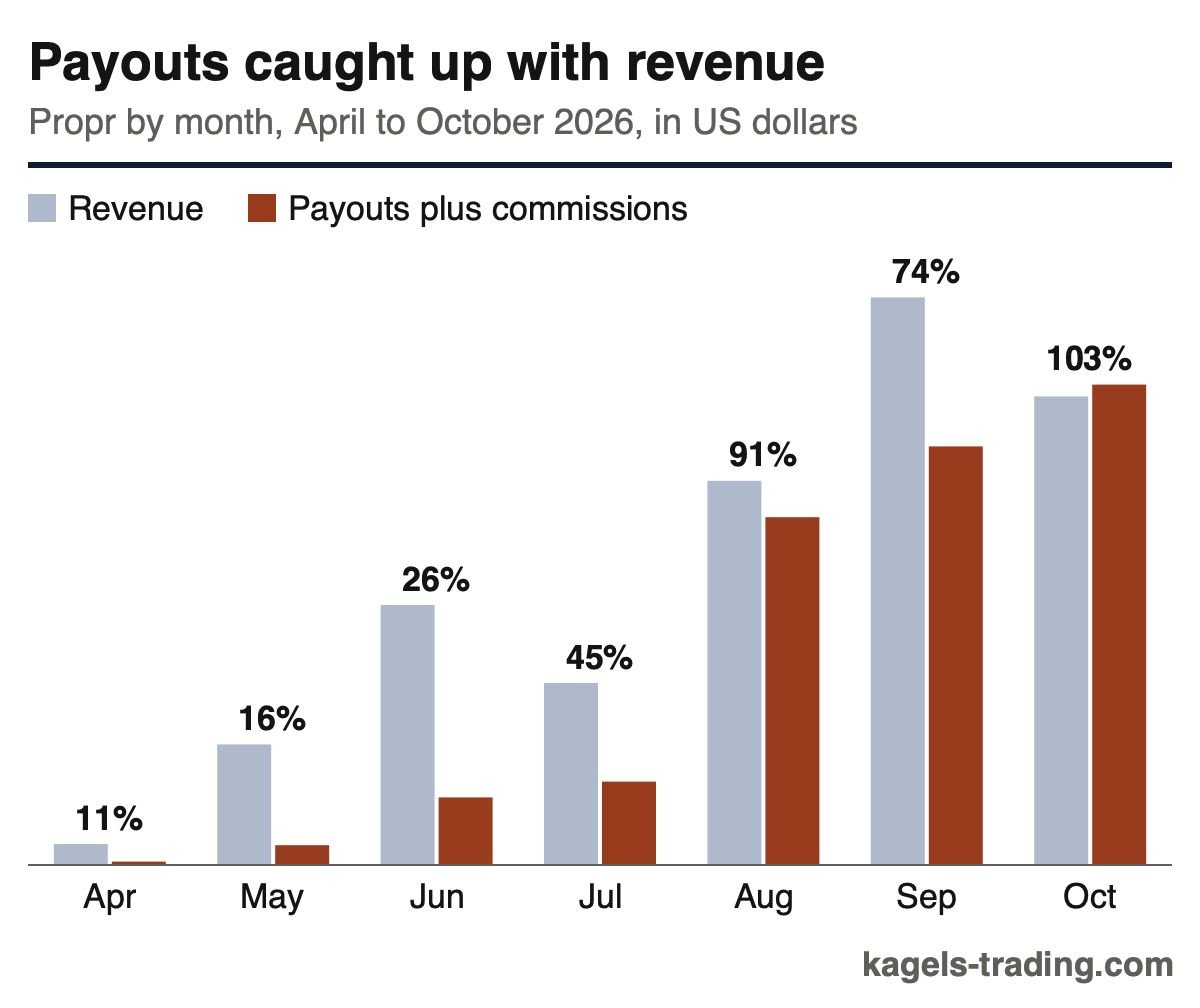
Propr’s income is test fees, and nearly all of it now goes straight back out. That is the core of the story. From April to July, payouts took 11 to 37 percent of revenue, a pattern typical for a young prop firm, because few early buyers have reached a payout yet. In August the share jumped to 82 percent, and in October it reached 93 percent.
 Click to enlarge
Source: Propr transparency dashboard.
In October, Propr paid out more than it earned before hedging. Revenue was $1,324,847, payouts $1,230,508 and affiliate commissions $127,576, which leaves a minus of about $33,000. These figures come from Propr’s dashboard data; the founder’s slide shows commissions of $132,485, which makes the minus slightly larger. A hedging profit of $285,952 turned that into a reported gross profit of $252,715, or 19 percent. Fixed costs come on top; the dashboard estimates them at $100,000 a month, while the founder’s own stress table shows $70,000.
The founder says this openly and has set himself a limit. In his October review of November 5, he calls 19 percent the first month under his 20 percent threshold. If gross profit stays below 20 percent for two consecutive months, he says, Propr will cut what it offers per dollar of fee: lower position limits and leverage, pricing by trader edge, restrictions around volatile events and payout caps. He expects 25 percent in November. Propr also reduced funded capital by 24 percent in October, to $17.7 million, and capped tests.
November has started the other way. In the first days to November 6, revenue was $238,360, payouts $211,636 and commissions $18,972, and the hedge book realized a further $134,493 loss. That is a gross loss of $126,742 so far. A few days prove little on their own, but if this trend holds, the rule changes described above could arrive. Anyone buying a test today should reckon with tighter terms.
The hedge book on November 5: what the data shows
Propr keeps part of its trades internal and copies others to the live market, but the exact share is unclear. Copied trades are called A-book and internal ones B-book. The dashboard shows 2.3 percent A-book, yet the data feed behind it marks this figure as a fallback, not a live value, so I would not rely on that number. What matters for you: on an internal trade, a simulated gain is a liability the firm carries itself.
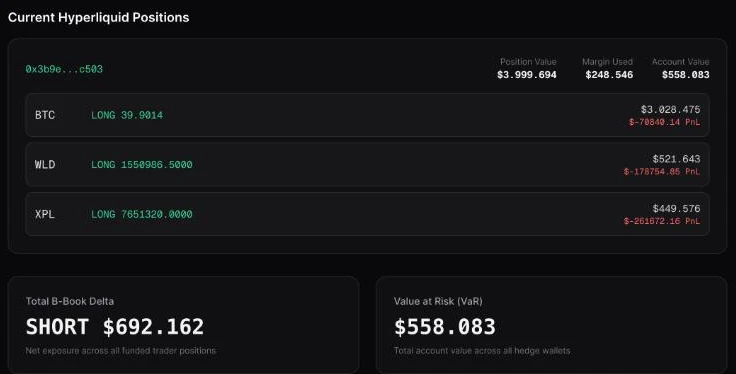
On November 5, the public hedge wallet held long positions worth about $4 million on $561,000 of account value. That is about 7.1 times the total account value, by my calculation, or about 10 times the $400,059 held in the perpetuals account alone. I checked the figures on the Hyperliquid API at 22:32 UTC, and they match Propr’s dashboard. The positions come from a single wallet, and Propr may change them at any time.
 Click to enlarge
| Long position | Value | Open result |
|---|---|---|
| BTC $77,674 to $75,975 |
$3,031,268 | -$68,047 |
| WLD $0.4516 to $0.3363 |
$521,380 | -$179,019 |
| XPL $0.0930 to $0.0588 |
$449,752 | -$261,496 |
| Total | $4,002,400 | -$508,562 |
Below each coin: entry price to current price. Source: Hyperliquid public API, wallet 0x3b9e…c503, November 5, 2026, 22:32 UTC.
These figures move by the minute, so treat them as a dated snapshot. At a later check on November 6, at 18:32 UTC, Propr had cut the BTC long from about 39.9 to 28 BTC, while WLD and XPL were unchanged. Position value was about $3.1 million, the open loss $490,304 and the account value $549,767. Propr had paid out a further $40,643 that day, and I found no public statement from the firm on the hedge losses.
Most of the loss comes from two small coins, not from Bitcoin. WLD and XPL account for about 87 percent of the open loss on a quarter of the position value. Neither appears among the 20 largest B-book exposures on the dashboard. Propr does not say why the wallet holds them. They may be copies of individual traders’ positions, which would fit its stated model of following its best traders, but I cannot tell that from the public data.
If the market keeps falling and these positions stay in place, Propr could lose on both sides. The dashboard shows traders on the internal book net short by about $692,000; those simulated accounts gain if their markets fall. The wallet, in contrast, is net long and loses in that case. How large the combined effect would be depends on which assets move, so these totals do not give a figure. Propr’s dashboard describes its Hyperliquid activity as “market-neutral hedging”. The wallet on its own is clearly not neutral; whether the whole book is, I cannot judge from outside.
 Click to enlarge
Source: Hyperliquid public API, November 5, 2026, 22:32 UTC.
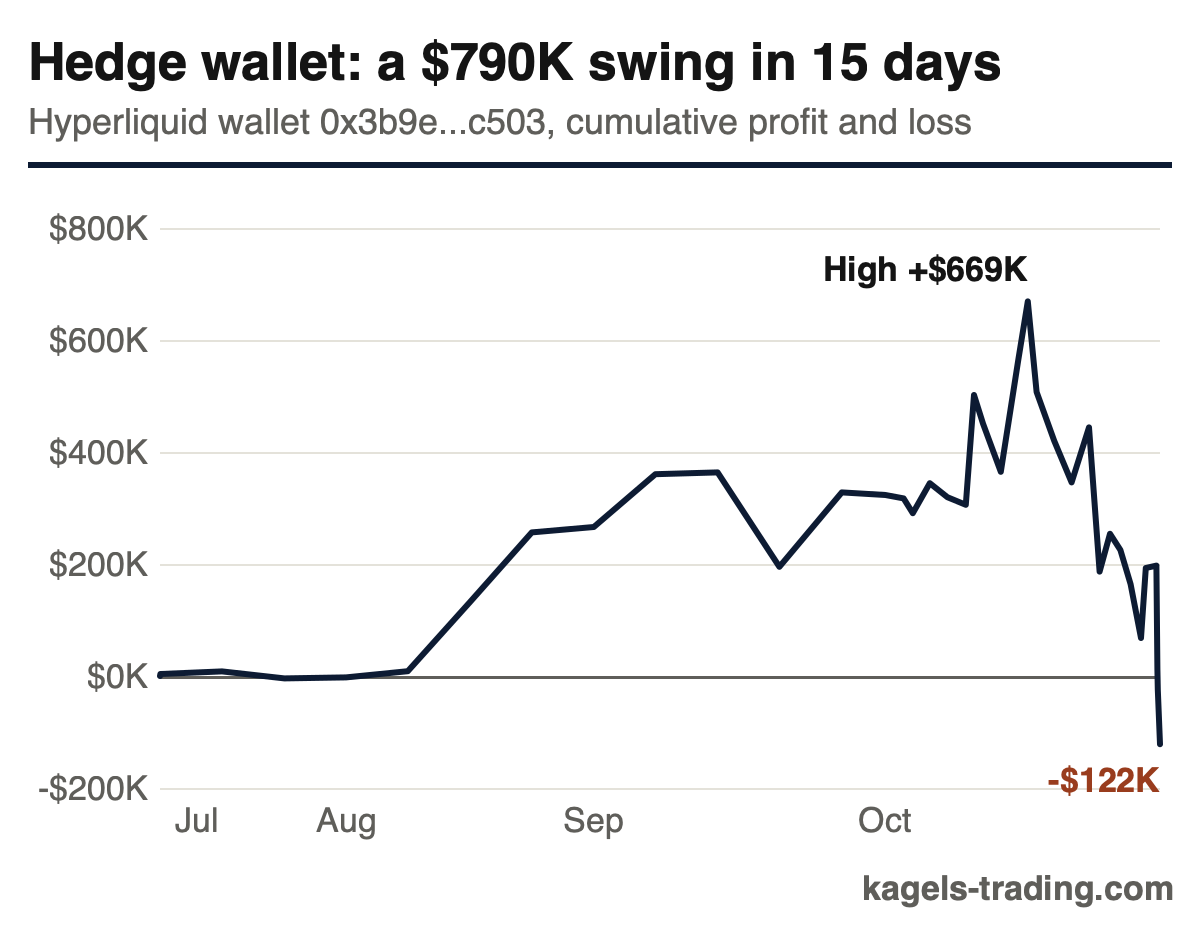
This wallet has given back all of its earlier gains. At the snapshot of November 5, its 24-hour result was -$352,922, over 7 days -$339,205 and over 30 days -$437,186; since its start it stands at -$121,688. Propr’s dashboard headline still shows +$501,180 in hedge profit, but that is a different measure: “realized only”, across three wallets. The hedging page lists open positions only for this wallet. If that is complete, realized profit minus the $508,562 open loss comes to about zero. Open losses can also recover, and the positions could be closed, cut or added to at any time.
The reserve is smaller than it first sounds. Propr reports $596,000, and I confirmed the parts: $556,000 sits on Hyperliquid under the label margin, $40,412 is in the hot wallet, and the cold reserve holds nothing. So about 93 percent of the reserve is in the same account as the losing positions. The open losses are already deducted from that figure, so do not subtract them again. For October, the founder put public reserves at $861,097. On November 5, about $200,000 moved into the hedge account from another wallet during the slide, according to Hyperliquid’s ledger. Hyperliquid showed a BTC liquidation price of $63,930 at that moment, assuming the other positions and balances stay as they are.
The founder’s answer is a stress test and a $4 million credit line. He reports a liquidity cover of 450 percent: $4.86 million against a modelled stress month with a $1.08 million cash outflow. Three points matter here. That post went out at about 10:16 UTC on November 5, before most of the day’s loss. Its stress case assumes hedging contributes $0, not that it loses money. And $4 million of the cover is a credit facility from the founder himself, which I could not verify. In August, he wrote it would be posted onchain temporarily for verification, and it does not appear in the public reserve today. By my calculation, $596,000 covers about 55 percent of his stress month without it.
The Radecker video: what his numbers show
One source for this review needs a clear label. The German video by Christoph Radecker, published on November 5, 2026, argues that Propr’s business model is breaking. Radecker runs IQ Capital, a direct competitor, and says in the same video that traders should work with good firms “like us, like IQ Capital”. We earn commission from IQ Capital too. Neither he nor we are neutral here, so I checked his numbers at the source instead of repeating them.
His figures hold up against the source data. I compared them with Propr’s dashboard and the Hyperliquid API, and they fit, apart from small differences due to timing.
| Claim in the video | Checked |
|---|---|
| Hedge wallet about -$350,000 in 24 hours | Confirmed: -$352,922 |
| About -$330,000 in 7 days, about -$440,000 in 30 days | Confirmed: -$339,205 and -$437,186 |
| About -$500,000 in open losses | Confirmed: -$508,562 |
| Gross profit about -$110,000 in November so far | Confirmed on Nov 5: -$108,216 |
| October profit came only from hedging | Confirmed: about -$33,000 before hedging |
| Propr will probably not survive | His opinion; the data does not show this |
His conclusion goes further than the data. “Personally, I don’t believe it,” he says about Propr’s survival. The public numbers show pressure on margin and liquidity. They do not show a firm’s full assets and liabilities, and they do not show that it cannot pay. Payouts were running on the day of the video, I found no report of stopped payouts as of November 5, and the video does not mention the founder’s credit line or the cuts to funded capital. In the automatic transcript, he also seems to call one of the coins Trump’s; WLD is the ticker of Worldcoin. A one-day snapshot in a falling market also says little about the next month.
Propr reviews: what Trustpilot shows
On Trustpilot, Propr scores 4.4 of 5 from 67 reviews, which is a small base. That was on November 5, 2026. About 87 percent are five-star and 9 percent one-star. According to its Trustpilot profile, the firm has a paid subscription, replies to negative reviews and has not invited customers recently, and Trustpilot itself warns that reviews may not be representative.
The negative reviews are mostly about support and the platform, not about unpaid money. Reviewers from August and September 2026 describe slow replies, a payment error, a disputed test result and stop orders that did not behave as expected; Propr replied to that last one that it is in beta and offered a refund or reset. These are individual reports, not proven facts. Many review sites praising Propr earn referral money from it, so I give them little weight. An exception is The Industry Spread, which states it has no referral ties. On September 7, it traced a payout onchain and found it matched the dashboard.
Is Propr legit?
Propr is a real business that pays real money, but it is not a regulated one. You buy a service, not an investment. The firm is not a broker and takes no deposits, and your claim on a payout rests on terms it can change. Under those terms, BVI law and BVI courts apply, class actions are waived, and its liability is capped at the fees you paid for the service. Whether these clauses hold in your country is a legal question this review does not answer.
A lot speaks for Propr. Revenue, payouts, reserve, hedge positions and pass rates are public, and I could verify the key wallet figures myself. I have not seen this much from any other firm in our prop trading overview. Without that openness, this review could not exist. The founder is named and writes about his own mistakes, such as having no cap on tests.
Several things speak against it. The firm is about seven months past its first revenue and has not lived through a long downturn. Its margin has fallen sharply, and its reserve is small against $1.2 million in monthly payouts. The hedging that carried its October result has turned sharply against it. The public roadmap also looks out of date, with a token launch on August 24, 2026, still listed as planned. And the rules give it wide discretion over who gets paid.
My verdict on legitimacy: I see no evidence that Propr is a scam, and clear signs of pressure on its margin and liquidity. In more than 45 years in the markets, since 1980, I have seen many firms look healthy until a bad week. Public numbers are a real advantage, because you can watch the problem develop. Only pay fees you could lose completely, and treat the fee like the price of a seminar, not an investment. Trading with leverage carries a high risk of loss.
Pros and cons of Propr
Propr is strong on openness and trading freedom, and weak on financial cushion and on the fine print. Here are the main strengths and weaknesses in brief.
Pros
- Public books: revenue, payouts, reserve and hedge positions can be checked, in part onchain.
- Fast payouts: a median of under 10 minutes, on demand from $20.
- Wide trading freedom: bots, AI agents, news and weekend trading are allowed.
- No time limit, no minimum days, no consistency rule.
- Low entry: tests from $25, with static drawdown on the 1-Step accounts.
Cons
- Thin margin: payouts took 93 percent of revenue in October.
- Small verified reserve: $596,000 on November 5, almost all of it in the hedge account.
- Hedge risk: long positions of about 7 times the wallet’s value and $509,000 in open losses at that time.
- Discretion: broad bans, risk interviews and likely tighter terms.
- No regulator, young firm, BVI courts, simulated accounts.
- Rule contradictions on leverage, multiple accounts and the 2-Step high-water mark.
Alternatives to Propr
Perp-based prop firms are still a small market, and the same questions separate them. Ask what share of revenue goes to payouts, how large the verifiable reserve is and how often the firm has changed its rules. Few firms let you check this, which is one reason not to judge Propr more harshly than firms that publish nothing.
Our reviews of other firms use the same method. The Bitfunded review covers another crypto prop firm and its payout review; our prop trading guides cover futures firms too. We earn commission from some firms in this field, as each page states, and this page carries no partner link to Propr.
Our verdict: rare openness, and the numbers call for caution
Propr offers something rare: you can see the risk with your own eyes. Its payout record is real, its rules suit automated crypto traders and its low-priced tests are easy to try. The founder discusses his problems in public, which many firms in this industry never do.
What I see right now would make me careful. Payouts are close to revenue, the main hedge wallet has fallen below zero since its start, and the verified reserve is small. The founder has already named the next step if the margin stays low: lower limits and possibly payout caps. How this plays out, I do not know.
In short: if you want to try Propr, keep it small and take your money out as you earn it. I would not buy a large account until the November figures are in. If you are already funded, the on-demand payout is your best protection, because profit you have not requested is only a number on a simulated account.
- Good fit for: experienced crypto traders with a tested, ideally automated system, who can lose the fee and check the dashboard themselves.
- Not a fit for: beginners, anyone who needs a regulated counterparty, traders running several accounts, and anyone counting on a payout to cover living costs.
This review describes the firm’s rules, costs and public data at one point in time; it is not investment advice. It is not a recommendation to buy or to avoid an account, and the hedge figures can change within minutes. Check the live dashboard before you decide.
Frequently asked questions about Propr
Is Propr legit?
Propr pays real USDC and publishes its payouts, but it is young and unregulated, and its margin is under pressure. The company is Propr Limited in the British Virgin Islands. I found no evidence of a scam and no report of stopped payouts as of November 5, 2026. All accounts are simulated, and you buy a test, not an investment.
Are payouts at Propr at risk?
Payouts were running on November 5, 2026, but the cushion behind them has become thinner. That day its hedge wallet showed $509,000 in open losses, and its public reserve was $596,000, nearly all of it in that same account. The founder also cites a $4 million credit line, which I could not verify. The public data does not show the firm’s full finances, so request profits as you earn them.
How much does Propr cost?
The 1-Step costs $25 to $1,998 and the 2-Step $50 to $1,499, each as a one-time fee. The price depends on account size and type; the Turbo is cheapest and has only a 3 percent drawdown. Fees are not refundable, and discounts often change the final price.
How does Propr pay out?
You request a payout at any time from $20, and Propr sends 80 percent of your simulated profit in USDC. Positions must be closed, and each payout sweeps your entire profit. You need a KYC check first. Propr reports a median payment time of about 10 minutes.
Does Propr really hedge trades on Hyperliquid?
Partly: it holds public positions on Hyperliquid, but the share of trades it copies is unclear. The 2.3 percent on its dashboard comes from a data feed marked as a fallback. The firm decides which trades to copy, and execution is not guaranteed for any trader. You can see the current positions on its hedging page.
Can I use Propr from the United States?
The United States is not on Propr’s list of restricted countries, and its dashboard shows US traders as its largest group by revenue. The list names about 30 countries, including Russia, Iran, Nigeria and Pakistan, and it can change. Using a VPN from a restricted country ends the account with no refund. This says nothing about the legal position in your state, so check that yourself.
More Prop Trading guides
- Understand the drawdown rules
Trailing Drawdown at Prop Firms: The Math, With Real Trades
Static, end-of-day and intraday trailing limits, risk per trade and pass rates, tested with 61 real trades.
- Check Take Profit Trader
Take Profit Trader Review: Rules, Costs and Payouts
Test rules, full costs, PRO and PRO+ payouts and the drawdown rule that changes after you pass.
- Check Bulenox
Bulenox Review 2026: Rules, Costs and Payouts
Three account types for a one-time fee, drawdown options, payout rules and the open questions about the company.
- Check Bitfunded
Bitfunded Review 2026: Rules, Costs and Payouts
A crypto prop firm: four account types, loss limits with open positions, payout review and what the competition prize pool is made of.
- Check IQ Capital
IQ Capital Review 2026: Costs, Rules and Payouts
Crypto, CFD and futures accounts from $9, the strict per-trade loss limit, payout caps and the company in Saint Lucia.
- Check Tradeify
Tradeify Review 2026: Prices, Rules and Payout Caps
Growth, Select and Lightning compared: one-time prices, the real-time drawdown and how far the payout caps sit below the profit goals.
- Check Apex Trader Funding
Apex Trader Funding Review 2026: Prices, Rules and Payouts
What the evaluations really cost, EOD vs Intraday on a 50K account, payout caps and what the User Agreement says about rewards.
- Check Topstep
Topstep Review 2026: Rules, Costs and Payouts
Three stages, two of them simulated: the monthly fee per attempt, the trailing loss limit and why the timing of the first payout matters.