
IQ Capital Review 2026: Costs, Rules and Payouts


Contents
- IQ Capital in 30 seconds
- What is IQ Capital?
- What does IQ Capital cost?
- IQ Capital rules: drawdown, position loss and consistency
- IQ Capital payouts: how much and how fast?
- IQ Capital reviews: what Trustpilot shows
- Is IQ Capital legit?
- Pros and cons of IQ Capital
- Alternatives to IQ Capital
- Our verdict: cheap to start, strict once funded
- Frequently asked questions about IQ Capital
- About the author
IQ Capital grew quickly in Germany, and it now wants US traders, too. Its countries page lists the United States and the United Kingdom as accepted, and Google searches for the name in the US have risen sharply since the summer of 2026. The pitch: funded accounts up to $200,000 for crypto, CFDs and futures, starting at $9.
For our German review I opened an account myself, tried the web platform and followed the firm’s Discord. For this English version I checked every price, rule and payout condition again against the IQ Capital pricing page, the help center and the company’s own FAQ on October 17 and 18, 2026. I also read all English one- and two-star reviews on Trustpilot, because they show where traders actually run into trouble.
Disclosure: Kagels Trading is an affiliate partner of IQ Capital. If you buy an account through one of our links, we may earn a commission; your price does not change. The criticism in this review stands as the sources show it. How we research and write is described on our editorial policy page.
IQ Capital in 30 seconds
- Overall: a young prop firm run by Christoph Radecker, with simulated accounts for crypto, CFDs and futures. The rules are documented in detail, but the firm’s own pages contradict each other on several points, including where the company is registered.
- Cost: a Core challenge costs $40 to $200 for crypto and CFDs and $39 to $95 for futures at the current 80 percent sale. After you pass, an activation fee of $129 to $999 is due, and most accounts cost $5 or $19 per 30 days to keep running.
- The rule to know: on Core accounts with a position loss limit, which covers all crypto and CFD Core accounts, one market may not lose more than 1 percent of the starting balance in the challenge and 0.5 percent once funded, and commissions, spreads and slippage count toward that limit. Futures accounts can choose a daily loss limit instead. More than half of the English negative reviews are about the position loss rule.
- Payouts: 90 percent on Core accounts, first request after 10 active trading days, capped per request and at half of your profit. Payment in USDC or by bank transfer.
- Good fit for: disciplined traders who risk well below 0.5 percent per trade and want crypto or CFD accounts with overnight holding. Less suited to futures traders who want the usual US setup at the lowest cost.
- Trust signals: Trustpilot 4.7 of 5 from 577 reviews on October 18, 2026, 404 of them in German. The operator is a company registered in Saint Lucia in 2026.
What is IQ Capital?
IQ Capital is a prop trading firm that sells access to simulated trading accounts for crypto, CFDs and futures and pays traders a share of the simulated profit. You either pass a challenge first or buy an instant funding account that skips the test. Only the strongest traders are moved to IQ Elite, where the firm says you trade real capital.
A prop firm, short for proprietary trading firm, provides trading capital or simulated accounts and shares the profits with the trader instead of taking deposits from customers. IQ Capital says so itself in its disclaimer: traders do not invest their own capital, and trading takes place in simulated evaluation environments or proprietary funded accounts. What you pay are fees, not deposits.
IQ Capital sells two separate product lines with their own prices and rules. Crypto and CFDs run on the in-house IQC Trader platform, built on Volumetrica, or on MetaTrader 5. Futures run on Quantower, ATAS and Deepcharts, or through Tradovate, which also lets you trade from TradingView or NinjaTrader. Within each line there are three plans: Core, Rapid and Instant Funding.
Do not confuse the firm with other companies of the same name. IQ Capital at iqcapital.io has nothing to do with IQ Capital Invest, which the German financial regulator BaFin warned about in June 2024, or with the UK venture capital firm IQ Capital in Cambridge. Google mixes these names in its results, which also inflates the search numbers for the brand.
Who is behind IQ Capital?
The managing director named in the imprint is Christoph Radecker, a German futures trader. On its homepage the firm calls him a trading championship winner. In an interview with the German site prop-trader.de he described his path from warrants to futures in 2006, his work on the European rollout of NinjaTrader and his time as a co-founder of the prop firm The Trading Pit, which he left after an exit. We could not confirm the championship result on the organiser’s website, so I only report it as the firm’s claim.
Radecker appears in person, which is less common in this industry than it should be. The help area in the dashboard has videos in which he explains the rules, and he is visible in the community. Bulenox, for comparison, names no managers at all, as our Bulenox review shows. A known name is no guarantee, but it means someone is accountable in public.
IQ Capital at a glance
| Point | Details |
|---|---|
| Operator | BEYOND IQ CAPITAL Ltd, Gros Islet, Saint Lucia (company no. 2026-00296); paying agent Payora Group Limited, Limassol, Cyprus |
| Managing director | Christoph Radecker |
| Markets | Crypto, CFDs (forex, indices, commodities, stocks), CME futures |
| Account sizes | Crypto and CFDs $50,000 to $200,000; futures $50,000 and $100,000 |
| Plans | Core, Rapid, Instant Funding |
| Profit split | 90% (Core, Instant), 80% (Rapid) |
| Platforms | IQC Trader (Volumetrica), MetaTrader 5; Quantower, ATAS, Deepcharts, Tradovate (with TradingView, NinjaTrader) |
| US traders | Accepted according to the countries page |
Sources: imprint, pricing page, countries page and help center of iqcapital.io, checked October 17 and 18, 2026.
What does IQ Capital cost?
IQ Capital advertises an 80 percent discount on almost everything, so the crossed-out list price is not the price you pay. The pricing page shows both numbers side by side with the promo code 80FUNDING, and the homepage also advertises a refund on the first payout. Such sales have run for months, so the sale price is the realistic one, but check the final price at checkout on the day you buy.
The cheapest way in is a promotional account for $9. The firm presents it as a way to try the platform and the rules with little money at stake. You may hold only one crypto/CFD and one futures promo account, and promo accounts cannot be reset. One spot on the homepage still speaks of a “$1 Challenge”, while every other page names $9.
Our discount code KAGELS also works at the English checkout. Because we are an affiliate partner, the code is linked to us as well. IQ Capital’s promo codes are personal and single-use, so enter the code at checkout and compare the final price with the current sale price before you pay.
Crypto and CFD prices
| Account | Core challenge | Activation | Rapid | Instant funding |
|---|---|---|---|---|
| $50,000 | $40 | $129 | $135 | $349 |
| $100,000 | $89 | $149 | $225 | $699 |
| $200,000 | $200 | $999 | – | – |
Sale prices from the IQ Capital pricing page, identical for MetaTrader 5 and Volumetrica, checked October 18, 2026. List prices: Core $199, $445 and $999, Rapid $675 and $1,125, instant funding $1,745 and $3,495. Rapid accounts have no activation fee on the pricing page.
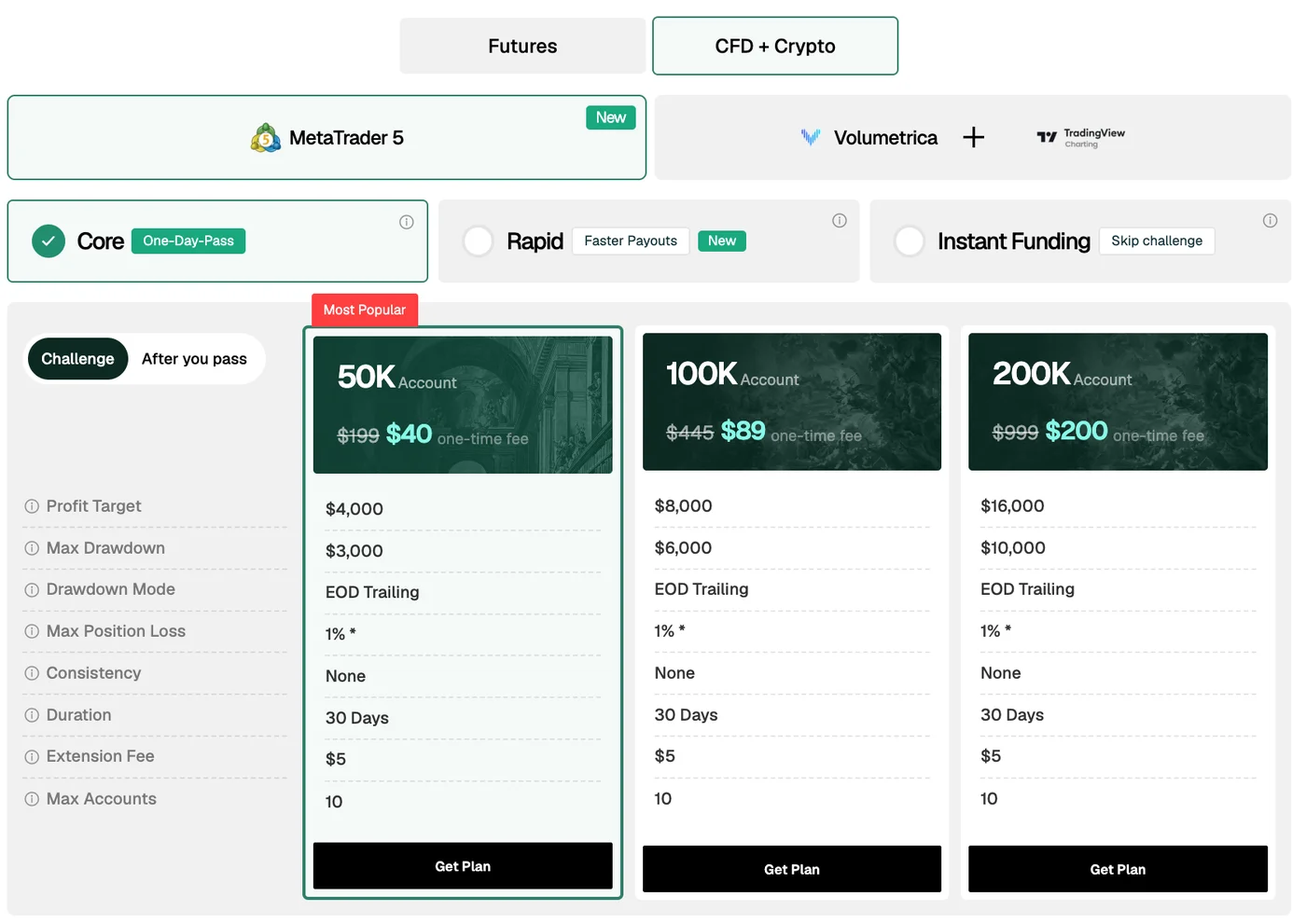 Click to enlarge
Futures prices
Futures accounts come in two risk versions, and the version decides which platforms you can use. Core accounts with a position loss limit run only on Quantower, ATAS and Deepcharts. If you want to trade through Tradovate, TradingView or NinjaTrader, you need an account with a daily loss limit instead; the help center says only those accounts are eligible for Tradovate.
| Account | Core challenge | Activation | Instant funding |
|---|---|---|---|
| $50,000 | $39 with position loss limit $49 with daily loss limit |
$129 | $349 |
| $100,000 | $95 | $149 | $699 |
Sale prices from the IQ Capital pricing page, checked October 18, 2026. List prices: Core $195 or $245 and $475, instant funding $1,745 and $3,495. Rapid futures cost the same as Rapid crypto: $135 and $225 on sale.
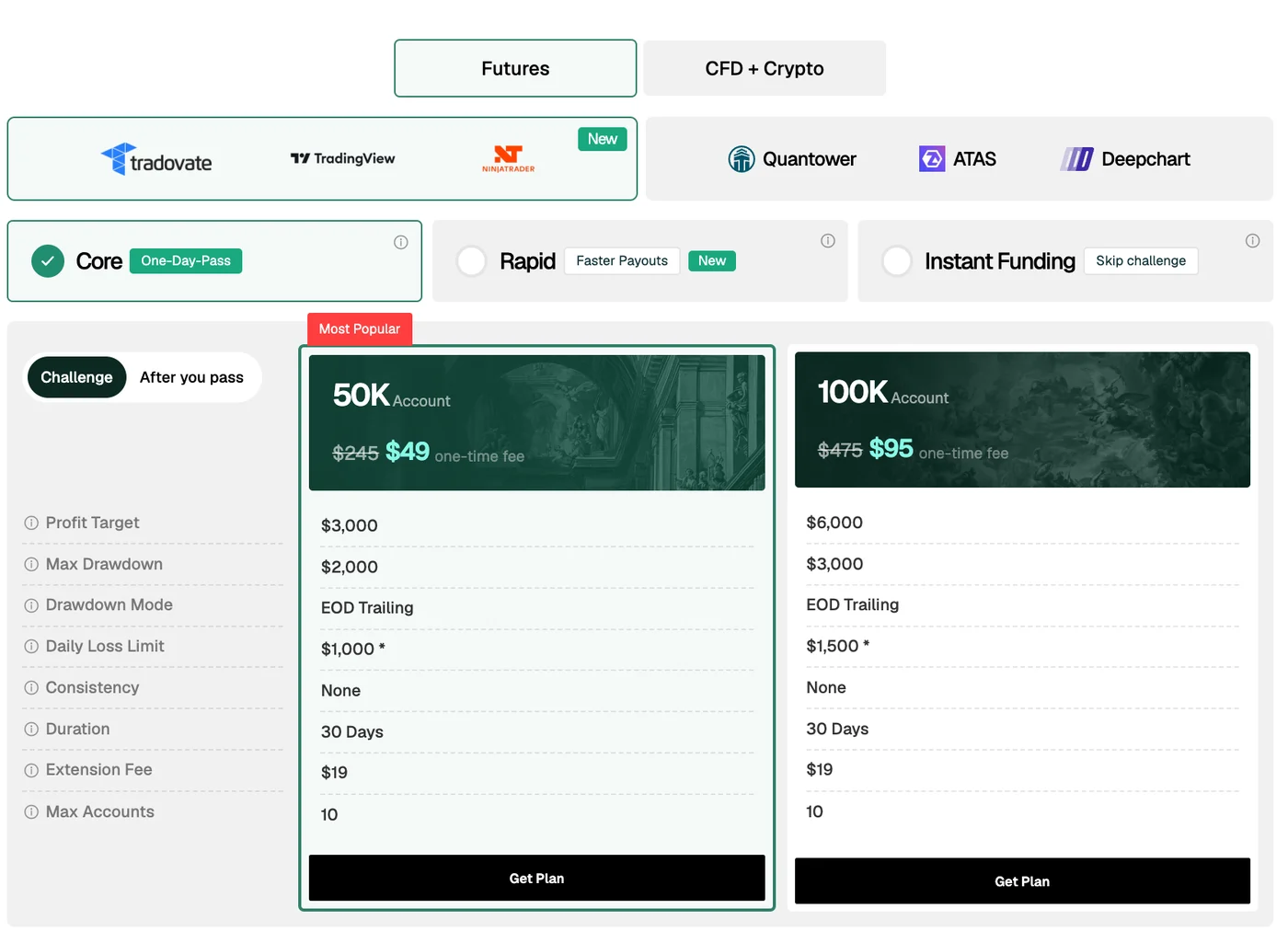 Click to enlarge
Running costs come on top, and they are easy to miss. Every Core challenge and every funded account runs for 30 days at a time. To keep it, you pay an extension fee of $5 for crypto and CFD accounts or $19 for futures accounts (older futures accounts can still cost $39, the help center says); without it, access ends for good, and the fee is not refundable, even if you lose the account before the new period starts. A reset after a breach costs $299 or $599. The Rapid futures funded account is the exception: the help center says it has no expiry date.
Commissions are charged per trade and count against your loss limits. For crypto on IQC Trader, IQ Capital charges a taker fee of 0.035 percent and a maker fee of 0.016 percent; on MetaTrader 5, crypto CFDs cost 0.12 percent per round trip. Forex and commodity CFDs cost $2.50 per lot and side, index CFDs are free. For futures, the help center names $2 per side for a mini and $0.75 for a micro contract on dxFeed and $2.88 and $0.80 on Tradovate, while the FAQ still says $1.50 and $0.50. Positions held overnight in CFDs pay swap fees.
Prices and sales change often, so check the pricing page on the day you buy. It shows every plan with its list price, the sale price and the fees after passing: here is the current IQ Capital pricing.
IQ Capital rules: drawdown, position loss and consistency
The drawdown at IQ Capital is an end-of-day trailing drawdown. Your loss floor moves up only once a day, after the New York close, based on your highest end-of-day equity, not with every intraday high. That is an advantage over intraday trailing models. But the floor itself applies at every moment, and it is measured against your equity, including open losses: if your equity falls below it during the session, the account is closed immediately, even before the trade is closed. The help center calls the base “balance” in one sentence and “equity” in the next, so watch the limit shown in your dashboard. Once the floor reaches the starting balance, or at the latest after your first payout, it stays fixed there.
A drawdown is the maximum loss a prop firm allows before it closes the account. On a $50,000 Core crypto or CFD account it is $3,000, on $100,000 it is $6,000 and on $200,000 it is $10,000. Futures accounts with a daily loss limit get less room: $2,000 on $50,000 and $3,000 on $100,000. The FAQ still says the drawdown is “6% of the starting balance”, which does not match these 4 percent accounts. Our guide to risk management shows how to size positions for a fixed loss budget.
The position loss limit: the rule behind most complaints
On Core accounts with a position loss limit, a single market may not lose more than 1 percent of the starting balance in the challenge and 0.5 percent once you are funded. On a $50,000 account that is $500 in the challenge and $250 in the funded account. The help center states that unrealized losses, slippage, commissions and spreads all count toward this limit, and that “even merely approaching or exceeding the limit on an open position can be considered a violation.”
Several trades in the same market count as one position. If you hold two trades in the Nasdaq at the same time, they share the $250 budget, so each may risk only $125. The help center itself recommends keeping risk at 0.25 to 0.4 percent and trading micro contracts in volatile markets. A stop loss does not protect you if slippage pushes the fill past the line.
A breach of this limit is a soft breach first. The position is closed, the account stays open and you can keep trading. The third breach is a hard breach and closes the account. Trades shorter than 15 seconds are only marked, not counted. This is what IQ Capital advertises as “up to 2 forgiven breaches”, but it applies only to the position loss limit; a drawdown breach always closes the account at once.
A simple calculation shows why costs matter so much here. Forex and commodity CFDs cost $5 per lot for opening and closing. If you trade 50 lots of a commodity CFD on a $50,000 funded account, $250 in commissions use up the entire limit before the price has moved at all. In our German review we documented a Trustpilot case in which the commission on a large natural gas trade alone came to about $708, above the $500 challenge limit. If you trade size, do this math before every trade.
Daily loss limit on futures accounts
Futures accounts with a daily loss limit drop the position loss rule and cap the whole day instead. The limit is $1,000 on $50,000 and $1,500 on $100,000. On the Core version the help center calls reaching it a hard breach, so the account closes at once. You get more freedom per trade but less total room, because the drawdown is also smaller.
Consistency, trading days and scalping
The Core challenge has no consistency rule and no minimum number of trading days. Once funded, a 30 percent consistency rule applies: your best day may not exceed 30 percent of your total profit. If you make $300 on one day, you need at least $1,000 in total profit before you can request a payout. The rule resets after each payout. Rapid challenges have a 40 percent rule.
A consistency rule limits how much of your total profit may come from a single day. It does not close your account; it only delays the payout until your profits are spread more evenly. Day traders who make most of their money on a few strong days should check this against their own history before buying.
The scalping rule decides whether a payout is approved. At least half of your trades must last longer than 15 seconds, and at least half of your profit must come from such trades. The list of prohibited practices also rules out high-frequency trading, latency arbitrage, copy trading from external signals, black-box bots and hedging across accounts. Hedging within one account is allowed only on crypto and CFD accounts.
Trading hours and news
News trading is fully allowed at IQ Capital. There are no blackout windows around CPI, the jobs report or Fed decisions, but the firm warns about slippage, and slippage counts toward the position loss limit. That combination makes news trades on Core accounts riskier than at firms with a pure daily loss model.
Futures positions are closed automatically every day at 4:45 pm New York time. Futures trade from 6:00 pm to 4:45 pm Eastern Time, Monday to Friday, so holding futures overnight or over the weekend is not possible. Crypto and CFD positions can be held overnight and over the weekend, with swap fees on CFDs. Our guide to futures market hours explains the CME sessions.
IQ Capital payouts: how much and how fast?
On Core and Instant accounts, your first payout request is possible after 10 active trading days. An active day is any day with at least one trade, with no minimum profit. Each request may cover at most 50 percent of your total profit, and the help center sets a cap per request on top.
| Account | Requests 1 and 2 | Requests 3 and 4 | Request 5 and later |
|---|---|---|---|
| $50,000 | up to $1,500 | up to $2,000 | up to $2,500 |
| $100,000 | up to $2,000 | up to $2,500 | up to $3,000 |
| $200,000 | up to $3,000 | up to $3,500 | up to $4,000 |
Caps per request on Core accounts, before the profit split. Source: IQ Capital help center, article “Performance Reward Core”, checked October 17, 2026.
The 90 percent split is applied to the amount you request, not to the whole profit. A $2,000 request pays you $1,800. For every later request, you need another 10 active trading days, and your new profit since the last payout must be at least half of the amount you request. There is no minimum payout.
IQ Capital pays in USDC on the Ethereum network or by bank transfer. The firm promises processing within 48 hours and charges no fee of its own, but your exchange or bank may. For US traders, a USDC payout means you need a crypto exchange account to turn it into dollars, unless you choose the bank transfer.
Rapid plans pay faster but less. The split is 80 percent, and the account closes after the fifth payout; any profit left in it at that point is lost, because the account is simulated. Each request may again cover at most half of your profit, and the caps are lower than on Core accounts. Rapid is built for traders who want quick cash from a few good weeks, not for a long-term account.
| Rapid account | Payout rules | Cap per request |
|---|---|---|
| Crypto | after 1 active day, no consistency rule | $1,000 / $1,500, later $1,500 / $2,000 |
| CFD | after 1 active day, 40% consistency in the help center, none on the pricing page | $1,000 / $1,500, later $1,500 / $2,000 |
| Futures 1D | daily, daily loss limit $1,000 / $1,500, 2nd breach closes the account | $1,000 / $1,500, later $1,500 / $2,000 |
| Futures 3D | every 3 active days, 40% consistency, no daily loss limit | $2,000 / $2,000, later $2,000 / $3,000 |
Amounts for the $50,000 / $100,000 account; “later” means from the third request. Caps before the 80/20 split. Sources: IQ Capital help center, articles on Rapid performance rewards and Rapid funded accounts, and the pricing page, checked October 17 and 18, 2026. Crypto and CFD accounts also keep the 0.5 percent position loss limit.
Rapid CFD accounts are the one place where IQ Capital’s own pages disagree on a payout rule. The help center names a 40 percent consistency rule for the Rapid CFD funded account, while the pricing page shows none for crypto and CFD Rapid accounts. Until the firm clears this up, assume the stricter rule and ask support before you buy.
The strongest traders can be moved to an IQ Elite account with real capital. The risk team decides; one trigger is reaching $25,000 in payouts on one account. An Elite account starts at a balance of zero, allows weekly payouts of up to 100 percent of profits at a 90/10 split and has individual risk limits. All funded accounts are closed when you move up, and losing an Elite account blocks new evaluations for a time.
IQ Capital reviews: what Trustpilot shows
On Trustpilot, IQ Capital scores 4.7 of 5 from 577 reviews. That was on October 18, 2026. 518 reviews give five stars and 24 give one star. 404 reviews are in German and only 133 in English, which shows where the firm’s customers come from so far. The profile has been managed by the company since September 2025, and Trustpilot marks it as a paying customer that actively invites reviewers.
IQ Capital has started to reply to criticism, but only to some of it. Trustpilot counts replies to 6 of 29 negative reviews, the latest on October 11, 2026. None of the 15 English one- and two-star reviews had a reply when I read them. On its own website the firm shows 4.8 stars, “20,000+ funded traders” and “$3.5M+ paid out”; these are its own figures, and I cannot check them.
The English negative reviews follow a clear pattern. More than half of them describe positions closed by the position loss limit through slippage or spread, stop losses filled far from the order, or a payout refused with reference to that rule. One reviewer made 4 percent in a CFD account and was still at minus 1 percent after commissions. Two others say they paid and their account was never activated. These are user accounts, not established facts, but they point to the same rule this review warns about.
Our own experience was positive on the service side. In the German test, the web platform was modern and easy to read, the founder’s videos in the dashboard were genuinely helpful and the Discord was active, with questions answered and payouts shared in public. The German test covered the platform, the dashboard and the community; for payout speed I rely on the firm’s rules and on user reports.
Is IQ Capital legit?
IQ Capital is not a broker and not a bank; it sells fee-based access to simulated trading accounts. You buy a service, not an investment. In its FAQ the firm writes that prop firms “trade their own money and are therefore not broker-dealer regulated.” For you that means: there is no investor protection of the kind a regulated broker offers, and no deposit you could get back.
The company behind the brand is young and registered offshore. The imprint names BEYOND IQ CAPITAL Ltd in Gros Islet, Saint Lucia, with a company number from 2026, and a paying agent in Limassol, Cyprus. The FAQ, however, still says IQ Capital “is incorporated in the UAE”, and Trustpilot lists the United Arab Emirates. The imprint gives no phone number, only an email address. If you ever had a dispute, you would be dealing with a company in the Caribbean.
Several facts speak for the firm. The founder is known by name and active in public, the rules are documented in detail with worked examples, US traders are openly accepted, and the homepage names the crypto exchange Phemex as a backer with “$10M+ in institutional capital”. That figure is the firm’s own claim about Phemex, and I could not check it.
My verdict on legitimacy: a real firm with a known founder, but with contradictions in its own documents and a very strict core rule. The contradictions on the registered country, the futures commissions and the drawdown percentage are not proof of bad faith, but they show that the rulebook is not yet carefully maintained. Only pay amounts you could lose completely without trouble, and treat the challenge fee like the price of a seminar, not like an investment.
Pros and cons of IQ Capital
Rules, costs and the firm’s own documents add up to a mixed picture. Here are the main strengths and weaknesses in brief.
Pros
- Low entry price: a promotional account for $9, Core challenges from $39 at the current sale.
- End-of-day drawdown: the floor moves only once a day and is fixed after the first payout.
- No daily loss limit and no minimum days in the Core challenge: on position-loss accounts you can pass in a single session.
- Crypto, CFDs and futures under one roof: with overnight and weekend holding on crypto and CFD accounts.
- Known founder: Christoph Radecker is named in the imprint and visible in videos and the community.
- US traders accepted: futures also through Tradovate, TradingView and NinjaTrader.
Cons
- Strict position loss limit: 0.5 percent per market once funded on position-loss accounts, including commissions, spreads and slippage.
- Running fees: $5 or $19 per account every 30 days (only Rapid futures funded accounts are exempt), plus an activation fee after passing Core.
- Payout caps: at most 50 percent of your profit and $1,500 to $4,000 per request on Core accounts.
- Rapid accounts close after five payouts: at an 80 percent split.
- Contradictions in the firm’s own pages: registered country, commissions and drawdown percentage.
- Young offshore company: registered in Saint Lucia in 2026, contact by email only.
Alternatives to IQ Capital
For US futures traders, the main alternatives are the classic US futures prop firms. The names that come up most often in comparisons are Topstep, Apex Trader Funding, My Funded Futures, Tradeify and Take Profit Trader. Check for each of them whether they limit your loss per trade, per day or only through the drawdown. On this site we have reviewed Take Profit Trader and Bulenox so far, and our prop trading comparison puts IQ Capital next to The Trading Pit.
For crypto and CFD traders, IQ Capital competes with forex prop firms such as FTMO and The5ers and with crypto firms such as Bitfunded, which we cover in our Bitfunded review. The deciding question is the same everywhere: how much may you lose per trade, per day and in total, and what do commissions do to that budget? If you compare these three numbers side by side, you compare the real hurdles instead of the advertising.
Our verdict: cheap to start, strict once funded
IQ Capital has a low entry price, but the full cost comes later. The $9 promo account and Core challenges from $39 on sale make it cheap to try; a funded Core account then adds an activation fee and the monthly extension fee. The end-of-day drawdown is fair, and crypto and CFD traders get something most US futures firms do not offer: overnight and weekend holding. The founder is known, the platform is modern and the community is active.
My main criticism is aimed at one rule. In more than 45 years in the markets, since 1980, I have rarely seen a risk limit that punishes normal trading costs as hard as the position loss limit does. Half a percent of the starting balance per market, including slippage and commissions, leaves very little room on a funded account, and more than half of the English complaints on Trustpilot lead back to it. If you trade this account, risk 0.25 percent or less per trade and use small contract sizes.
In short: IQ Capital suits disciplined traders with small, controlled risk per trade who want crypto or CFD accounts with a low entry price. It is not a way to learn trading, and futures traders who prefer a pure daily loss model should compare other futures firms such as Take Profit Trader first.
- Good fit for: crypto and CFD traders with tight stops, swing traders who want to hold crypto or CFDs overnight, and anyone who wants to test a prop firm for $9.
- Not a fit for: traders who size up on strong setups, futures traders who hold overnight, and anyone who only trusts money to an onshore company.
If you want to try it, start with the smallest account and read the help center article for your exact plan before you buy. Here is the IQ Capital website. As an affiliate partner we may earn a commission if you buy; this review is not investment advice and not a recommendation to buy an account. Trading with leverage carries a high risk of loss.
Frequently asked questions about IQ Capital
Is IQ Capital legit?
IQ Capital is a real prop firm with a known founder, but a young offshore company. The operator is BEYOND IQ CAPITAL Ltd in Saint Lucia, managed by Christoph Radecker; its FAQ still names the UAE. Trustpilot shows 4.7 of 5 from 577 reviews (October 18, 2026), with complaints mostly about the position loss limit. IQ Capital is not a regulated broker; it sells access to simulated accounts.
Can US traders use IQ Capital?
Yes, the United States is on IQ Capital’s list of accepted countries. Restricted are sanctioned countries such as Iran, North Korea, Cuba and Russia. US futures traders can use Quantower, ATAS and Deepcharts, or Tradovate with TradingView and NinjaTrader on accounts with a daily loss limit.
How much does IQ Capital cost?
At the current 80 percent sale, Core challenges cost $40 to $200 for crypto and CFDs and $39 to $95 for futures. The list prices are $195 to $999. After passing, an activation fee of $129 to $999 is due, and each account costs $5 or $19 every 30 days. Instant funding accounts cost $349 and $699 on sale.
How do payouts work at IQ Capital?
On Core accounts, the first payout request is possible after 10 active trading days. Each request may cover at most half of your profit and is capped at $1,500 to $4,000 depending on account size and payout number. You keep 90 percent, paid in USDC or by bank transfer, with processing promised within 48 hours.
What is the IQ Capital max position loss rule?
On accounts with a position loss limit, it caps the loss in one market at 1 percent of the starting balance in the challenge and 0.5 percent once funded. Commissions, spreads and slippage count toward the limit, and several trades in the same market are added together. A breach closes the position; the third breach closes the account. Futures accounts with a daily loss limit do not have this rule.
Which platforms does IQ Capital support?
Crypto and CFD accounts run on IQC Trader (Volumetrica) or MetaTrader 5. Futures accounts run on Quantower, ATAS and Deepcharts, or on Tradovate, which connects to TradingView and NinjaTrader. You choose the platform when you buy, and as a rule accounts cannot be moved later; only some funded futures accounts with a daily loss limit can be migrated to Tradovate under conditions the firm sets.
This US edition is based on our German edition on kagels-trading.de and has been adapted for US readers.
More Prop Trading guides
- Check Take Profit Trader
Take Profit Trader Review: Rules, Costs and Payouts
Test rules, full costs, PRO and PRO+ payouts and the drawdown rule that changes after you pass.
- Check Bulenox
Bulenox Review 2026: Rules, Costs and Payouts
Three account types for a one-time fee, drawdown options, payout rules and the open questions about the company.
- Check Bitfunded
Bitfunded Review 2026: Rules, Costs and Payouts
A crypto prop firm: four account types, loss limits with open positions, payout review and what the competition prize pool is made of.