
Bulenox Review 2026: Rules, Costs and Payouts


Contents
- Bulenox in 30 seconds
- What is Bulenox?
- Qualification, Fast Track and Momentum: three paths to a payout
- What does Bulenox cost? The prices at a glance
- Bulenox rules: drawdown, trading hours and news
- Bulenox payouts: how fast and how much?
- From Master to funded account: when do you trade real money?
- Bulenox reviews: what Trustpilot shows
- Is Bulenox legit?
- Pros and cons of Bulenox
- Alternatives to Bulenox
- Our verdict: documented rules, open questions about the company
- Frequently asked questions about Bulenox
- About the author
Bulenox rebuilt its whole pricing model in the summer of 2026. If you read an older review today, you are looking at conditions that no longer exist. The monthly subscription is gone, replaced by a one-time fee, and two new account types called Fast Track and Momentum were added.
For this review I collected the prices, rules and payout terms directly from Bulenox. The sources are the pricing page, the Bulenox FAQ, the help center, the commission sheet and the terms of use, checked on October 8, 2026. I did not buy an account myself, and we have no business relationship with Bulenox. How we research and write is described on our editorial policy page.
Bulenox in 30 seconds
- Overall: a US futures prop firm registered in Delaware that sells simulated accounts for a one-time fee. Since August 2026 there is no monthly subscription. The rules are documented in detail, but the terms of use date from 2021 and no longer match the offer.
- Cost: for the smallest account of $25,000, Momentum costs $94, Qualification $145 plus a Master activation fee of $143, and Fast Track $338. Commissions per contract come on top.
- Payouts: the first $10,000 is yours in full, after that you keep 90 percent. Bulenox says it processes Fast Track and Momentum requests the same day as a rule, but the classic Master account only on Wednesdays.
- Good fit for: futures day traders with a Windows computer and a tested setup who are flat before the close. Not for Mac users without Windows and not for swing traders.
- Trust signals: Trustpilot 4.7 of 5 from 1,815 reviews, but no replies to negative reviews, and the website names no founders or managers. Checked on October 8, 2026.
What is Bulenox?
Bulenox is a US prop trading firm from Delaware that gives futures traders simulated accounts from $25,000 to $150,000 for a one-time fee, pays out the first $10,000 of profits in full and 90 percent after that.
The model follows the familiar prop trading pattern. You pay a test or access fee, trade a simulated account and, if you succeed, receive a share of the simulated profit. Only after several payouts can Bulenox move you to a funded account with real money, and the firm alone decides that.
A funded account is a trading account on which a trader uses a prop firm’s capital and receives a share of the profit.
You can trade futures on the four CME Group exchanges only. That means CME, CBOT, NYMEX and COMEX. Bulenox lists about 40 contracts, among them the E-mini S&P 500, the Nasdaq 100, crude oil, gold, currency futures, grains, livestock and Micro Bitcoin. Almost every large contract has a micro version, and one standard contract counts as ten micros. Stocks, options, spot forex and CFDs are not offered.
Everything runs through the Rithmic data feed. To start, you install the Rithmic software R|Trader Pro; after that, Bulenox says you can connect one of more than 20 platforms, among them NinjaTrader, Quantower, Sierra Chart, MultiCharts and ATAS. Tradovate and TradingView are not on the list. The help center names one limit itself: Rithmic runs on Windows and is not supported on macOS or ChromeOS. If you are about to buy a machine, our guide to trading computers covers the Windows question.
The brand belongs to Bulenox LLC, with an address in Wilmington, Delaware. The Bulenox help center names no founders or managers; its “About Us” page only speaks of a platform “built by traders, for traders”. Who runs the firm therefore cannot be confirmed from the firm’s own pages.
Bulenox at a glance
| Company | Bulenox LLC, Wilmington, Delaware |
| Account types | Qualification, Fast Track, Momentum |
| Account sizes | $25,000 to $150,000 |
| Markets | Futures on CME, CBOT, NYMEX, COMEX |
| Data feed | Rithmic, Windows only |
| Profit split | First $10,000 at 100%, then 90/10 |
| Trustpilot | 4.7 of 5, 1,815 reviews (Oct 8, 2026) |
Qualification, Fast Track and Momentum: three paths to a payout
Since the rebuild, Bulenox offers three account types that differ mainly in whether you have to pass a test. Markets, platforms and account sizes are the same for all three. A copy in the Internet Archive from July 22, 2026 shows how much has changed: back then Bulenox still sold the Qualification as a monthly subscription, and by the end of August Fast Track and Momentum were online.
Qualification: the classic path with a Master account
With the Qualification, you first pass a test account. You reach the profit target without breaking the loss limit. There is no minimum number of trading days, and access lasts 30 days. Bulenox then reviews your account, and only after you pay a one-time activation fee do you trade the Master account, where payouts are possible.
Fast Track: straight to the payout account
Fast Track skips the test completely. You pay once and trade a simulated payout account from day one, with no test target and no minimum trading days. For your first payout, however, you must reach a profit goal that is just as high as the test target of the other two models. After at least three payouts, Bulenox may review the account for a funded account.
Momentum: a test with a free Master account
Momentum is a test that already includes the Master stage. Like the Qualification, you reach a profit target, with no minimum days and no consistency rule during the test. Bulenox then activates the Momentum Master without an activation fee. Access to the test also lasts 30 days.
For all three models you choose a risk model before you buy. It is either a trailing drawdown or an end-of-day drawdown. The choice is locked for the life of the account and sets the contract limit, the loss limit and the daily loss limit. The rules section below shows how both models work.
Your website login and your trading login are two different things. With your bulenox.com login you enter the member area, buy accounts and request payouts. For trading you get a separate Rithmic User ID with its own password there, which you use in R|Trader Pro or your platform. All of a trader’s accounts sit under exactly one of these user IDs.
What does Bulenox cost? The prices at a glance
All three models cost a one-time fee; Bulenox no longer sells a subscription for new accounts. To compare them fairly, you have to add the activation fee of the classic Master account. The table therefore shows the one-time fees up to an account with payout rights, based on list prices and assuming you pass without a reset. You still have to meet the payout conditions there before any money is paid out.
| Account | One-time fees up to a payout account |
|---|---|
| $25,000 | Qualification + activation: $145 + $143 = $288 Momentum: $94 Fast Track: $338 |
| $50,000 | Qualification + activation: $175 + $148 = $323 Momentum: $143 Fast Track: $488 |
| $100,000 | Qualification + activation: $215 + $248 = $463 Momentum: $248 Fast Track: $648 |
| $150,000 | Qualification + activation: $325 + $498 = $823 Momentum: $358 Fast Track: $788 |
List prices from the pricing page of bulenox.com, activation fees from the help center, both checked October 8, 2026.
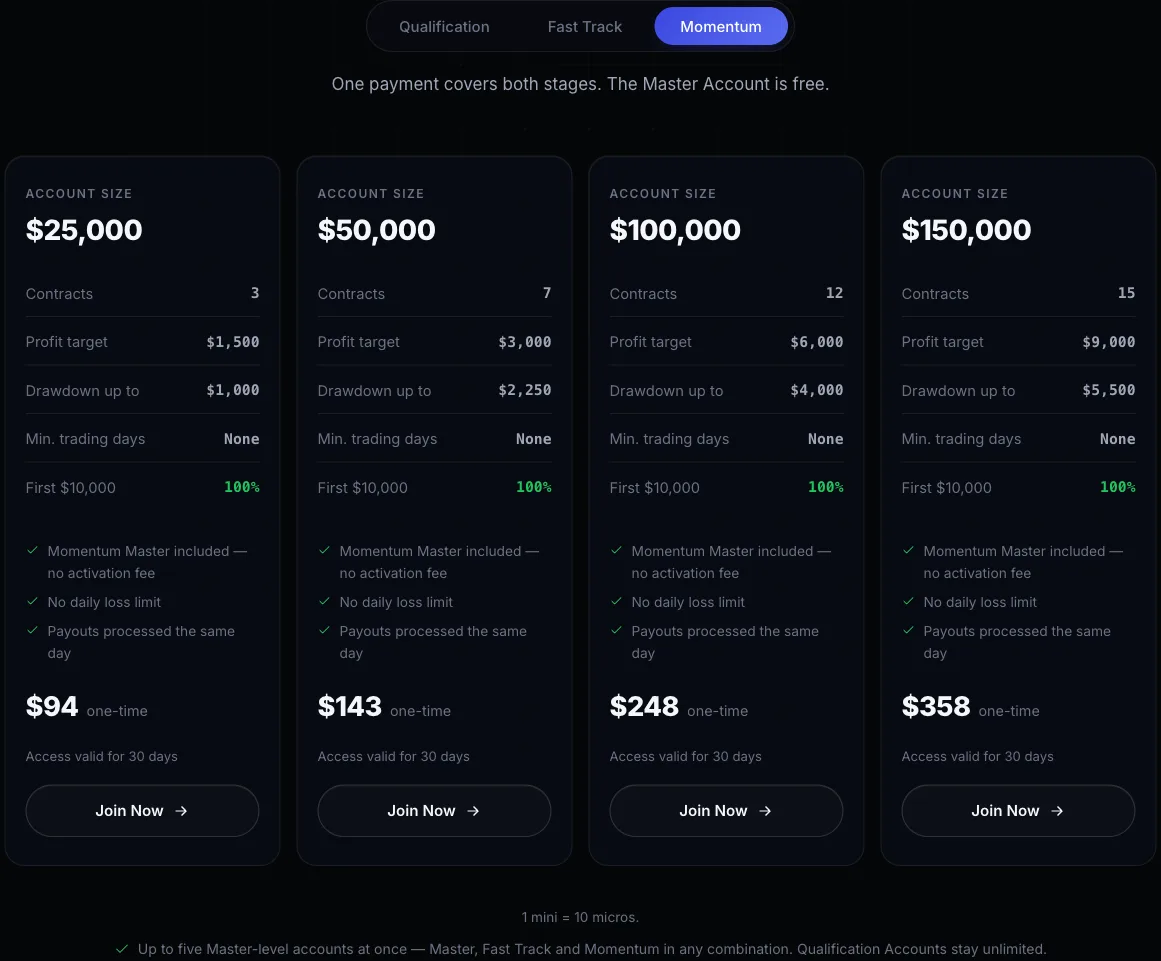 Click to enlarge
Momentum is the cheapest path in every account size, as long as you pass on the first attempt. On the Qualification, a reset after a drawdown breach costs $78 and returns the account to its starting balance, but it does not extend the 30-day access. The help center names no reset for Momentum. Fast Track saves you the test stage completely; in the three smaller sizes it costs more than Qualification plus activation, while for the $150,000 account it is slightly cheaper.
The screenshot shows one more detail: the Momentum account with the trailing drawdown has no daily loss limit, while the end-of-day version does. Do not compare prices alone, either. Accounts of the same size do not have the same risk budget: on the $50,000 account, the Qualification allows a $2,500 drawdown, Momentum and Fast Track only $2,250.
List prices are not always the final prices. Bulenox advertises discounts on its own website, and the price you pay can differ from the list prices shown here. Check the final price at checkout before you buy.
Running costs come on top while you trade. Bulenox charges commissions per side, so once when you enter and again when you exit. According to the commission sheet of August 11, 2026, an E-mini S&P 500 contract costs $2.09 per side and a Micro E-mini $0.61, so $4.18 and $1.22 per round trip. Commissions are part of your profit and loss and therefore count against your drawdown.
A single checkbox can get expensive. When you sign the Rithmic agreement, you declare yourself a non-professional or a professional. As a private trader you pay nothing extra for exchange data; as a professional, the pricing page says Bulenox charges $116 a month. Elsewhere the help center names $112 per exchange and month, so the two figures contradict each other. If you connect a trade copier or other software through a Rithmic API, you pay another $100 a month.
Bulenox rules: drawdown, trading hours and news
The most important decision comes before you buy. You choose between two risk models, and you cannot change this choice later. Both are available on all three account types and set how your loss limit moves.
At a prop firm, the drawdown is the maximum loss limit of an account; if the account value falls below it, the account is suspended or closed.
Option 1: trailing drawdown without scaling
With Option 1, the loss limit follows your highest account value in real time, including open profits. Bulenox gives its own example: a $100,000 account with a $3,000 drawdown starts with a limit of $97,000. If an open profit briefly lifts the account value to $100,800, the limit moves up to $97,800, even if you close the trade with only $500 profit in the end. In return, you trade the full contract size from day one.
Option 2: end-of-day drawdown with a daily loss limit
With Option 2, the limit moves only once a day, after the close and based on your closing balance. Swings during the day do not move it. Instead there is a daily loss limit that stops trading for the rest of the session without closing the account. The help center names two exceptions: the $25,000 Fast Track account has no daily loss limit, and on a Master account it is removed for good once the loss limit has locked. On the Qualification and the Master account, a scaling plan applies as well: you start with fewer contracts and may trade more as your profit cushion grows.
The daily loss limit and the drawdown are two different things. The end-of-day model only decides when the loss limit is moved up. If your account value falls below the existing limit during the session, that is a breach, and the account is closed or suspended. The daily loss limit, by contrast, only pauses the current trading day.
On the Master account, the loss limit locks at some point. Once it reaches the starting balance plus $100, it stays there for good. On a $50,000 Master this happens at an account value of $52,600, and the limit is then fixed at $50,100. According to the help center, the same principle applies to Fast Track.
Trading hours, news and account limits
Overnight positions are not allowed. The trading day runs from 5 p.m. to 4 p.m. CT (6 p.m. to 5 p.m. ET), and all positions must be closed by 3:59 p.m. CT (4:59 p.m. ET). The trading hours of the contracts themselves are in our guide to futures market hours.
News trading is explicitly allowed. Around CPI, Fed decisions and the jobs report there are no blackout windows and no forced closing; the only limits are the drawdown and the contract limit. If you trade around the Fed, our guide to the Fed interest rate decision lists the meeting dates. The FAQ allows bots, algorithms and trade copiers only as user-built tools for the account owner’s personal use; commercial, shared, rented or publicly distributed tools are banned. The older terms of use also require third-party algorithms to be approved by Bulenox management, so clear any automation with support first.
A Master account must trade at least once a week. If you go more than a week without a trade and without notice, the help center says the account may be put on hold or disabled. In total you may hold up to five Master-level accounts at the same time, whether Master, Fast Track or Momentum Master. Qualification accounts are unlimited.
Bulenox payouts: how fast and how much?
The profit split is generous: the first $10,000 in payouts is entirely yours. It is counted once per trader across all accounts. After that you keep 90 percent and Bulenox takes 10 percent. Payouts go out by ACH, wire transfer or PayPal; Bulenox charges no transfer fee itself, but banks and PayPal may deduct their own fees.
The three paths differ mainly in speed. Fast Track requests that arrive on a weekday before 12:01 p.m. CT (1:01 p.m. ET) are ordinarily processed the same day; weekends, bank holidays and compliance checks can delay this. Momentum also names same-day processing. This means processing of the request, not money arriving in your bank account. The classic Master account pays out only on Wednesdays, and the request must be in by Friday 11:59 p.m. CT. The table compares the two paths that include a test.
| Condition | Master and Momentum |
|---|---|
| Trading days | Master: 10 per payout Momentum: 5 qualifying profitable days per cycle |
| Consistency rule | Master: 40 percent Momentum: 35 percent |
| Minimum request | Master: $1,000 Momentum: $500 to $1,000 |
| Maximum on the $50,000 account | Master: $1,500 for the first three, then no cap Momentum: $1,500, $2,000, $2,500, from the fourth $3,000 |
| Processing | Master: Wednesdays Momentum: the same day, according to Bulenox |
Source: Bulenox help center, withdrawal rules and Momentum payout pages, checked October 8, 2026.
The consistency rule is the biggest hurdle before a payout. Your best trading day may only make up a limited share of your total profit in the payout period. Bulenox shows the math itself: with $5,000 profit and a best day of $2,500, the share is 50 percent, so the 40 percent limit on the Master is missed. If total profit grows to $7,500, the share is 33 percent and the payout goes through. Missing the rule does not close the account; you simply keep trading until the share fits.
For later payouts, the help center contradicts itself. The same section says that the best day does not reset after a payout, that the rule applies over the entire trading period, and that only the results of the new cycle count. Whether a strong day from before the first payout still counts later cannot be read from it with certainty. Ask support to confirm before you build your planning on it.
Momentum also sets conditions that the table only shows in short form. A qualifying profitable day needs at least $100 net profit after commissions on the $25,000 account, $150 on $50,000, $200 on $100,000 and $250 on $150,000. For a payout, the balance must reach at least $26,500, $53,000, $104,500 or $156,500. From the second payout on, each cycle also needs new net profit of $1,000, $2,000, $3,500 or $5,000, and the payout can never exceed the profit of the current cycle.
Fast Track has the strictest rule. There, your best day may make up only 20 percent of the cycle profit for the first payout, 25 percent for the second and 30 percent from the third on. For the first payout you also need a profit goal, $3,000 on the $50,000 account. After that, every cycle on that size needs $2,000 in new net profit; each request must be at least $1,000, the first three payouts are capped at $2,000 and every later one at $2,500.
On the classic Master account, a safety cushion stays in the account. After every payout, a minimum profit above the starting balance must remain, $2,600 on the $50,000 account. To request the minimum payout of $1,000 there, you therefore need a balance of at least $53,600.
Before the first payout, Bulenox requires documents signed by hand. You send an ID document and a tax form: a W-9 for U.S. persons, a W-8BEN for non-U.S. persons; electronic signatures are not accepted. The FAQ adds that funded traders are independent contractors and that U.S. citizens receive Form 1099-NEC. How you report payouts depends on your situation, so ask a tax professional.
From Master to funded account: when do you trade real money?
The regular path to real capital starts after three payouts. Only when a Master account has had three successful payouts can Bulenox consider it for a funded account. The help center says clearly that the move is not automatic: it is at Bulenox’s discretion and requires you to accept a separate agreement. If you decline, the Master account is closed.
Profits from the Master account do not move with you. Each funded account starts with its own end-of-day drawdown as a risk frame, and Bulenox stresses that this is neither a deposit nor a credit. Other active Master accounts with at least one payout may move into their own funded accounts under certain conditions. For Fast Track, the FAQ names 30 trading days in addition to three payouts.
One detail does not fit. The terms of use linked by Bulenox are dated July 2021 and say word for word that the company “does not provide live trading”. The help center, by contrast, describes the funded account as a real brokerage account traded with real money. Before you switch, read the separate funded account agreement that Bulenox presents at that stage.
Bulenox reviews: what Trustpilot shows
On Trustpilot, Bulenox scores very well: 4.7 of 5 from 1,815 reviews. That was on October 8, 2026. About 90 percent are five-star reviews, and 74 reviewers give one star. In the last twelve months, 727 reviews were added, the latest on October 8, 2026. The firm has managed its Trustpilot profile itself since May 2021.
Two notes on the profile are worth knowing. Trustpilot shows Bulenox as a customer with a paid subscription and notes that the company does not reply to negative reviews. The subscription alone is no evidence against the firm. The missing replies weigh more for me: they mean there is no public statement on the portal about negative reviews. Whether complaints are handled outside Trustpilot cannot be seen from this.
Bulenox publishes no pass rate. Other firms do: our Take Profit Trader review shows how many tests were passed there in 2025. At Bulenox this number is missing from the website, so how many buyers ever see a payout cannot be measured, and the many five-star reviews do not answer that question.
Is Bulenox legit?
Bulenox is not a broker and not a bank; it sells access to simulated trading accounts. You buy a service, not an investment. The company is a Delaware LLC, and its terms provide for binding individual arbitration of covered disputes under the rules of the American Arbitration Association, with Delaware law and the place of arbitration in Delaware. The clauses name exceptions and apply only as far as the law allows, but they limit your options in a dispute, so read them before you pay.
The documentation of the rules speaks for Bulenox. Fees, the drawdown math, payout caps and consistency rules are in the help center with worked examples, and the commission sheet carries a date. The list of restricted countries is public, too, in the FAQ: the United States, Canada, the UK and Australia are not on it, while countries such as Croatia, Serbia, Monaco, China and Taiwan are.
Gaps in the transparency of the firm itself speak against it. The website names no founders or managers, the linked terms of use are still dated July 2021 and contain a clause for the case that you order a product with recurring charges, and two pages name different prices for the same exchange data. Bulenox rules out refunds once an account has been used.
My verdict on legitimacy: the rules are documented in detail, but one payout rule is unclear and questions about the people running the firm remain. The open point is how the Master consistency rule counts after a payout. Only pay amounts you could lose completely without trouble, and treat the test fee like the price of a seminar, not like an investment. Trading futures carries a high risk of loss.
Pros and cons of Bulenox
Rulebook, prices and the firm’s own presentation add up to a mixed picture. Here are the main strengths and weaknesses in brief.
Pros
- One-time fee instead of a subscription: since August 2026 there is no monthly fee for new accounts, and Momentum even includes the Master stage without an activation fee.
- First $10,000 in full: up to that amount you keep the whole profit, after that 90/10.
- No minimum trading days in the test: Qualification and Momentum can in theory be passed in a single day.
- News trading allowed: no blackout windows around CPI, Fed decisions or the jobs report.
- Detailed documentation: drawdown, consistency and payout caps are in the help center with worked examples, though the Master consistency rule after a payout is described in contradictory ways.
Cons
- Open questions about management: the website names no founders or managers, and the terms of use date from 2021.
- Windows only: Rithmic, the required data feed, does not run on macOS.
- Strict consistency rules: 40 percent on the Master, 35 percent on Momentum, and on Fast Track as low as 20 percent at first.
- Classic Master pays only on Wednesdays: plus 10 trading days per payout and a safety cushion that stays in the account.
- Real money only at the firm’s discretion: the move to a funded account is not guaranteed, and Master profits do not move with you.
Alternatives to Bulenox
Bulenox competes with several US futures prop firms. The names that come up most often in comparisons are Topstep, Apex Trader Funding, My Funded Futures, Tradeify and Take Profit Trader. On this site we have reviewed Take Profit Trader so far; our prop trading page covers further firms.
The key questions are the same for every firm. How does the drawdown work in the payout account, and how strict is the consistency rule? If you put these two points side by side, you compare the real hurdles instead of the advertising.
Our verdict: documented rules, open questions about the company
Bulenox improved its offer with the rebuild in the summer of 2026. Without a monthly subscription, a failed attempt costs money only once, and Momentum covers the test and the Master stage in a single payment. The rules are documented in detail, news trading is allowed, and the first payouts are not split.
My criticism is aimed less at the rules than at the firm behind them. In more than 45 years in the markets, since 1980, I have learned to trust a business partner with money only when I know who runs it. Bulenox names no people, its terms of use are out of date, and the path to real capital depends entirely on the firm’s discretion. Also work through the consistency rules with your own trading style before you buy: if you make your profits on a few strong days, you will wait a long time for the first payout on the Master.
In short: Bulenox is a usable choice for experienced futures day traders who use Momentum as the cheapest entry and budget the fee as tuition. It is not a way to learn trading, and it does not suit swing traders who hold positions overnight.
- Good fit for: disciplined day traders with a tested setup and a Windows computer who are flat before the close and trade at least once a week.
- Not a fit for: beginners without a tested strategy, swing traders who hold overnight, and anyone who only trusts money to a firm with known management.
This review describes the firm’s rules and costs; it is not investment advice. It is not a recommendation to buy an account, and we do not earn a commission from Bulenox.
Frequently asked questions about Bulenox
Is Bulenox legit?
The rules are documented in detail, but questions about the management remain. Bulenox LLC is based in Wilmington, Delaware, but its website names no founders or managers. Trustpilot shows 4.7 of 5 from 1,815 reviews (October 8, 2026). Bulenox is not a regulated broker; it sells access to simulated accounts.
How much does Bulenox cost?
Since August 2026 you pay once instead of every month. Momentum costs $94 to $358, Qualification $145 to $325 plus a Master activation fee of $143 to $498, and Fast Track $338 to $788, for accounts from $25,000 to $150,000. Commissions per contract and side come on top, and promotions can change the final price at checkout.
How fast does Bulenox pay out?
On Fast Track and Momentum, Bulenox says it processes requests the same day as a rule; on the classic Master account only on Wednesdays. When the money arrives also depends on your bank or PayPal. The first $10,000 is entirely yours, then 90 percent. Payouts go out by ACH, wire transfer or PayPal.
What are the Bulenox rules for drawdown?
You choose a trailing or an end-of-day drawdown before you buy, and the choice is locked for the life of the account. The trailing drawdown follows your highest value in real time, including open profits. The end-of-day drawdown moves only once a day after the close and usually comes with a daily loss limit. If you fall below the existing limit during the session, you lose the account under both models.
Which platforms does Bulenox support?
Bulenox runs on the Rithmic data feed, and the firm lists more than 20 platforms. Among them are NinjaTrader, Quantower, Sierra Chart, ATAS and MultiCharts. Rithmic runs on Windows only, and Tradovate and TradingView are not on the list.
Which countries are restricted at Bulenox?
The United States is not restricted, and neither are Canada, the UK or Australia. The list does include countries such as Croatia, Serbia, Monaco, China, Hong Kong and Taiwan, and Bulenox says it can change at any time. Check the current list in the FAQ before you buy.
This US edition is based on our German edition on kagels-trading.de and has been adapted for US readers.