
Apex Trader Funding Review 2026: Prices, Rules and Payouts


Contents
- Apex Trader Funding in 30 seconds
- What is Apex Trader Funding?
- What Apex costs
- EOD vs Intraday drawdown on a 50K account
- Rules that decide whether you pass and keep the account
- How do Apex payouts work?
- Platforms and markets
- Reviews and reliability
- Pros and cons of Apex Trader Funding
- Who Apex fits and who should avoid it
- Apex vs Topstep and Tradeify
- Our verdict: clear rules, tight limits, discretion in the contract
- Frequently asked questions about Apex Trader Funding
- About the author
Apex Trader Funding sells a paid test in a simulated environment, not access to real trading capital. If you pass, you keep trading on a simulated Performance Account and can request payouts. The rules are public and detailed. The User Agreement, however, makes every payout a decision at Apex’s discretion.
For this review we read Apex’s own pages on November 6, 2026. That means the product selector, the help center, the User Agreement and the risk disclosure. We did not buy an account, so this is documentation research, not a first-hand test. Prices and rules can change, so check them again before you pay.
Apex Trader Funding in 30 seconds
- Overall: a futures prop firm in Austin, Texas, founded in 2021 according to the company. Evaluations and Performance Accounts are simulated. Live trading is invitation only.
- Cost: Apex’s selector lists a 50K Intraday evaluation at $249 plus a $99 activation fee. On November 6, 2026, the code SAVENOW took 90 percent off the evaluation for a limited time, not off the activation fee.
- Drawdown: Intraday follows open profits in real time. EOD is calculated at 4:59:59 PM ET but also enforced in real time the next session.
- Daily loss limit: none on the Intraday evaluation. The EOD evaluation and both Performance Accounts have one.
- Payouts: 100 percent of an approved amount, with a cap per payout and at most six payouts per account. The account then closes.
- Main caution: the site says “No Payout Denials”, but the User Agreement lets Apex deny or reduce rewards “for any reason or no reason”.
What is Apex Trader Funding?
Apex Trader Funding is a US futures prop firm that charges traders a fee for simulated accounts and may pay rewards based on simulated results.
The company describes three stages, and only the last one touches the live market. You buy an Evaluation, activate a simulated Performance Account (PA) after you pass, and may be invited into a separate Live Prop Trading Program. Founder and CEO Darrell Martin previously ran the education site Apex Investing. For the general model, see our prop trading guide.
“All trading is simulated only” is the sentence to keep in mind. The User Agreement says balances in your accounts are simulated and that you own no funds or positions in them. So a simulated loss does not become a real trading loss. That is not a ceiling on every claim, though: the agreement lets Apex demand back rewards it has paid in certain cases, such as a payment source that is not yours or a chargeback. It also says in its own words that an unpaid balance is not a debt Apex owes you.
Apex at a glance
| New account sizes | 25K, 50K, 100K, 150K |
| Drawdown types | Intraday Trail or EOD Trail, same dollar amounts |
| Fee model | one-time, 30 calendar days, no resets, no refunds |
| Payout split | 100% of approved PA payouts; 90/10 in the Live program |
| Accounts | up to 20 PAs per person and household |
| Trading day | 6:00 PM to 4:59 PM ET, flat before 4:59 PM ET |
| Platforms | Rithmic, Tradovate or WealthCharts, chosen at checkout |
Apex product selector and help center, read November 6, 2026.
Three stages, three sets of rules
- Simulated, you payEvaluationReach the profit target within 30 calendar days without touching the drawdown.
- Simulated, Apex may payPerformance AccountScaling, daily loss limit and consistency apply. Up to six payouts, then the account closes.
- Real market, by invitationLive programSeparate rules, 90/10 split. All simulated accounts close on selection.
The Live program is not the next purchase, it is an invitation. Apex says it may move a trader at any time. On selection, all simulated accounts close, and fees for active evaluations are refunded. Positive PA balances go into a Bonus Vault, which Apex calls a tracking ledger with no stored value. Eligible traders may receive a monthly bonus of 20 percent of live withdrawals, 40 percent in the first payout month.
A live account starts small. The balance starts at $0 with a $3,000 end-of-day drawdown and 3 mini contracts. You can request payouts daily from $500, above a $3,100 safety net. There are no account fees, but Apex describes professional data fees and other live costs in its Live program FAQ.
What Apex costs
Apex sells each evaluation in two price paths, and the code changes the math. The Standard path is cheaper up front and adds an activation fee when you pass. The No Activation Fee path costs more up front. The selector shows one price for all three platforms. Below are its list prices and prices with SAVENOW on November 6, 2026. These are selector quotations, not verified checkout totals: the sign-up form shows no amount before you enter personal details.
| Standard path | Intraday list | Intraday with code | EOD list | EOD with code | Activation Intraday / EOD |
|---|---|---|---|---|---|
| 25K | $167 | $16.70 | $490 | $49 | $89 / $109 |
| 50K | $249 | $24.90 | $590 | $59 | $99 / $129 |
| 100K | $790 | $79 | $1,190 | $119 | $129 / $139 |
| 150K | $1,190 | $119 | $2,190 | $219 | $149 / $159 |
| No Activation Fee path | Intraday list | Intraday with code | EOD list | EOD with code |
|---|---|---|---|---|
| 25K | $690 | $69 | $1,090 | $109 |
| 50K | $799 | $79.90 | $1,190 | $119 |
| 100K | $999 | $99.90 | $1,590 | $159 |
| 150K | $1,890 | $189 | $2,490 | $249 |
Selector quotations, not checkout totals. One-time fees, 30 calendar days of access. Apex product selector and coupon page, read November 6, 2026.
Treat the discount as dated, not as the price. On November 6, the site advertised 90 percent off with a countdown that pointed to about midnight ET on November 10. The coupon page says codes do not apply to activation fees or resets. Apex says it gives no refund if you forget a code, so check the final price before you pay.
Which path is cheaper depends on how many attempts you expect. On 50K Intraday with the code, the selector puts Standard at $24.90 + $99 = $123.90 for one pass, against $79.90 without the activation fee. With two purchases, one failed and one passed, it flips: $148.80 against $159.80. At list prices, Standard stays cheaper: $348 against $799.
The fee is not the whole bill. Evaluations have no resets. If you fail or run out of time, you buy again. A Five Pack buys five identical evaluations that share one 30-day clock: $950 list or $95 with the code on 50K Intraday Standard. Commissions come off your balance per trade, and an NQ round turn costs $3.10 on Tradovate and WealthCharts and $3.98 on Rithmic.
Can you still buy Legacy accounts?
Apex’s own pages disagree on this. The Legacy overview says these accounts have not been available “to anyone” since March 1, 2026. The Legacy page offers them “for a limited time” in six sizes on three platforms, from $177 a month before a code, and the inactivity policy mentions promotional Legacy accounts. The sign-up form opened on November 6; we did not complete a purchase. Legacy is a monthly subscription with different rules. The rest of this review covers the new accounts only.
EOD vs Intraday drawdown on a 50K account
Both types allow the same $2,000 drawdown on a 50K account, and the difference is what moves the limit. Intraday trails your highest balance, including open profit. EOD moves only with your closing balance at 4:59:59 PM ET. Both are enforced in real time: if you touch the limit, positions are liquidated and the evaluation fails or the PA closes. For the general math, see our guide to prop firm drawdown rules.
| 50K evaluation | Intraday | EOD |
|---|---|---|
| Start, drawdown limit | $48,000 | $48,000 |
| Day 1: open profit to $51,500, closes at $50,500 | limit moves to $49,500 | limit moves to $48,500 at the close |
| Room on day 2 | $1,000 | $2,000, but see the loss limit |
| Daily loss limit on day 2 | none | $1,000, at $49,500 |
| Day 2: open loss of $1,200 | fails at $49,500 | stopped at $49,500, account stays open |
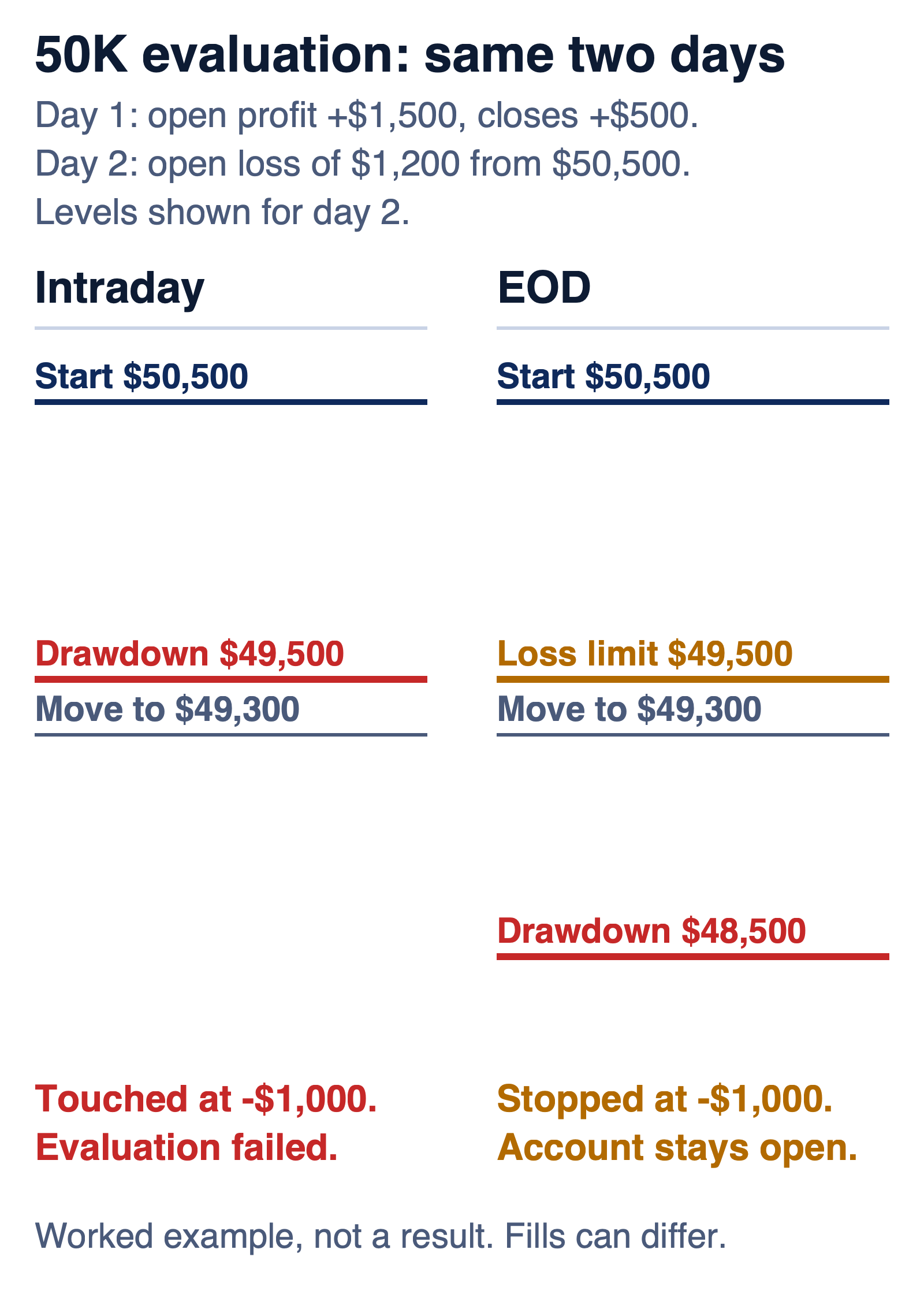 Click to enlarge
Source: Kagels Trading, own graphic from Apex's drawdown and daily loss limit rules.
EOD gave this trader a second chance, at a higher price. The list fee is $590 against $249, and the activation fee is $129 against $99. EOD helps if you often give back open profit. It does not make intraday losses harmless, because the daily loss limit ends your session early and the drawdown still applies in real time.
The limit stops trailing at a different point in each account. In a PA, it stops at the starting balance plus $100, which is $50,100 on 50K. In Rithmic and WealthCharts evaluations, it stops at the profit target balance. In Tradovate evaluations, it trails without a stop. So the platform changes the rule, not only the screen.
Rules that decide whether you pass and keep the account
Evaluation parameters
| Account | Profit target | Max drawdown | Max contracts | Daily loss limit, EOD evaluation only |
|---|---|---|---|---|
| 25K | $1,500 | $1,000 | 4 | $500 |
| 50K | $3,000 | $2,000 | 6 | $1,000 |
| 100K | $6,000 | $3,000 | 8 | $1,500 |
| 150K | $9,000 | $4,000 | 12 | $2,000 |
Apex help center, read November 6, 2026.
You can pass in one day, but not after day 30. There is no minimum number of trading days and no consistency rule in the evaluation. Access runs 30 calendar days and ends at 6:00 PM ET on day 30, with no extension. After passing, you have 7 calendar days to activate the PA, or that pass expires.
Scaling and daily loss limit in the PA
The PA starts smaller than the evaluation, and that applies to Intraday and EOD alike. Your tier for the next session depends on the closing balance, and it can go down again. Hitting the daily loss limit liquidates positions and pauses trading until the next session at 6:00 PM ET, but does not close the account.
| Account | Tiers by profit: contracts, daily loss limit |
|---|---|
| 25K | $0: 1, $500 · $1,000: 2, $500 · $2,000: 2, $1,250 |
| 50K | $0: 2, $1,000 · $1,500: 3, $1,000 · $3,000: 4, $2,000 · $5,999 or $6,000 (Apex’s pages differ): 4, $3,000 |
| 100K | $0: 3, $1,750 · $2,000: 4, $1,750 · $3,000: 5, $1,750 · $5,000: 6, $2,500 · $10,000: 6, $3,500 |
| 150K | $0: 4, $2,500 · $2,000: 5, $2,500 · $3,000: 7, $2,500 · $5,000: 10, $3,000 · $10,000: 10, $4,000 |
Each entry starts at the profit shown. Apex scaling levels and daily loss limit, read November 6, 2026.
Apex’s two tables give different starting points for the top 50K tier, and this is unresolved. The scaling page runs the tier below up to $5,999 and starts the top tier at $5,999. The daily loss page starts it at $6,000. Get the boundary for your account from Apex support in writing before you plan around it.
Banned and restricted activity
The rulebook can close an account for conduct as well as for a breached drawdown. These points come from the Prohibited Activities page and the User Agreement:
- No hedging: no opposing positions in the same or correlated markets, across your accounts or within your household. Apex’s examples include short NQ against long ES.
- No automation: bots, algorithms and high-frequency trading are banned.
- Copy trading only in a narrow form: you enter each order by hand in one account, and only your own accounts mirror it exactly.
- Flat before the close: everything must be closed before 4:59 PM ET, and agricultural markets by 2:05 or 2:20 PM ET.
- Stops and risk: every trade needs a working or mental stop. Using the full drawdown as your stop is banned, and Apex’s example of bad risk is a 5-tick target with a 150-tick stop.
- News: allowed in your normal strategy, but not orders on both sides of the market hoping for a lucky fill.
- Stockpiling: buying discounted evaluations to blow through them is banned.
- Inactivity: a PA needs 2 trading days with at least $50 net profit in every rolling 30 days, or it closes.
Are metals available?
Metals are listed again, but check your own account. The home page and the instrument lists for all three platforms include gold, silver, copper, platinum and palladium. Third-party sites report a suspension in early 2026 and a return in May 2026. We found no notice from Apex on either step and could not test an account. On Rithmic, View Risk Parameters shows your active products, and an order on a product that is not enabled is rejected without penalty.
How do Apex payouts work?
Apex pays 100 percent of an approved payout from a Performance Account, limited by qualifying days, a safety net, a 50 percent consistency rule, a cap per payout and a maximum of six payouts.
Four conditions must be met before you can request a payout. The product pages require five qualifying days at the daily minimum since the start or your last payout. Your balance must clear the safety net, and only profit above it can be paid. Your best day must be under 50 percent of net profit since the last payout. Each request must be at least $500.
| Account | Qualifying day, Intraday | Qualifying day, EOD | Safety net | Min. balance to request |
|---|---|---|---|---|
| 25K | $100 | $100 | $26,100 | $26,600 |
| 50K | $200 | $250 | $52,100 | $52,600 |
| 100K | $250 | $300 | $103,100 | $103,600 |
| 150K | $300 | $350 | $154,100 | $154,600 |
| Payout | 25K, both | 50K Intraday / EOD | 100K Intraday / EOD | 150K Intraday / EOD |
|---|---|---|---|---|
| 1 | $1,000 | $1,500 / $1,500 | $2,000 / $2,000 | $2,500 / $2,500 |
| 2 | $1,000 | $2,000 / $1,500 | $2,500 / $2,500 | $3,000 / $3,000 |
| 3 | $1,000 | $2,500 / $2,000 | $3,000 / $2,500 | $3,000 / $3,000 |
| 4 | $1,000 | $2,500 / $2,500 | $3,000 / $3,000 | $4,000 / $3,000 |
| 5 | $1,000 | $3,000 / $2,500 | $4,000 / $4,000 | $4,000 / $4,000 |
| 6 | $1,000 | $3,000 / $3,000 | $4,000 / $4,000 | $5,000 / $5,000 |
| Most in total | $6,000 | $14,500 / $13,000 | $18,500 / $18,000 | $21,500 / $20,500 |
Intraday payouts and EOD payouts, read November 6, 2026. Totals are our sums and are maximums, not expected results.
First-payout example on a 50K EOD account
Reaching the minimum balance does not unlock the full first payout. Suppose you make $600, $500, $450, $550 and $500 on five days. Each day clears the $250 minimum, and your best day is about 23 percent of the $2,600 profit, so you pass consistency. The balance is $52,600, the lowest balance that allows a request.
| Step | Balance | What you can request |
|---|---|---|
| After five days, $2,600 profit | $52,600 | $500, only the amount above the $52,100 safety net |
| To reach the first-payout cap, $3,600 profit | $53,600 | $1,500, the cap for payout 1 |
| After a $1,500 payout | $52,100 | Next request: five new qualifying days per the product pages, see the conflict below |
After the payout, the account has less room than the balance suggests. The drawdown is fixed at $50,100 by then, so the cushion back to the limit is $2,000. By the tier table, a closing balance of $52,100 also puts you back to 3 contracts and a $1,000 daily loss limit. Keep trading only as if the requested money has already left, because a request is denied automatically if the balance falls below the minimum.
Timing, payment and what “No Payout Denials” means
Apex quotes 5 to 11 business days for most users. It lists 2 business days for review, 3 to 4 to send the money and 3 to 7 for your bank. US traders are paid by ACH to a US account in their own name, and need an SSN or TIN on file.
Apex’s pages conflict on the time between payouts, and this is unresolved. The product pages say five qualifying days at the minimum in the table above. The payout method article says eight trading days after a request, including five with at least $50. We could not settle this. Get the rule for your account from Apex support in writing before you plan around it.
The marketing and the contract do not say the same thing. The home page promises “No Payout Denials” and no payout reviews. Section 12 of the User Agreement calls rewards discretionary and says Apex may “deny, modify, reduce, cap, delay, or revoke” them “for any reason or no reason”. It also provides for audits, and it states that it controls if it conflicts with guidance on the website. We have not assessed how a court would read this. We cannot tell from outside how often this happens. Apex’s payout list showed 15 approved entries on November 6, which is provider-reported and shows no totals or rates.
Platforms and markets
You choose Rithmic, Tradovate or WealthCharts at checkout and cannot convert later. A wrong choice is not refundable. Rithmic is not native on a Mac. Tradovate runs in the browser and on a Mac, and is the only route to EUREX products, which need extra exchange subscriptions. It also checks your live balance and open positions when you request a payout. WealthCharts has a built-in trade copier.
Apex covers CME Group futures plus EUREX on Tradovate. That includes equity indexes, currencies, agriculture, energy, metals and micro contracts on bitcoin and ether. There are no stocks, CFDs or spot forex. Level 1 data is included, and market depth costs extra. Apex advertises a free NinjaTrader license.
US residents are eligible, and many other countries are not. Apex publishes a restricted-country list. The United States and Canada are not on it. You may not use a VPN to disguise your location. Payment cards and payout accounts must be in your own name.
Reviews and reliability
Trustpilot showed 4.2 from 21,615 reviews on November 6, 2026. The profile is claimed by the company and marked as a paid subscription. It tells you that many customers are satisfied, not how a dispute over your payout would end. Read recent complaints about refunds and rule enforcement as well as the praise.
We could read two federal cases in public docket copies on November 7, 2026. Riot v. Apex Trader Funding (W.D. Tex., No. 1:24-cv-01557, filed December 18, 2024) is a copyright case that ended on August 20, 2026 with an agreed judgment, whose terms we have not read. Lawton v. Apex Trader Funding (W.D. Tex., No. 1:26-cv-02078, filed July 24, 2026) is recorded as a fraud suit under the Commodity Exchange Act, with an amended complaint on November 4, 2026. A complaint is an allegation, not a finding, and we have not read this one. The list is not complete, because other docket pages would not open.
We make no claim about payout reliability from our own experience. This version contains no first-hand account data. A public list of payouts and a good average rating are not independent proof, and individual forum complaints are not proof of the opposite. The firm’s rulebook and contract are what we can actually verify.
Pros and cons of Apex Trader Funding
The strengths are in the structure, and the weaknesses are in the limits and the contract. Read the pros and cons below against your own plan.
Pros
- One-time fees with no recurring billing on new accounts
- Up to 20 PAs per person and household
- A choice of drawdown type and price path
- Public, detailed rule tables
- No minimum days in the evaluation
Cons
- Rewards are discretionary under the User Agreement, which denies any claim to them
- Caps per payout and at most six payouts per account
- High list prices, so low cost depends on a dated code
- No resets and no refunds
- Help articles that contradict other Apex pages
Who Apex fits and who should avoid it
Apex can suit a disciplined manual futures trader who has done the math. It fits if your stop works with the first daily loss limit tier, you can produce qualifying days without breaking consistency, and you can afford to lose the fee. It also fits if you want several accounts and enter every order by hand.
Avoid it if you need a contractual right to your balance, because the agreement denies one. It also does not fit algorithmic traders, anyone who holds positions past the close, or traders who hedge across markets. If you treat a discounted evaluation as a lottery ticket, the rules against stockpiling and the fees will work against you.
Apex vs Topstep and Tradeify
These three firms differ most in how you pay and how you are capped. Compare total cost and payout limits, not only the discount. Details are in our Topstep review and Tradeify review.
| 50K account | Apex (Intraday Standard) | Topstep (Standard) | Tradeify (Growth) |
|---|---|---|---|
| List fee | $249, one-time | $49 a month | $145, one-time |
| Activation | $99 | $149 | none |
| No-activation option | $799, one-time | $95 a month | not needed |
| Resets | none | $49 | $95 |
| Funded split | 100% of approved payouts, capped | 90/10 | 90/10 |
Apex selector quotations and Topstep and Tradeify pricing pages, read November 6, 2026, before discount codes.
Our verdict: clear rules, tight limits, discretion in the contract
Apex publishes more detail than many firms, but it keeps the final word. You can calculate fees, drawdown and caps in advance. The agreement says you have no claim to a payout, and it allows Apex to demand back paid rewards in certain cases. A $13,000 to $14,500 lifetime cap on a 50K account also sets hard limits on what one account can return, even if everything goes right.
If you try it, start small and treat the fee as money you can lose. Compare Standard and No Activation Fee by your realistic number of attempts, read Section 12 of the User Agreement, and check the final price at checkout. Futures trading is risky, simulated results do not guarantee future results, and this review is not investment advice.
Frequently asked questions about Apex Trader Funding
Is Apex Trader Funding legit?
It is a real company with public rules, but payouts remain at its discretion. Apex Trader Funding Inc. lists a mailing address in Austin, Texas. The site advertises “No Payout Denials”, while the User Agreement says rewards are discretionary. We cannot give a general verdict on reliability from these sources.
Is Apex Trader Funding real money or simulated?
Evaluations and Performance Accounts are simulated, and payouts are real money if approved. No live market execution takes place in these accounts. Real-market trading happens only in the separate Live program, by invitation.
What is the difference between EOD and Intraday at Apex?
Intraday trails your peak balance in real time, including open profit, and EOD moves only with your closing balance. Both are enforced in real time. The EOD evaluation adds a daily loss limit, which the Intraday evaluation does not have. Both PAs have one.
How much does Apex cost?
Apex’s selector lists a 50K Intraday evaluation at $249 plus a $99 activation fee. On November 6, 2026, the code SAVENOW cut the evaluation fee to $24.90 for a limited time, but not the activation fee. A No Activation Fee version lists at $799.
How fast does Apex pay?
Apex says most users receive money within 5 to 11 business days. That covers review, sending and bank processing. US payouts go by ACH. Apex’s product pages say five qualifying days before a request, but another Apex article says eight trading days after a prior request, so confirm this with support.
How many Apex accounts can I have?
You can hold up to 20 Performance Accounts per person and household. Apex sets no limit on evaluations, though the Agreement lets it limit active accounts. Copying trades is allowed only between your own accounts, with manual entry in the originating account.
This English edition is based on our German edition on kagels-trading.de and has been adapted for international readers.
More Prop Trading guides
- Understand the drawdown rules
Trailing Drawdown at Prop Firms: The Math, With Real Trades
Static, end-of-day and intraday trailing limits, risk per trade and pass rates, tested with 61 real trades.
- Check Take Profit Trader
Take Profit Trader Review: Rules, Costs and Payouts
Test rules, full costs, PRO and PRO+ payouts and the drawdown rule that changes after you pass.
- Check Bulenox
Bulenox Review 2026: Rules, Costs and Payouts
Three account types for a one-time fee, drawdown options, payout rules and the open questions about the company.
- Check Bitfunded
Bitfunded Review 2026: Rules, Costs and Payouts
A crypto prop firm: four account types, loss limits with open positions, payout review and what the competition prize pool is made of.
- Check IQ Capital
IQ Capital Review 2026: Costs, Rules and Payouts
Crypto, CFD and futures accounts from $9, the strict per-trade loss limit, payout caps and the company in Saint Lucia.
- Check Tradeify
Tradeify Review 2026: Prices, Rules and Payout Caps
Growth, Select and Lightning compared: one-time prices, the real-time drawdown and how far the payout caps sit below the profit goals.
- Check Topstep
Topstep Review 2026: Rules, Costs and Payouts
Three stages, two of them simulated: the monthly fee per attempt, the trailing loss limit and why the timing of the first payout matters.
- Check Propr
Propr Review 2026: Rules, Payouts and the Hedge Losses
A prop firm built on Hyperliquid: prices, rules, fast payouts and what its public data shows about margin, reserve and hedge losses.