
Jim Simons: Medallion Fund Returns, Strategy and Access


Contents
- Jim Simons in 30 seconds
- Who was Jim Simons?
- Renaissance Technologies: from Monemetrics to a quant fund
- Medallion Fund returns from 1988 to 2018
- How does the Medallion Fund make money?
- Can you invest in Renaissance Technologies?
- The tax dispute: the dark side of Medallion
- What traders can and cannot take from Jim Simons
- Verdict: the most successful fund in history, and no blueprint to copy
- Frequently asked questions about Jim Simons
- About the author
A mathematician with no Wall Street experience built the most successful fund in financial history, and hardly anyone can explain how. Jim Simons’ Medallion Fund earned an average of about 66% a year before fees from 1988 to 2018. After fees, investors still kept about 39%, over 31 years and with exactly one losing year.
For traders, the interesting part is not the number itself. At first, Simons traded on intuition. The change came when his firm Renaissance Technologies hired mathematicians, physicists and computer scientists, searched price data for small, recurring patterns and left more and more decisions to models. Here you learn how that works, why you still cannot invest and which parts of his method fit a private account. This article follows our editorial policy. It is for education, not investment advice, and past results do not predict future returns.
Jim Simons in 30 seconds
- Mathematician and code breaker: Simons earned his PhD at Berkeley at 23, broke codes for the NSA and ran the math department at Stony Brook University for ten years. In 1976 he won the Oswald Veblen Prize.
- Founder of Renaissance Technologies: he started the firm in 1978 as Monemetrics, and it took its current name in 1982. The Medallion Fund followed in 1988.
- The best documented record: from 1988 to 2018, Medallion made about 66% a year before fees and about 39% after fees. The only losing year after fees was 1989.
- Closed to outsiders: Medallion has taken no outside money since 1993. According to an SEC filing dated July 1, 2026, the open Renaissance funds require a minimum investment of $5 million.
- Died in 2024: Simons died on May 10, 2024, aged 86, in New York. Forbes last estimated his fortune at $31.4 billion.
Who was Jim Simons?
Jim Simons was an American mathematician and hedge fund founder who started the firm that became Renaissance Technologies in 1978 and, with the Medallion Fund, earned about 66% a year before fees from 1988 to 2018.
Mathematics came long before money. Simons was born on April 25, 1938, in Massachusetts, studied at MIT and earned his PhD at the University of California, Berkeley, at 23. He then taught briefly at MIT and Harvard.
His first job outside the university was breaking codes. At the Institute for Defense Analyses in Princeton, he worked on encrypted messages for the National Security Agency. In 1968 he was fired for speaking out against the Vietnam War: first in a letter to The New York Times, later in an interview with Newsweek.
Being fired turned into a springboard. In 1968 he took over the math department at Stony Brook University and ran it for ten years. In 1974 he published the work on Chern-Simons invariants with Shiing-Shen Chern, which is used today in string theory and condensed matter physics. In 1976 it won him the Oswald Veblen Prize of the American Mathematical Society, one of the top awards in geometry.
Simons himself divided his working life into three parts: mathematician, investor and philanthropist. With his wife Marilyn Simons, he founded the Simons Foundation in 1994 to fund basic research in mathematics and science. The foundation has documented his life in detail.
Renaissance Technologies: from Monemetrics to a quant fund
In 1978 Simons left the university and started a trading firm in a small strip mall near Stony Brook. It was first called Monemetrics and was renamed Renaissance Technologies in 1982. In the early years, according to Gregory Zuckerman’s account, Simons relied on intuition like other traders. The Simons Foundation speaks of several false starts before the firm found its approach.
The breakthrough came when the data made the decision. Simons brought in mathematicians such as Leonard Baum and James Ax and had them build models that searched historical prices for recurring patterns. In 1988 this became the Medallion Fund, named after the math awards Simons and Ax had won.
What stood out most was who Renaissance hired. Instead of Wall Street traders and analysts, it hired mathematicians, physicists, computer scientists and statisticians. Two of the most important, Peter Brown and Robert Mercer, came from IBM’s speech recognition research in 1993. They took over when Simons stepped down as CEO in early 2010. Since July 2024, Brown has led the firm together with David Lippe as co-CEO.
Quantitative trading means trading in which buy and sell decisions come from statistical models and historical data and are usually executed automatically.
What this looks like on a smaller scale is explained in our guide to algorithmic trading, with trading algorithms, automated execution and the steps from idea to live system.
Medallion Fund returns from 1988 to 2018
The Medallion Fund is the main fund of Renaissance Technologies. It uses mathematical models to open a very large number of short-term positions and has taken no money from outside investors since 1993.
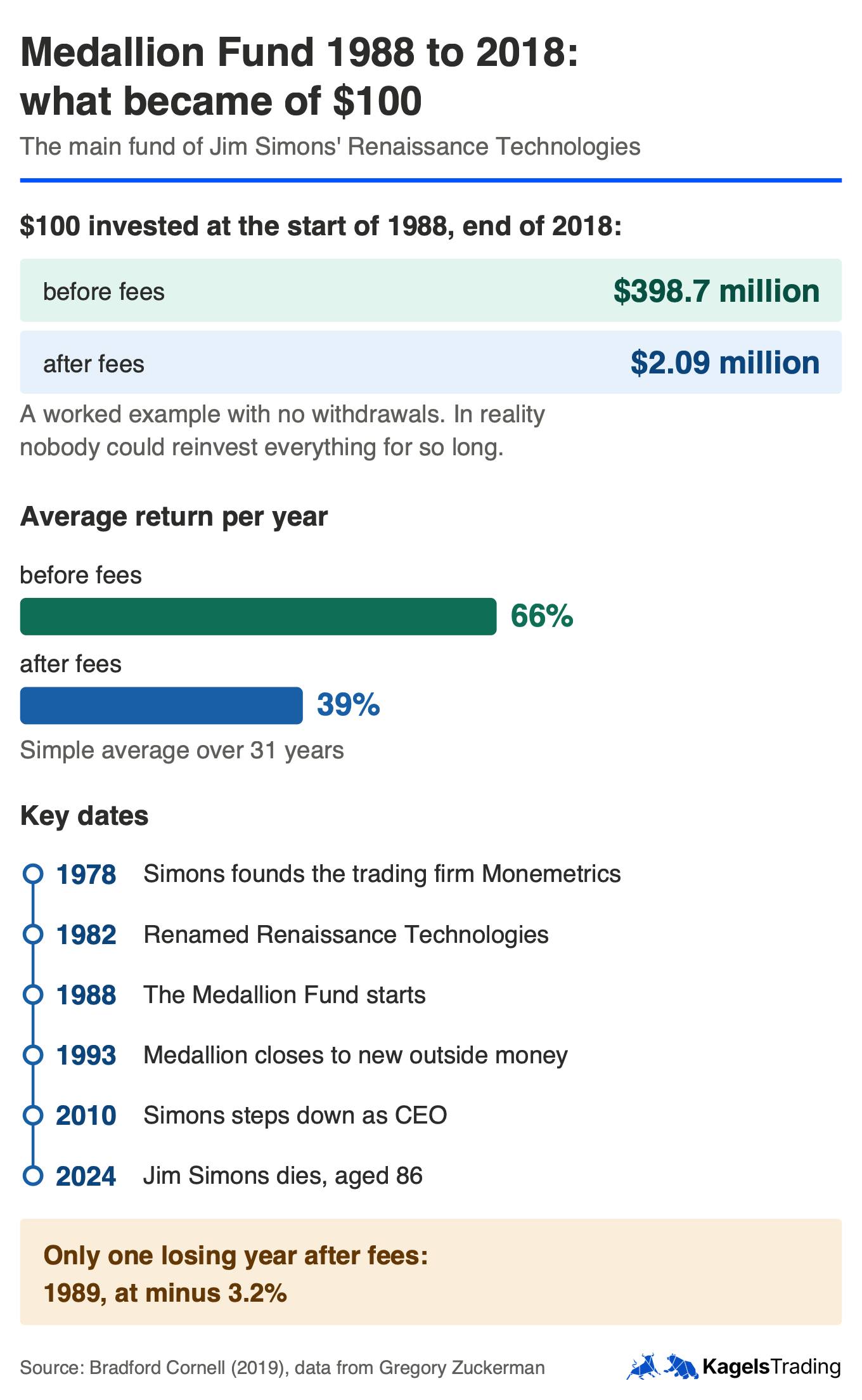
The best-known analysis comes from a finance professor, not from Renaissance. Bradford Cornell of UCLA analyzed the yearly returns that the journalist Gregory Zuckerman published in his book in a study. On average, Medallion returned 66.1% a year before fees from 1988 to 2018 and 39.2% after fees. Compounded, the figures are 63.3% and, by our own calculation from Cornell’s table, 37.8%.
| Year | Before fees | After fees |
|---|---|---|
| 1988 (start) | 16.3% | 9.0% |
| 1989 | 1.0% | minus 3.2% |
| 2000 | 128.1% | 98.5% |
| 2008 (financial crisis) | 152.1% | 82.4% |
| 2018 | 76.4% | 40.0% |
| Average 1988 to 2018 | 66.1% | 39.2% |
Source: Bradford Cornell (2019), based on the data in Gregory Zuckerman’s book, simple average.
The near absence of losing years is the most striking part. Before fees, the fund had no losing year in 31 years. After fees there was one: 1989, at minus 3.2%. In 2000, when the dot-com bubble burst, Medallion made 128% before fees, and in the crisis year 2008 even 152%.
Medallion charged exceptionally high fees. Cornell’s table shows a 5% management fee a year and a profit share of 20% until 2000, 36% in 2001 and 44% from 2002. That investors still kept almost 40% a year shows how large the edge before fees was.
The size of the fund did not slow down returns. According to Cornell, Medallion grew from $20 million to $10 billion without its returns fading. Beyond that size, the fund hardly grew. Cornell points out that it stopped taking new money at times, so gains could not all be reinvested. The infographic below is therefore only a worked example: $100 invested at the start of 1988 would have grown to about $398.7 million before fees by the end of 2018, and to about $2.1 million after fees by our calculation.
 Click to enlarge
These figures need context. Renaissance does not publish returns. The numbers come from documents Zuckerman obtained for his book and are not an audited report. Cornell’s study is an academic analysis of this data, not an independent audit of the fund’s accounts. How Medallion compares with other legends is in our ranking of the best traders in the world, with all sources.
How does the Medallion Fund make money?
Renaissance has never disclosed its models. What is known comes from Zuckerman’s reporting, Cornell’s study and a US Senate hearing in 2014. That gives no recipe, but a clear picture of how the fund is built.
Medallion trades very often and holds very briefly. Before the Senate subcommittee in 2014, the tax expert Steven Rosenthal said that the Renaissance funds made more than 100,000 trades a day and over 30 million a year, and turned over almost their whole portfolio about every three months. According to Cornell, the fund holds long and short positions at the same time, so it bets on rising and falling prices. The transcript is publicly available from the US government.
The reported hit rate was only just above 50%. Zuckerman quotes Robert Mercer as saying that Medallion was right on about 50.75% of its trades. Over millions of trades, that was enough to make billions. Whether such an edge holds up does not depend on the hit rate alone, though, but also on the average wins and losses and on trading costs.
Cornell found a negative link to the stock market. His regression of yearly excess returns against the US market index gave a beta of about minus 1. Beta measures how closely a fund’s returns move with the overall market. That does not mean Medallion moved as a mirror image of the market: it was far ahead in good stock market years too. But the returns cannot be explained as payment for bearing market risk.
Cornell considers one explanation possible: Medallion may simply be a better market maker. A market maker constantly quotes buy and sell prices and earns the small spread between them. Whoever does that faster and smarter than everyone else earns a lot over millions of trades. Cornell himself writes, however, that the size of the returns stretches this explanation to its limit.
The fund got its leverage through options. At the same hearing, Renaissance’s CFO Mark Silber explained that Medallion had bought so-called barrier options from Deutsche Bank and Barclays. They gave more leverage and loss protection than a normal brokerage account allowed.
Can you invest in Renaissance Technologies?
You cannot get into the Medallion Fund. It has taken no outside money since 1993, and in 2005 Renaissance paid out its last outside investor. Since then it has essentially been a fund for employees, former employees and their families.
The latest filing with the SEC shows who owns the fund today. In its Form ADV dated July 1, 2026, Renaissance reports gross assets of about $61 billion for Medallion Holdings, before deducting debt, and 549 beneficial owners. About 80% of the fund belongs to Renaissance itself and related persons. In total, the firm manages about $96 billion and has 310 employees, 170 of them in investment and research.
Other Renaissance funds are open to qualified outside investors. For the fund structures of the Renaissance Institutional Equities Fund and the Diversified funds, the same filing lists a standard minimum investment of $5 million. That is not an offer for ordinary retail investors. In his 2019 study, Cornell describes the results of these funds at that time as far less remarkable than Medallion’s, and according to Zuckerman they follow a different strategy. The study gives no current assessment of their returns.
There is no Renaissance stock. The firm is not listed. Its public documents include the Form ADV and the quarterly 13F filings with the SEC. The 13F filings show certain reportable securities positions at quarter end, but no separate Medallion portfolio and no short positions. They appear up to 45 days after the quarter ends and are therefore no template to copy.
Be careful if someone offers you a Renaissance fund. Renaissance states on its own homepage that rentec.com and renfund.com are its only official websites, and that other websites claiming to belong to the firm or its funds are not legitimate. According to Renaissance, an offer may only be made through a confidential offering document to eligible investors. You can look up the firm under CRD number 106661 in the SEC’s adviser database. The entry confirms the firm, not whether a person contacting you in its name is genuine.
The tax dispute: the dark side of Medallion
The biggest conflict in Renaissance’s history was about taxes, not losses. In July 2014, the Permanent Subcommittee on Investigations of the US Senate examined Medallion’s barrier options. The accusation: through the options, short-term trading gains had been booked as long-term capital gains, which are taxed at a much lower rate in the US.
The amounts were correspondingly large. For the years 2000 to 2013, the subcommittee staff estimated that Renaissance had avoided more than $6 billion in taxes this way. Renaissance disagreed: the options had been bought for leverage and loss protection, regardless of their tax treatment, and its tax returns complied with the law.
In 2021 the dispute ended in a settlement. According to a letter from Renaissance CEO Peter Brown to investors, reported by Reuters, current and former executives would pay up to $7 billion in taxes, interest and penalties to the IRS. Simons himself was to pay an additional $670 million.
For traders, the case mainly points to the conditions behind the track record. Leverage through bank products, a special tax structure and bargaining power with large banks are open only to a fund of this size. How much of the return comes from the models, the leverage, the costs or the taxes cannot be separated from public information.
What traders can and cannot take from Jim Simons
Medallion cannot be copied, but some principles can be transferred. The line runs where the advantage comes from money, data and people rather than from the method.
What you can take from Simons’ method
- Rules instead of gut feeling: the turning point at Renaissance was the moment the model decided. A discretionary trader also benefits from written entry and exit rules.
- Measure your own edge: a small edge is enough if it is real. Whether a rule showed an edge in the past can be checked with backtesting. That proves nothing about the future: you need tests on unused data and realistic costs.
- Many small bets instead of a few big ones: Medallion spreads its risk over millions of trades. For a private account, that means small positions and a strategy with many opportunities.
- Take costs seriously: with a hit rate just above 50%, fees and the spread decide whether anything is left at the end.
What does not transfer to a private account
- The infrastructure: its own data centers, decades of data and about 170 employees in investment and research alone.
- The execution costs: at more than 100,000 trades a day, every fraction of a cent counts. A private account cannot count on the trading conditions of a fund this size.
- Leverage through bank options: such structures are open only to large funds and were the subject of a years-long tax dispute.
- Decades of testing the models: Renaissance has data and experience going back decades, and even that guarantees no future results. A pattern from a single backtest can be pure chance.
If you apply the first list, you already work by the principle behind Simons’ success. How to turn your own rule into code and test it is shown in the guide to building a Python trading bot. For position size and costs, the same applies as at Medallion: position sizing decides whether a small edge can work at all over many trades.
Verdict: the most successful fund in history, and no blueprint to copy
Jim Simons stands for the most successful documented use of mathematical models in trading. About 66% a year before fees over 31 years, with a single losing year after fees: Cornell finds no counterpart in the entire finance literature. According to Robert Mercer, a small statistical edge over millions of trades played the main role. How returns of this size came about cannot be settled with public data, however. Nor do they prove that models are generally superior to discretionary approaches.
That is exactly why Medallion is not a blueprint to copy. Everything publicly known points to data, people, execution costs and leverage that only a fund of this size has. You cannot invest either, and according to Zuckerman, the funds open to outsiders follow a different strategy from Medallion.
What transfers is the attitude behind it. Fixed rules, a measured rather than a felt edge and a position size that allows many small bets work on a small account too. What the discretionary opposite looks like, with a few large macro positions, is shown in our portrait of Paul Tudor Jones and his risk control.
Frequently asked questions about Jim Simons
What is Jim Simons known for?
Jim Simons was an American mathematician, code breaker and the founder of Renaissance Technologies. He lived from 1938 to 2024, ran the math department at Stony Brook University for ten years and in 1978 founded the trading firm that became Renaissance. The Medallion Fund followed in 1988.
What were the Medallion Fund’s returns?
From 1988 to 2018, about 66% a year on average before fees and about 39% after fees. That is the result of Bradford Cornell’s analysis of the figures from Gregory Zuckerman’s book. After fees there was only one losing year, 1989.
Can you invest in the Medallion Fund?
No, the Medallion Fund has taken no money from outside investors since 1993. According to the SEC filing of July 2026, about 80% of it belongs to Renaissance and related persons. The open Renaissance funds require a $5 million minimum and are aimed at institutions.
Is there a Renaissance Technologies stock?
No, Renaissance Technologies is not publicly traded. Its public documents are the Form ADV and the quarterly 13F filings with the SEC. The 13F filings appear with a delay and show no short positions and no separate Medallion portfolio.
What strategy did Jim Simons use?
Simons relied on quantitative trading with mathematical models that search historical data for small, recurring patterns. Medallion holds a very large number of short-term long and short positions at the same time. According to Robert Mercer, the fund was right on only about 50.75% of its trades and made its money through volume.
What was Jim Simons’ net worth?
Forbes estimated his fortune at $31.4 billion in April 2024. Through the Simons Foundation, he and his wife Marilyn funded mainly mathematics and basic research. Stony Brook University received a $500 million gift in 2023.
Is there a book about Jim Simons?
Yes, The Man Who Solved the Market by Gregory Zuckerman, published in 2019. It is still the most detailed source on Renaissance Technologies, and the return figures in this article originally come from it as well, through Cornell’s study.
This US edition is based on our German edition on kagels-trading.de and has been adapted for US readers.
More Famous Traders guides
- See who really performed best
Best Traders in the World, Ranked by Documented Returns
A ranking built only from documented annual returns, from Jim Simons to Warren Buffett, and why the famous 120% figures are missing.
- Understand trading championships
World Cup Trading Championship: Winners, Rules, Criticism
How the real-money World Cup Trading Championship works, what it costs to enter, record winners, German champions and its flaws.
- Meet the record holder
Larry Williams: The 11,376% Record Holder, Fact-Checked
Larry Williams and his 11,376% year: his COT approach, the Oops pattern, the volatility breakout and the criticism.
- Meet the Prince of the Pit
Richard Dennis: The Prince of the Pit and the Turtle Traders
Richard Dennis from $400 to a fortune, the Turtle experiment, his losses in 1987 and 1988 and what is really documented.
- Learn the Turtle rules
Turtle Trading: The Original Rules of Richard Dennis
The key original Turtle trading rules: entries, position size with N, the 2N stop, adding units and the exits.
- Understand the stock contest
US Investing Championship: Rules, Winners and Records
The real-money US Investing Championship: divisions, verification, recent winners and records, with dates.
- Read the classic interviews
Market Wizards: Jack Schwager's Books and Their Lessons
Jack Schwager's Market Wizards books: which traders each one features and the lessons they share.
- Meet the oldest legend
Jesse Livermore: Rules, Books and Lessons of a Legend
Jesse Livermore from his own 1940 book and the 1923 novel about him: rules, bankruptcies and lessons.
- Meet the first Market Wizard
Michael Marcus: How the First Market Wizard Traded
Michael Marcus: from early wipeouts to $80 million on a company account, and the rules he took from it.
- Meet the trend-following pioneer
Ed Seykota: Trend Following Pioneer From Market Wizards
Ed Seykota: early computerized trend following, his risk rules and what Market Wizards documents.
- Learn short-term setups
Linda Raschke: Trading Rules, Setups and Books
Linda Raschke: Holy Grail, Turtle Soup and the 3-10 oscillator, and where her famous 50 rules come from.
- Trade the opening range
Toby Crabel: Opening Range Breakout and His Numbers
Toby Crabel: opening range breakout, short-term price patterns and what is known about his record.
- Understand Buffett's investing approach
Warren Buffett: Portfolio and Investing Strategy
Berkshire's disclosed holdings, Buffett's investment principles and the limits of following a reported portfolio.
- Meet the 1987 crash trader
Paul Tudor Jones: Strategy Behind the 1987 Crash Trade
Paul Tudor Jones: the short before Black Monday, global macro, the 200-day rule, 5 to 1 and what the legend leaves out.
- Learn the SEPA method
Mark Minervini: SEPA, Trend Template and VCP Explained
Mark Minervini: SEPA, the eight Trend Template criteria, the VCP pattern, his risk rules and two contest wins.
- Understand All Weather
Ray Dalio: All Weather, Bridgewater and Lessons for Traders
Ray Dalio: what the All Weather portfolio really is, Bridgewater, his debt warnings and what traders can use.