
Vest Markets Review 2026: Is Vest Capital Real or Simulated?


Contents
- Vest Markets in 30 seconds
- What is Vest Markets?
- Accounts and prices: Instant or Evaluation
- Vest Capital rules: drawdown and daily loss
- Vest Capital payouts: claim, then withdraw in USDC
- Real money or simulated? What the terms say
- Who is behind Vest Markets?
- Refunds and failed launches
- Vest Markets reviews: what Trustpilot shows
- Pros and cons of Vest Markets
- Alternatives to Vest Markets
- Our verdict: cheap entry, contradictory promises
- Frequently asked questions about Vest Markets
- About the author
Vest Markets tells you in its help pages that your funded account trades real capital, but its legal terms say every account is simulated. That one contradiction is the most important thing to know before you buy a Vest Capital account. The terms also contain a clause in which you confirm that you did not rely on marketing or Discord statements.
For this review I read the firm’s own documents and nothing else first. The sources are the Prop Trading Terms of Service, the Vest documentation, the pricing page, the FAQ and the Trustpilot profile, all checked on November 20, 2026. After that I checked outside sources: a company press release and the Philippine SEC’s advisory list. I did not buy an account, and we have no business relationship with Vest. How we research and write is described on our editorial policy page.
Vest Markets in 30 seconds
- Overall: a perpetual futures platform with a prop program called Vest Capital. You trade stocks, indices, crypto, commodities and forex on one account with up to 100x leverage.
- Cost: one-time fees from $10 (Instant, $500 account) to $2,000 (Instant, $50,000). Evaluation accounts start at $15 in the docs and $75 on the pricing cards.
- Payouts: claim profit at any time, credited within 24 hours, then withdrawn in USDC to a crypto wallet. No bank transfer.
- The catch: the terms say all accounts are simulated, payouts come from Vest’s general funds, and Vest may model slippage and the price impact of your own trades. The contract partner is Vest Exchange Inc. in Panama. Checked on November 20, 2026.
What is Vest Markets?
Vest Markets is a perpetual futures platform that also sells funded trading accounts under the name Vest Capital. A perpetual future is a contract that tracks a price, like the S&P 500 or Bitcoin, and never expires. You post USDC as collateral and can trade hundreds of markets on cross margin.
The prop program is the part most traders search for. You pay a one-time fee, get an account with a set size and a loss limit, and keep 80 to 95 percent of the profit you claim. If you are new to the model, our prop trading page explains how it works across firms.
Vest’s funding round is on record, but most backer names come from Vest itself. Fortune reported on October 7, 2026 that New York startup Vest Labs raised a $13 million seed round led by Portal Ventures, founded by Justin Ma, Rikuya Takatsu and Maximilian Tsiang. The docs also list Coinbase and Jane Street, and a company press release adds Coinbase Ventures and others, but not Jane Street. I found no independent confirmation for these individual backers.
Vest Markets at a glance
| Contract partner | Vest Exchange Inc., Panama (Prop Terms) |
| Copyright line | Vest Labs Inc. (website footer) |
| Product | perpetual futures, funded accounts (Vest Capital) |
| Markets | stocks, indices, crypto, commodities, forex |
| Leverage | up to 100x, by market |
| Account sizes | $500 to $50,000 (simulated per the terms) |
| Profit split | 80 or 90% (Evaluation), 95% (Instant) |
| Payout | USDC to a crypto wallet |
| Trustpilot | 3.2 from 33 reviews (Nov 20, 2026, changes often) |
Accounts and prices: Instant or Evaluation
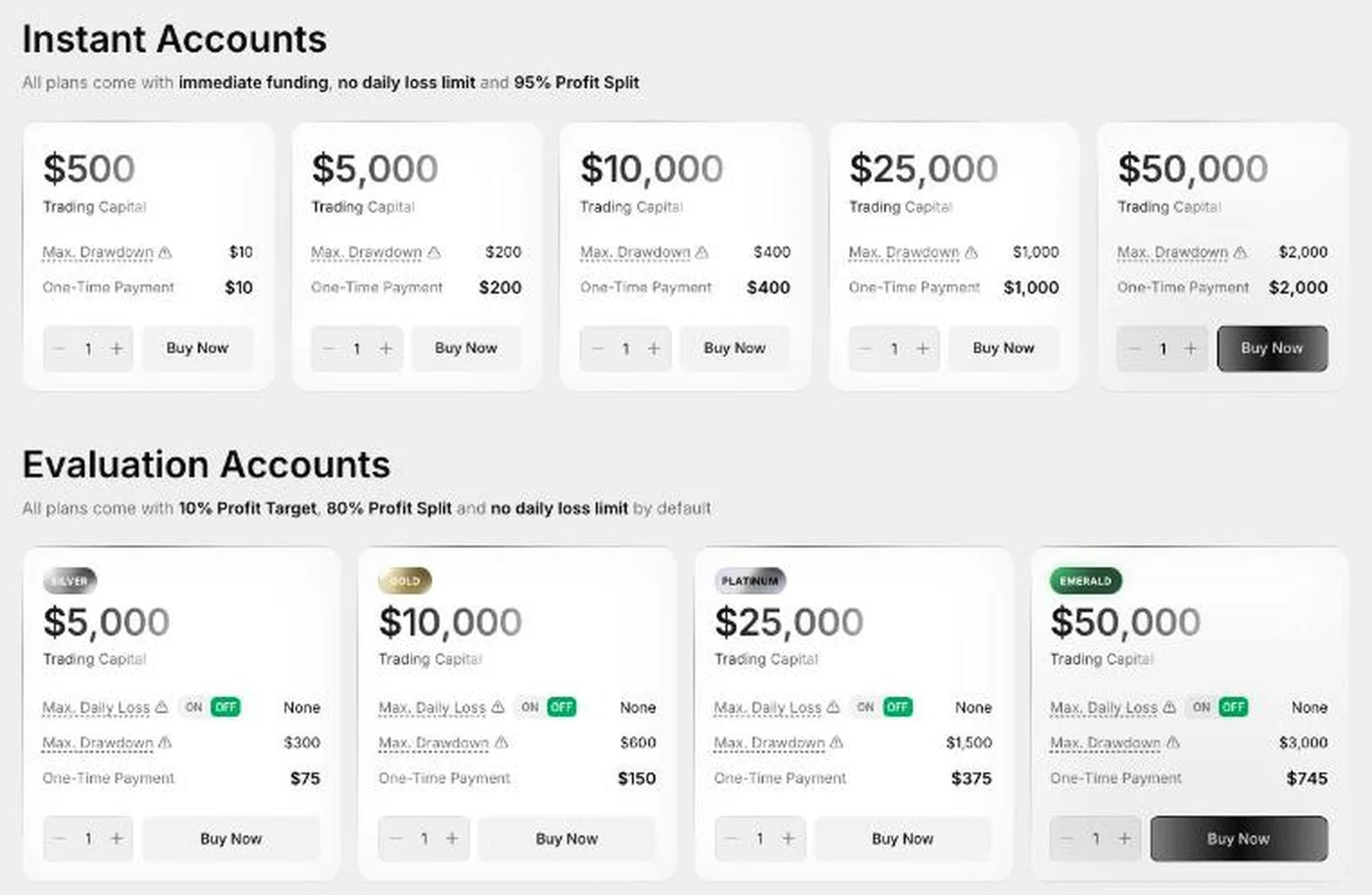
Vest Capital offers two paths: an Instant account with no test, or an Evaluation account with a profit target. Both trade the same markets on the same platform. They differ in price, loss rules and profit split.
 Click to enlarge
Instant accounts
On an Instant account the fee equals your maximum loss. If you buy the $10,000 account for $400, the account closes as soon as your equity falls below $9,600, so after a loss of more than $400. There is no daily loss limit and no profit target, and the split is a flat 95 percent.
| Account size | One-time fee | Max. drawdown |
|---|---|---|
| $500 | $10 | $10 (2%) |
| $5,000 | $200 | $200 (4%) |
| $10,000 | $400 | $400 (4%) |
| $25,000 | $1,000 | $1,000 (4%) |
| $50,000 | $2,000 | $2,000 (4%) |
Source: Vest Capital pricing page, checked November 20, 2026.
The cheap price buys very little room. A 4 percent drawdown on a $25,000 account is $1,000, so one bad trade with high leverage can end it. In practice you are paying $1,000 for the chance to keep 95 percent of whatever you make before your losses pass $1,000.
Evaluation accounts
Evaluation accounts are cheaper per dollar of room, but you must pass a test first. The maximum loss is a fixed 6 percent on every size. The pricing page shows four cards with a 10 percent target, an 80 percent split and no daily loss limit: Silver $5,000 for $75, Gold $10,000 for $150, Platinum $25,000 for $375 and Emerald $50,000 for $745.
You can also build your own 1-Step account. The account tiers page lists 36 combinations of a 10 or 20 percent target, a 3 or 4 percent daily loss limit or none, and an 80 or 90 percent split. Prices range from $25 to $450 for Silver to Platinum. A fixed 2-Step account costs $15, $35 or $90 and needs 10 percent, then a further 5 percent.
The docs and the pricing page do not match. The docs stop at $25,000 and never mention the $50,000 Emerald or Instant account. The docs themselves say the live pricing page is the source of record, so check it on the day you buy.
Vest Capital rules: drawdown and daily loss
The maximum drawdown at Vest Capital is a static floor: it is set once from your starting balance and never moves with your profits. On a $25,000 Evaluation account the floor is $23,500. If equity, including open losses, falls below it, the account closes.
The optional daily loss limit resets at 8 p.m. New York time. With a 4 percent limit and a $25,000 balance at the reset, the daily floor is $24,000. Between resets, trading profits and losses do not move it, but withdrawals lower it and non-trading credits raise it by the full amount. The next reset sets a new floor, and the separate maximum drawdown floor stays fixed. Our prop firm drawdown guide explains static and trailing limits with numbers.
Breaking either limit ends the account at once. According to the loss limits page, there is no warning and no grace period, and the account cannot be recovered. You buy a new account.
Most other rules are loose. The FAQ allows news trading, scalping and holding over the weekend, and there is no consistency rule and no minimum number of trading days. You can hold up to 10 funded accounts and 100 evaluation accounts. API trading is not available on funded accounts, and XRP cannot be traded there; the overview page also lists HYPE as currently unavailable.
Trading fees come on top of the one-time fee. According to the markets page, maker orders are free, while taker orders cost 0.01 percent on most markets, 0.0025 percent on indices and commodities and 0.0015 percent on forex. A market order on a $25,000 stock position costs about $2.50 each way. Open positions also pay or receive funding every hour, as the funding page explains; the docs do not say whether funded accounts are treated differently.
Vest Capital payouts: claim, then withdraw in USDC
| Step | Rule |
|---|---|
| Claim profit | any time, no minimum, no cap |
| Processing | 24 hours to your Primary Account |
| Split | 80 or 90% (Evaluation), 95% (Instant), fixed at purchase |
| Withdrawal | USDC to a wallet you choose, minimum 1 USDC |
| Limit | $50,000 per rolling 24 hours leaving the platform |
Source: Vest docs and FAQ, checked November 20, 2026.
Payouts at Vest are two separate steps. First you submit a Claim Profit request, which moves your share to your Primary Account within 24 hours and cannot be reversed. Then you withdraw USDC to a crypto wallet; the claiming profit page names no bank route.
The payout terms are friendlier than at many firms. There is no payout threshold, no waiting cycle and no consistency rule, and you can claim as often as you like. The trade-off is that you need a crypto wallet, and you carry the tax and transfer work for USDC yourself.
Real money or simulated? What the terms say
The Prop Terms of Service, updated on November 12, 2026, state that all accounts, including Instant Funded Accounts, are simulated. No real capital, margin or collateral is credited to you, and your fee buys access to the program, not a trading account. The terms call your trades Trade Ideas that Vest may use, ignore or trade against.
The help pages say the opposite. The docs promise “Real Vest capital. Not simulated,” and the FAQ says the capital behind a live account “is real.” The terms also contain a non-reliance clause: you agree that you did not rely on statements in marketing, on social media or on Discord. How a court or arbitrator would weigh these statements is a legal question I cannot answer.
Vest’s press release leaves the question open. The October 2026 announcement says traders “trade in a simulated trading environment” and also that “every funded trade is placed in the real market.” Both can be true if your account is simulated and Vest copies trades on its own, but no document I read explains that link. Before you buy, ask support in writing whether your funded trades reach the market and under which contract.
Three more points in the terms matter for your money. They concern who pays you, how your fills are priced and whose interests come first.
- Who pays you: compensation comes from Vest’s general corporate funds, and fees form part of the revenue that pays it. Vest says it does not claim that payouts are funded by profitable live trading.
- How fills are modeled: Vest may design and adjust simulation variables, including unfavorable slippage, partial fills and the price impact of your own simulated trades, under a good faith duty.
- Conflicts of interest: Vest may hedge or trade on its affiliated venue Vest Exchange and keeps rebates and incentives, which are not part of your results.
In my view, a simulated model is not a problem in itself. Most prop firms run demo accounts. What bothers me is a firm that tells you one thing in its FAQ and the reverse in its contract, and a contract that lets the firm shape the slippage on the trades it pays you for.
Who is behind Vest Markets?
The contract partner is Vest Exchange Inc., a corporation in Panama. The terms place the service in the Republic of Panama, apply Panamanian law and send disputes to arbitration at the Panama Conciliation and Arbitration Centre, in English and in Panama. They also contain a class action waiver.
The website names a different company. The footer says Vest Labs Inc., without an address or registration number, and Trustpilot lists the United States as the contact country. Neither the terms nor the docs name a regulator or a licence.
Eligibility is wider than at many firms. The terms bar Cuba, North Korea, Iran, Russia, Syria and the Philippines, plus sanctioned persons, and forbid VPNs. The United States is not on that list, but the terms reserve the right to refuse anyone, so confirm your country with support before you pay.
A Philippine regulator advisory carries the Vest name. The Philippine SEC lists an advisory titled “Vest Trading Platform; Vest Exchange; Vest Market; Vest”, dated April 16, 2026. The SEC website was down for maintenance when I checked on November 20, 2026, so I could not read the full text; the BitPinas SEC watchlist summarizes it as offering funded accounts and derivatives to local traders without SEC registration. Because I could not read the advisory, I cannot confirm which website or company it names. The advisory concerns Philippine registration, and the Philippines is a country the current terms exclude.
Refunds and failed launches
Refunds are narrow. You can ask within three days if you have not placed a trade, but crypto payments and purchases from your payout balance are final. If you buy several accounts in one batch, one trade on any of them makes the whole batch non-refundable.
The platform has had pricing incidents. Vest’s own incident reports list a rollback on April 15, 2026 after wrong prices hit about 10 percent of active accounts, and two pricing bugs in June 2026 in ES and EWY. Vest says affected users were compensated or corrected; all three happened on the older trade.vestmarkets.com platform.
Vest Markets reviews: what Trustpilot shows
Trustpilot shows a split picture: 3.2 from 33 reviews when I last checked on November 20, 2026. About 52 percent give five stars and 45 percent one star, and the score changes often as new reviews arrive. Vest has not invited reviews recently, and Trustpilot notes that it has not replied to negative reviews.
The positive reviews praise fast payouts. One reviewer writes about buying more than 100 evaluations and receiving over $10,000 after fees. Several others mention quick support and simple rules. I could not verify the payouts behind these reviews.
The negative reviews focus on fills and delivery. One buyer of three accounts reports slippage about three times the estimate shown before the trade; others report a paid account that was not delivered or a charge without explanation. These are single reports that I could not verify, but they show why the slippage rules in the terms deserve a close look.
The firm’s own Trustpilot text describes a different model. It speaks of a paid evaluation in simulation, after which traders who meet the targets “can be considered” for a separate, no-fee simulated program. That is not how the pricing page and FAQ describe Instant accounts and the switch to a live account.
Pros and cons of Vest Markets
Pros
- Low entry price: an Instant account from $10, evaluations from $15 in the docs.
- Static loss limit: the drawdown floor never trails your profits.
- Payouts on demand: no threshold, no cycle, processed within 24 hours.
- Few trading rules: news, scalping and weekend holding allowed, no consistency rule.
- Many markets: stocks, indices, crypto, commodities and forex on one account.
Cons
- Contradiction on capital: docs and FAQ say real, the terms say simulated.
- Modeled slippage: the terms let Vest set slippage and price impact in the simulation.
- Payouts from fees: compensation comes from general funds that include customer fees.
- Panama and arbitration: no licence named in the documents, Panamanian law, class action waiver.
- Crypto only: payouts in USDC to a wallet, no bank transfer.
- Tight Instant limits: 2 to 4 percent maximum loss.
Alternatives to Vest Markets
Ask every prop firm two questions before you pay. Does the contract match the marketing, and who decides how your fills are priced? At Vest, the first answer is no and the second is the firm itself.
If you want crypto perpetuals, compare a dedicated crypto firm. Crypto prop firms differ a lot in how openly they report hedging and payouts. Our Propr review covers a firm on Hyperliquid that publishes its hedge positions, and the Bitfunded review another crypto prop firm. For futures on regulated exchanges, the Bulenox review and Take Profit Trader review show how other firms document their rules.
Our verdict: cheap entry, contradictory promises
On paper, Vest Capital has some of the simplest rules I have seen. A static loss limit, no consistency rule, payouts on demand and a split of up to 95 percent. Read the contract and you find simulated accounts, payouts from general funds and a firm that can model the slippage on your trades.
I only work with partners whose contract says what their marketing says. That is what more than 45 years in the markets, since 1980, have taught me. Vest’s help pages promise real capital while its terms deny it, and that contradiction outweighs the low price for me.
In short: Vest Markets is not a recommendation from me. If you try it anyway, use the smallest account, treat the fee as the price of the test, and claim profits early and often.
- Good fit for: experienced traders who understand perpetual futures, hold a crypto wallet and accept a simulated program with crypto payouts.
- Not a fit for: beginners, traders who want a regulated counterparty, and anyone who needs payouts to a bank account.
This review describes the firm’s rules and costs; it is not investment advice. Trading perpetual futures with leverage carries a high risk of loss, and we do not earn a commission from Vest.
Frequently asked questions about Vest Markets
Is Vest Markets legit?
Many users report payouts from Vest Markets, but its terms describe a simulated program run from Panama. The contract partner is Vest Exchange Inc., the documents name no licence, and the terms let Vest model slippage and pay from general funds. Trustpilot showed 3.2 from 33 reviews on November 20, 2026.
Is Vest Capital real money or simulated?
According to the terms, all accounts are simulated, including Instant accounts. The docs and FAQ say the capital is real, but the terms state that no real capital is credited to you and that you may not rely on marketing statements.
How much does Vest Capital cost?
Instant accounts cost $10 to $2,000, the same as their maximum loss. Evaluation accounts cost $75 to $745 on the pricing cards; custom 1-Step and 2-Step accounts in the docs start at $15. Every fee is one-time.
How do Vest Markets payouts work?
You claim profit at any time and receive your share within 24 hours. The split is 80 or 90 percent on Evaluation accounts and 95 percent on Instant accounts. You then withdraw USDC to a crypto wallet, with up to $50,000 per 24 hours.
Can US traders use Vest Markets?
The terms do not list the United States among the barred countries. Barred are Cuba, North Korea, Iran, Russia, Syria and the Philippines, plus sanctioned persons, and VPNs are not allowed. Vest can refuse anyone, so confirm with support before you buy.
Does Vest Capital have a daily loss limit?
Instant accounts and the default Evaluation cards have no daily loss limit. Custom 1-Step accounts can add a 3 or 4 percent daily limit for a lower price, and the 2-Step account always has 3 percent. The static 6 percent maximum drawdown applies to every Evaluation account.
More Prop Trading guides
- Understand the drawdown rules
Trailing Drawdown at Prop Firms: The Math, With Real Trades
Static, end-of-day and intraday trailing limits, risk per trade and pass rates, tested with 61 real trades.
- Check Take Profit Trader
Take Profit Trader Review: Rules, Costs and Payouts
Test rules, full costs, PRO and PRO+ payouts and the drawdown rule that changes after you pass.
- Check Bulenox
Bulenox Review 2026: Rules, Costs and Payouts
Three account types for a one-time fee, drawdown options, payout rules and the open questions about the company.
- Check Bitfunded
Bitfunded Review 2026: Rules, Costs and Payouts
A crypto prop firm: four account types, loss limits with open positions, payout review and what the competition prize pool is made of.
- Check FundedHero
FundedHero Review 2026: Rules, Costs and Payouts
A CFD prop firm on TradeLocker: account types, payout caps, the defamation policy, the suspended Trustpilot rating and the unregulated partner broker.
- Check IQ Capital
IQ Capital Review 2026: Costs, Rules and Payouts
Crypto, CFD and futures accounts from $9, the strict per-trade loss limit, payout caps and the company in Saint Lucia.
- Check Tradeify
Tradeify Review 2026: Prices, Rules and Payout Caps
Growth, Select and Lightning compared: one-time prices, the real-time drawdown and how far the payout caps sit below the profit goals.
- Check FundedNext
FundedNext Review 2026: Stellar Rules, Payouts and US Access
Four Stellar CFD models and the futures line-up: prices, the 60, 80 or 90 percent payout options, the news rule and what US traders get.
- Check Funding Pips
Funding Pips Review 2026: Models, Reward Rules and Payouts
Five forex models from $29, the 60 to 100 percent reward cycles, the daily auto-close on funded accounts and the Dubai legal route.
- Check The5ers
The5ers Review 2026: Programs, Prices and Payout Rules
High Stakes New and Classic, Growth, Bootcamp and futures: prices, starting shares from 50 percent, payout caps and the Tel Aviv legal route.
- Check Apex Trader Funding
Apex Trader Funding Review 2026: Prices, Rules and Payouts
What the evaluations really cost, EOD vs Intraday on a 50K account, payout caps and what the User Agreement says about rewards.
- Check Topstep
Topstep Review 2026: Rules, Costs and Payouts
Three stages, two of them simulated: the monthly fee per attempt, the trailing loss limit and why the timing of the first payout matters.
- Check Earn2Trade
Earn2Trade Review 2026: New Rules, Prices and Payouts
The November 2026 rule change, Trader Career Path vs Gauntlet Mini on a 50K account and how the 50 or 80 percent split works.
- Check Ufunded
Ufunded Review: Fees, Rules, Payouts and Warnings
Instant simulated accounts for a one-time fee of up to $34,500, the fixed loss limit that one trade can hit, payout caps and the FSMA and AFM warnings.
- Check Propr
Propr Review 2026: Rules, Payouts and the Hedge Losses
A prop firm built on Hyperliquid: prices, rules, fast payouts and what its public data shows about margin, reserve and hedge losses.