
Bank of Canada Interest Rate Decision: Dates and Times


Contents
- The BoC rate decision in 30 seconds
- What is the Bank of Canada rate decision?
- When is the next Bank of Canada rate decision?
- The latest BoC decision: September 2026
- Bank of Canada decision dates for 2026 and 2027
- What time is the Bank of Canada decision?
- Canada’s policy rate: from 0.25 to 5.00 and back to 2.25 percent
- How much does a BoC decision move the Canadian dollar?
- BoC, Fed, ECB and BoE compared
- How to handle the BoC date as a trader
- Conclusion: at the Bank of Canada, wording and timing count
- Frequently asked questions about the Bank of Canada rate decision
- About the author
On 28 October 2026 the Bank of Canada and the Federal Reserve decide on the same day, with the Canadian decision four and a quarter hours earlier. The Bank of Canada interest rate decision comes at 9:45 a.m. Eastern Time, the Fed follows at 2:00 p.m. Canada’s policy rate has stood at 2.25 percent since October 2025.
Here you will find every decision date to the end of 2027, the state after the decision of 2 September and my own analysis of 62 decisions. It shows how much the Canadian dollar really moves after a BoC day, and why the answer depends on the currency pair you look at.
The BoC rate decision in 30 seconds
- The Bank of Canada rate decision is the Governing Council’s decision on Canada’s policy rate, the target for the overnight rate. It comes eight times a year, as a rule on a Wednesday.
- The policy rate is 2.25 percent. It has applied since 30 October 2025 and was confirmed seven times in a row, most recently on 2 September 2026.
- The next decision comes on Wednesday, 28 October 2026. It is published together with a new Monetary Policy Report, and the Fed decides on the same day.
- The Bank of Canada publishes at 9:45 a.m. Eastern Time. In central Europe that is usually 3:45 p.m., but on 28 October it is 2:45 p.m. because of the clock change.
- There is no vote with names. The Council decides by consensus, and a summary of the deliberations follows two weeks later.
- In my measurement across 62 decisions since 2019, USD/CAD moved on average 1.45 times as much after a BoC decision as on other trading days.
What is the Bank of Canada rate decision?
The Bank of Canada rate decision is the Governing Council’s decision on the level of Canada’s policy rate, the target for the overnight rate. It is published eight times a year on fixed Wednesdays, four times together with the Monetary Policy Report.
The target for the overnight rate is the rate at which the central bank wants banks to lend each other money overnight. Through it, the Bank of Canada steers short-term interest rates across the Canadian financial system.
Around the policy rate the Bank of Canada sets a narrow operating band. At present it pays banks 2.20 percent on deposits, and the rate for central bank loans, the Bank Rate, is 2.50 percent. The policy rate of 2.25 percent sits in between. The name Bank Rate can mislead: at the Bank of England it is the policy rate, in Canada it is the top of the band.
The decision is taken by a council that currently has six members, the Governing Council. They are Governor Tiff Macklem, Senior Deputy Governor Carolyn Rogers and four Deputy Governors. According to the Bank’s description of its decision-making process, the decision is reached by consensus, not by a vote.
The inflation target is set jointly by the central bank and the government. It is 2 percent, the midpoint of a range of 1 to 3 percent, measured by Canada’s consumer price index (CPI). Canada introduced inflation targets in 1991, and this target has applied since 1995. It is reviewed every five years, and according to the Bank of Canada the next renewal is due before the end of 2026.
When is the next Bank of Canada rate decision?
The next Bank of Canada rate decision comes on Wednesday, 28 October 2026, at 9:45 a.m. Eastern Time (2:45 p.m. in central Europe), together with the new Monetary Policy Report.
After that comes 9 December 2026, and all eight dates for 2027 are already fixed. The October date is special twice over. On the same day the Federal Reserve decides at 2:00 p.m. ET, and the ECB follows one day later. And European readers need to note the clock change: Europe is already back on winter time, North America is not yet.
The latest BoC decision: September 2026
The Bank of Canada left its policy rate at 2.25 percent on 2 September 2026. It was the seventh hold in a row since the last cut in October 2025, as the statement of 2 September 2026 shows.
The economy had just recovered when trade talks with the United States broke down. In the second quarter Canada grew at an annualised rate of 3.3 percent, after a very weak first quarter. The unemployment rate fell to 6.4 percent in July. Then came new US tariffs and Canadian counter-tariffs. According to the deliberations, the new US tariffs hit roughly 5 percent of Canadian goods exports to the US.
At the same time the war in the Middle East is keeping energy prices high. Canadian inflation has hovered around 3 percent for months and stood at 3.0 percent in August, according to Statistics Canada. Excluding gasoline it rose from 2.2 percent in July to 2.4 percent in August. The September decision was still based on the July data, when the core measures were also close to 2 percent.
The tone has still become sharper. In the summary of deliberations of 16 September, the Council says the risk of broader inflation has risen. If energy prices spill over into other goods, that could require a monetary policy response. In June the Council still spoke of looking through the energy shock.
The Council did not agree on everything. The summary names a diversity of views on how much slack the economy still has and on whether the tariffs will slow growth enough to contain price pressure by themselves. The summary of deliberations is therefore where different assessments within the Council can become visible.
Arguments for a hold in October
- According to the Bank of Canada, the economy and inflation evolved broadly as forecast in July.
- The core measures were close to 2 percent in July, according to the Bank of Canada.
- The new US tariffs could weaken demand and the recovery.
- The labour market is still seen as soft, and wage growth is subdued.
Arguments for a rate rise
- Headline inflation has been near the top of the 1 to 3 percent range since April.
- The Council explicitly sees a higher risk of broader inflation.
- The counter-tariffs make inputs more expensive and could feed into prices over time.
- Excluding gasoline, inflation rose from 2.2 percent in July to 2.4 percent in August.
What matters in October are the new forecasts. The Monetary Policy Report of 28 October shows how the Bank of Canada now sees inflation and growth. The forecasts can point in either direction.
Bank of Canada decision dates for 2026 and 2027
The eight regular decisions fall on a Wednesday, in 2026 and 2027 five to eight weeks apart. In January, April, July and October the Monetary Policy Report with new forecasts is published at the same time. The Bank published the 2027 dates on 27 July 2026 in its schedule announcement.
| Decision (Wednesday) | ET / central Europe | MPR |
|---|---|---|
| 28 Oct 2026 | 9:45 a.m. / 2:45 p.m. | yes |
| 9 Dec 2026 | 9:45 a.m. / 3:45 p.m. | no |
| 27 Jan 2027 | 9:45 a.m. / 3:45 p.m. | yes |
| 3 Mar 2027 | 9:45 a.m. / 3:45 p.m. | no |
| 28 Apr 2027 | 9:45 a.m. / 3:45 p.m. | yes |
| 2 Jun 2027 | 9:45 a.m. / 3:45 p.m. | no |
| 21 Jul 2027 | 9:45 a.m. / 3:45 p.m. | yes |
| 8 Sep 2027 | 9:45 a.m. / 3:45 p.m. | no |
| 27 Oct 2027 | 9:45 a.m. / 3:45 p.m. | yes |
| 8 Dec 2027 | 9:45 a.m. / 3:45 p.m. | no |
Bank of Canada decision dates from its schedule announcement of 27 July 2026. Times converted date by date. MPR = Monetary Policy Report on the same day.
The Bank of Canada can act between the regular dates at any time. That is rare, most recently in March 2020. Back then it cut the policy rate three times in March, twice outside the schedule, from 1.75 to 0.25 percent.
What time is the Bank of Canada decision?
The Bank of Canada publishes its rate decision at 9:45 a.m. Eastern Time, the local time in Ottawa. In central Europe that is 3:45 p.m., and 2:45 p.m. in the short weeks when Europe and North America are on different clock times.
The reason is the different calendar of the clock change. Canada, like the US, moves to daylight saving time on the second Sunday in March and back on the first Sunday in November. Europe changes on the last Sunday in March and in October. In 2026, 28 October falls exactly into this gap. All other dates listed here to the end of 2027 fall outside it.
About 45 minutes after the statement comes the press conference. The Governor and the Senior Deputy Governor explain the decision to journalists; on dates with a Monetary Policy Report it starts a little later. Two weeks later the summary of deliberations follows, after every decision since 2023.
For traders the timing has a practical consequence. At 9:45 a.m. ET the US stock market has been open for a quarter of an hour, and Europe is still trading. Since 2025 the BoC date has often fallen on the same Wednesday as the Fed decision: at five of eight dates in 2025, again at five in 2026, and at four in 2027 according to the Fed calendar. Then the Canadian dollar reacts twice on one day, first to Ottawa and in the afternoon to Washington.
Canada’s policy rate: from 0.25 to 5.00 and back to 2.25 percent
The Bank of Canada has been through a full rate cycle since 2022. From March 2020 to March 2022 the policy rate stood at 0.25 percent. Then came ten rises to 5.00 percent in July 2023, and from June 2024 nine cuts totalling 2.75 percentage points.
Every rate change since the turn in 2022
| Decision | Change | Policy rate |
|---|---|---|
| 2 Mar 2022 | +0.25 | 0.50% |
| 13 Apr 2022 | +0.50 | 1.00% |
| 1 Jun 2022 | +0.50 | 1.50% |
| 13 Jul 2022 | +1.00 | 2.50% |
| 7 Sep 2022 | +0.75 | 3.25% |
| 26 Oct 2022 | +0.50 | 3.75% |
| 7 Dec 2022 | +0.50 | 4.25% |
| 25 Jan 2023 | +0.25 | 4.50% |
| 7 Jun 2023 | +0.25 | 4.75% |
| 12 Jul 2023 | +0.25 | 5.00% |
| 5 Jun 2024 | −0.25 | 4.75% |
| 24 Jul 2024 | −0.25 | 4.50% |
| 4 Sep 2024 | −0.25 | 4.25% |
| 23 Oct 2024 | −0.50 | 3.75% |
| 11 Dec 2024 | −0.50 | 3.25% |
| 29 Jan 2025 | −0.25 | 3.00% |
| 12 Mar 2025 | −0.25 | 2.75% |
| 17 Sep 2025 | −0.25 | 2.50% |
| 29 Oct 2025 | −0.25 | 2.25% |
Every change of the Bank of Canada policy rate since March 2022 in percentage points, each effective the following day. Source: Bank of Canada.
The figures come from the Bank of Canada’s policy rate page. One date stands out: on 13 July 2022 the Bank raised its rate by a full percentage point at once. The Fed never went further than 0.75 points per meeting that year.
Among the cuts, the pause in the summer of 2025 stands out. After 12 March 2025 the Bank of Canada held three times in a row and only cut twice more in September and October. Since then the policy rate has stood at 2.25 percent, as low as it was before the rise of July 2022.
How much does a BoC decision move the Canadian dollar?
For this article I recalculated all 62 regular rate decisions since January 2019. The price source is the ECB reference rates, which are set at 2:15 p.m. central European time, so before the announcement. I therefore measure the absolute percentage change from the reference rate on the decision day to the reference rate on the next trading day, and compare it with the same span on all other trading days.
The difference is clear, but smaller than for some other central banks. After a BoC decision USD/CAD changed on average by 0.42 percent, against 0.29 percent on other trading days. That is a factor of 1.45. At 47 of 62 decisions the change was above the median of the other days.
The higher average survives an additional calendar filter. At 35 of the 62 decisions, a Fed decision the same evening or an ECB decision the next trading day fell into the measuring window. Without these dates 27 observations remain, and against the same comparison group the factor is 1.44. The analysis shows an association in time, but it does not isolate the influence of the Bank of Canada. The chart below puts both results side by side for USD/CAD and EUR/CAD, and all 62 values are listed at the end of this section.
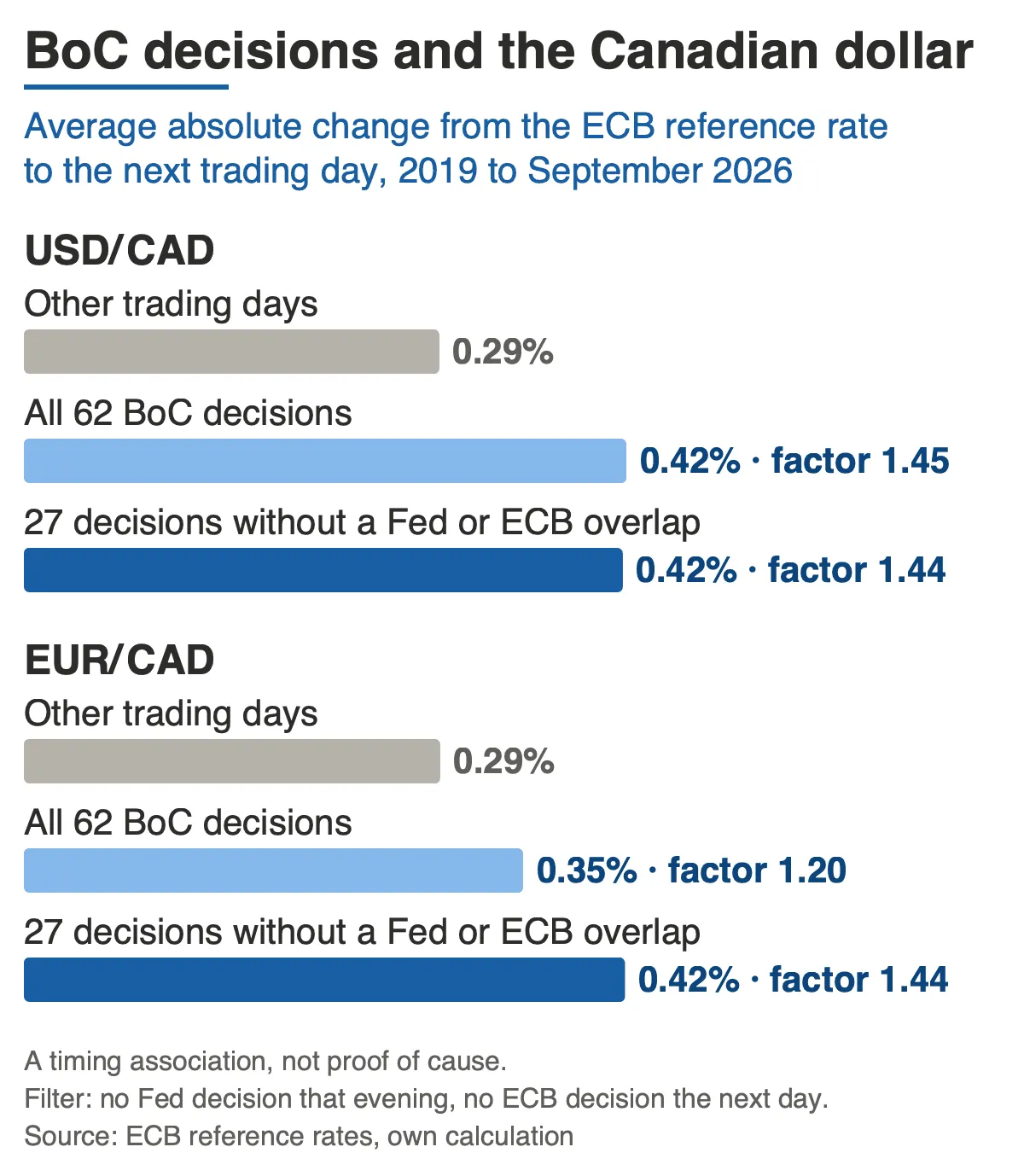 Average absolute change from the ECB reference rate on the decision day to the next trading day, January 2019 to September 2026. The filter leaves out dates with a Fed decision the same evening or an ECB decision the next day. Source: ECB reference rates, own calculation.
Against the euro the picture is weaker only in the full data set. There the factor for EUR/CAD is 1.20. After the same calendar filter both pairs are at about 1.44. This analysis alone therefore does not show that USD/CAD is generally the better pair for trading the BoC date.
The most striking moves
| Decision | USD/CAD in % | Step |
|---|---|---|
| 12 Jul 2017 | −1.37 | rise |
| 6 Sep 2017 | −1.68 | rise |
| 6 Dec 2017 | +1.39 | hold |
| 13 Apr 2022 | −0.75 | rise |
| 29 Oct 2025 | +0.57 | cut |
| 2 Sep 2026 | −0.96 | hold |
Change of USD/CAD from the ECB reference rate on the decision day to the next trading day, calculated from EUR/CAD and EUR/USD. All steps were 0.25 percentage points, except 0.50 on 13 April 2022. A minus means a stronger Canadian dollar. 12 July 2017 was the first rise since 2010; on 29 October 2025 the Fed decided the same evening.
For the Canadian dollar the textbook rule holds more often than for the pound, but only just. Of the 15 rises at regular dates since 2017, nine strengthened the Canadian dollar against the US dollar and six weakened it. Of the ten cuts at regular dates it was five to five; the two emergency cuts of March 2020 are not counted. So the direction of the rate step does not reliably predict the direction of the price.
One possible reason is the gap to expectations, which this study cannot measure. On 2 September 2026 the rate stayed unchanged, and in the same window USD/CAD fell by 0.96 percent. The statement stressed the inflation risks much more sharply than in July. How much of the move it caused cannot be determined from these daily data.
A note on the method. Reference rates are not tradable prices, and the overnight span contains everything else that happened in that time, such as US data the next day. The direction count starts in 2017 because rate steps were too rare before, the strength measurement in 2019 because the Fed and ECB dates are fully documented only from then. Since July 2022 the ECB has published its decisions at 2:15 p.m., so roughly at the end of the measuring window. The comparison group is the same in both analyses.
All 62 BoC decisions since 2019, one by one
| Decision | USD/CAD in % | Step |
|---|---|---|
| 9 Jan 2019 | −0.18 | hold |
| 6 Mar 2019 | +0.32 | hold |
| 24 Apr 2019 | +0.41 | hold |
| 29 May 2019 | −0.04 | hold |
| 10 Jul 2019 | −0.43 | hold |
| 4 Sep 2019 | −0.88 | hold |
| 30 Oct 2019* | +0.52 | hold |
| 4 Dec 2019 | −0.78 | hold |
| 22 Jan 2020 | +0.90 | hold |
| 4 Mar 2020 | +0.51 | cut |
| 15 Apr 2020 | +0.33 | hold |
| 3 Jun 2020 | −0.30 | hold |
| 15 Jul 2020 | −0.22 | hold |
| 9 Sep 2020 | −0.49 | hold |
| 28 Oct 2020 | +0.71 | hold |
| 9 Dec 2020 | −0.15 | hold |
| 20 Jan 2021 | −0.69 | hold |
| 10 Mar 2021 | −0.58 | hold |
| 21 Apr 2021 | −0.78 | hold |
| 9 Jun 2021 | +0.24 | hold |
| 14 Jul 2021 | +0.54 | hold |
| 8 Sep 2021 | +0.04 | hold |
| 27 Oct 2021 | −0.41 | hold |
| 8 Dec 2021 | +0.47 | hold |
| 26 Jan 2022* | +0.96 | hold |
| 2 Mar 2022 | −0.41 | rise |
| 13 Apr 2022 | −0.75 | rise |
| 1 Jun 2022 | +0.07 | rise |
| 13 Jul 2022 | +1.30 | rise |
| 7 Sep 2022 | −0.50 | rise |
| 26 Oct 2022 | +0.63 | rise |
| 7 Dec 2022 | −0.46 | rise |
| 25 Jan 2023 | +0.01 | rise |
| 8 Mar 2023 | +0.43 | hold |
| 12 Apr 2023 | −0.64 | hold |
| 7 Jun 2023 | −0.25 | rise |
| 12 Jul 2023 | −0.48 | rise |
| 6 Sep 2023 | +0.09 | hold |
| 25 Oct 2023 | +0.45 | hold |
| 6 Dec 2023 | +0.34 | hold |
| 24 Jan 2024 | +0.42 | hold |
| 6 Mar 2024 | −0.63 | hold |
| 10 Apr 2024 | +0.95 | hold |
| 5 Jun 2024 | +0.15 | cut |
| 24 Jul 2024 | +0.42 | cut |
| 4 Sep 2024 | −0.32 | cut |
| 23 Oct 2024 | −0.17 | cut |
| 11 Dec 2024 | −0.12 | cut |
| 29 Jan 2025* | −0.16 | cut |
| 12 Mar 2025 | −0.08 | cut |
| 16 Apr 2025 | −0.26 | hold |
| 4 Jun 2025 | −0.33 | hold |
| 30 Jul 2025* | +0.31 | hold |
| 17 Sep 2025* | +0.20 | cut |
| 29 Oct 2025* | +0.57 | cut |
| 10 Dec 2025* | −0.34 | hold |
| 28 Jan 2026* | −0.29 | hold |
| 18 Mar 2026* | +0.07 | hold |
| 29 Apr 2026* | −0.05 | hold |
| 10 Jun 2026 | +0.35 | hold |
| 15 Jul 2026 | −0.35 | hold |
| 2 Sep 2026 | −0.96 | hold |
Change of USD/CAD from the ECB reference rate on the decision day to the next trading day, calculated from EUR/CAD and EUR/USD. A minus means a stronger Canadian dollar. * = Fed decision the same evening.
BoC, Fed, ECB and BoE compared
For CAD traders what counts is not the Canadian rate alone, but its gap to the US dollar. The rate differential helps decide where capital flows. The table shows the state after the September meetings.
| Bank | Policy rate | Next decision |
|---|---|---|
| BoC | 2.25% | 28 Oct 2026 |
| Fed | 3.75 to 4.00% | 28 Oct 2026 |
| ECB | 2.50% | 29 Oct 2026 |
| BoE | 3.75% | 5 Nov 2026 |
As of 27 September 2026. BoC: Canada, Fed: United States, ECB: euro area, BoE: United Kingdom. ECB: deposit facility rate, effective since 16 September 2026. Fed: target range, decided on 16 September 2026.
Against the US dollar Canada is 1.5 to 1.75 percentage points behind. Since the Fed raised rates in September while the Bank of Canada stood still, the gap has widened. That makes the US dollar more attractive for interest-rate investors, which is one reason rate differentials are watched so closely in carry trades.
The price action of 2026 fits this picture. According to the ECB reference rates, USD/CAD rose from 1.3733 on 2 January to 1.4143 on 25 September, so the Canadian dollar lost about 3 percent against the US dollar. Against the euro it was almost unchanged, with EUR/CAD last at 1.6127. The current chart picture is in our USD/CAD forecast.
The sister articles cover the other dates. How the European Central Bank decides is explained in the ECB rate decision, the Bank of England with its named votes in the BoE rate decision. Japan follows in the BoJ rate decision, and the other big commodity currency in the RBA rate decision. The Swiss franc follows in the SNB rate decision.
How to handle the BoC date as a trader
European traders should set the alarm one hour earlier in October. On 28 October the decision comes at 2:45 p.m. central European time, not 3:45 p.m. Anyone who set an alarm or a calendar alert with the usual time will miss the first reaction. For readers in North America nothing changes: it is 9:45 a.m. ET as always.
At the Bank of Canada, read the wording rather than the votes. Because the Bank decides by consensus, changes in the jointly published wording matter a lot. They show the Council’s assessment, but not an individual dissent. The summary of deliberations two weeks later can make different views of the members visible.
On days with a Fed decision, plan for two events. On such Wednesdays USD/CAD moves first on the Bank of Canada in the morning and then on the Fed in the afternoon. A position that survives the first event also has to survive the second. If you want to know what the market expects from the Fed, the FedWatch Tool shows the priced probabilities.
Do not forget the oil price. Canada is a large oil exporter, and the Bank of Canada explains its current caution with energy prices. An oil price jump can move the Canadian dollar more than the rate decision itself. The current view on oil is in our crude oil forecast.
Reduce your position on days when a surprise is possible. In my measurement there were large changes on hold dates too. With a normal stop-market order the stop price is not a guaranteed execution price. Once triggered it is executed as a market order, and in fast moves the fill can differ clearly from the stop level.
Conclusion: at the Bank of Canada, wording and timing count
The BoC rate decision is predictable: eight regular dates a year, on Wednesdays, at 9:45 a.m. Eastern Time. The calendar is fixed to the end of 2027. For European readers the only exception is 28 October 2026 at 2:45 p.m., and on exactly that day the Fed decides too.
The content is open. Across all 62 measuring windows since 2019, the average absolute change of USD/CAD was 1.45 times that of other trading days, and 1.44 times after the additional calendar filter. The direction follows the rate step only narrowly: nine of 15 rises since 2017 strengthened the Canadian dollar.
For 28 October the tone matters most. Inflation is at the top of the target range at 3.0 percent, and the tariffs weigh on the recovery. Whether the Bank of Canada turns its September warning into a step depends on the new forecasts in the Monetary Policy Report and on whether energy prices spill over into other goods. For the assessment it is worth reading the statements on inflation first and the rate figure second.
Frequently asked questions about the Bank of Canada rate decision
What time does the Bank of Canada announce its rate decision?
The Bank of Canada announces at 9:45 a.m. Eastern Time, the local time in Ottawa. In central Europe that is usually 3:45 p.m.; in the weeks when Europe and North America are on different clock times it is 2:45 p.m., in 2026 on 28 October.
What is Canada’s interest rate now?
The Bank of Canada’s policy rate is 2.25 percent, effective since 30 October 2025. On 2 September 2026 it was confirmed for the seventh time in a row. The Bank Rate is 2.50 percent and the deposit rate 2.20 percent.
What is inflation in Canada?
Inflation stood at 3.0 percent in August 2026, according to Statistics Canada. That is near the top of the 1 to 3 percent range. Excluding gasoline it rose from 2.2 percent in July to 2.4 percent in August.
How often does the Bank of Canada decide on interest rates?
The Bank of Canada decides eight times a year, as a rule on a Wednesday. Four times the Monetary Policy Report with new forecasts is published at the same time. Unscheduled decisions are possible, most recently in March 2020.
Who sets interest rates at the Bank of Canada?
The Governing Council, which currently has six members, sets the rate. They are Governor Tiff Macklem, Senior Deputy Governor Carolyn Rogers and four Deputy Governors. The Council decides by consensus; individual votes are not published.
How much does USD/CAD move around a Bank of Canada decision?
In my measurement across 62 decisions since 2019, USD/CAD changed on average by 0.42 percent. That is from the ECB reference rate on the decision day to the next trading day, against 0.29 percent on other trading days, so about 1.45 times as much. For EUR/CAD the factor in the full data set was 1.20.
This article is translated from the German edition on kagels-trading.de.
More Central Banks guides
- Follow the US dollar
Fed Interest Rate Decision 2026: Dates, Rate and Outlook
Every FOMC date, the latest decision and dot plot, and how much a Fed decision moves markets.
- Follow the euro
ECB Interest Rate Decision 2026: Dates and Latest Decision
Current ECB rates, every meeting date with times and what traders should watch.
- Follow the yen
BoJ Interest Rate Decision: Dates, Times and Japan's Rate
Bank of Japan meeting dates to the end of 2027 and how much the yen and the Nikkei move on BoJ days.
- Follow the British pound
Bank of England Interest Rate Decision: Dates and Times
Every MPC date to the end of 2027 with times, the named votes of 2026 and how much EUR/GBP moves on BoE days.
- Follow the Swiss franc
SNB Interest Rate Decision: Dates, Times and the Swiss Franc
SNB meeting dates to the end of 2027 with times, the latest decision and how much the franc moves on SNB days.
- Follow the Australian dollar
Next RBA Meeting 2026: Decision Dates, Times and the Aussie
RBA dates with the Monday-evening times in New York, the 2026 votes and how much the Australian dollar moves.
- Read Fed expectations
CME FedWatch Tool Explained: Forecasting Fed Rate Decisions
How FedWatch turns futures prices into rate probabilities, and how accurate it has been.