
Bank of England Interest Rate Decision: Dates and Times


Contents
- The BoE rate decision in 30 seconds
- What is the Bank of England rate decision?
- When is the next Bank of England rate decision?
- The latest BoE decision: September 2026
- Bank of England decision dates for 2026 and 2027
- What time is the Bank of England decision?
- The UK policy rate: from 0.10 to 5.25 and back to 3.75 percent
- How much does a BoE decision move the pound?
- BoE, ECB, Fed and SNB compared
- How to handle the BoE date as a trader
- Conclusion: at the Bank of England, the votes show the direction
- Frequently asked questions about the Bank of England rate decision
- About the author
In February 2026 the Bank of England was one vote short of a rate cut; seven months later three of its nine policymakers want to raise rates. So the direction of the dissenting votes in the Bank of England interest rate decision has turned, although Bank Rate has stood unchanged at 3.75 percent since December 2025.
Here you will find every decision date to the end of 2027, the state after the decision of 17 September and my own analysis of 78 regular decisions. It shows how much the British pound really moves on BoE days, and why the votes often tell you more than the rate itself.
The BoE rate decision in 30 seconds
- The Bank of England rate decision is the Monetary Policy Committee’s decision on Bank Rate, the policy rate of the United Kingdom. It comes eight times a year, almost always on a Thursday.
- Bank Rate is 3.75 percent. It has applied since 18 December 2025 and was confirmed on 17 September 2026 by 6 votes to 3. The three dissenters wanted 4 percent.
- The next decision comes on Thursday, 5 November 2026. It is published together with a new Monetary Policy Report.
- Regular decisions are published at noon London time. That is 7:00 a.m. Eastern Time on most dates and 1:00 p.m. in central Europe all year round.
- In my measurement across 78 regular decisions since 2017, EUR/GBP moved on average 1.4 times as much on BoE days as on other trading days, and 1.8 times on days with a rate change.
- On four of the five rate-rise days with the largest moves, the pound weakened against the euro rather than strengthened.
What is the Bank of England rate decision?
The Bank of England rate decision is the Monetary Policy Committee’s decision on the level of Bank Rate, the policy rate of the United Kingdom. It is published eight times a year, together with the minutes of the meeting and the vote of every single member.
Bank Rate is the rate the Bank of England pays on the reserves commercial banks hold at the central bank. Through it, the Bank of England steers short-term interest rates across the British financial system.
The decision is taken by a committee of nine members, the Monetary Policy Committee. The MPC consists of Governor Andrew Bailey, three Deputy Governors, the Chief Economist and four external members appointed directly by the Chancellor of the Exchequer. The members are listed on the MPC page.
The Bank of England publishes the vote of each MPC member by name. So you can see who stands for a higher or lower rate. A simple majority decides, and in a tie the Governor has the casting vote. Members in the minority state in the minutes which rate they would have preferred. These dissenting votes are often the real news for traders.
The target is not set by the central bank itself, but by the government. The Bank of England is asked to deliver inflation of 2 percent, measured by the UK consumer price index (CPI). The Bank of England Act 1998 gives it operational responsibility, that is, control over the means.
When is the next Bank of England rate decision?
The next Bank of England rate decision comes on Thursday, 5 November 2026, at noon London time (7:00 a.m. Eastern Time, 1:00 p.m. in central Europe), together with the new Monetary Policy Report.
After that comes 17 December 2026, and all eight dates for 2027 are already fixed. The full list with the quarterly report is below. November has one special feature: it comes one week after the Fed and the ECB, which decide on 28 and 29 October.
The latest BoE decision: September 2026
The Bank of England left Bank Rate at 3.75 percent on 17 September 2026. The vote was 6 to 3. Megan Greene, Catherine Mann and Chief Economist Huw Pill voted for a rise to 4 percent, as in July. That is stated in the Monetary Policy Summary of 17 September 2026.
The hawks’ reason is the energy price shock from the Middle East. UK inflation rose to 3.1 percent in August, and the Bank of England expects a further rise in the coming quarters. The 3.1 percent triggered an open letter exchange between the Governor and the Chancellor, which the Bank published with the minutes. According to the minutes, about 0.7 of the 1.1 percentage points of overshoot come directly from energy prices, mainly fuel.
The majority still holds, because it does not yet see second-round effects. These are firms and workers passing higher energy costs on into prices and wages. According to the committee there is little evidence of that so far, and the weak labour market dampens inflation over time. Still, the Bank sees the risks to inflation clearly skewed to the upside, more so than in July.
The market is well ahead of the surveyed professionals. Almost all participants in the Market Participants Survey, closed on 4 September, expected an unchanged rate, and the median expectation was a longer pause after that. The money market curve, by contrast, rises and reaches about 4.9 percent by the end of 2027, according to the minutes. The Bank attributes part of this to risk premia, not only to expected rises.
A second decision was taken at the same meeting and hardly made headlines. The MPC voted unanimously for a plan to run down its stock of UK government bonds from earlier purchases completely by the end of 2034. The plan foresees annual sales of £20 billion, while maturing bonds run off as well.
Arguments for a hold in November
- Six of nine members so far see no sufficient second-round effects.
- According to the September minutes, a large part of the inflation overshoot comes from direct energy effects.
- The labour market is weak and dampens inflation over time.
- In the survey closed on 4 September, the median expectation was a longer pause.
Arguments for a rate rise
- The number of votes for a rise has grown from zero in March to three in July and September.
- Inflation is 3.1 percent and, according to the Bank of England, set to rise further.
- The committee sees the risks to inflation more skewed to the upside than in July.
- Higher inflation forecasts or stronger second-round effects could add pressure for a rise.
Bank of England decision dates for 2026 and 2027
The Bank of England decides eight times a year, and four times the Monetary Policy Report is published at the same time. This quarterly report contains the new forecasts for growth and inflation. In my measurement the report dates moved the pound clearly more than the others; the figures are below. All dates are on the Bank’s MPC dates page.
| Decision (Thursday) | ET / central Europe | MPR |
|---|---|---|
| 5 Nov 2026 | 7:00 a.m. / 1:00 p.m. | yes |
| 17 Dec 2026 | 7:00 a.m. / 1:00 p.m. | no |
| 4 Feb 2027 | 7:00 a.m. / 1:00 p.m. | yes |
| 18 Mar 2027 | 8:00 a.m. / 1:00 p.m. | no |
| 29 Apr 2027 | 7:00 a.m. / 1:00 p.m. | yes |
| 17 Jun 2027 | 7:00 a.m. / 1:00 p.m. | no |
| 29 Jul 2027 | 7:00 a.m. / 1:00 p.m. | yes |
| 16 Sep 2027 | 7:00 a.m. / 1:00 p.m. | no |
| 4 Nov 2027 | 8:00 a.m. / 1:00 p.m. | yes |
| 16 Dec 2027 | 7:00 a.m. / 1:00 p.m. | no |
Bank of England decision dates from its MPC dates page, as of 27 September 2026. Noon London time, converted date by date. MPR = Monetary Policy Report on the same day.
The MPC can act between the regular dates at any time, and it has done so in crises. In March 2020 the Bank of England cut Bank Rate twice outside the schedule within eight days, on 11 and 19 March, from 0.75 to 0.10 percent. Such decisions are rare, but they show that a fixed calendar is no guarantee.
What time is the Bank of England decision?
Regular Bank of England rate decisions are published at noon London time. That is 7:00 a.m. Eastern Time on most dates and 1:00 p.m. in central Europe all year round. The minutes and the votes of all nine members are published at the same time.
European readers do not need a seasonal conversion. The UK moves to summer time and back on the same weekends as the EU, so London is always exactly one hour behind Frankfurt. For readers in North America it is different: the US changes its clocks two to three weeks earlier in March and one week later in autumn. In those weeks the decision arrives at 8:00 a.m. ET, among the dates listed here on 18 March 2027 and 4 November 2027. Unscheduled decisions can be published at other times.
The vote usually takes place the day before; it is published only at Thursday noon. According to the Bank of England, the MPC meets three times: first on the state of the economy, then for the debate, and in the last meeting, usually on the Wednesday, it votes. There the Governor proposes the policy he believes will command a majority.
For traders the midday timing has a practical consequence. At noon London time European markets have been trading for hours, while the US stock market opens only at 9:30 a.m. ET. The first reaction therefore shows in the pound, in UK government bonds and in the FTSE 100.
The UK policy rate: from 0.10 to 5.25 and back to 3.75 percent
The Bank of England has been through a full rate cycle in just under four years. In March 2020 Bank Rate stood at 0.10 percent, the lowest level in its rate database, which goes back to 1975. From December 2021 came 14 rises in a row to 5.25 percent in August 2023, and since August 2024 six cuts.
Every rate change since the turn in 2021
| Decision | Change | Bank Rate |
|---|---|---|
| 16 Dec 2021 | +0.15 | 0.25% |
| 3 Feb 2022 | +0.25 | 0.50% |
| 17 Mar 2022 | +0.25 | 0.75% |
| 5 May 2022 | +0.25 | 1.00% |
| 16 Jun 2022 | +0.25 | 1.25% |
| 4 Aug 2022 | +0.50 | 1.75% |
| 22 Sep 2022 | +0.50 | 2.25% |
| 3 Nov 2022 | +0.75 | 3.00% |
| 15 Dec 2022 | +0.50 | 3.50% |
| 2 Feb 2023 | +0.50 | 4.00% |
| 23 Mar 2023 | +0.25 | 4.25% |
| 11 May 2023 | +0.25 | 4.50% |
| 22 Jun 2023 | +0.50 | 5.00% |
| 3 Aug 2023 | +0.25 | 5.25% |
| 1 Aug 2024 | −0.25 | 5.00% |
| 7 Nov 2024 | −0.25 | 4.75% |
| 6 Feb 2025 | −0.25 | 4.50% |
| 8 May 2025 | −0.25 | 4.25% |
| 7 Aug 2025 | −0.25 | 4.00% |
| 18 Dec 2025 | −0.25 | 3.75% |
Every change of Bank Rate since December 2021 in percentage points, taken from the Bank of England’s Bank Rate database.
The figures come from the Bank of England’s Bank Rate database. On 3 November 2022 the MPC raised Bank Rate by 0.75 percentage points to 3.00 percent. It was the largest single rise since the MPC began setting rates independently in 1997.
Since December 2025 Bank Rate has stood still, but the votes behind it have turned. The MPC voting history shows it meeting by meeting:
| Meeting | Vote | Minority |
|---|---|---|
| 5 Feb 2026 | 5 to 4 | four for a cut |
| 19 Mar 2026 | 9 to 0 | none |
| 30 Apr 2026 | 8 to 1 | one for a rise |
| 18 Jun 2026 | 7 to 2 | two for a rise |
| 30 Jul 2026 | 6 to 3 | three for a rise |
| 17 Sep 2026 | 6 to 3 | three for a rise |
MPC votes on Bank Rate in 2026, each a majority to hold at 3.75 percent. Source: Bank of England MPC voting history.
Within seven months the direction of the minority has reversed. In February one vote was missing for a cut; since July three members have called for a rise. The rate itself has not moved. Anyone who looks only at Bank Rate misses this shift completely.
How much does a BoE decision move the pound?
For this article I recalculated the 78 regular rate decisions from February 2017 to September 2026. Since 2017 the MPC has met eight times a year as a rule. The price source is the ECB reference rates, set at 2:15 p.m. central European time, so one hour and 15 minutes after a regular announcement. I measure the size of the daily change against the previous reference rate. The comparison group is the other 2,411 reference-rate days since January 2017. The two unscheduled cuts of March 2020 are left out of both groups.
The difference is visible, but smaller than for the Swiss National Bank. On decision days EUR/GBP moved on average by 0.39 percent, against 0.28 percent on other trading days. That is a factor of 1.4. At 47 of 78 dates the move was above the median of the other days. Since the turn in rates in December 2021 the factor is 1.5, measured against the other days of the same period.
On days with a rate change the average daily move was larger than on days without one. At the 22 dates with a rate step EUR/GBP moved on average by 0.52 percent, a factor of 1.8. At the 56 dates without a change it was 0.35 percent, a factor of 1.2. But there were large moves in both groups: on 8 February 2018 EUR/GBP moved 1.31 percent with the rate unchanged. The chart below shows every date since 2022: blue for rate steps, grey for holds.
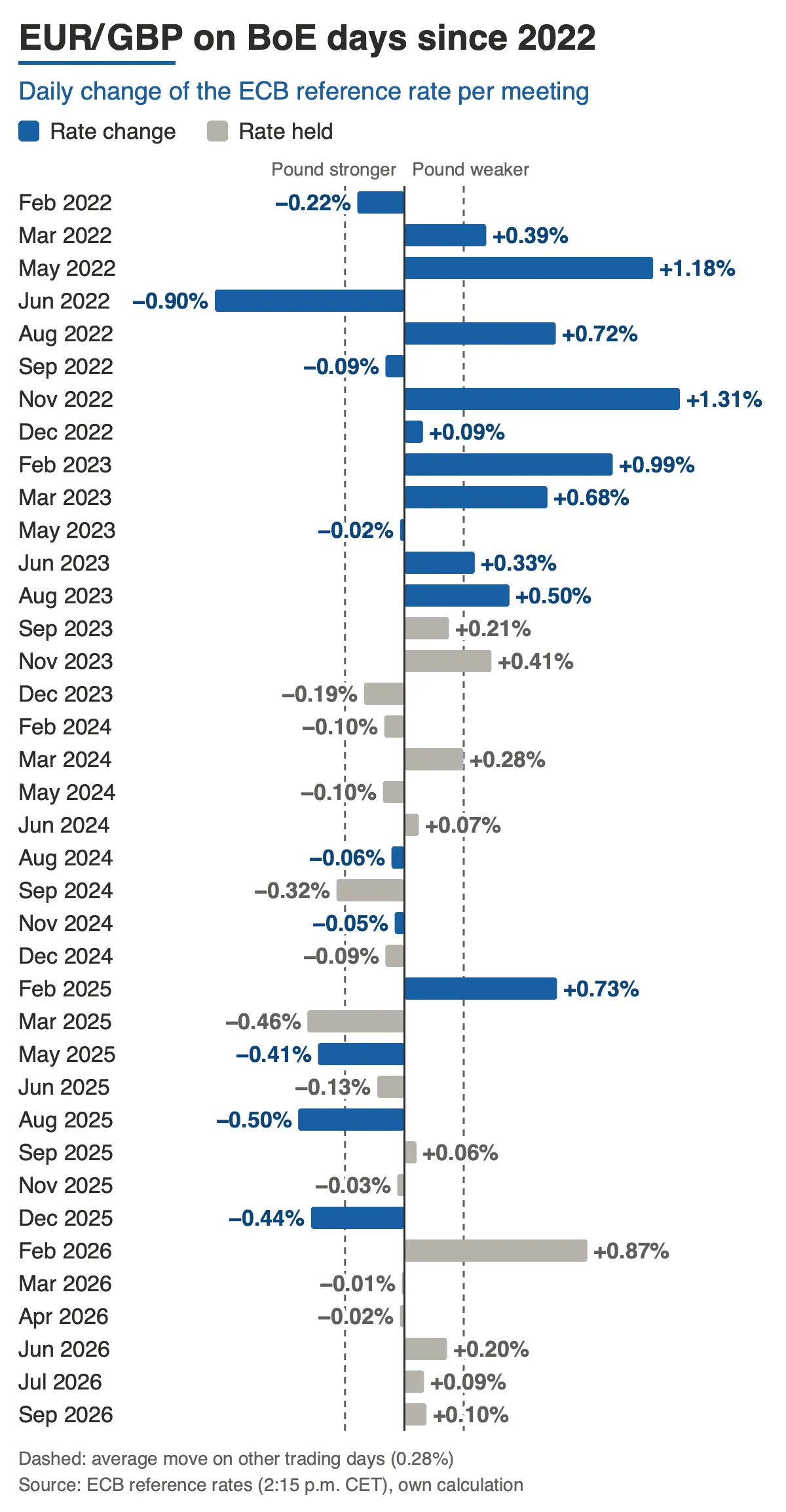 EUR/GBP at all 38 BoE decisions from February 2022 to September 2026: daily change of the ECB reference rate. A plus means a weaker pound. The dashed line shows the average move on other trading days from 2017 to 2026. Source: ECB reference rates, own calculation.
The quarterly report separates the dates too. At the 39 regular dates with a Monetary Policy Report, or its predecessor the Inflation Report, the average daily move was 0.50 percent. At the 39 dates without a report it was 0.29 percent, about as much as on an ordinary trading day. Even at the 25 report dates with an unchanged rate the average was 0.45 percent. This is a descriptive comparison: most rate steps also fell on report dates, so it does not prove a separate report effect.
The most striking moves
| Decision | EUR/GBP | Occasion |
|---|---|---|
| 2 Nov 2017 | +1.49% | first rise since 2007 |
| 5 May 2022 | +1.18% | rise to 1.00% |
| 16 Jun 2022 | −0.90% | rise to 1.25% |
| 3 Nov 2022 | +1.31% | rise of 0.75 points |
| 2 Feb 2023 | +0.99% | rise to 4.00% |
| 5 Feb 2026 | +0.87% | hold, 5 to 4 |
| 17 Sep 2026 | +0.10% | hold, 6 to 3 |
Daily change of the ECB reference rate EUR/GBP at selected BoE dates. A plus means a weaker pound.
In this selection the pattern does not fit the simple rule that a rate rise strengthens the currency. On four of the five rise days with the largest moves the pound weakened. On 2 November 2017 the Bank of England raised rates for the first time in ten years, and the pound lost about 1.5 percent against the euro on the same day. Only on 16 June 2022 did it gain. These are five selected days, not a test across all rises.
One possible explanation is the gap between the decision and the expectations priced in before. The outlook can matter too, and a hold can move the market when the vote is close, as on 5 February 2026 with 5 to 4. My daily data do not measure these expectations, however, and therefore cannot show what caused an individual move.
A note on the method that applies to any analysis with the dollar. The Bank of England often decides the day after the Federal Reserve, most recently on 17 September 2026, after the Fed the evening before. The ECB reference rate for GBP/USD then also contains the Fed reaction. I therefore look at EUR/GBP to avoid the direct dollar component. That pair also reacts to euro area news and global events, so it does not isolate the effect of the Bank of England. Reference rates are not tradable prices, and the daily window also contains news before the announcement.
BoE, ECB, Fed and SNB compared
For pound traders what counts is not the UK rate alone, but its gap to the other currencies. The rate differential helps decide where capital flows. The table shows the state after the September meetings.
| Bank | Policy rate | Next decision |
|---|---|---|
| BoE | 3.75% | 5 Nov 2026 |
| ECB | 2.50% | 29 Oct 2026 |
| Fed | 3.75 to 4.00% | 28 Oct 2026 |
| SNB | 0.00% | 10 Dec 2026 |
As of 27 September 2026. BoE: United Kingdom, ECB: euro area, Fed: United States, SNB: Switzerland. ECB: deposit facility rate, effective since 16 September 2026. Fed: target range, decided on 16 September 2026.
Against the euro the pound has a rate advantage of 1.25 percentage points, against the dollar practically none. Bank Rate sits exactly at the lower end of the Fed’s target range. In EUR/GBP, by contrast, two central banks with a clear gap face each other.
The differences also show in the price action of 2026. Against the euro the pound has gained since the start of the year: according to the ECB reference rates, EUR/GBP fell from 0.8719 on 2 January to 0.8605 on 25 September. Against the dollar it lost ground, with GBP/USD falling from 1.3443 to 1.3252 over the same period.
The sister articles cover the other dates. How the European Central Bank decides is explained in the ECB rate decision, the US central bank in the Fed rate decision and Japan in the BoJ rate decision. The two big commodity currencies follow in the Bank of Canada rate decision and the RBA rate decision, the Swiss franc from the table above in the SNB rate decision.
How to handle the BoE date as a trader
Read the vote first, then the rate. An unchanged rate with 6 to 3 is a different message from one with 9 to 0. The number of dissenters and their direction are in the first lines of the Monetary Policy Summary, before the reasoning.
Watch the dates with a Monetary Policy Report. That is when new forecasts for inflation and growth appear, and they shift expectations for several meetings at once. 5 November is such a date.
Choose the pound pair that matches what you want to watch. If you want to follow UK monetary policy without the direct dollar component, look at EUR/GBP. GBP/USD depends more on the dollar and therefore also on the Fed, as our GBP/USD forecast shows; for the euro side, the EUR/USD forecast gives the current view.
Reduce your position on days when a surprise is possible. My measurement shows larger moves on average on days with a rate step and on report dates, but there were large moves with an unchanged rate too. On the big rise days the direction did not follow from the step itself. A normal stop-market order does not guarantee the execution price, and in fast moves the fill can differ clearly from the stop level.
Do not underestimate the Bank of England as the market’s counterpart. How costly it can get when the central bank and the market stand on different sides was shown on Black Wednesday in September 1992, when the UK had to leave the European Exchange Rate Mechanism.
Conclusion: at the Bank of England, the votes show the direction
The BoE rate decision is predictable: eight regular dates a year, almost always on Thursdays, at noon London time. The calendar is fixed to the end of 2027. For readers in North America it is 7:00 a.m. ET on most dates and 8:00 a.m. in the weeks when US and UK clocks differ. Only unscheduled decisions can come at other times.
The content is open. My analysis of 78 regular dates shows that EUR/GBP moves on average 1.4 times as much on BoE days as otherwise, and clearly more on days with a rate step and on report dates. The data do not support a simple rule that a rise strengthens the pound: on four of the five most striking rise days it weakened.
For 5 November the vote therefore matters most. Since July three of nine members have wanted to raise rates, and inflation is well above target at 3.1 percent. Whether this becomes a rise depends on the new forecasts in the Monetary Policy Report and on whether energy prices feed through into wages.
Frequently asked questions about the Bank of England rate decision
What time does the Bank of England announce its rate decision?
Regular decisions are published at noon London time. That is 7:00 a.m. Eastern Time on most dates, 8:00 a.m. ET in the weeks when US and UK clocks differ, and 1:00 p.m. in central Europe all year. The minutes and votes appear at the same time.
What is the UK interest rate now?
Bank Rate is 3.75 percent, effective since 18 December 2025. On 17 September 2026 it was confirmed by 6 votes to 3; the three dissenters wanted a rise to 4 percent.
Has the Bank of England raised interest rates?
No, not recently. The last rise came on 3 August 2023 to 5.25 percent. Since August 2024 the Bank of England has cut six times, most recently in December 2025 to 3.75 percent. Since July 2026, however, three of nine members have voted for a rise.
How often does the Bank of England decide on interest rates?
The Bank of England decides eight times a year, almost always on a Thursday. Four times the Monetary Policy Report with new forecasts is published at the same time. Unscheduled decisions are possible, as in March 2020.
Who sets interest rates at the Bank of England?
The Monetary Policy Committee with nine members sets the rate. They are Governor Andrew Bailey, three Deputy Governors, the Chief Economist and four external members. Every vote is published by name, and in a tie the Governor decides.
How much does the pound move on a Bank of England decision day?
In my measurement across 78 regular dates since 2017, EUR/GBP moved on average by 0.39 percent on decision days. On other trading days it was 0.28 percent, so about 1.4 times as much. On days with a rate change the factor was 1.8, but there were large moves with an unchanged rate too.
This article is translated from the German edition on kagels-trading.de.
More Central Banks guides
- Follow the US dollar
Fed Interest Rate Decision 2026: Dates, Rate and Outlook
Every FOMC date, the latest decision and dot plot, and how much a Fed decision moves markets.
- Follow the euro
ECB Interest Rate Decision 2026: Dates and Latest Decision
Current ECB rates, every meeting date with times and what traders should watch.
- Follow the yen
BoJ Interest Rate Decision: Dates, Times and Japan's Rate
Bank of Japan meeting dates to the end of 2027 and how much the yen and the Nikkei move on BoJ days.
- Follow the Swiss franc
SNB Interest Rate Decision: Dates, Times and the Swiss Franc
SNB meeting dates to the end of 2027 with times, the latest decision and how much the franc moves on SNB days.
- Follow the Canadian dollar
Bank of Canada Interest Rate Decision: Dates and Times
Bank of Canada dates with times in New York and Europe, the latest decision and how much USD/CAD moves after BoC days.
- Follow the Australian dollar
Next RBA Meeting 2026: Decision Dates, Times and the Aussie
RBA dates with the Monday-evening times in New York, the 2026 votes and how much the Australian dollar moves.
- Read Fed expectations
CME FedWatch Tool Explained: Forecasting Fed Rate Decisions
How FedWatch turns futures prices into rate probabilities, and how accurate it has been.