
Next RBA Meeting 2026: Decision Dates, Times and the Aussie


Contents
- The RBA rate decision in 30 seconds
- What is the RBA rate decision?
- When is the next RBA rate decision?
- The latest RBA decision: September 2026 and the outlook
- RBA decision dates for 2026 and 2027
- What time is the RBA decision?
- Australia’s policy rate: from 0.10 to 4.60 percent, above the 2023 peak
- How much does an RBA decision move the Australian dollar?
- RBA, Fed, ECB and BoC compared
- How to handle the RBA date as a trader
- Conclusion: at the RBA, timing and the vote count matter
- Frequently asked questions about the RBA rate decision
- About the author
In 2026 the Reserve Bank of Australia reversed all three rate cuts of the previous year within three months, in March with the narrowest majority its board can have: 5 to 4. For traders outside Asia the RBA interest rate decision also comes at an awkward time: in New York usually late on Monday evening, in Europe early on Tuesday morning.
Here you will find every decision date to the end of 2027, the state before the decision of 29 September 2026 and my own analysis of 98 decisions. It shows how much the Australian dollar really moves on RBA days, and why the direction of a rate step says little about the direction of the price.
The RBA rate decision in 30 seconds
- The RBA rate decision is the Monetary Policy Board’s decision on the cash rate, Australia’s policy rate. It comes eight times a year, as a rule on a Tuesday.
- The cash rate is 4.60 percent. The RBA raised it four times in 2026 by 0.25 points each, most recently on 29 September, effective the next day. That decision was unanimous.
- The next decision comes on Tuesday, 3 November 2026. It brings the new Statement on Monetary Policy, and 8 December closes the year.
- The RBA publishes at 2:30 p.m. Sydney time. In New York that is Monday 10:30 or 11:30 p.m. or Tuesday 12:30 a.m., depending on the season; in central Europe 4:30, 5:30 or 6:30 a.m.
- The statement gives the vote count, but no names. In March the rise passed by 5 votes to 4.
- In my measurement across 98 decisions since 2017, EUR/AUD moved on average 1.43 times as much on RBA days as on other trading days, and 1.84 times on days with a rate step.
What is the RBA rate decision?
The RBA rate decision is the Monetary Policy Board’s decision on the cash rate, Australia’s policy rate. It is published eight times a year on a Tuesday, four times together with the Statement on Monetary Policy.
The cash rate is the rate at which banks in Australia lend each other money overnight. The RBA sets a target for it, the cash rate target, and steers the market so that the actual rate lands there.
Since March 2025 a dedicated body has taken the decision, the Monetary Policy Board. It has nine members: Governor Michele Bullock as chair, her deputy, the Secretary to the Treasury as the most senior official of the finance ministry, and six external members appointed by the Treasurer. That is set out on the Monetary Policy Board page.
A simple majority decides, and in a tie the chair has the casting vote. Unlike the Bank of England, the RBA does not publish names. The statement only says how many members voted for what. This vote count is often the real news for traders.
The goal is inflation between 2 and 3 percent. The RBA has a dual mandate: price stability and full employment. In its statements it measures success against the midpoint of the range, that is 2.5 percent.
When is the next RBA rate decision?
The next Reserve Bank of Australia rate decision comes on Tuesday, 3 November 2026, at 2:30 p.m. Sydney time. From early November Sydney is on summer time, so that is 10:30 p.m. Eastern Time on Monday and 4:30 a.m. in central Europe. The meeting starts the day before, on Monday.
After that comes 8 December 2026, and all eight dates for 2027 are already fixed. The November meeting also brings the new Statement on Monetary Policy with fresh forecasts, which makes it the more important of the two remaining dates.
The latest RBA decision: September 2026 and the outlook
The RBA raised the cash rate to 4.60 percent on 29 September 2026, unanimously. The step of 25 basis points ended two pauses in June and August and was the fourth rise of the year, as the statement of 29 September 2026 shows. The new rate applies from 30 September.
The Board named the reason in one sentence. Inflation remains elevated, it wrote, and some of the upside risks flagged in August are materialising. Labour market conditions have eased broadly as expected, and the Board points to heightened uncertainties, among them the unresolved conflict in the Middle East and disruptions to global oil supply that keep pressure on energy prices.
The reason for the rises is inflation that was too high even before the oil price shock. According to the RBA, inflation picked up materially in the second half of 2025, partly because of capacity pressures in the domestic economy. The conflict in the Middle East added a second push. In the RBA’s assessment, higher fuel prices are already being passed on to other goods.
The latest figures are clearly above the target range. In July 2026 the consumer price index rose 3.5 percent year on year, after 3.8 percent in June, according to the Australian Bureau of Statistics. The trimmed mean, the measure of underlying inflation, was unchanged at 3.6 percent. In its August forecast the RBA expects a return to around the midpoint of the target range only towards the end of 2027.
The RBA explicitly keeps the next step open. It will do what it considers necessary, the August statement says, including further rises if upside risks materialise. At the same time it sees signs of cooling: consumer spending is growing more slowly, house prices are falling in some capital cities, and the labour market has eased a little more than expected.
Arguments for a hold
- After three rises, financial conditions are noticeably tighter, according to the RBA.
- Consumer spending is slowing as expected, and new housing loans are falling.
- The labour market has eased a little more than the RBA expected.
- In June and August the board voted unanimously for a pause each time.
Risks that argue for a further rise
- Inflation was 3.5 percent in July, the trimmed mean 3.6 percent.
- According to the RBA’s August forecast, inflation reaches the midpoint of the range again only towards the end of 2027.
- Higher fuel prices are already feeding into other prices, according to the RBA.
- The board explicitly names further rises as an option.
RBA decision dates for 2026 and 2027
Since 2024 the RBA has had eight regular dates a year; until 2023 it had eleven. The board meets on Monday afternoon and on Tuesday, and the result is published on Tuesday at 2:30 p.m. Sydney time. All dates are in the RBA calendar.
| Decision in Sydney (Tuesday) | New York / central Europe | SMP |
|---|---|---|
| 29 Sep 2026 | Tue 12:30 a.m. / 6:30 a.m. | no |
| 3 Nov 2026 | Mon 10:30 p.m. / 4:30 a.m. | yes |
| 8 Dec 2026 | Mon 10:30 p.m. / 4:30 a.m. | no |
| 9 Feb 2027 | Mon 10:30 p.m. / 4:30 a.m. | yes |
| 23 Mar 2027 | Mon 11:30 p.m. / 4:30 a.m. | no |
| 4 May 2027 | Tue 12:30 a.m. / 6:30 a.m. | yes |
| 22 Jun 2027 | Tue 12:30 a.m. / 6:30 a.m. | no |
| 10 Aug 2027 | Tue 12:30 a.m. / 6:30 a.m. | yes |
| 28 Sep 2027 | Tue 12:30 a.m. / 6:30 a.m. | no |
| 2 Nov 2027 | Mon 11:30 p.m. / 4:30 a.m. | yes |
| 14 Dec 2027 | Mon 10:30 p.m. / 4:30 a.m. | no |
RBA decision dates from its calendar, as of 27 September 2026. 2:30 p.m. Sydney time, converted date by date. “Mon” in New York means the evening before the Tuesday decision in Sydney. SMP = Statement on Monetary Policy on the same day.
The Statement on Monetary Policy appears in February, May, August and November. It contains the new forecasts for growth and inflation and, according to the RBA, is published at the same time as the decision. The RBA last acted outside the schedule in March 2020: the board met on 18 March, announced the cut to 0.25 percent on 19 March, effective from 20 March.
What time is the RBA decision?
The Reserve Bank of Australia publishes its rate decision at 2:30 p.m. Sydney time on a Tuesday. In New York that is Monday evening at 10:30 or 11:30 p.m., or Tuesday at 12:30 a.m., depending on the season. In central Europe it is 4:30, 5:30 or 6:30 a.m. on Tuesday.
In the southern hemisphere daylight saving time runs the other way round. Sydney moves to summer time on the first Sunday in October and back on the first Sunday in April. The US changes on the second Sunday in March and the first Sunday in November, Europe on the last Sunday in March and October. That is why the gap to Sydney keeps changing, and why there are three different times in each place. The chart below shows for 2027 which time applies when.
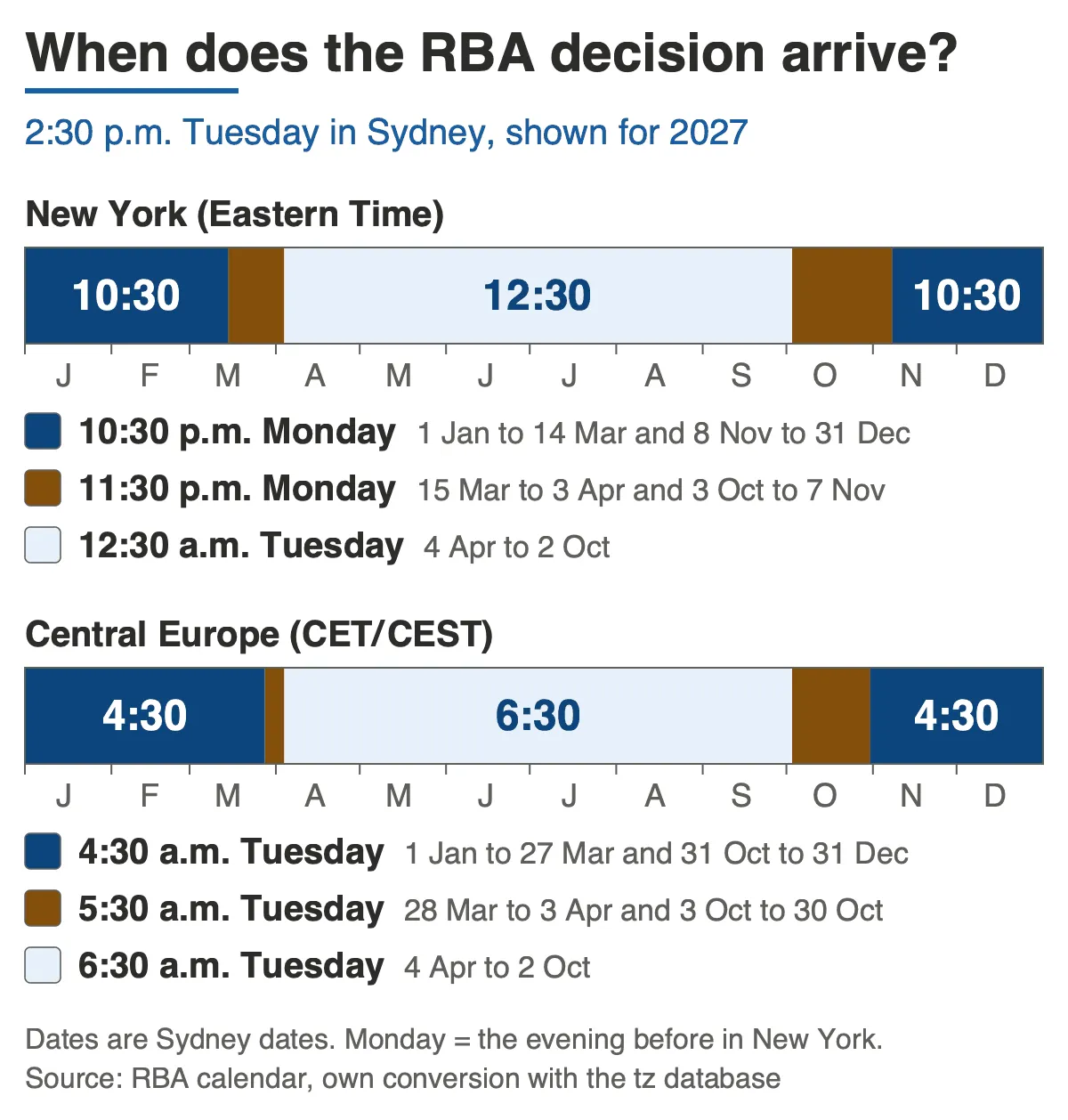 The RBA publishes at 2:30 p.m. Sydney time. Converted day by day with the time zone database for 2027. Dates are Sydney dates. Source: RBA calendar, own conversion.
One hour after the statement comes the press conference. The Governor explains each decision to the press at 3:30 p.m. Sydney time. Two weeks later the minutes of the meeting follow.
For traders outside Asia the date falls into the Asian session. When the decision lands, Tokyo is open, while New York has closed and Europe has not yet opened. The first reaction therefore shows in the Australian dollar and on the Sydney stock exchange. The currency market keeps trading through the night, so by the next morning the result has long been priced.
Australia’s policy rate: from 0.10 to 4.60 percent, above the 2023 peak
Since 2022 the RBA has been through two tightening cycles with a short easing in between. From November 2020 to May 2022 the cash rate stood at 0.10 percent. Then came 13 rises to 4.35 percent in November 2023. In 2025 the RBA cut three times to 3.60 percent. In 2026 it reversed all three cuts and then went further: four rises took the cash rate to 4.60 percent, a quarter point above the 2023 peak.
Every rate change since the turn in 2022
| Decision | Change | Cash rate |
|---|---|---|
| 3 May 2022 | +0.25 | 0.35% |
| 7 Jun 2022 | +0.50 | 0.85% |
| 5 Jul 2022 | +0.50 | 1.35% |
| 2 Aug 2022 | +0.50 | 1.85% |
| 6 Sep 2022 | +0.50 | 2.35% |
| 4 Oct 2022 | +0.25 | 2.60% |
| 1 Nov 2022 | +0.25 | 2.85% |
| 6 Dec 2022 | +0.25 | 3.10% |
| 7 Feb 2023 | +0.25 | 3.35% |
| 7 Mar 2023 | +0.25 | 3.60% |
| 2 May 2023 | +0.25 | 3.85% |
| 6 Jun 2023 | +0.25 | 4.10% |
| 7 Nov 2023 | +0.25 | 4.35% |
| 18 Feb 2025 | −0.25 | 4.10% |
| 20 May 2025 | −0.25 | 3.85% |
| 12 Aug 2025 | −0.25 | 3.60% |
| 3 Feb 2026 | +0.25 | 3.85% |
| 17 Mar 2026 | +0.25 | 4.10% |
| 5 May 2026 | +0.25 | 4.35% |
| 29 Sep 2026 | +0.25 | 4.60% |
Every change of the cash rate target since May 2022 in percentage points, each effective the following day. Source: RBA cash rate table.
The figures come from the RBA’s cash rate table. It lists the date from which each new rate applies, the day after the decision. The pace of 2022 stands out: four rises in a row of 0.50 percentage points each from June to September.
In 2026 the board’s votes were at times very close. The statements give the result for every meeting:
| Meeting | Vote | Step |
|---|---|---|
| 3 Feb 2026 | unanimous | +0.25 |
| 17 Mar 2026 | 5 to 4 | +0.25 |
| 5 May 2026 | 8 to 1 | +0.25 |
| 16 Jun 2026 | unanimous | hold |
| 11 Aug 2026 | unanimous | hold |
Votes of the Monetary Policy Board in 2026, steps in percentage points. In March and May the minority voted to hold. Source: RBA statements.
In March the rise had a lead of only one vote. According to the statement of 17 March, five members voted for the rise and four to hold. In May only one member voted to hold. In June and August the board was unanimous, both times for a pause.
How much does an RBA decision move the Australian dollar?
For this article I recalculated all 99 RBA dates since January 2017; prices exist for 98 of them. The price source is the ECB reference rates, set at 2:15 p.m. central European time, so after the announcement in Sydney. I measure the absolute percentage change from the previous available reference rate to the reference rate on the day of the announcement, and compare it with the same span on all other trading days. A window that spans an RBA date without its own reference rate does not count towards the comparison group.
Against the euro the difference is clear. EUR/AUD changed on average by 0.51 percent on RBA days, against 0.35 percent on other trading days. That is a factor of 1.43. At 65 of 98 dates the change was above the median of the other days. The regular Fed and ECB decision dates do not normally fall into these windows. That does not rule out unscheduled measures and other news: the window to 19 March 2020 also contained the ECB’s emergency purchase programme PEPP.
The difference was largest on days with a rate change. At the 25 dates with a rate step EUR/AUD changed on average by 0.65 percent, a factor of 1.84. At the dates with a hold the factor was 1.29. Relative to its own comparison days the difference was larger for EUR/AUD than for AUD/USD, where the factor is 1.32. The average absolute change, however, was higher for AUD/USD, at about 0.60 percent against 0.51 percent.
Since 2024 the relative difference has been smaller in this small sample. Across all 21 dates the factor is 1.24 for EUR/AUD and 1.06 for AUD/USD. Looking only at the 15 dates without a rate change, the factors are 1.25 and 0.98. This does not mean that future hold dates will be quiet.
The most striking moves
| Decision | AUD/USD in % | Step |
|---|---|---|
| 19 Mar 2020 | −1.57 | cut |
| 2 Aug 2022 | −1.51 | rise |
| 2 May 2023 | +1.64 | rise |
| 7 Nov 2023 | −1.18 | rise |
| 3 Feb 2026 | +0.93 | rise |
| 17 Mar 2026 | +0.74 | rise |
| 5 May 2026 | −0.18 | rise |
Change of AUD/USD from the previous available ECB reference rate to the day of the announcement, calculated from EUR/AUD and EUR/USD. All steps were 0.25 percentage points, except 0.50 on 2 August 2022. A plus means a stronger Australian dollar. 19 March 2020 was an emergency cut to 0.25 percent; on 17 March 2026 the rise passed by 5 votes to 4.
The direction of the rate step does not predict the direction of the price. Of the 16 rises since 2017, eight strengthened the Australian dollar against the US dollar and eight weakened it. Of the nine cuts it was four to five. On 2 August 2022 the Australian dollar fell by 1.5 percent although the RBA raised rates by half a point.
One possible reason is the gap to expectations, which is not measured here. If a rise has long been priced in, deviations from expectations, the reasoning and the outlook can matter most. A note on the method: reference rates are not tradable prices, and the span between two reference rates contains everything else that happened in that time, in March 2020 for example the Covid panic across all markets. The daily data do not isolate the influence of the RBA.
RBA, Fed, ECB and BoC compared
At 4.60 percent Australia is well above the Fed, the ECB and the Bank of Canada. For traders what counts is the rate gap to the other currencies, because it helps decide where capital flows. The table shows the state after the September decision.
| Bank | Policy rate | Next decision |
|---|---|---|
| RBA | 4.60% | 3 Nov 2026 |
| Fed | 3.75 to 4.00% | 28 Oct 2026 |
| ECB | 2.50% | 29 Oct 2026 |
| BoC | 2.25% | 28 Oct 2026 |
As of 27 September 2026. RBA: Australia, Fed: United States, ECB: euro area, BoC: Canada. ECB: deposit facility rate, effective since 16 September 2026. Fed: target range, decided on 16 September 2026.
Against the euro Australia is 1.85 percentage points ahead, against the US dollar 0.35 to 0.60 points. That makes the Australian dollar interesting for interest-rate investors, for example in carry trades. The sister currency, the Canadian dollar, is more than two points lower at 2.25 percent, as the Bank of Canada rate decision explains.
The price action of 2026 fits this picture. According to the ECB reference rates, EUR/AUD fell from 1.7508 on 2 January to 1.6220 on 25 September, so the Australian dollar gained about 8 percent against the euro. Against the US dollar it rose from 0.6695 to 0.7030 over the same period. The RBA itself points to the higher exchange rate.
The sister articles cover the other dates. How the European Central Bank decides is explained in the ECB rate decision, the US central bank in the Fed rate decision. The Bank of England follows in the BoE rate decision, Japan in the BoJ rate decision and Switzerland in the SNB rate decision.
How to handle the RBA date as a trader
Plan for the date the evening before, not the next morning. In New York the decision comes late on Monday evening or just after midnight, in Europe before the open. If you hold an open position in the Australian dollar, decide the evening before whether it should run through the decision.
Read the vote count first, then the rate. A hold by 9 to 0 is a different message from one by 5 to 4. The RBA gives the result in its statement, and since March 2026 we know how close it can get.
Trade the Australian dollar through the pair that answers your question. Relative to other trading days the difference in my measurement was larger against the euro, while the absolute change was larger in AUD/USD. No trading recommendation follows from this. The current view on AUD/USD is in our AUD/USD forecast.
Expect the price in the morning to be far away from the evening before. Currency trading continues through the Asian session. When New York or Europe starts trading, the price can therefore already differ clearly from the previous evening. With a normal stop-market order the stop price is not a guaranteed execution price, and fast moves and thin liquidity can lead to different fills.
Conclusion: at the RBA, timing and the vote count matter
The RBA rate decision is predictable: eight regular dates a year, normally on Tuesdays, at 2:30 p.m. in Sydney. For readers in New York that is Monday evening or just after midnight, in Europe early on Tuesday morning. The calendar is fixed to the end of 2027.
The direction is open. The RBA raised rates three times in 2026 and has held since, but inflation is still above the target range at 3.5 percent. In my analysis the average absolute change was largest at dates with a rate step, and no direction could be read from it.
For 29 September it is worth looking beyond the rate at the vote count and the reasoning. The vote count shows how broadly the current decision is supported. It does not fix the next step. For 3 November the new data, the wording of the statement and the updated forecasts also count.
Frequently asked questions about the RBA rate decision
What time does the RBA announce its rate decision?
The Reserve Bank of Australia announces at 2:30 p.m. Sydney time on a Tuesday. In New York that is Monday 10:30 or 11:30 p.m. or Tuesday 12:30 a.m., depending on the season; in central Europe it is 4:30, 5:30 or 6:30 a.m. on Tuesday.
What is Australia’s interest rate now?
The cash rate is 4.60 percent, effective since 30 September 2026. The RBA raised it four times in 2026, the last step unanimously on 29 September. The next decision comes on 3 November 2026.
What is inflation in Australia?
In July 2026 inflation was 3.5 percent, according to the Australian Bureau of Statistics. The trimmed mean was 3.6 percent. Both are above the RBA’s target range of 2 to 3 percent.
Why is the Australian dollar so strong in 2026?
Against the euro the Australian dollar gained about 8 percent from January to September. The RBA raised rates four times in 2026 and at 4.60 percent is above the Fed, the ECB and the Bank of Canada. In its August statement it names the higher exchange rate as part of the tighter financial conditions after these rises.
Who sets interest rates at the RBA?
The Monetary Policy Board with nine members sets the rate. They are Governor Michele Bullock, her deputy, the Secretary to the Treasury and six external members. A majority decides, and the vote count is published without names.
How much does the Australian dollar move around an RBA decision?
In my measurement across 98 dates since 2017, EUR/AUD changed on average by 0.51 percent. That is from the previous available ECB reference rate to the reference rate on the day of the announcement, against 0.35 percent on other trading days, so about 1.43 times as much. On days with a rate step the factor was 1.84.
This article is translated from the German edition on kagels-trading.de.
More Central Banks guides
- Follow the US dollar
Fed Interest Rate Decision 2026: Dates, Rate and Outlook
Every FOMC date, the latest decision and dot plot, and how much a Fed decision moves markets.
- Follow the euro
ECB Interest Rate Decision 2026: Dates and Latest Decision
Current ECB rates, every meeting date with times and what traders should watch.
- Follow the yen
BoJ Interest Rate Decision: Dates, Times and Japan's Rate
Bank of Japan meeting dates to the end of 2027 and how much the yen and the Nikkei move on BoJ days.
- Follow the British pound
Bank of England Interest Rate Decision: Dates and Times
Every MPC date to the end of 2027 with times, the named votes of 2026 and how much EUR/GBP moves on BoE days.
- Follow the Swiss franc
SNB Interest Rate Decision: Dates, Times and the Swiss Franc
SNB meeting dates to the end of 2027 with times, the latest decision and how much the franc moves on SNB days.
- Follow the Canadian dollar
Bank of Canada Interest Rate Decision: Dates and Times
Bank of Canada dates with times in New York and Europe, the latest decision and how much USD/CAD moves after BoC days.
- Read Fed expectations
CME FedWatch Tool Explained: Forecasting Fed Rate Decisions
How FedWatch turns futures prices into rate probabilities, and how accurate it has been.