
CME FedWatch Tool Explained: Forecasting Fed Rate Decisions


Contents
The interest-rate decisions of the US Federal Reserve are among the most important dates in a trader’s calendar. Stocks, bonds, currencies or commodities: hardly any market is left untouched. The CME FedWatch Tool shows what the market expects before the Fed decides.
The tool is based on the prices of Fed funds futures and turns them into probabilities for every possible rate level. If you can read this data, you have a clear information edge, whether for your own positioning, for hedging strategies or simply for a better understanding of what markets are pricing in right now.
This article explains how the tool works, puts the links between rate decisions and different asset classes into context, and looks at how accurate its forecasts are.
The CME FedWatch Tool in 30 seconds
- The CME FedWatch Tool uses 30-day Fed funds futures to calculate market expectations for US interest-rate changes, in real time and free of charge.
- The Fed meets eight times a year to decide on interest rates. The results have a major impact on stocks, bonds, currencies and the whole real economy.
- The tool reacts almost in real time to new economic data (CPI, PPI, PCE) and to geopolitical events, such as the Iran war, which made expectations of a rate cut collapse from 25% to 0% within one month.
- According to a study published in the Journal of Futures Markets, the tool predicts the Fed’s rate decision with 88% accuracy 30 days in advance. Fed funds futures on their own reach 75%.
- The tool matters to many market participants: bond holders, stock traders, currency traders and institutional investors use it for trading and hedging strategies.
The CME FedWatch Tool
The FedWatch Tool is provided by CME Group (Chicago Mercantile Exchange), the world’s largest futures exchange. It is designed to let investors, traders and economists gauge current market expectations for a change in interest rates.
The tool’s calculations are based on 30-day Fed funds futures.
Fed funds futures are standardised futures contracts traded at CME. Their price reflects the market’s expectation of the average overnight rate (the federal funds rate) in the contract month.
On this basis, the tool calculates the probability of a possible rate change, or of the current rate level being kept.
The FedWatch Tool is updated continuously. Every change in expectations, for example after new economic and inflation data or because of geopolitical events, is fed into the calculation almost in real time. Anyone can use the tool, free of charge.
While the FedWatch Tool shows US rate expectations, the current state of ECB policy, including market expectations and scenarios, is covered in our article on the ECB rate decision.
Why do Fed meetings matter so much?
Eight times a year the US central bank, the Federal Reserve, holds a two-day meeting to discuss the current interest-rate level, meaning the current target range, which is 0.25 percentage points wide, and the economic outlook.
Market participants usually await the result with great interest. It comes in three acts:
- The announcement of the rate decision itself.
- The press conference shortly afterwards, which explains the decision in more depth, takes into account the labour market, presents the economic projections and may hint at possible adjustments in the near future.
- Finally, three weeks after the meeting, the FOMC minutes.
The FOMC (Federal Open Market Committee) is the monetary policy body of the US Federal Reserve. It has twelve voting members: the seven governors of the Federal Reserve Board and five of the twelve regional Fed presidents.
The minutes give a detailed picture of what was discussed and how the votes were split within the committee.
FOMC meeting dates 2026 and 2027
| Meeting | Press conference | Projections (SEP) |
|---|---|---|
| 15 and 16 September 2026 | Yes | Yes |
| 27 and 28 October 2026 | Yes | No |
| 8 and 9 December 2026 | Yes | Yes |
| 26 and 27 January 2027 | Yes | No |
| 16 and 17 March 2027 | Yes | Yes |
| 27 and 28 April 2027 | Yes | No |
| 8 and 9 June 2027 | Yes | Yes |
| 27 and 28 July 2027 | Yes | No |
| 14 and 15 September 2027 | Yes | Yes |
| 26 and 27 October 2027 | Yes | No |
| 7 and 8 December 2027 | Yes | Yes |
The rate decision is released on the second day of each meeting at 2:00 pm Eastern Time (usually 20:00 in Germany), and the press conference follows at 2:30 pm. At its meeting on 29 July 2026, the Fed left its policy rate in the range of 3.50 to 3.75% for the fifth time in a row, with three FOMC members voting for a rise of 0.25 percentage points. The dates up to the end of 2027 come from the official FOMC calendar. Source: federalreserve.gov. All details on the latest decisions are in our article on the Fed rate decision.
Interest rates and interest-rate futures: why they matter for markets and the economy
In the German-speaking media, coverage of interest rates is mostly limited to the rate level itself and what it means for savings, borrowing costs and house prices.
In capital markets and the real economy, the effects go much further. Borrowing costs directly affect companies’ investment, and with it modernisation, expansion and new lines of business, and in the end growth, employment and competitiveness.
In capital markets, a rate cut, for example, leads investors to expect a more promising economic outlook and therefore rising stock prices.
Borrowing costs also play a key role for stock purchases on credit and highly speculative leveraged investments. When credit is cheap, more money flows into the market from this side too, and liquidity rises.
Interest-rate futures are exchange-traded contracts that oblige buyers and sellers to buy or sell the underlying at a fixed price on a fixed date. Like other futures, they can be used both to hedge against rate changes and for pure speculation. Trading them needs a broker with access to the relevant exchanges such as CBOT; what that costs per contract is documented from real statements in our Interactive Brokers review.
What the FedWatch Tool shows us
As mentioned at the start, the CME FedWatch Tool is based on 30-day Fed funds futures.
You can see the current state at any time on the CME FedWatch page, as the following example shows.
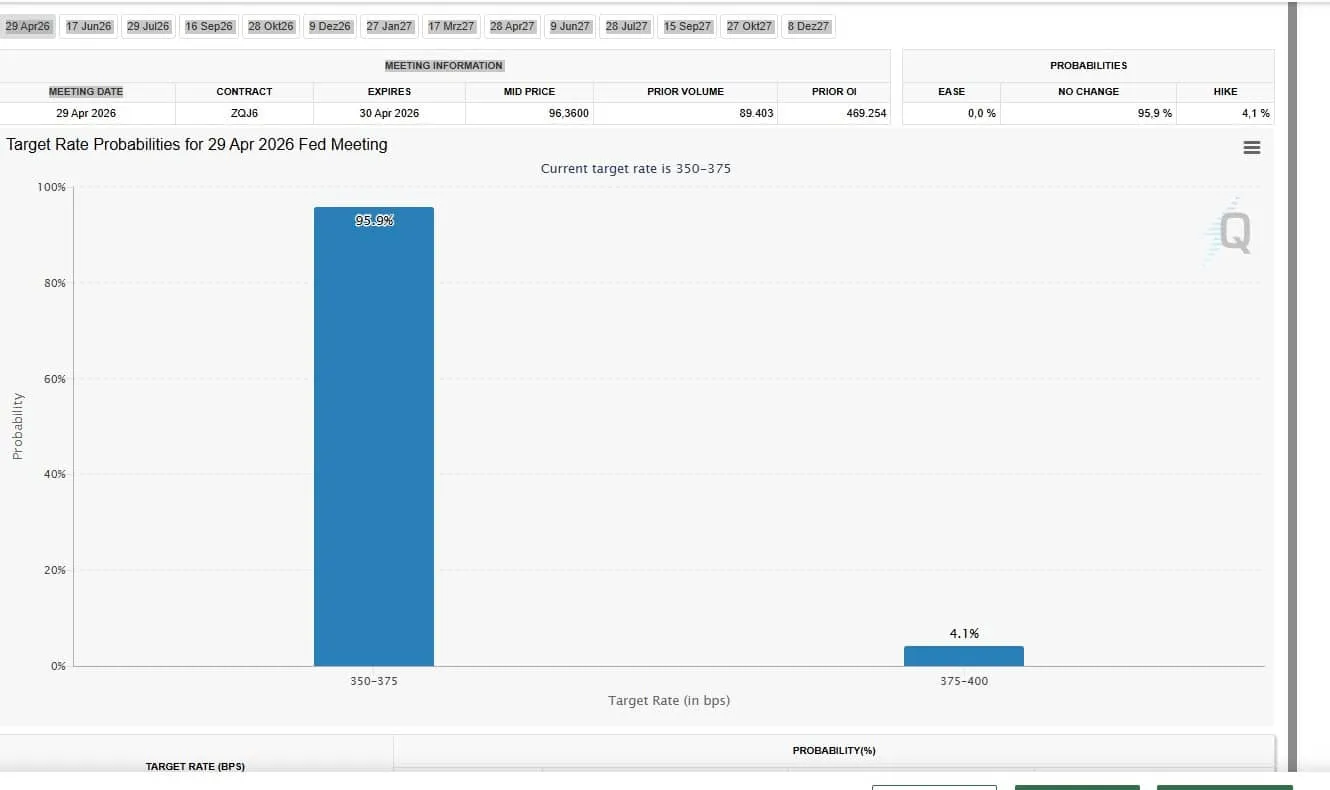 Example view from the tool: before the Fed meeting on 29 April 2026, the probability of an unchanged rate of 3.50 to 3.75% was 95.9%. Source: CME FedWatch, as of March 2026.
Below this constantly updated chart there is a table with comparison values for one day, one week and one month earlier. When this article was first written, at the end of March 2026 and almost exactly one month after the Iran war broke out, the table showed strikingly how expectations of a rate cut had collapsed from almost 25% to 0% within one month.
 When the Iran war broke out, the probability of a rate cut fell from about 25% to 0%. Source: CME FedWatch, as of March 2026.
The tool’s probability view for later meetings also showed how the probability of a rate rise first increased with distance in time and then fell again. The highlighted column marks the probability group with the highest percentage for each meeting date. For the end of 2027, the CME FedWatch Tool even showed a rate cut as the most likely outcome.
If you want to dig deeper into how the FedWatch Tool works, CME explains its method in Understanding the CME Group FedWatch Tool Methodology. I warmly recommend it to readers with an interest in statistics and probability.
A study titled Watching the FedWatch by Stefano Bonini, Shengyu Huang and Majeed Simaan (published online in December 2025, Journal of Futures Markets, Vol. 46, 2026) found that the CME FedWatch Tool predicts FOMC rate decisions with 88% accuracy 30 days before the meeting. That is better than Fed funds futures on their own, which reach 75%.
Prediction markets give a second reading of the same question. On October 6, 2026, Kalshi priced an 82 percent chance of unchanged rates at the October meeting, while the FedWatch Tool showed 80.6 percent. Our Kalshi review documents the comparison, and our guide to prediction markets explains how such event contracts work.
So it pays to follow the information on the CME Group page actively. The benefits are wide-ranging:
Effects on asset classes
Bond holders can profit from price gains when a cut in the policy rate is expected. If inflation risks darken the investment sky, it is worth considering a hedge, either by buying put options or certificates on the underlying bond future, or by selling bonds, especially long-dated ones or those with weaker credit ratings (for example junk bonds, also called high yield: debt issued by companies with limited creditworthiness). In the opposite case, a rate cut, buying high-yield bonds together with the prospect of a better economic outlook can deliver attractive (additional) returns.
Traders and speculative market participants often use bond futures to put their trading strategies into practice directly. Institutional investors mainly hedge against interest-rate risk.
Currency trading is affected by changing rate levels too. When the interest rate of a currency rises, it often attracts additional capital and gains against other currencies. This is why interest-rate differentials are seen as a factor that drives value. So it is easy to see how important and useful the tool is for money and stock markets, for currencies, carry trades and much more.
Market behaviour around the Fed date…
On the day of the rate decision, or more precisely when the announcement is due, you should expect higher volatility. During the press conference that follows, erratic moves are also common. How much of that unrest the bond market prices in ahead of time shows in the MOVE index of Treasury volatility.
Something only for news traders, a routine time to stay out for many day traders, and stop and position management for longer-term investments: these are the usual consequences for your own behaviour.
Important for newcomers: if the Fed decision confirms expectations, the related price move has usually already happened. The result was already priced in.
…and the big picture
The following chart shows the long-term history of US interest rates and the Dow Jones from 1971 to today.
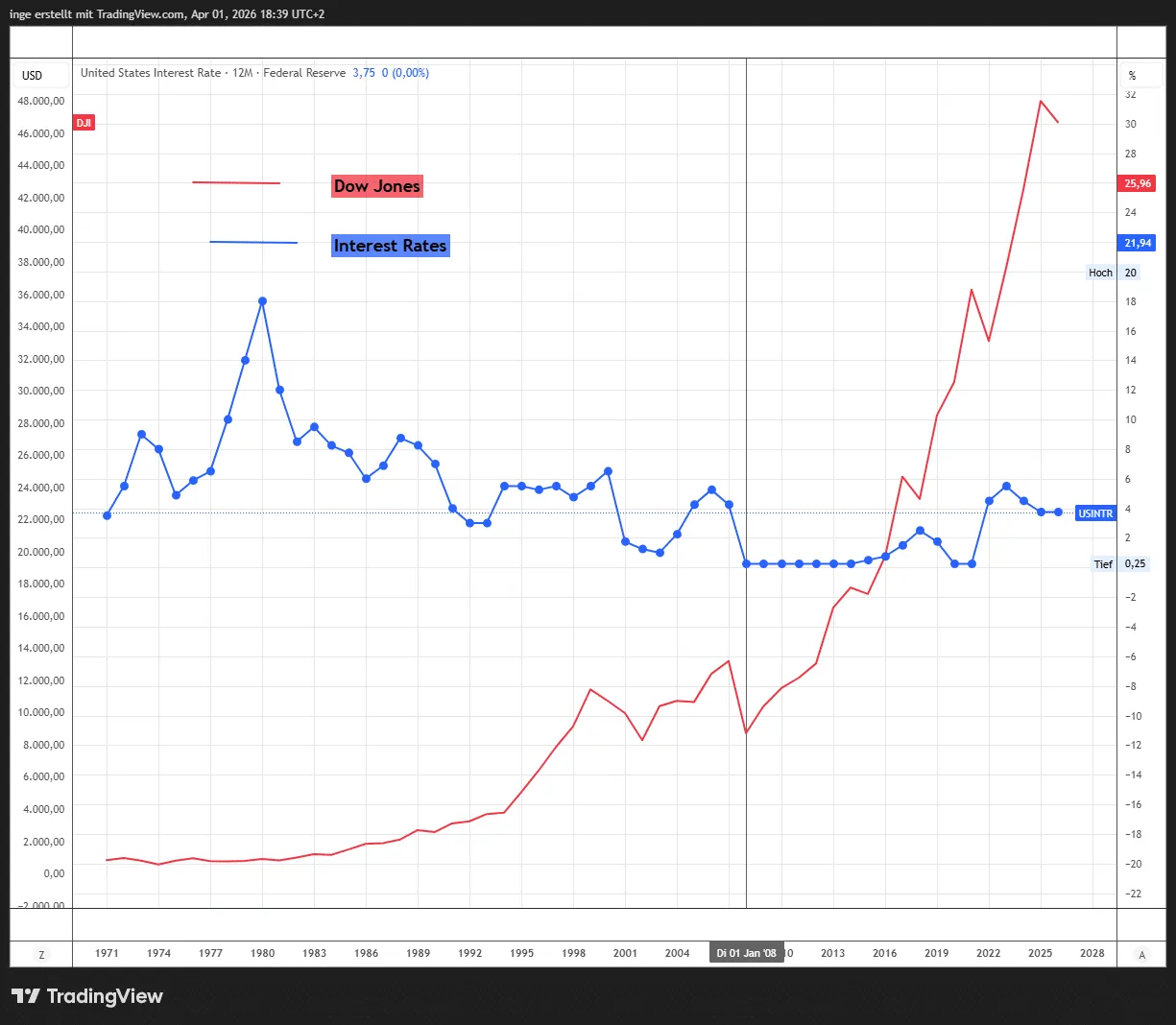 US interest rates (blue) and the Dow Jones (red) from 1971 to 2026. Chart labels in German: Hoch = high, Tief = low. Source: TradingView.
The priced-in probabilities jump most strongly straight after the US jobs report, the most important monthly date for rate expectations. How the Fed’s own projections and the 10-year Treasury yield fit together is shown in our interest rate forecast.
Conclusion: the CME FedWatch Tool
It is no surprise that the CME FedWatch Tool keeps growing in popularity and has become a widely used real-time source.
With 88% accuracy 30 days ahead, it gets the rate decision right in almost nine out of ten cases.
It is especially worth checking the tool after the release of key inflation data: the CPI (Consumer Price Index), the PPI (Producer Price Index) and the US core PCE (Personal Consumption Expenditures), which is considered particularly relevant for the Fed.
Core PCE is the Fed’s preferred inflation measure, because unlike the CPI it takes into account substitution effects in consumer behaviour and leaves out volatile energy and food prices.
This applies above all around possible turning points: the switch from a cycle of rate cuts to a cycle of rate rises, and vice versa.
FAQ about the CME FedWatch Tool
What is the CME FedWatch Tool?
The CME FedWatch Tool is a free online tool from the Chicago Mercantile Exchange (CME Group). It shows in real time how likely it is that the US Federal Reserve will cut, raise or leave interest rates unchanged at its next meeting.
Where do the probabilities come from?
The values are not based on surveys or expert forecasts, but on the prices of Fed funds futures: futures contracts that market participants use to bet on future interest rates. The more money flows in one direction, the higher the probability shown.
How reliable are the forecasts?
According to the study “Watching the FedWatch”, the tool is right in about 88% of cases 30 days before a Fed decision. The closer the meeting gets, the more precise the expectations become, and the hit rate rises clearly in the short term.
Does the CME FedWatch Tool tell me whether the Fed will cut or raise rates?
No. The FedWatch Tool does not know what the Fed will do. It shows market participants’ expectations of a possible rate rise, a rate cut or unchanged rates, and expresses these expectations as probabilities.
Is there a tool like this only for Fed decisions, or can you follow other markets too?
A tool for the euro area has now been built using the same method as the CME FedWatch Tool. It does not come from an institution as prominent as CME, but from a private developer. You can find it at ECB Watch Tool.
This article is based on CME Group and Federal Reserve sources and on Karsten Kagels’ experience as a trader. It is not investment advice.
This article is translated from the German edition on kagels-trading.de.
More Central Banks guides
- Follow the US dollar
Fed Interest Rate Decision 2026: Dates, Rate and Outlook
Every FOMC date, the latest decision and dot plot, and how much a Fed decision moves markets.
- Follow the euro
ECB Interest Rate Decision 2026: Dates and Latest Decision
Current ECB rates, every meeting date with times and what traders should watch.
- Follow the yen
BoJ Interest Rate Decision: Dates, Times and Japan's Rate
Bank of Japan meeting dates to the end of 2027 and how much the yen and the Nikkei move on BoJ days.
- Follow the British pound
Bank of England Interest Rate Decision: Dates and Times
Every MPC date to the end of 2027 with times, the named votes of 2026 and how much EUR/GBP moves on BoE days.
- Follow the Swiss franc
SNB Interest Rate Decision: Dates, Times and the Swiss Franc
SNB meeting dates to the end of 2027 with times, the latest decision and how much the franc moves on SNB days.
- Follow the Canadian dollar
Bank of Canada Interest Rate Decision: Dates and Times
Bank of Canada dates with times in New York and Europe, the latest decision and how much USD/CAD moves after BoC days.
- Follow the Australian dollar
RBA Interest Rate Decision: Dates, Times and the Aussie
RBA dates with the Monday-evening times in New York, the 2026 votes and how much the Australian dollar moves.