
Al Brooks: Books in Order, Trading Course and Price Action


Contents
- Al Brooks in 30 seconds
- Who is Al Brooks?
- Al Brooks price action: what the method looks like
- Al Brooks books in order
- Brooks Trading Course: what you get
- Al Brooks books or course: what it costs and how to choose
- Is Al Brooks profitable? What we found on his track record
- My view: what the books give you in real trading
- Who Al Brooks suits and who should wait
- Conclusion: required reading for price action traders, not a finished trading plan
- Frequently asked questions about Al Brooks
- About the author
Al Brooks says he lost money trading for ten years before he took every indicator off his chart. The former eye surgeon went on to become one of the best-known authors on price action, the style of trading that starts from the price movement on the chart itself. He has written four books and sells the Brooks Trading Course.
I have read his books, and I consider them very valuable, but they are theory you still have to work through. This guide shows the reading order, what the books and the course cost, and how to decide between them. It also says what we could and could not check about his trading results. We have no business relationship with him, and I did not test the course or the trading room for this article.
Al Brooks in 30 seconds
- Who: a former eye surgeon who says he has been a professional trader for more than 30 years and has taught traders since 2009.
- Method: he reads the chart bar by bar. Market context comes before any single pattern, and his book and video charts add a 20-bar moving average.
- Books: four titles from Wiley. His own site says to start with the three-part series, not the older book.
- Reading order: Trends, then Trading Ranges, then Reversals.
- Course: $399 once for the main video course, $499 for both versions. The trading room is $99 a month.
- Limit: in the sources we checked, we found no independently audited track record.
Who is Al Brooks?
Al Brooks is an American professional trader, author and former eye surgeon who teaches traders to read price charts bar by bar through his four books and the Brooks Trading Course.
His first career was in medicine. Wiley’s author note lists a math degree from Trinity College in 1974 and a medical degree from the University of Chicago in 1978. On his own site he adds that he taught eye surgery at Emory University, then opened a practice in Los Angeles. He is not the actor Albert Brooks, who also turns up when you search his name.
His start in trading was expensive. He began in October 1987 and shorted the market on the morning of the crash, then bought back at a loss because he had a full surgery schedule that day. In an interview with Comparic he says he then lost money for ten years, despite books, courses, tutors and sophisticated indicators.
The turning point was removing everything extra. He dropped the indicators and the outside help and went back to a simple chart. His site says he now day trades the Emini, the small S&P 500 futures contract, and also trades forex, stocks and commodities. That is his own account, and we could not check it independently.
He became known as a teacher. He says he has lectured at the Chicago Mercantile Exchange and regularly speaks at MoneyShow and TradersExpo. His site also says Futures magazine, where he was a contributor for many years, called him “the trader’s trader”.
| Item | Details |
|---|---|
| Former career | Eye surgeon, MD University of Chicago |
| Trading since | October 1987, professional for more than 30 years (his own statement) |
| Markets | Emini, forex, stocks, commodities (his own statement) |
| Books | Four titles, Wiley, 2009 to 2012 |
| Paid offers | Video course, trading room, chart pattern encyclopedia |
| Free material | Parts of his manual, glossary, sample videos, blog |
Al Brooks price action: what the method looks like
Price action trading is a style in which the price movement on the chart is the basis for the trading decision, which does not rule out a supporting indicator.
Brooks asks about the state of the market first and about the pattern second. In his free online manual he says context matters more than candle patterns. He first decides whether the market is in a trend or a trading range. In a trend he then asks whether it is in a channel or in a breakout. My own take on this way of reading charts is in the guide to price action trading.
His method is not strictly free of indicators. His glossary says the charts in his videos and books use a 20-bar exponential moving average, and that any moving average can be useful. If that tool is new to you, start with this guide to moving averages.
You have to learn his vocabulary, because the books assume it. Three terms come up constantly in his books and videos:
- Always In: the direction you would confidently choose if you were forced to enter long or short. It does not mean you must hold a position all the time.
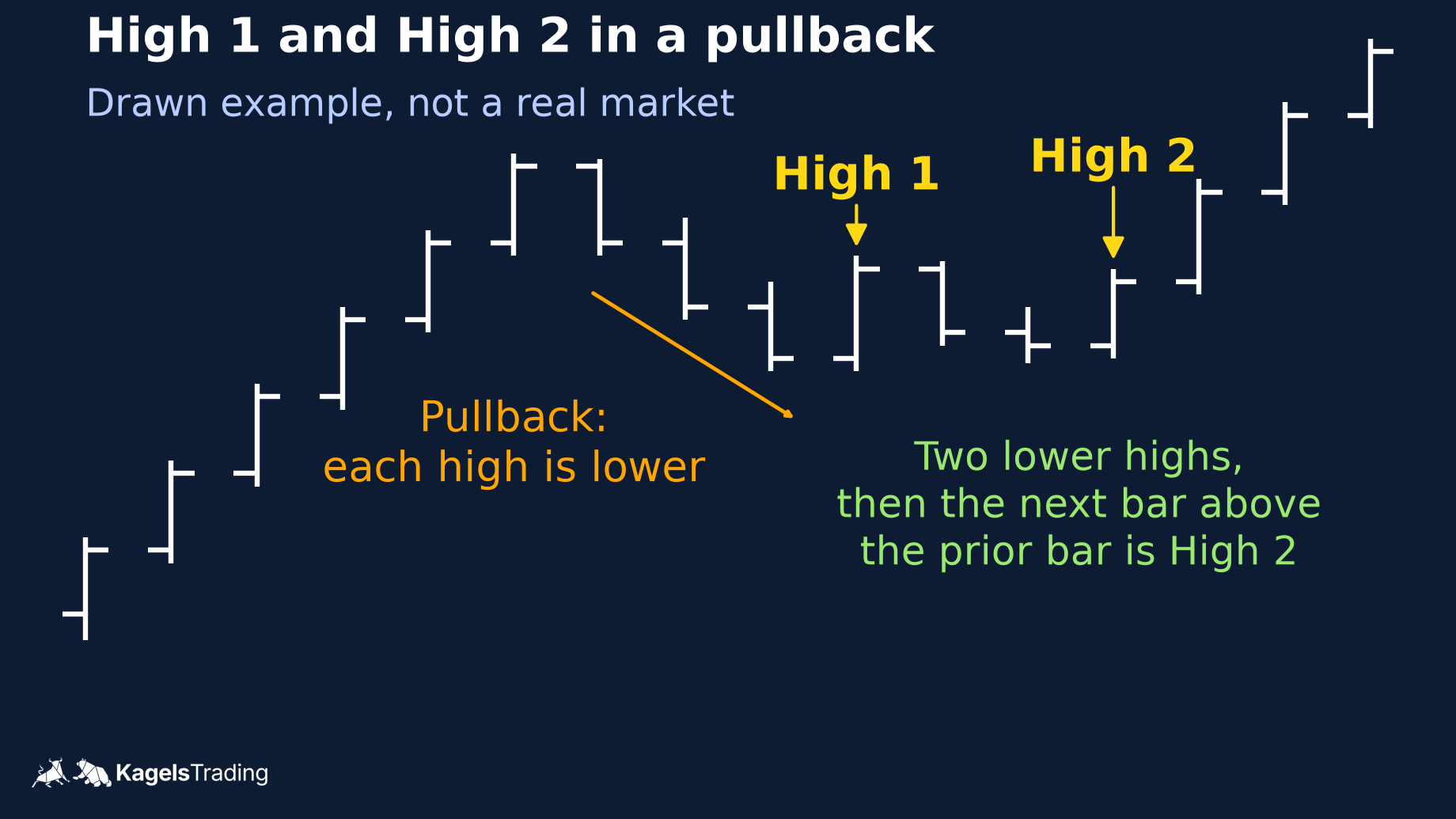
- High 1 and High 2: in a pullback in an uptrend, High 1 is a bar with a high above the prior bar. If a lower high follows, the next bar with a high above the prior bar is High 2. Low 1 and Low 2 are the mirror image.
- Trader’s equation: a trade makes sense only if the probability of success times the reward is greater than the probability of failure times the risk. The glossary itself says the probability can never be known exactly.
The drawing below shows that count in a single pullback. Read it from left to right: first come the lower highs, then each bar that trades above the prior bar.
 Click to enlarge
Source: Definition in the Brooks glossary.
His swing trade definition is about the ratio of reward to risk. He calls a trade a swing trade when the reward is at least twice as large as the risk, and says it should be the foundation for every trader even though he scalps many trades himself. He also tells beginners to enter with stop orders, which trigger only when price reaches a set level. Practical uses of this are in my guide to pullback trading and in the one on position sizing.
The method has one limit built in: it is discretionary. The trader decides in the moment, not a fixed rule set, so two readers can count the same chart differently. You get a feel for how he explains this in a long interview on Desire To TRADE from August 2025, or through his free sample videos.
Al Brooks books in order
Al Brooks has written four books, all published by Wiley. The three-volume series came out from late 2011 to early 2012. Brooks puts it at 540,000 words, and together the volumes run to 1,680 pages.
| Book | Year, pages | Topic |
|---|---|---|
| Reading Price Charts Bar by Bar | 2009, 432 | The earlier book: the whole system in one volume |
| Trading Price Action Trends | 2011, 480 | Trends and the basics of reading bars |
| Trading Price Action Trading Ranges | 2012, 624 | Trading ranges, breakouts, order management |
| Trading Price Action Reversals | 2012, 576 | Reversals and the change between market phases |
Page counts: wiley.com. Publication dates: Amazon.de, both checked 8 November 2026. Prices are in the cost table below.
Brooks recommends starting with the series, not with his oldest book. His books page says the greatest concern among readers was how difficult Reading Price Charts Bar by Bar was to read, and that the series was written to address this. His recommended sequence is below. The same page offers chart downloads for all the books.
- The seriesBook 1: TrendsThe starting point: trends and the basic terms.
- The seriesBook 2: Trading RangesThe longest volume: sideways markets and how to handle breakouts.
- The seriesBook 3: ReversalsReversals come last.
Source: brookstradingcourse.com, books page, checked 8 November 2026. His recommended sequence does not include Reading Price Charts Bar by Bar.
Which Al Brooks book should you read first? Trading Price Action Trends, if you follow his own advice. One volume looks like the easier way in, but his site points the other way. In an Elite Trader thread from February 2024, one reader says he keeps giving up on Reading Price Charts. That is a single voice, but it fits what the books page says.
Do not read the volumes straight through. Take one chapter, look for what it describes on real charts and only then move on. If you are new to bars and candles, begin with how to read candlestick charts or a broader reference work such as Murphy’s technical analysis classic. My wider list by goal is in the guide to trading books.
The books also exist in other languages. Brooks says they have been translated widely. A German edition of Reading Price Charts Bar by Bar was announced for November 2026, which matters only if you read German. Audio versions exist too, but a work this dependent on charts loses most of its content without them.
Brooks Trading Course: what you get
The Brooks Trading Course is an English-language video course by Al Brooks that teaches his price action method in modules for futures, forex, stocks and other markets.
There are three versions. The course page lists the main course with 97 hours of video, a forex version with 94 hours and a package of both with 133 hours. Each is a one-time payment with lifetime access and English subtitles. The home page speaks of over 100 hours and 52 modules, so the provider’s own figures differ slightly.
You can check a lot for free before you pay. There are sample videos, and 12 of the 25 chapters of the manual are public. The manual, by his description, gives a good overview of the course material. Each manual chapter is also a post on his blog.
The trading room is a separate monthly cost. The home page says they discuss Emini price action through the day, with a free trial and access at $99 a month. A European session with DAX and FTSE started in June 2025, presented by Tim Fairweather and Tim Stout. It launched at $59 for that first month, and we could not check the current price.
Reviews of the room are thin and mixed. On Trustpilot, the unclaimed profile showed a score of 2.5 from only 8 reviews on 8 November 2026. One reviewer in August 2026 called the room commentary in hindsight, while a February 2026 reviewer found the education useful. These are individual opinions that we did not check, and eight reviews are too few to prove anything.
I did not test the course or the room for this article. The details above come from the provider’s site. For the video course it states a 30-day money-back guarantee if you contact them and give your reasons. It does not establish the same for the trading room. The same page warns that learning price action takes much longer than 30 days and that the course is not suitable for anyone looking for a get-rich-quick system.
Al Brooks books or course: what it costs and how to choose
| Offer | Scope | Price |
|---|---|---|
| Manual, sample videos, glossary | 12 of 25 manual chapters public | Free |
| Trading Price Action, three volumes | 1,680 pages | Hardcover $76.99 each, $230.97 in total. E-books $24, $24 and $46, $94 in total |
| Reading Price Charts Bar by Bar | 432 pages | Hardcover $81.00, e-book $24.00 |
| Brooks Trading Course | 97 hours of video | $399 once |
| Brooks Forex Trading Course | 94 hours of video | $399 once |
| Package of both courses | 133 hours of video | $499 once |
| Trading room | US session | $99 a month, free trial |
| Encyclopedia of Chart Patterns | More than 8,000 slides | $199, only for members registered 60 days or more |
Prices: wiley.com US list prices and brookstradingcourse.com, 8 November 2026. Retail prices differ and change often. The three-volume totals are our own addition.
The books cost less than the course, so price alone rarely decides it. The real question is whether you learn better from text or video. His books page calls books or videos a common question, gives his answer and points to a topic in the support forum. In the Elite Trader thread above, one poster who skipped the books calls the video course pretty good, which is again one opinion.
What do you need right now?
- A free look at his style before you spend anythingManual and sample videos
- A thorough read at your own paceThe three-volume series, in his order
- Explanations on screen, step by stepThe video course
- A view on whether it fits you at allWho he suits
- Not sure yetTake the free manual chapters first
This is our reading of his offers, not a test result. Prices checked 8 November 2026.
Do not buy the trading room in advance. It is the only offer here with a recurring cost, so try the free trial when you can actually follow the session. Set the cost against your account as well: on a small account, $399 is a noticeable part of your risk capital.
The larger cost is the trading itself. Many of Brooks’s examples come from futures, and the US disclosure rule for futures accounts states that the risk of loss “can be substantial”. How much to risk per trade is covered in my guide to risk management. This article is market education, not investment advice.
Is Al Brooks profitable? What we found on his track record
In the sources we checked, we found no independently audited track record for Al Brooks. That proves neither that he is profitable nor that he is not. We looked at his website, the interview, Wiley’s author notes, Trustpilot and the Elite Trader threads on him on 8 November 2026. This was a limited search, not a full audit, and he may have records we did not see.
Forum users argue about exactly this gap. In a long Elite Trader thread, one poster doubts anyone can know how much of his income comes from trading and how much from selling information. Another asks the critics when they last showed an audit of their own trades. Neither side settles the question with evidence.
Treat it as education, not as a promise of returns. Keep provider claims, personal opinions and checkable facts apart. His home page shows customer testimonials with a disclaimer that they may not be representative. They do not replace independent proof. In his favor, the guarantee page openly turns away readers who want quick riches, as noted above.
For you, a different question matters more. Does the material help you read a chart better? You can test that with the free chapters without ever seeing his account statements. Whatever his record is, your results depend on your own execution.
My view: what the books give you in real trading
In general I am not a big fan of trading books, but here my advice is clear: every price action trader should have studied Al Brooks. I have read the books and consider them very valuable. Our chart analyst Christian Möhrer is also convinced by Brooks.
You need patience and time. Brooks goes into great detail, and that is both the strength and the hurdle. The Trading Ranges volume alone has 624 pages. In a clip on Brooks’s own YouTube channel, Tom Hougaard calls himself a huge fan, says it is “not casual reading” and adds that he may not trade the way Brooks does.
In the end, though, these are theoretical works. In practical trading, you have to see what use you can make of them. For me, trading books help you know the terms and keep developing in practice. They do not replace a trading plan.
One way to turn the reading into something usable: pick a single setup, for example a breakout from a trading range. Follow it in a paper trading account and log every case in a trading journal. Record the failures too, because a few good trades prove no edge.
Who Al Brooks suits and who should wait
He suits traders who already know the basics. If you understand trends and support and resistance, have traded a little and want to read charts more precisely, there is a great deal of material here. He fits especially well if you watch short time frames in day trading, since he works mainly on 5-minute charts.
Wait if you are at the very beginning. Without basic knowledge, the volume is more likely to overwhelm you than help. The same goes if you want fixed rules you can simply follow, or if you only have a few hours a month. If you are weighing other paid education, use this checklist for trading courses first.
Conclusion: required reading for price action traders, not a finished trading plan
I would advise every price action trader to study Al Brooks. His books are very valuable, but they demand patience and time and remain theory in the end. What you get out of them only shows in your own trading.
Start with Trading Price Action Trends, and check the course through its free material first. The course makes sense if you learn better on screen. In the sources we checked, we found no independently audited track record, which establishes neither profitability nor the opposite. You are buying knowledge about charts, not profits. Test that knowledge yourself, on a paper account first, with realistic position sizes and costs.
Frequently asked questions about Al Brooks
Who is Al Brooks?
Al Brooks is an American trader, author and former eye surgeon known for teaching price action. He wrote four books for Wiley and runs the Brooks Trading Course. He says he has traded professionally for more than 30 years.
What order should I read the Al Brooks books in?
Brooks recommends Trading Price Action Trends first, then Trading Ranges, then Reversals. The older Reading Price Charts Bar by Bar is not the starting point, because his site says readers found it difficult to read.
Should I buy the Al Brooks books or the course?
It depends mainly on whether you learn better from text or from video. The three volumes cost about $94 to $231 at Wiley’s list prices, and the course costs $399. Try the free manual chapters and sample videos first.
How much does the Al Brooks trading course cost?
The Brooks Trading Course costs $399 as a one-time payment, and the package with the forex course costs $499. The trading room is a separate $99 a month. These prices were checked on 8 November 2026.
Is Al Brooks a profitable trader?
Our research could not confirm independently whether he trades profitably. In the sources we checked, we found no independently audited track record. That proves neither profitability nor the opposite. He describes himself as a professional trader.
Who are the Al Brooks books for?
They suit traders with some experience who want to read charts more precisely. Beginners are often overwhelmed, because he goes into great detail and uses many terms of his own.
What is Al Brooks’s net worth?
We know of no reliable figure for his net worth. The estimates circulating online have no source we could verify. The number also says nothing about the value of his books.
This US edition is based on our German edition on kagels-trading.de and has been adapted for US readers.
More Trading Books guides
- Choose your first trading book
Best Trading Books: Where to Start and What to Read Next
Twelve books by goal, with a reading order for beginners and the limits of each book.
- Decide on Murphy's chart analysis classic
Technical Analysis of the Financial Markets: Review
The 1999 edition, what its chapters cover, where it stops and how to use it as a reference.
- Pick a trading magazine
Best Trading Magazines in 2026: Which Are Still Worth Reading
Which magazines still publish in 2026, what Stocks & Commodities, TradersWorld, Barron's, IBD and MoneyWeek cost and who each suits.