
Best Trading Magazines in 2026: Which Are Still Worth Reading


Contents
- Trading magazines in 30 seconds
- How we chose the magazines
- Trading magazines compared: price and reader
- Stocks & Commodities: the magazine for technical traders
- TradersWorld: classical technical analysis for little money
- Barron’s: weekly market news for investors
- Investor’s Business Daily: stock lists and the CAN SLIM system
- MoneyWeek: the UK weekly on investing
- Trade press: magazines for professionals, not private traders
- Old magazine addresses that now redirect
- Free alternatives to trading magazines
- Conclusion: which trading magazine is worth it
- Frequently asked questions about trading magazines
- About the author
A good trading magazine gives you tested ideas, not tips for tomorrow’s trade. Many lists of trading magazines online are old: some addresses on them now lead elsewhere, and other titles are written for bank and fund traders, not for people who trade their own account. This guide names the magazines that offer current issues in 2026, what they cost and who each one suits.
We checked every magazine on its own website on 31 October and 1 November 2026. Prices, issues and offers come from the publishers’ own pages on those days. We did not buy a subscription or order a trial issue, so this guide describes what each publisher offers, not what is behind the paywall. There are no affiliate links on this page.
Trading magazines in 30 seconds
- Technical Analysis of Stocks & Commodities (traders.com): the magazine for technical traders since 1982, with articles on indicators and trading systems and free code each month. $130 for one year including the digital edition.
- TradersWorld: technical analysis from classical methods to trading psychology, published since 1986, $19.95 a year.
- Barron’s and Investor’s Business Daily: market news and stock ideas for active investors, sold as digital subscriptions with changing introductory offers.
- MoneyWeek: a weekly UK magazine on investing, from £32.99 a quarter for the digital version.
- Trade press, not for private traders: Traders Magazine, The TRADE and Global Trading cover market structure and execution for professionals.
How we chose the magazines
Only magazines that still offer current issues in 2026 made the list. Each magazine for private traders had to show a current issue or current articles on 31 October or 1 November 2026 and state a price on its own website. The trade press appears as a separate group without prices. Titles whose old web address now sends you elsewhere appear only in the section on redirected addresses.
We sorted the magazines by the reader they serve. Technical traders want methods they can test. Investors who trade stocks want market news and stock lists. Professionals at banks and funds want news on regulation and execution. A magazine can be excellent and still be the wrong one for you.
What do you want from a magazine?
- Indicators, chart methods and trading systems you can testStocks & Commodities
- A low-cost magazine on classical technical analysisTradersWorld
- Weekly market news and stock ideasBarron's
- Lists of growth stocks and a buying systemInvestor's Business Daily
- A UK view on markets and personal investingMoneyWeek
- News on market structure and execution for professionalsTrade press
Prices and offers checked on the publishers' websites on 31 October and 1 November 2026.
Trading magazines compared: price and reader
| Magazine | Price | Best for |
|---|---|---|
| Stocks & Commodities | $130 a year | Technical traders |
| TradersWorld | $19.95 a year | Small budgets |
| Barron’s | Varies by region | Stock investors |
| Investor’s Business Daily | $20 for 2 months, then unclear | Stock traders |
| MoneyWeek | £32.99 a quarter after 6 free issues | UK investors |
Prices are what each publisher showed on 31 October (Stocks & Commodities) or 1 November 2026. They are the cheapest regular or introductory term and are in the currency of the pages we checked, and introductory offers change often. Check the price at checkout before you subscribe, especially for shipping outside the United States.
Stocks & Commodities: the magazine for technical traders
Technical Analysis of Stocks & Commodities is the first magazine to look at if you trade with charts. It has appeared since 1982 and is published by Technical Analysis, Inc. Each issue brings articles on indicators, chart patterns and trading systems, by regular authors such as John Ehlers and Perry Kaufman and by traders who present their own method.
I have known Stocks & Commodities for at least 30 years. It was one of the first information sources I could use as a trader, even before the internet existed. I have good memories of it, and I learned a lot from it.
The November 2026 issue shows the typical mix. It includes a new exponential moving average by Igor Durkin, an article by Andrea Unger on building a Nasdaq trend-following system with AI-assisted coding, a beginner’s guide to trading around earnings and regular columns on futures and chart patterns.
 Click to enlarge
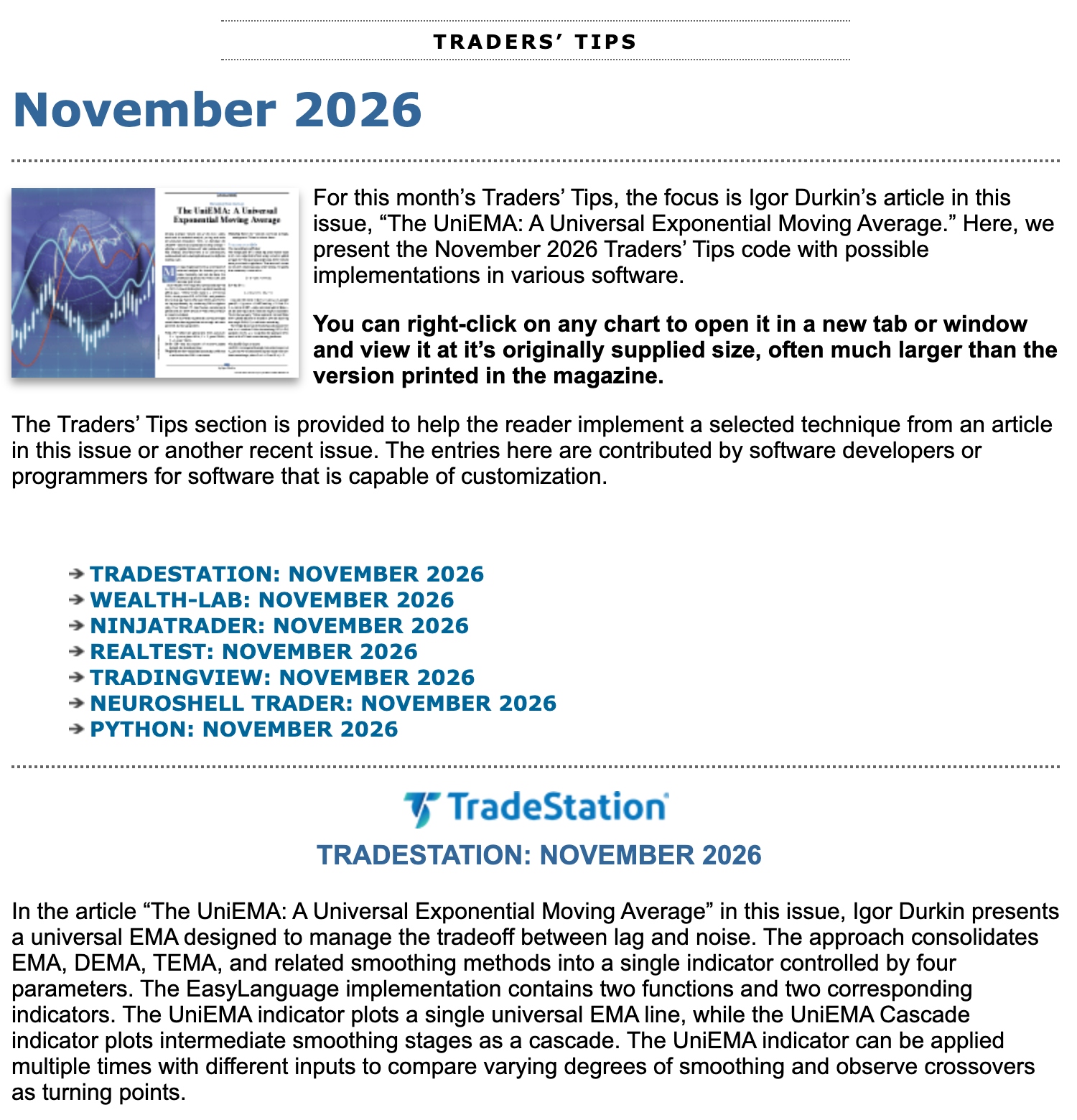
The Traders’ Tips set the magazine apart. Each month, software developers turn one article into code for their platforms. In November 2026 the page listed TradeStation, Wealth-Lab, NinjaTrader, RealTest, TradingView, NeuroShell Trader and Python, and it opened without a login. If you write your own scripts, for example in Pine Script, you can test an idea from the magazine right away.
The archive is the real value of a subscription. According to the publisher, a subscription includes access to more than 17,000 articles going back to the first issue, and a search across titles and article text. A new AI tool answers questions from the archive with citations. A small selection of free articles and a free trial issue are available without paying.
The price is fair for what you get, but it is not cheap. On 31 October 2026, the store listed $130 for one year, $220 for two, $290 for three and $430 for five years, each including the digital edition. Shipping outside the United States costs extra. Single articles sell as PDFs for $2.95 to $5.95.
The limits are clear. The magazine is written for readers who like formulas and testing; if you only want market opinions, it is too dry. Treat any published backtest as a starting point for your own test, not as proof. The website carries a lot of broker advertising. The sister magazine Working Money still has its archive on the same site, but the newest article on its home page dates from August 2019.
TradersWorld: classical technical analysis for little money
TradersWorld is the low-cost choice for technical traders. It has been published since 1986 by Halliker’s, Inc. in Springfield, Missouri. The publisher describes it as a magazine on trading techniques from classical to modern methods and on the psychology of trading. On 1 November 2026, issue number 102 was offered free after you enter your name and email address. We could not verify when that issue appeared, and the site does not state how often new issues are published.
A subscription cost $19.95 a year with a 30-day guarantee. That is the lowest price in this guide. The website is basic, though: on 1 November 2026, its home page still showed a template testimonial signed “John Doe”. Read the free issue first and decide whether the style suits you before you pay.
Barron’s: weekly market news for investors
Barron’s is a weekly magazine on markets and stocks from Dow Jones, the publisher of The Wall Street Journal. It suits investors who want market news and stock ideas, not traders looking for chart methods. The digital subscription includes daily access to the website and the mobile apps.
The price depends on where you live. From Germany, the subscription page on 1 November 2026 offered All Access Digital at €4 per four weeks for one year instead of the regular €9.99; bundles with MarketWatch and The Wall Street Journal cost more. Readers in the United States see a different offer. Check the renewal price before you sign up.
Investor’s Business Daily: stock lists and the CAN SLIM system
Investor’s Business Daily is built around one method for buying growth stocks. The method is CAN SLIM, developed by IBD’s founder William O’Neil. The digital service offers daily market analysis, lists of leading stocks, a stock checkup with IBD’s own ratings and a screener for more than 9,000 stocks and ETFs, according to the offer page.
The offer page was not consistent on the day we checked. On 1 November 2026, it showed an introductory price of $20 for two months, then two different monthly renewal prices for IBD Digital ($44.95 and $38.95) and a footnote with an expired 2022 date. Check the exact price at checkout. IBD suits active stock traders who like a fixed system; its tools cover stocks and ETFs, not futures or forex.
MoneyWeek: the UK weekly on investing
MoneyWeek is a weekly magazine for private investors in the United Kingdom. It covers shares, funds, pensions and the economy, with a British view. For traders it is background reading, not a source of trading methods.
It is the only magazine here with a free trial of several issues. On 1 November 2026, the first six issues were free, then digital cost £32.99, print £45.99 and print plus digital £48.99 for every 13 issues, about a quarter of a year. Cancel before the trial ends if it is not for you.
Trade press: magazines for professionals, not private traders
Many searches for “trading magazine” lead to trade press for banks and funds. These magazines are good at what they do, but they do not teach you to trade. They report on market structure, execution, regulation and people moves in the industry.
- Traders Magazine writes on US equity market trading and technology, with departments such as algorithms, clearing, options and trading venues.
- The TRADE covers execution and trading technology for buy-side and sell-side firms; on 1 November 2026, its magazine archive listed issues up to number 89.
- Global Trading covers trading and the FIX protocol worldwide, with research on execution quality and payment for order flow.
Read them if you want to understand how orders reach the market. For your own trading, the magazines above are the better fit. If you are curious how market makers earn their money, our guide to market makers is a shorter start.
Old magazine addresses that now redirect
Some titles from older lists no longer lead to a magazine. On 1 November 2026, the old address of Futures magazine (futuresmag.com) forwarded visitors to the blog of a prop trading firm, and the address of tastylive’s Luckbox magazine forwarded to tastylive’s news pages. Old issues can still be interesting, but do not subscribe through an old link you find in a list.
Free alternatives to trading magazines
You do not need a subscription to learn from good sources. Many traders now follow podcasts, blogs and free data sites. I collect the ones I like on Karsten’s Picks, from the Traders’ Tips of Stocks & Commodities to the weekly CFTC positioning report.
Books still teach the basics better than any magazine. A magazine gives you new ideas every month, but a good book gives you the foundation to judge them. Our guide to the best trading books shows where to start, and the guide to trading education compares courses, coaching and self-study.
Conclusion: which trading magazine is worth it
For technical traders, Technical Analysis of Stocks & Commodities is the strongest magazine still in print. Its archive since 1982 and the monthly code make it a research library more than a magazine. TradersWorld is the cheap alternative, Barron’s and IBD suit stock investors, and MoneyWeek suits UK readers.
Start with the free material before you pay. Most magazines in this guide offer a free issue, free articles or a low introductory price. Read one or two issues, test one idea from them, and subscribe only if you would miss the next issue.
Frequently asked questions about trading magazines
What is the best magazine for traders?
For technical traders, it is Technical Analysis of Stocks & Commodities. It has been published since 1982, with articles on indicators and trading systems and free code each month. Stock investors are better served by Barron’s or Investor’s Business Daily.
Is Stocks & Commodities worth it?
It is worth it if you test indicators and trading systems yourself. On 31 October 2026, one year cost $130 including the digital edition and access to the archive of more than 17,000 articles. If you want market opinions rather than methods, choose another magazine.
Are there free trading magazines?
No magazine in this guide is completely free, but most offer free material. Stocks & Commodities has free articles, the Traders’ Tips and a trial issue, TradersWorld a free issue and MoneyWeek six free issues.
What happened to Futures magazine?
Its old web address no longer leads to a magazine. On 1 November 2026, futuresmag.com forwarded visitors to the blog of a prop trading firm.
What is the difference between Traders Magazine and Stocks & Commodities?
They are written for different readers. Traders Magazine is trade press for professionals at banks and funds and covers market structure and execution. Stocks & Commodities is written for traders who trade their own account and covers methods such as indicators and trading systems.
More Trading Books guides
- Choose your first trading book
Best Trading Books: Where to Start and What to Read Next
Twelve books by goal, with a reading order for beginners and the limits of each book.
- Decide on Murphy's chart analysis classic
Technical Analysis of the Financial Markets: Review
The 1999 edition, what its chapters cover, where it stops and how to use it as a reference.