
Rothschild Family: History, Wealth and Myths Fact-Checked


Contents
- Rothschild family in 30 seconds
- Who are the Rothschilds?
- Origins: Mayer Amschel Rothschild and the Frankfurt Judengasse
- Five sons, five cities: the network
- The Napoleonic Wars: gold for Wellington
- Waterloo 1815: legend and reality
- The business model in the 19th century
- From banking house to target of hatred
- The decline of the houses
- The Rothschilds today
- How rich is the Rothschild family really?
- Rothschild family timeline: the documented turning points
- Verdict: what explains the rise
- Frequently asked questions about the Rothschild family
- About the author
In 1763 a young man of about twenty came back to Frankfurt’s Judengasse, a street three to four meters wide whose gates stayed locked at night and on Sundays. Sixty years later his five sons sat in Frankfurt, London, Paris, Vienna and Naples and lent money to governments. How that happened can be traced in deeds, contracts and bank ledgers.
This article tells the story of the Rothschild family plainly and with sources. It covers the business model, the turning points, the decline of most houses and what still exists today. Where legend and evidence disagree, you see both side by side. This article follows our editorial policy. It is history for education, not investment advice.
Rothschild family in 30 seconds
- Origin: Mayer Amschel Rothschild was born in Frankfurt’s Judengasse in 1744 and started out as a coin dealer.
- Network: his five sons opened houses in London, Paris, Vienna and Naples between 1798 and 1821; the eldest ran Frankfurt.
- Breakthrough: from 1814, Nathan Rothschild supplied gold for Wellington’s army. After that, government bonds became the core business.
- Waterloo: the story of a stock market coup in 1815 comes from an antisemitic pamphlet of 1846 and is not supported by evidence.
- Decline: Naples closed in 1863, Frankfurt in 1901, Vienna was seized in 1938, Paris was nationalized in 1981/82.
- Today: Rothschild & Co reports revenue of about €2.99 billion for 2025; Edmond de Rothschild manages CHF 198 billion for clients.
- Wealth: trillion-dollar figures are made up. Documented single values are in the single-digit billions.
Who are the Rothschilds?
The Rothschilds are a Jewish banking family from Frankfurt am Main. Their founder Mayer Amschel Rothschild (1744 to 1812) and his five sons built a network of banking houses in five European cities that became one of the most important lenders to European states in the 19th century.
The name comes from a house in the Judengasse. According to the Rothschild Archive, ancestors of the family built the House of the Red Shield (“zum roten Schild”) around 1530 (archived version). The family kept the name even after Mayer Amschel bought the House of the Green Shield in 1785.
One point matters for everything that follows: there is no single “Rothschild” company. There are several family branches with their own firms, some of which work together while others are run separately.
Origins: Mayer Amschel Rothschild and the Frankfurt Judengasse
Life in the ghetto
The Frankfurt Judengasse was a ghetto, a closed quarter where Jews were forced to live. The street was only three to four meters wide and about 330 meters long. In the 18th century more than 3,000 people lived there.
Residents could leave only on weekdays and during the day. At night and on Sundays and holidays the gates stayed shut, as the Jewish Museum Frankfurt describes.
Mayer Amschel was born in the House “zur Hinterpfann”. The Neue Deutsche Biographie (NDB), the standard German biographical dictionary, gives his birth as February 23, 1743 or 1744; the Rothschild Archive says 1744. His father Amschel Moses died in 1755, his mother Schönche in 1756. Mayer Amschel was eleven and twelve at the time.
Coin dealing and the road to the court of Hesse
After his parents died, he was apprenticed to a banking house in Hanover, probably Oppenheim. There he learned bills of exchange, the trade in written payment orders between cities. In Hanover he also met General von Estorff, a keen coin collector. Through this contact he found his niche: trading rare coins.
In 1763 he returned to Frankfurt. As a coin dealer he gained access to Prince William of Hesse, who then ruled the county of Hanau. On September 21, 1769, William gave him the title of court agent (“Hoffaktor”), a supplier to the court with the prince’s protection.
The title was access, not wealth. According to the NDB, the trade in coins and antiques remained his main source of income until the late 1780s. Only from 1789 did he take part in the prince’s exchange business, and from 1796 in his loans.
William was considered one of the richest princes in Europe. Part of his income came from subsidy treaties: from 1776, Hesse-Kassel supplied soldiers to Britain in the American War of Independence and was paid for it. William became landgrave in 1785 and elector in 1803.
From dealer to banker
The road to capital ran through William’s asset manager Karl Friedrich Buderus. He passed business to Rothschild and became a silent partner in 1809. From 1792 came supplies for the imperial army, which earned Rothschild the title of imperial court agent in 1801.
When Napoleon occupied Hesse-Kassel in 1806 and William went into exile, Rothschild managed part of the prince’s assets. He invested money through his son Nathan in British government securities. This later grew into the legend that he had saved the elector’s entire treasure. The NDB records that he in fact kept only a few chests of files.
Five sons, five cities: the network
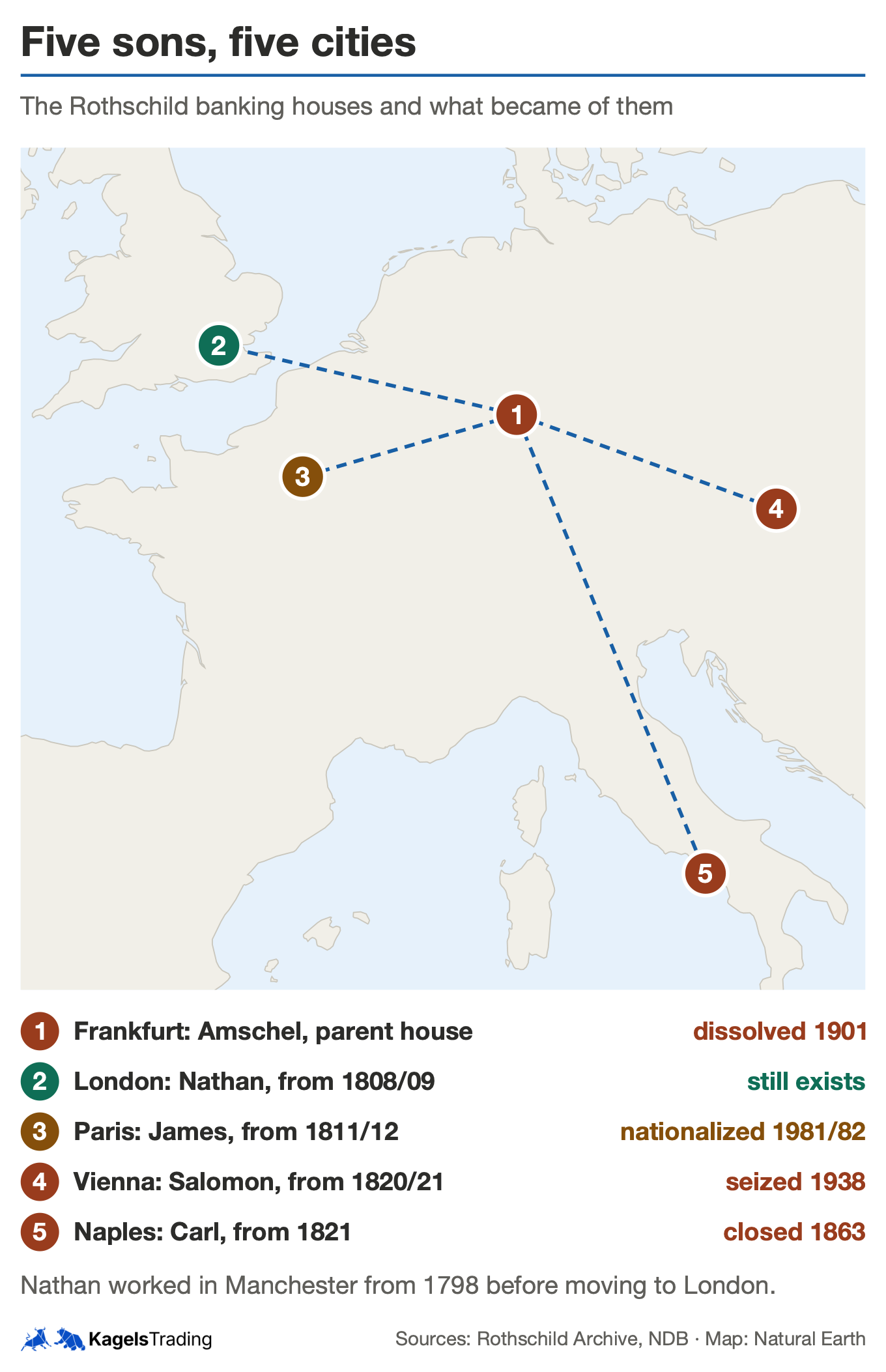
In 1770 Mayer Amschel married Gutle Schnapper (1753 to 1849), the daughter of a court agent. They had five sons and five daughters, all named in the NDB. The father placed his sons in the most important financial centers of Europe.
The map below shows the five locations and what became of each house. Each number marks one son and his city.
 Click to enlarge
Source: Kagels Trading, own graphic.
| Son | City, from | End of the house |
|---|---|---|
| Amschel Mayer (1773 to 1855) | Frankfurt, parent house | dissolved 1901 |
| Salomon Mayer (1774 to 1855) | Vienna, from 1820/21 | seized 1938 |
| Nathan Mayer (1777 to 1836) | Manchester from 1798, London from 1808/09 | continues as part of Rothschild & Co |
| Carl Mayer (1788 to 1855) | Naples, from 1821 | closed 1863 |
| James Mayer (1792 to 1868) | Paris, from 1811/12 | nationalized 1981/82, refounded |
In 1822 the Austrian emperor made the five brothers barons. The family still uses their coat of arms with the five arrows and the motto “Concordia, Integritas, Industria”. The founding years vary by one year depending on the source. The Rothschild Archive itself gives both 1811 and 1812 for James, and 1809 rather than 1808 for London.
The partnership deed of 1810 and the will
On September 27, 1810, Mayer Amschel signed a partnership deed with his sons. From then on the bank was called “Mayer Amschel Rothschild & Söhne” and all sons were partners. Daughters and sons-in-law were excluded.
Article XII of the deed required secrecy. Widows, heirs and guardians were not allowed to see the books or the letters. Only the last balance sheet counted. His will, made before his death on September 19, 1812, confirmed this line.
The rule held for a long time. According to the NDB, until 1960 no partner of the Rothschild bank came from outside the direct line of Mayer Amschel.
Why the network was faster
Business between cities ran on bills of exchange, written orders to pay. Between unrelated banks, every order needed checking and trust. Between brothers, both were largely taken care of.
A network of trusted couriers carrying the family’s letters is documented. The brothers used carrier pigeons by the 1840s at the latest, according to the Rothschild Archive (archived version). The archive finds no evidence that the news of Waterloo in 1815 came by pigeon. Later even Queen Victoria used the courier service for her overseas mail, as the archive’s timeline records.
Marriage policy added to this. Rothschilds often married each other, so that capital and knowledge stayed in the family. The Jewish Encyclopedia counted 58 marriages of descendants up to 1905, 29 of them between first cousins.
The Napoleonic Wars: gold for Wellington
During Napoleon’s Continental System, Mayer Amschel and his sons traded in British goods. The NDB describes how they helped organize the smuggling of British colonial goods.
French sanctions were mostly headed off by Frankfurt’s ruler Carl Theodor von Dalberg, who was well disposed toward Rothschild. In 1811 Dalberg granted Frankfurt’s Jews civil rights, and Mayer Amschel helped raise the payment of 440,000 guilders. In 1816 the civil rights were taken back.
The real breakthrough came in 1814 with an order from the British government. Wellington’s army was fighting in southern France and needed gold to pay soldiers and suppliers. In January 1814 the government, through the commissary-in-chief John Charles Herries, asked Nathan Rothschild to obtain gold.
The brothers quietly bought gold on the continent and sent it to the army. This happened again in 1815, after Napoleon’s return from Elba. According to the Fondation Napoléon, the commission was 2 percent.
It is often said that the Rothschilds financed “both sides” of the Napoleonic Wars. There is no evidence for this. What is documented is that they financed Britain’s war against Napoleon.
Waterloo 1815: legend and reality
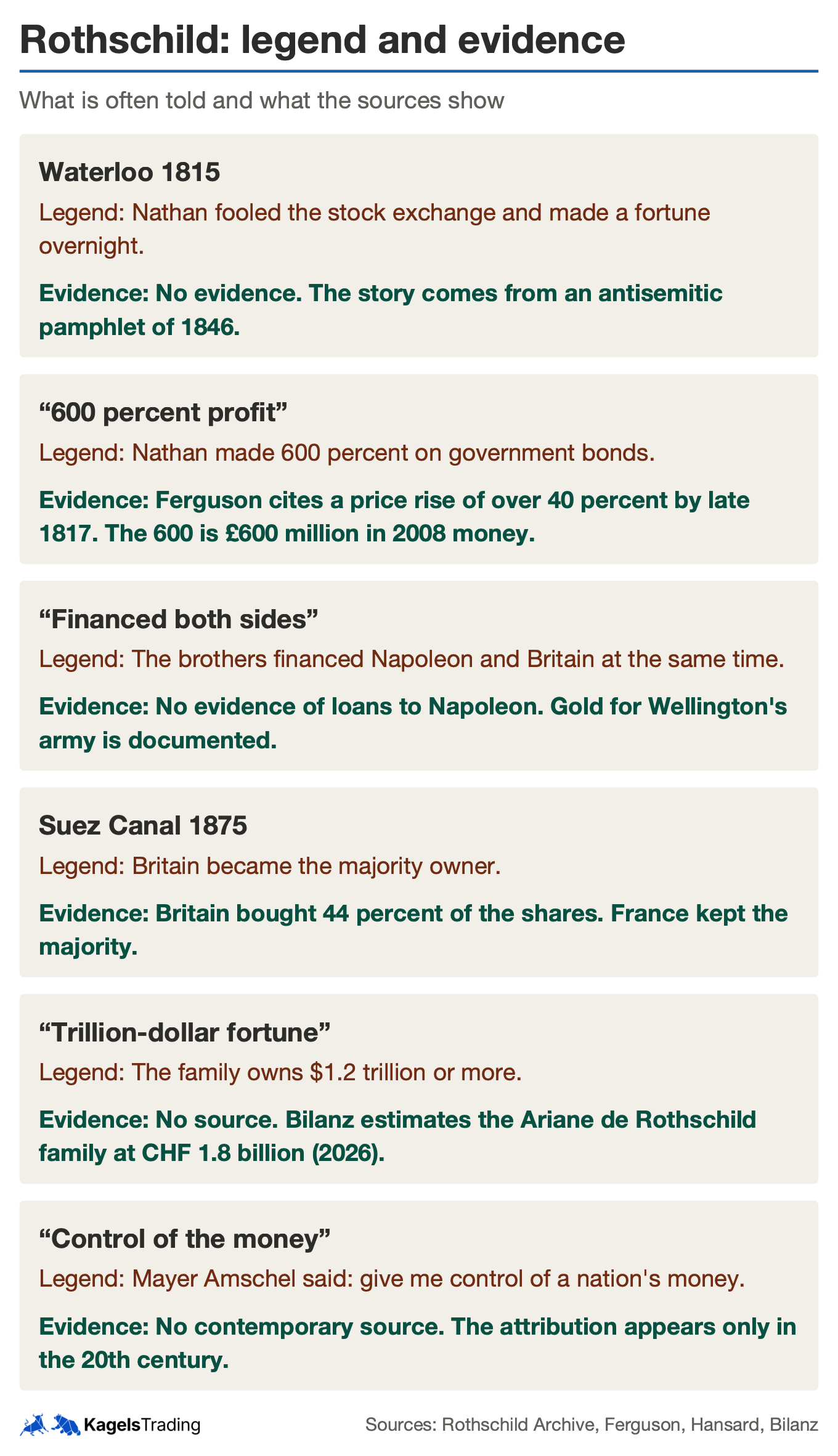
The graphic below sets the best-known legends against the evidence. Each card names the claim and what the sources show.
 Click to enlarge
Source: Kagels Trading, own graphic.
The most famous Rothschild story goes like this: Nathan learns first of the victory at Waterloo on June 18, 1815, fakes a sale on the London Stock Exchange and then buys back cheaply. This story is not supported by evidence.
It comes from an antisemitic pamphlet published in Paris in 1846. The author, Georges Dairnvaell, wrote under the pseudonym “Satan”. The aim was to portray Jewish bankers as treacherous.
What the Rothschild Archive actually documents: Nathan received a letter from Ghent on June 21, a few hours before the official dispatch. But he was not the first in London with the news. His gain that day was modest according to the archive, and historian Niall Ferguson even sees losses rather than gains for 1815.
The real profit came later and was no coup. Nathan bought British government bonds, known as consols, and held them until late 1817. In “The Ascent of Money”, Ferguson describes a price rise of more than 40 percent by the time he sold.
You often read about “600 percent profit”. This figure mixes up two things: in his 2008 book, Ferguson put the gain at about £600 million, converted into the money of that year. He gives no return of 600 percent. The same book became a TV series, which we list among our finance documentaries.
The same goes for the saying “buy when the cannons are roaring”, which is often attributed to Nathan Rothschild. There is no contemporary evidence for it.
The business model in the 19th century
Government bonds as the core business
A government bond is a loan to a state, issued as a tradable security. The Rothschilds took over such bonds, sold them on to investors and earned commissions and price gains. The advantage of the network: a bond could be placed in several countries at once.
Mercury from Almadén and the Royal Mint Refinery
In the 19th century, mercury was essential for extracting silver from ore and for refining gold. In 1835, a contract gave N M Rothschild & Sons the entire output of the Spanish mines of Almadén. The archive speaks of a de facto worldwide monopoly, not a legal one.
In 1852 Anthony de Rothschild took over the lease of the Royal Mint Refinery in London, which refined gold and silver for the British mint. It stayed in family hands for more than a century. In 1967 it was sold to Engelhard Industries.
Suez Canal 1875
In November 1875 the heavily indebted ruler of Egypt offered his shares in the Suez Canal. Parliament was not sitting, and Prime Minister Benjamin Disraeli needed the money at once. Lionel de Rothschild, Nathan’s son, lent the government £4 million.
With it, Britain bought 176,602 shares for £3,976,582, and the bank received a commission of 2.5 percent. That is what Hansard, the record of the British Parliament, shows for February 14, 1876.
In the debate of February 21, the bank’s letter was quoted: on top came 5 percent interest a year until repayment. The same debate gives the total of 400,000 shares, so Britain’s stake was 44 percent. The majority stayed in French hands.
The often quoted scene in which Lionel asks for security and is told “the British Government” is found only in later literature. The archive itself calls it a legend.
De Beers and oil from Baku
In 1887 N M Rothschild & Sons gave the entrepreneur Cecil Rhodes a loan of about £1 million. Rhodes used it to buy the French mining company Compagnie Française in a bidding war with Barney Barnato. On March 12, 1888, De Beers Consolidated Mines was formed.
The Paris Rothschilds entered the Russian oil business in Baku in 1886, through the Caspian and Black Sea Petroleum Company (BNITO). Around 1901, Baku supplied a good half of world output. In 1912 they sold the business to Royal Dutch and Shell in exchange for shares.
From banking house to target of hatred
The success of a Jewish family became an early target of antisemitic propaganda. The Waterloo pamphlet of 1846 was a start. In 1886 Édouard Drumont published his hate tract “La France juive”, about 1,200 pages in two volumes, which reached its 200th edition by 1914.
In 1903, excerpts of the “Protocols of the Elders of Zion” first appeared in Russia. The text is a forgery, and who wrote it has not been finally settled. In 1921 The Times of London showed that large parts were copied. In the United States, Henry Ford spread “The International Jew”, which drew heavily on the “Protocols”, in more than 500,000 copies, according to the Holocaust Memorial Museum.
Criticism of concentrated wealth is legitimate; equating it with a religion is antisemitism. Two alleged Rothschild quotes about control of money also have no contemporary source.
The best known of them, “Give me control of a nation’s money …”, appears with a Rothschild connection only in the 20th century. A US senator spread it in 1939 with the invented year 1790.
The Balfour Declaration of November 2, 1917, on the other hand, is evidence of political closeness. The British foreign secretary addressed the letter to Walter Rothschild, the 2nd Baron Rothschild, as the unofficial representative of British Jews.
The decline of the houses
The network that explains the rise fell apart piece by piece. Each house had a different reason, from politics to missing heirs.
- Naples 1863: after the unification of Italy, the house was closed.
- Frankfurt 1901: Wilhelm Carl von Rothschild died without a son. Because of male succession, the parent house was dissolved and passed to the Disconto-Gesellschaft.
- Vienna 1938: after the Anschluss, the Gestapo arrested Louis von Rothschild. He was released only in May 1939, after he had signed over most of his assets.
- Paris 1981/82: in 1940, family members fled occupied France. From 1949 Guy de Rothschild ran the Paris bank; under President Mitterrand it was nationalized in 1981/82.
Part of the Vienna assets survived the seizure. The stake in the Witkowitz ironworks had been transferred in trust to the British insurer Alliance Assurance before the Anschluss.
Guy de Rothschild said goodbye in 1981 with an article in Le Monde titled “Adieux Rothschild”. Its last line read: “A Jew under Pétain, a pariah under Mitterrand, for me that is enough.”
The Rothschilds today
Rothschild & Co
The Paris family started again in 1983 and was allowed to use the name again from 1986. In 2012 the French and British banking businesses were combined under Paris Orléans, which was renamed Rothschild & Co in 2015. In 2023 the family holding Concordia took over 95.65 percent, and the shares were delisted.
According to its 2025 annual review, Rothschild & Co earned revenue of €2,986 million. Consolidated net income was €574 million according to the consolidated accounts, of which €413 million was attributable to the group’s shareholders.
The group has three businesses: Global Advisory, Wealth and Asset Management, and Merchant Banking. It employs 4,866 people in 50 countries and manages €143 billion in its wealth and asset management business.
Alexandre de Rothschild has led the group since 2018. Between 2008 and 2012, the later French president Emmanuel Macron worked there, finally as a partner.
Edmond de Rothschild
A separate branch is the Edmond de Rothschild Group, based in Geneva and led by Ariane de Rothschild. According to its own results release, it managed client assets of CHF 198 billion at the end of 2025. It is not connected with Rothschild & Co.
Wine estates
The family’s Bordeaux estates are well known. Château Lafite Rothschild belongs to Domaines Barons de Rothschild, Château Mouton Rothschild to Baron Philippe de Rothschild SA. Then there are the estates of Edmond de Rothschild Heritage.
How rich is the Rothschild family really?
A family fortune in the trillions is not documented. Figures such as “$1.2 trillion” or “$15.7 trillion” circulate on websites without a source, some of them falsely citing Forbes.
Serious rankings cover only single branches. The Swiss magazine Bilanz estimates the wealth of the Ariane de Rothschild family at CHF 1.8 billion in its 2026 ranking, the same as a year earlier. Forbes last listed Benjamin de Rothschild, who died in 2021, at about $1.5 billion.
When you read such numbers, watch for a common mistake: assets under management are not family wealth. The CHF 198 billion at Edmond de Rothschild belongs to the bank’s clients, not to the family.
Rothschild family timeline: the documented turning points
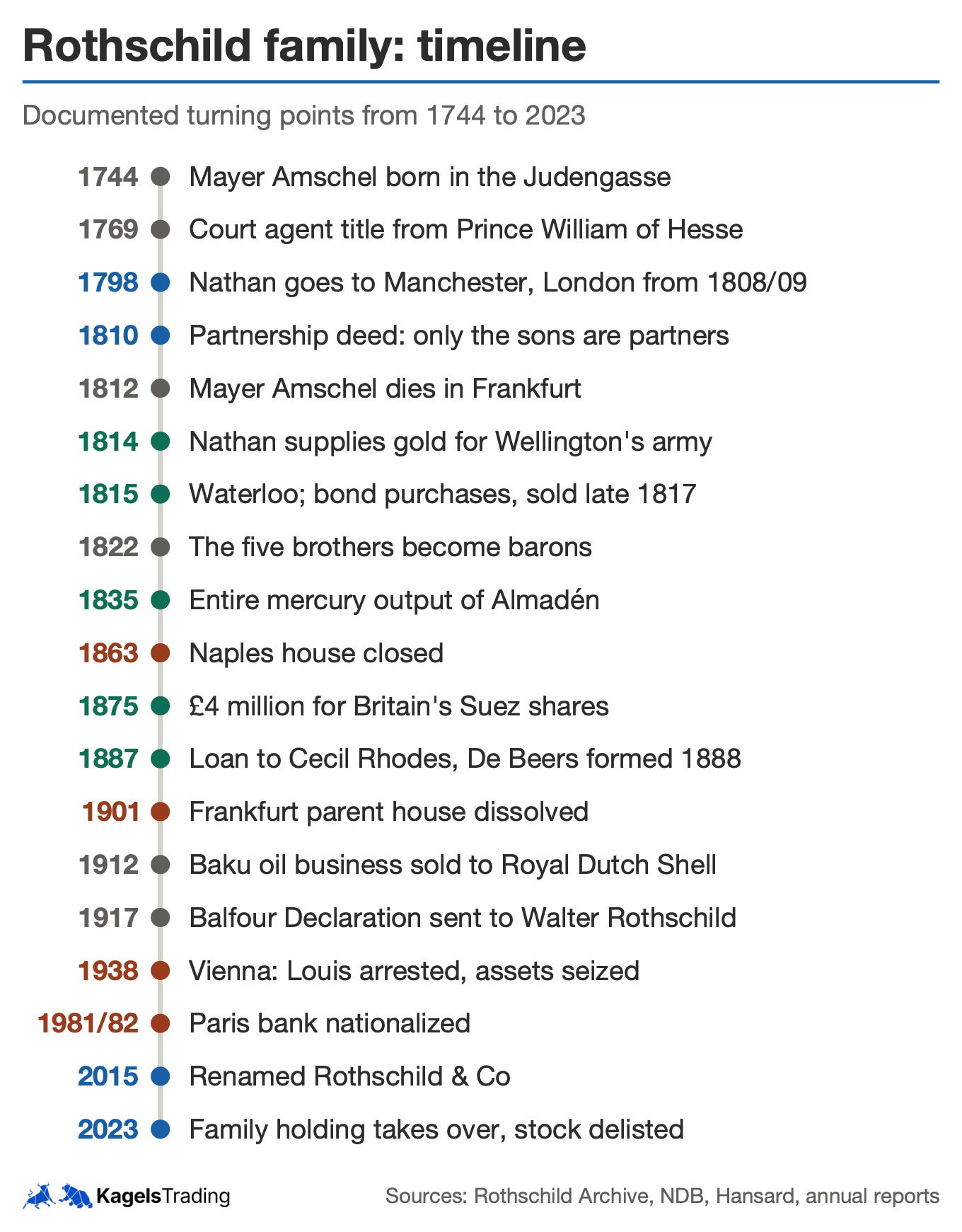
The timeline sums up the documented turning points in the family’s history, from the founder’s year of birth to the delisting of Rothschild & Co. The graphic shows only years that are documented in the sources of this article.
 Click to enlarge
Source: Kagels Trading, own graphic.
Verdict: what explains the rise
The Rothschilds’ rise rests on documented decisions, not on secret knowledge. Mayer Amschel used coin dealing as access to a rich prince and moved into the bond business only after more than twenty years. He placed his sons in five financial centers and bound them together by contract.
In the 19th century the network was a real edge: trust between brothers, fast couriers, bonds placed in several countries at once. But the same structure also made the family vulnerable, through missing heirs, wars, seizure and nationalization.
Today the name lives on mainly through Rothschild & Co, with advisory, wealth management and merchant banking, the Geneva-based Edmond de Rothschild Group and several wine estates. For me as a trader, the most instructive part is not Waterloo but the network: information and trust were a real advantage back then.
Frequently asked questions about the Rothschild family
How rich is the Rothschild family?
There is no documented total. Rankings cover only single branches, for example the Ariane de Rothschild family at an estimated CHF 1.8 billion (Bilanz 2026). Figures in the trillions have no source.
Which companies do the Rothschilds own?
The best known are the banking and advisory group Rothschild & Co, the Geneva-based Edmond de Rothschild Group and several wine estates. These include Château Lafite Rothschild and Château Mouton Rothschild. A current stake in Shell, Rio Tinto or De Beers is not documented.
Are the Rothschilds German?
The family comes from Frankfurt am Main. The well-known branches today are based mainly in France, Britain and Switzerland.
Is the story of the Waterloo stock market coup true?
No, it comes from an antisemitic pamphlet of 1846. What is documented is that Nathan Rothschild bought government bonds after 1815 and held them until 1817 for a price gain of more than 40 percent.
What is the Rothschild conspiracy theory?
It is the name for antisemitic conspiracy narratives. They claim that the family controls states and central banks. There is no evidence for them.
Which Rothschilds are there today?
The best known are Alexandre de Rothschild and Ariane de Rothschild. Alexandre has been executive chairman of Rothschild & Co since 2018, and Ariane heads the Edmond de Rothschild Group. Other family members run wine estates and foundations.
This article is translated from the German edition on kagels-trading.de.