
Warren Buffett: Portfolio and Investing Strategy


Contents
- Warren Buffett in 30 seconds
- Warren Buffett’s portfolio: what the name really means
- Buffett and Greg Abel: who makes the decisions?
- Berkshire’s holdings: the latest disclosed portfolio
- Portfolio changes: what Berkshire bought and sold
- Berkshire’s cash: flexibility and obligations
- Buffett’s strategy: principles readers can use
- Index funds: what Buffett actually recommended
- My assessment: what carries over to trading
- Frequently asked questions about Warren Buffett
- About the author
The “Warren Buffett portfolio” is not Warren Buffett’s personal stock account. It is the list of US-listed stocks that Berkshire Hathaway reports to the SEC every quarter. Buffett built the company over 60 years, but since January 1, 2026, Greg Abel has been its CEO, and the filing does not say who chose which trade.
This article shows the latest disclosed holdings, as of June 30, 2026, checked against the original filing. You will see the ten largest positions, what changed since March, how much cash Berkshire holds and which principles behind Buffett’s approach you can use yourself. I bought my first stocks in 1980 and have traded actively since 1986, mostly short term, so I also say which parts carry over to trading and which do not. This article follows our editorial policy. It is for education, not investment advice, and past results do not predict future returns.
Warren Buffett in 30 seconds
- Role today: Buffett is Chairman of Berkshire Hathaway. Greg Abel has been CEO since January 1, 2026.
- Method: buy wonderful businesses at fair prices, stay inside your circle of competence and hold for a very long time.
- Latest disclosure: on June 30, 2026, Berkshire reported $299.25 billion in 26 companies. Apple, American Express, Alphabet, Coca-Cola and Bank of America made up 71.9%.
- Limits: the filing is a snapshot published about 45 days later. It leaves out the owned businesses, cash and foreign holdings.
- Lesson for readers: copying the list is not the method. Patience and knowing what you understand are.
Warren Buffett’s portfolio: what the name really means
Warren Buffett’s portfolio is the set of securities that Berkshire Hathaway discloses on Form 13F, a quarterly report to the US Securities and Exchange Commission.
A 13F filing covers only one slice of Berkshire. Any institution with investment discretion over $100 million or more in so-called Section 13(f) securities must file it within 45 days of each quarter’s end, or on the next business day if that day falls on a weekend or holiday. These are mainly US exchange-traded stocks, plus some ETFs, options and convertible securities on an official SEC list. Berkshire’s own businesses, such as GEICO or the BNSF railroad, are not in it.
| A 13F filing shows | A 13F filing does not show |
|---|---|
| Share count and quarter-end value of each reported security | Owned subsidiaries such as GEICO, BNSF or Berkshire Hathaway Energy |
| The reporting date and the filing date | Stakes in non-US listed companies, such as the five Japanese trading houses |
| Which Berkshire units report the position | Cash and US Treasury bills |
| Who decided a trade, when, at what price and why |
The gap is large. On June 30, 2026, Berkshire’s balance sheet carried $323.8 billion in equity securities, while the 13F total was $299.25 billion. The difference includes the Japanese holdings, which Greg Abel’s letter of February 2026 calls comparable in importance to the major US positions.
Buffett and Greg Abel: who makes the decisions?
The handover was announced on stage and then confirmed in writing. At the annual meeting on May 3, 2025, Buffett said he would recommend Greg Abel as CEO. On May 4, 2025, the board voted unanimously to make Abel President and CEO from January 1, 2026, with Buffett staying on as Chairman, according to Berkshire’s news release of May 5, 2025.
In November 2025, Buffett wrote that he would stop writing the annual report and stop “talking endlessly” at the meeting. In his words, he was “going quiet.” He kept his yearly Thanksgiving letter. Abel wrote the 2025 annual letter himself, dated February 28, 2026, and noted that Buffett is still in the office five days a week.
For the stock portfolio, Abel’s letter is the clearest source. In his 2025 letter to shareholders, he writes that responsibility for equity investments “ultimately resides with me as CEO.” Ted Weschler manages about 6% of the investments, including part of the portfolio that Todd Combs used to oversee. Combs left Berkshire in December 2025 to join JPMorgan Chase.
What no filing tells you is who ordered a single purchase or sale. Every row of the June 2026 filing still lists Warren E. Buffett among the included managers with shared investment discretion. That is a legal reporting category, not a record of who picked the stock. So this article writes “Berkshire reported,” not “Buffett bought” or “Abel sold.”
Berkshire’s holdings: the latest disclosed portfolio
On June 30, 2026, Berkshire reported 89 rows worth $299,253,556,246 in total. The rows cover 29 securities from 26 companies, because some companies appear with more than one share class or several Berkshire units. The filing was submitted on August 14, 2026, the deadline for the second quarter. It names no confidentially omitted positions, and no amendment has followed so far.
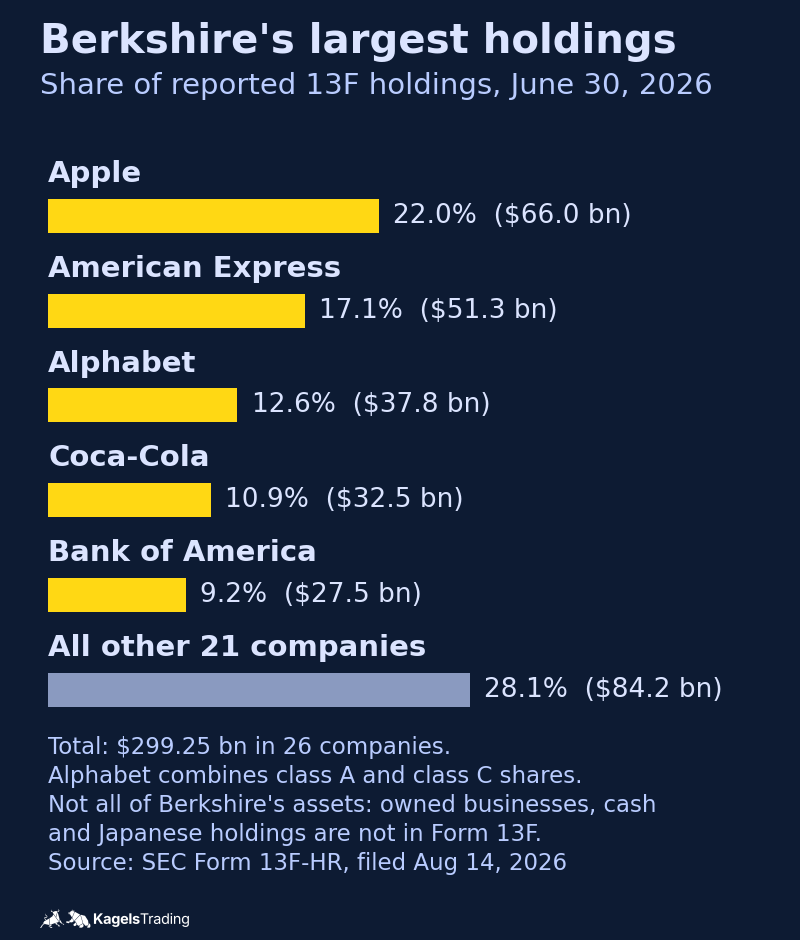 Click to enlarge
Source: SEC, Berkshire Hathaway Form 13F-HR, filed August 14, 2026.
Concentration is the most striking feature. The five largest companies account for 71.9% of the reported value and the ten largest for 91.0%. Berkshire’s own 10-Q confirms the top five by name: Alphabet, American Express, Apple, Bank of America and Coca-Cola.
| # | Company (ticker) | Value on June 30, 2026 | Weight |
|---|---|---|---|
| 1 | Apple (AAPL) | $65.95 bn | 22.04% |
| 2 | American Express (AXP) | $51.28 bn | 17.14% |
| 3 | Alphabet (GOOGL, GOOG) | $37.76 bn | 12.62% |
| 4 | Coca-Cola (KO) | $32.51 bn | 10.86% |
| 5 | Bank of America (BAC) | $27.54 bn | 9.20% |
| 6 | Chevron (CVX) | $13.99 bn | 4.67% |
| 7 | Occidental Petroleum (OXY) | $12.87 bn | 4.30% |
| 8 | Chubb (CB) | $11.67 bn | 3.90% |
| 9 | Moody’s (MCO) | $11.17 bn | 3.73% |
| 10 | Kraft Heinz (KHC) | $7.69 bn | 2.57% |
Source: Berkshire Hathaway, Form 13F-HR for June 30, 2026, our calculation. Weights are each company’s value divided by the filing total of $299.25 billion. Alphabet combines class A (78.8 million shares) and class C (27.2 million shares). Values are quarter-end market values, not purchase prices.
Two of these positions are not ordinary stock holdings on Berkshire’s balance sheet. Kraft Heinz and Occidental Petroleum are accounted for under the equity method, so they appear in the 13F but outside the 10-Q’s equity securities total. Abel’s letter calls the Kraft Heinz investment “disappointing.”
Portfolio changes: what Berkshire bought and sold
A higher value is not proof of buying. Berkshire held exactly 227,917,808 Apple shares on both March 31 and June 30, 2026, yet the position rose from $57.8 billion to $66.0 billion. Only the share count shows a change, so the table compares share counts between the two filings. That gives the net change between two dates, not every trade in between. No change matches a stock split ratio, and all other share counts are identical in both filings.
| Shares held | Mar 31 | Jun 30 | Change |
|---|---|---|---|
| Alphabet (A and C) | 57,835,013 | 105,979,600 | +83.2% |
| Delta Air Lines | 39,809,456 | 57,320,000 | +44.0% |
| Lennar (A and B) | 10,337,345 | 13,409,858 | +29.7% |
| Macy’s | 3,038,355 | 7,347,426 | +141.8% |
| New York Times | 15,146,535 | 15,700,000 | +3.7% |
| D.R. Horton | 0 | 3,564 | new |
| Bank of America | 513,624,165 | 483,394,015 | −5.9% |
| DaVita | 30,100,585 | 28,880,209 | −4.1% |
| Kroger | 50,000,000 | 39,000,000 | −22.0% |
| Ally Financial | 29,000,000 | 27,000,000 | −6.9% |
| Capital One | 7,150,000 | 3,000,000 | −58.0% |
| Nucor | 3,907,075 | 1,857,752 | −52.5% |
| Constellation Brands | 632,890 | 0 | sold out |
Dates are March 31 and June 30, 2026. Source: Berkshire Hathaway Form 13F-HR for March 31, 2026 and June 30, 2026, our comparison of share counts. All other reported share counts were unchanged, which does not rule out trades between the two dates.
Alphabet was the big move of the quarter. Berkshire almost doubled its combined stake and now reports Alphabet as its third-largest holding. Delta Air Lines grew by 44% to $5.4 billion. The new D.R. Horton line is tiny, about $0.6 million. On the other side, Capital One and Nucor were cut by more than half, and the small rest of Constellation Brands is gone.
The March filing had shown a bigger clean-up. Compared with December 31, 2025, it no longer contained 15 companies, among them Amazon, Visa, Mastercard and UnitedHealth. That was Berkshire’s first quarter under Abel as CEO. The filings themselves do not say who made those decisions or why, and a sale shown in a 13F tells you nothing about the price Berkshire received.
- BerkshireQuarter endJune 30, 2026: the holdings are counted at that day's market value.
- Berkshire and the SECFilingAugust 14, 2026: the report goes public, 45 days later.
- YouReadingYou see positions that may have changed in the meantime.
Berkshire bought Taylor Morrison on July 24, 2026, after the snapshot. The next 13F, for September 30, 2026, is due by November 16, 2026.
Berkshire’s cash: flexibility and obligations
On June 30, 2026, Berkshire’s insurance and other businesses held $359.2 billion in cash, cash equivalents and US Treasury bills. That is the figure from the quarterly report (10-Q), net of $771 million in Treasury bill purchases not yet paid. It is made up of $35.1 billion in cash and equivalents and $324.9 billion in short-term Treasury bills. The railroad, utilities and energy businesses held another $5.5 billion in cash, which I do not add, because it belongs to those operations.
This cash is larger than the whole 13F portfolio, but it is not one big pile waiting for a crash. Abel wrote in February 2026 that some of this capital is required to support the insurance operations and to protect Berkshire against extreme scenarios, while the rest is “dry powder.” Berkshire also says it will never let share buybacks push consolidated cash, equivalents and Treasury bills below $30 billion.
The cash is also being used. In the first half of 2026, Berkshire spent $39.4 billion on stock purchases and received $27.8 billion from stock sales, according to the cash flow statement. It bought back $4.8 billion of its own shares, mostly in the second quarter. After the quarter, on July 24, 2026, it acquired the homebuilder Taylor Morrison for about $6.8 billion in cash. These figures describe what happened. They are not a market forecast.
Buffett’s strategy: principles readers can use
Buffett’s method rests on a few ideas he explained himself, in his letters, over decades. In his 2013 letter, he wrote that he learned most of the thoughts in its investment discussion from Benjamin Graham’s book The Intelligent Investor, which he bought in 1949. Graham taught him to treat a stock as part of a business, not as a ticker.
Charlie Munger changed what kind of business Buffett bought. In the 2014 letter, Buffett describes Munger’s blueprint as simple: forget buying fair businesses at wonderful prices, and buy wonderful businesses at fair prices. That shift is why Berkshire holds brands and franchises rather than cheap statistical bargains.
Stay inside your circle of competence. In 1996, Buffett wrote that an investor only has to evaluate companies within his circle of competence. The size of that circle matters little, but knowing its boundaries is vital. Abel’s 2026 letter repeats the same rule as the first of Berkshire’s capital allocation principles: invest in businesses “we thoroughly understand.”
Patience is the part that turned principles into money. Coca-Cola is the clearest example. According to the 2022 letter, Berkshire completed a seven-year purchase program in August 1994, buying what is today 400 million shares for $1.3 billion. The dividend Berkshire received grew from $75 million in 1994 to $704 million in 2022. The June 2026 filing still shows exactly 400 million shares.
Buffett’s best-known rule on market mood comes from the 1986 letter. He wrote that Berkshire simply attempts to be “fearful when others are greedy” and greedy only when others are fearful. It is a description of behavior, not a timing signal.
Berkshire’s record is real, but you cannot copy its conditions. From 1965 to 2025, Berkshire’s market value per share grew by 19.7% a year, compared with 10.5% for the S&P 500 with dividends, according to the table in the 2025 letter. That is the return of Berkshire stock, not of the 13F portfolio. Berkshire invests insurance float, buys whole companies, gets offered deals private investors never see and pays taxes differently. A household account has none of these advantages.
Index funds: what Buffett actually recommended
For most people who do not study businesses, Buffett recommends a low-cost index fund, not stock picking. In the 2013 letter, he wrote that the goal of the non-professional should be to own a cross-section of businesses, and that a low-cost S&P 500 index fund will achieve it. He added that investors should buy over a long period and not sell when the news is bad.
He even named a provider, for one specific trust. For the money he leaves in trust for his wife, Buffett instructed the trustee to put 10% in short-term government bonds and 90% in a very low-cost S&P 500 index fund, adding: “(I suggest Vanguard’s.)” That is advice for one trust with a very long horizon, not a universal allocation rule for every reader.
What follows for you depends on your own situation. Buffett named a fund category and, in brackets, a provider, but no specific share class or ticker. How the index itself is moving right now is covered in our S&P 500 forecast. Fees, taxes and the right mix of stocks and bonds are decisions you should make for your own account.
My assessment: what carries over to trading
What impresses me most about Buffett is not his stock selection but his restraint. As a discretionary trader, I work on time frames of hours and days, not decades. But the ability to do nothing for long periods because nothing meets your standards is the hardest discipline in short-term trading too. If you have no reason to trade, you have no trade.
The time horizon and the portfolio design do not carry over. Five companies making up more than 70% of a portfolio works for Berkshire, with its insurance float and owned businesses behind it. For a trading account, such concentration would be a risk decision of its own; how much a single position may cost you is the topic of our risk management guide. Among the best traders in the world, Buffett stands out for the length of his record more than for its yearly peak.
A 13F is a delayed snapshot, not a recommendation. If you buy what Berkshire reported, you buy a decision whose reasons you do not know, often at a very different price and after the position may already have changed. I read the filings to understand how a disciplined investor behaves, not to copy trades.
Frequently asked questions about Warren Buffett
Is this Warren Buffett’s personal portfolio?
No, it is Berkshire Hathaway’s disclosed portfolio. The 13F filing lists stocks held by Berkshire and its subsidiaries. Buffett owns a large stake in Berkshire, so he benefits from these holdings indirectly, but the list is not his private brokerage account.
What are Berkshire’s largest disclosed holdings?
On June 30, 2026, the five largest were Apple, American Express, Alphabet, Coca-Cola and Bank of America. Together they made up 71.9% of the $299.25 billion Berkshire reported. Apple alone accounted for 22.0%.
How often are Berkshire’s holdings reported?
Once a quarter, normally within 45 days of the quarter’s end. If the deadline falls on a weekend or holiday, it moves to the next business day. The filing for June 30, 2026 came on August 14, 2026. The next one, for September 30, 2026, is due by November 16, 2026.
Does Buffett still run Berkshire?
No, Greg Abel has been CEO since January 1, 2026. Buffett remains Chairman of the board and, according to Abel’s letter of February 2026, is in the office five days a week. Abel writes that responsibility for the stock portfolio rests with the CEO.
Can investors copy Berkshire’s portfolio?
You can buy the same stocks, but you cannot copy the strategy behind them. The data is about six weeks old when published, it shows quarter-end values but no purchase or sale prices or reasons, and it leaves out Berkshire’s owned businesses, cash and foreign holdings. Berkshire’s insurance float and access to private deals have no equivalent in a private account.
What index-fund advice did Buffett give?
He recommends a low-cost S&P 500 index fund for investors who do not analyze businesses. For his wife’s trust, he set 90% in such a fund and 10% in short-term government bonds, and suggested Vanguard’s fund. That is his instruction for one trust, not a rule for everyone.
This US edition is based on our German edition on kagels-trading.de and has been adapted for US readers.
More Famous Traders guides
- See who really performed best
Best Traders in the World, Ranked by Documented Returns
A ranking built only from documented annual returns, from Jim Simons to Warren Buffett, and why the famous 120% figures are missing.
- Understand trading championships
World Cup Trading Championship: Winners, Rules, Criticism
How the real-money World Cup Trading Championship works, what it costs to enter, record winners, German champions and its flaws.
- Meet the record holder
Larry Williams: The 11,376% Record Holder, Fact-Checked
Larry Williams and his 11,376% year: his COT approach, the Oops pattern, the volatility breakout and the criticism.
- Meet the Prince of the Pit
Richard Dennis: The Prince of the Pit and the Turtle Traders
Richard Dennis from $400 to a fortune, the Turtle experiment, his losses in 1987 and 1988 and what is really documented.
- Learn the Turtle rules
Turtle Trading: The Original Rules of Richard Dennis
The key original Turtle trading rules: entries, position size with N, the 2N stop, adding units and the exits.
- Understand the stock contest
US Investing Championship: Rules, Winners and Records
The real-money US Investing Championship: divisions, verification, recent winners and records, with dates.
- Read the classic interviews
Market Wizards: Jack Schwager's Books and Their Lessons
Jack Schwager's Market Wizards books: which traders each one features and the lessons they share.
- Meet the oldest legend
Jesse Livermore: Rules, Books and Lessons of a Legend
Jesse Livermore from his own 1940 book and the 1923 novel about him: rules, bankruptcies and lessons.
- Meet the first Market Wizard
Michael Marcus: How the First Market Wizard Traded
Michael Marcus: from early wipeouts to $80 million on a company account, and the rules he took from it.
- Meet the trend-following pioneer
Ed Seykota: Trend Following Pioneer From Market Wizards
Ed Seykota: early computerized trend following, his risk rules and what Market Wizards documents.
- Learn short-term setups
Linda Raschke: Trading Rules, Setups and Books
Linda Raschke: Holy Grail, Turtle Soup and the 3-10 oscillator, and where her famous 50 rules come from.
- Trade the opening range
Toby Crabel: Opening Range Breakout and His Numbers
Toby Crabel: opening range breakout, short-term price patterns and what is known about his record.