
Stanley Druckenmiller: 30 Years Without a Losing Year


Contents
- Stanley Druckenmiller in 30 seconds
- Who is Stanley Druckenmiller?
- What is global macro, and how did Druckenmiller trade?
- Duquesne Capital: 30 years without a losing year
- The 1992 pound trade: why size decided
- The $3 billion mistake: when Druckenmiller beat himself
- What Druckenmiller warns about today
- What traders can copy from Druckenmiller, and what not
- Conclusion: the streak is impressive, the 2000 loss is instructive
- Frequently asked questions about Stanley Druckenmiller
- About the author
Stanley Druckenmiller ran his fund for 30 years and, according to reports, did not have a single losing year. He managed Duquesne Capital from 1981 to 2010 and, according to Morgan Stanley, averaged roughly 30 percent a year. That alone would make him worth studying.
His failure of discipline in 2000 is even more useful for traders. That year, at George Soros’s Quantum Fund, he lost about $3 billion in a few weeks, not because he misread the market, but because he bought what he knew was a bubble. His own verdict on it is unusually honest. This article follows our editorial policy.
Stanley Druckenmiller in 30 seconds
- 30 years without a losing year: Duquesne Capital, 1981 to 2010, about 30 percent a year according to reports; about $12 billion when he closed it.
- Global macro: he traded currencies, bonds, commodities and stock indexes based on economic developments.
- The pound trade started with him: by his own account, the 1992 bet against the British pound was his thesis; George Soros pushed the position size. Reported profit: over $1 billion.
- His biggest mistake was not an analysis error: in 2000, at the Quantum Fund, he bought tech stocks he knew were in a bubble and lost about $3 billion.
- Still active: he manages his own money through the Duquesne Family Office and warns about US debt.
Who is Stanley Druckenmiller?
Stanley Druckenmiller is a US investor, born in 1953, who ran the hedge fund Duquesne Capital from 1981 to 2010. He started in 1977 as a stock analyst at Pittsburgh National Bank and soon ran its equity research. In 1981, at 28, he founded Duquesne Capital Management in Pittsburgh.
From 1988 to 2000, he also ran George Soros’s Quantum Fund. Soros hired him as lead portfolio manager, and for twelve years he ran both funds at the same time. These years at Soros made him known outside the industry, above all because of one trade.
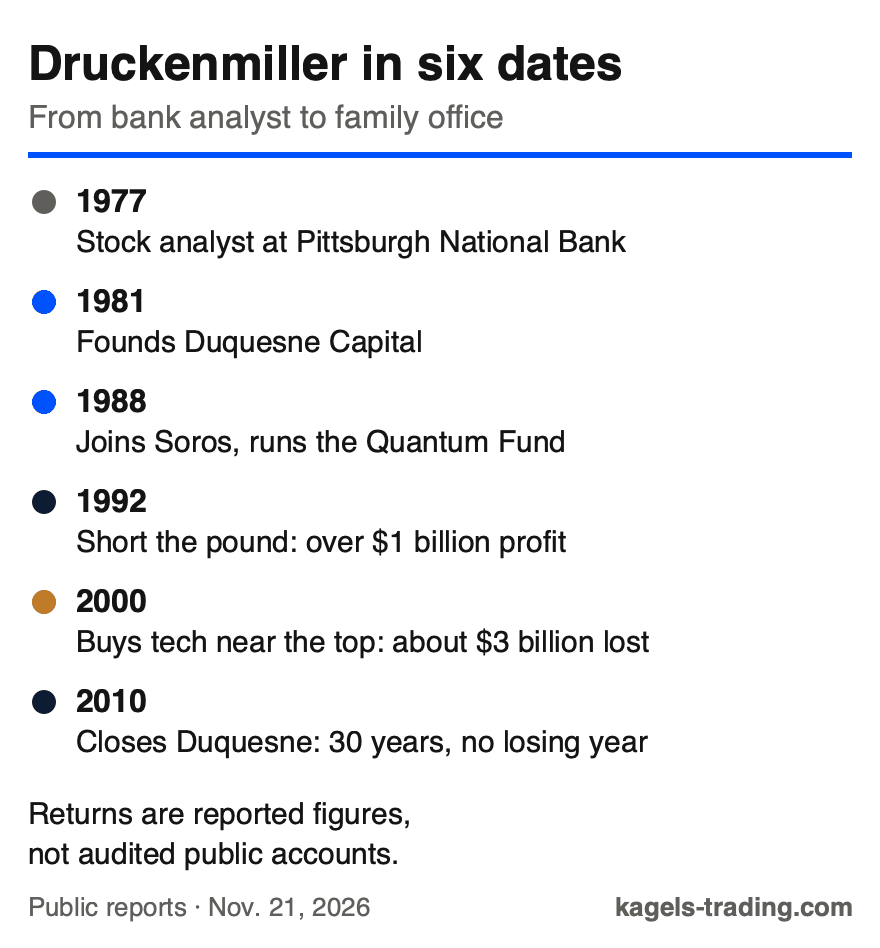 Click to enlarge
Source: Kagels Trading, own graphic.
What is global macro, and how did Druckenmiller trade?
Global macro is a trading approach that bets on economic developments such as interest rates, inflation and central bank policy across all asset classes, instead of on single companies. A global macro trader asks what happens when a central bank raises rates or a government can no longer defend its currency. The answer is traded where it works strongest: in currencies, bonds, commodities or stock indexes. Paul Tudor Jones and Ray Dalio built their firms on the same idea, with different risk styles.
Druckenmiller combined the macro view with charts. By his own account, the economic analysis set the direction and the chart helped with the timing. That mix of fundamentals and price action set him apart from purely academic macro investors.
The second building block was concentration. He held few positions and made them large instead of spreading the risk. His most quoted advice, which he credits to Mark Twain, is to put all your eggs in one basket and watch that basket very closely. For private traders, this is the riskiest part of his method and the one least worth copying.
Duquesne Capital: 30 years without a losing year
The streak is the real record, not the size of the return. Some traders reach 30 percent a year for a while. Thirty calendar years in a row without a negative year, with billions under management at the end, is what makes the reported record stand out. Jim Simons’s Medallion Fund earned more per year, but has taken no outside money for decades.
The reason lies on the loss side. Druckenmiller described his approach many times like this: when the picture is unclear, he trades small or not at all; when a thesis works, he adds heavily. Protecting capital in quiet phases pays for the few big winners. Anyone who reverses the order and trades big in unclear phases gets exactly the losing years missing from his record.
He credits one principle to Soros. What matters is not how often you are right, but how much you make when you are right and how little you lose when you are wrong. In essence, that is risk management and position sizing, stated by a trader who applied it for decades.
In 2010, he closed the fund and returned outside money. On August 18, 2010, he told investors he would stop, citing the heavy personal costs of competing over such a long time. At that point, the fund was about 5 percent down for the year, according to reports. The returns come from reported figures, not from audited public accounts, which is true of almost all trader records from that era; read them as an order of magnitude.
The 1992 pound trade: why size decided
One of the most famous trades in financial history began on Druckenmiller’s desk. In the headlines, it was Soros who broke the Bank of England. In his 2015 speech at the Lost Tree Club and later interviews, Druckenmiller describes the thesis as his own and the decision on size as Soros’s.
The setup was an exchange-rate band that Britain could not defend. As a member of the European Exchange Rate Mechanism, the UK had to keep the pound within a band against the German mark. The British economy was in recession and needed lower rates; defending the band demanded the opposite. Druckenmiller concluded that the link would break and built a short position, a bet on a falling pound.
The decisive moment was about size, not analysis. By his account, Quantum held a short of about $1.5 billion in August 1992, and in September he proposed raising it to $5.5 billion, the whole fund. Soros called it a one-way bet and said the position should be twice that size. They did not get the full amount on, but on September 16, 1992, Black Wednesday, the UK left the mechanism, and the reported profit was over $1 billion.
The lesson is the split of roles. The thesis came from Druckenmiller; the position size that Soros pushed turned a good trade into a historic one. That size rested on their assessment of this particular trade: they judged that the pound had far more room to fall than to rise. The position still carried exchange-rate, financing and policy risk, so using that size without that kind of asymmetry copies the math wrongly.
The $3 billion mistake: when Druckenmiller beat himself
His costliest mistake had nothing to do with a wrong market view. Druckenmiller had correctly identified the tech bubble of the late 1990s. He thought valuations were absurd, sold his tech stocks in January 2000 and first only lost patience.
Then came the part he could not explain himself. Around him, younger traders were making a lot of money with exactly the stocks he thought were overvalued. In spring 2000, near the March peak of the Nasdaq, he bought about $6 billion worth of tech stocks for the Quantum Fund and, by his own account, lost about $3 billion in roughly six weeks. Soon after, he left Soros.
His own verdict is the reason this episode belongs here. In the same Lost Tree Club speech, he said: “I didn’t learn anything. I already knew that I wasn’t supposed to do that.” He described himself as an emotional wreck at the time. A trader with twenty years of discipline and a correct analysis broke his own rules because he watched others profit. A written trading journal is not a beginner’s tool for exactly that reason.
What Druckenmiller warns about today
Since closing Duquesne, he manages only his own money. The Duquesne Family Office files quarterly reports on its US stock holdings, so part of the portfolio is public. These Form 13F filings show only a slice: they omit short positions and many other exposures, so they cannot reveal the complete portfolio or its net risk, and they come out weeks after the quarter ends.
In public, he talks mostly about US government debt. In an op-ed in the Wall Street Journal, published online on August 24, 2026, he criticized the Treasury’s decision of August 19 to raise its buybacks of long-term bonds to at least $4 billion per operation, after long-term yields had reached about a 19-year high. He called it price management and a mistake. The Treasury Secretary, Scott Bessent, once worked with Druckenmiller, which is why the piece drew wide attention.
Macro views of famous investors are not trading signals. Druckenmiller himself has said many times that he changes his mind as soon as the market moves against him. If you read his warnings as a position, you take the thesis without the exit plan that goes with it.
What traders can copy from Druckenmiller, and what not
His method splits into a transferable part and a dangerous part. Separating the two matters more than any single rule from his interviews, because both sound equally convincing from someone with his record.
What you can copy
- Trade small without a clear picture: cut risk in unclear phases instead of forcing activity.
- Check the payoff: before you enter, write down what you lose in the bad case and what you can make in the good case.
- Drop your opinion: he reversed positions as soon as his assumption proved wrong.
- Separate timing and direction: answer what will happen and when to enter as two questions.
What does not fit a private account
- Concentration in a few positions: it needs a capital cushion and information private traders do not have.
- Pound-trade sizes: they worked because of a lopsided risk profile that normal markets do not offer.
- Macro bets on central banks: they need staying power and the ability to sit through interim losses.
- His confidence with big bets: it rests on decades of experience and still cost him $3 billion in 2000.
The first list holds most of the benefit. The risk management in his method works on a small account just as it did on $12 billion. The spectacular bets are the part that, without his starting position, copies only the risk and not the edge.
Conclusion: the streak is impressive, the 2000 loss is instructive
Stanley Druckenmiller has one of the most cited long-term records in the industry. Thirty years without a losing year at about 30 percent a year, by most accounts, with sums at which most approaches stop working. What carried the streak was less forecasting skill than the willingness to do almost nothing in unclear phases.
His biggest trade and his biggest mistake show the same size from two sides. In 1992, a right thesis and a big position made a legend. In 2000, a big position without his own conviction became a $3 billion loss. The difference was not the analysis but whether conviction or the fear of missing out drove the trade, and that is a reason to keep your rules in writing.
Frequently asked questions about Stanley Druckenmiller
Who is Stanley Druckenmiller?
Stanley Druckenmiller is a US investor, born in 1953, who ran Duquesne Capital from 1981 to 2010. From 1988 to 2000, he also ran George Soros’s Quantum Fund. Today he manages his own money through the Duquesne Family Office.
Did Druckenmiller really never have a losing year?
According to all available reports, Duquesne Capital closed no calendar year with a loss in 30 years. Single months and quarters were negative; in 2010, the fund was about 5 percent down at the time he announced the closure. The figures come from reported results, not from audited public accounts.
What was Stanley Druckenmiller’s biggest mistake?
Buying tech stocks in spring 2000, shortly before the bubble burst. By his own account, he bought about $6 billion of tech stocks and lost about $3 billion in roughly six weeks. He calls it a failure of discipline, not of analysis.
Was the 1992 pound trade Soros’s or Druckenmiller’s?
By Druckenmiller’s own account, the thesis was his; Soros pushed for the larger size. Druckenmiller ran the Quantum Fund and had built the bet against the pound. Soros called it a one-way bet, and the reported profit was over $1 billion.
How does Stanley Druckenmiller invest today?
Through the Duquesne Family Office, which manages only his own money. Its US stock holdings are reported quarterly and are public, but the filings appear weeks late and omit short positions and many other exposures.
How much is Stanley Druckenmiller worth?
Estimates vary widely, so we do not give a figure. Published estimates put his wealth in the billions of dollars, but they differ between sources and years. Such estimates rest on publicly known assets and carry large uncertainty.
This English edition is based on our German edition on kagels-trading.de and has been adapted for international readers.
More Famous Traders guides
- See who really performed best
Best Traders in the World, Ranked by Documented Returns
A ranking built only from documented annual returns, from Jim Simons to Warren Buffett, and why the famous 120% figures are missing.
- Meet the quant pioneer
Jim Simons: Medallion Fund Returns, Strategy and Access
Jim Simons and the Medallion Fund: 66% a year before fees from 1988 to 2018, how it traded, why you cannot invest and what traders can use.
- Understand trading championships
World Cup Trading Championship: Winners, Rules, Criticism
How the real-money World Cup Trading Championship works, what it costs to enter, record winners, German champions and its flaws.
- Meet the record holder
Larry Williams: The 11,376% Record Holder, Fact-Checked
Larry Williams and his 11,376% year: his COT approach, the Oops pattern, the volatility breakout and the criticism.
- Meet the Prince of the Pit
Richard Dennis: The Prince of the Pit and the Turtle Traders
Richard Dennis from $400 to a fortune, the Turtle experiment, his losses in 1987 and 1988 and what is really documented.
- Understand the stock contest
US Investing Championship: Rules, Winners and Records
The real-money US Investing Championship: divisions, verification, recent winners and records, with dates.
- Meet the oldest legend
Jesse Livermore: Rules, Books and Lessons of a Legend
Jesse Livermore from his own 1940 book and the 1923 novel about him: rules, bankruptcies and lessons.
- Meet the first Market Wizard
Michael Marcus: How the First Market Wizard Traded
Michael Marcus: from early wipeouts to $80 million on a company account, and the rules he took from it.
- Meet the trend-following pioneer
Ed Seykota: Trend Following Pioneer From Market Wizards
Ed Seykota: early computerized trend following, his risk rules and what Market Wizards documents.
- Learn short-term setups
Linda Raschke: Trading Rules, Setups and Books
Linda Raschke: Holy Grail, Turtle Soup and the 3-10 oscillator, and where her famous 50 rules come from.
- Trade the opening range
Toby Crabel: Opening Range Breakout and His Numbers
Toby Crabel: opening range breakout, short-term price patterns and what is known about his record.
- Understand Buffett's investing approach
Warren Buffett: Portfolio and Investing Strategy
Berkshire's disclosed holdings, Buffett's investment principles and the limits of following a reported portfolio.
- Meet the 1987 crash trader
Paul Tudor Jones: Strategy Behind the 1987 Crash Trade
Paul Tudor Jones: the short before Black Monday, global macro, the 200-day rule, 5 to 1 and what the legend leaves out.
- Learn the SEPA method
Mark Minervini: SEPA, Trend Template and VCP Explained
Mark Minervini: SEPA, the eight Trend Template criteria, the VCP pattern, his risk rules and two contest wins.
- Understand All Weather
Ray Dalio: All Weather, Bridgewater and Lessons for Traders
Ray Dalio: what the All Weather portfolio really is, Bridgewater, his debt warnings and what traders can use.
- Learn the Impulse System
Alexander Elder: Impulse System, Triple Screen and Books
Alexander Elder: from psychiatrist to trading author, the Impulse System, Triple Screen, his 2% and 6% rules and his books.
- Separate the Rothschild story from the legends
Rothschild Family: History, Wealth and Myths Fact-Checked
How a family from Frankfurt's Jewish ghetto built five banking houses, what Waterloo and Suez really show and what exists today.