
Forex Market Hours: When the Week Opens, Closes and Pauses


Contents
- Forex market hours in 30 seconds (as of November 19, 2026)
- When does the forex market open and close?
- Daylight saving time: the gap weeks
- When are spreads tightest?
- Which pair to trade at which time
- Can you trade forex on the weekend?
- Gold: the daily one-hour break
- Holidays: when forex really stops
- Your broker’s server time
- Conclusion: one New York clock, three exceptions
- Frequently asked questions about forex market hours
- About the author
The forex market has no opening bell, but it does have a fixed week. It runs from Sunday 5 p.m. to Friday 5 p.m. New York time, and every trading day ends at 5 p.m. ET with the rollover. Everything else, from the best hours for spreads to the weeks when the open moves for UK traders, follows from that one New York clock.
All times on this page are as of November 19, 2026. We checked them against Cboe FX, one of the large spot currency trading venues, the broker FOREX.com, the CME Group and IG. Brokers can differ by an hour or so; your own platform’s server time decides what your charts show. How we research is described on our editorial policy page.
Forex market hours in 30 seconds (as of November 19, 2026)
- Week: Sunday 5:00 p.m. ET to Friday 5:00 p.m. ET. In the UK that is Sunday 10 p.m. to Friday 10 p.m., in India Monday early morning to Saturday early morning.
- Daily close: 5 p.m. ET. Open positions are rolled over to the next settlement date, and spreads widen for a few minutes.
- Gap weeks: on three or four Sundays a year, depending on the year, US and UK clocks are out of step, and the week opens at 9 p.m. UK time.
- Best liquidity: when London and New York are both open, roughly 8 a.m. to noon ET.
- Weekend: no regular trading. Some brokers quote a few pairs on Saturday and Sunday at their own prices.
- Holidays: Cboe FX closes only on New Year’s Day and Christmas Day. Around other holidays, the market trades thin.
When does the forex market open and close?
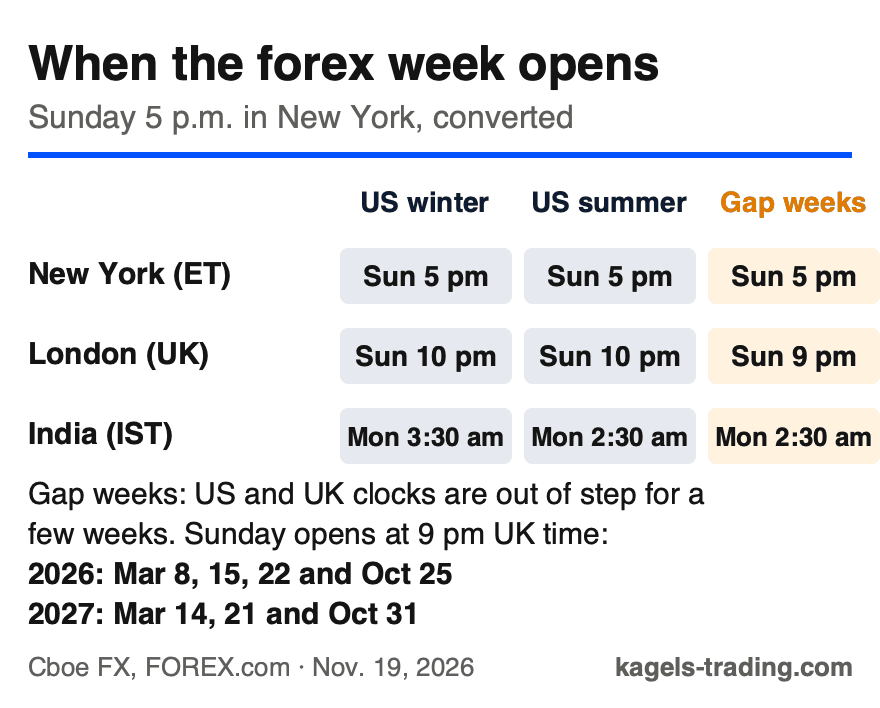
The forex week opens on Sunday at 5 p.m. ET and closes on Friday at 5 p.m. ET. That is how Cboe FX lists its spot trading hours, and the FOREX.com market hours page gives the same window “including most U.S. holidays”. There is no central exchange: banks, brokers and trading venues quote prices over the counter, and the week starts when the first centres in New Zealand and Australia are at work on Monday morning.
 Click to enlarge
Source: Kagels Trading, own graphic from Cboe FX trading hours.
New York time is the anchor, so the open moves in other countries. In the UK the week opens at 10 p.m. on Sunday in both winter and summer, because the UK and the US both change their clocks. India has no daylight saving time, so the open falls at 3:30 a.m. on Monday while the US is on standard time and at 2:30 a.m. during US daylight time.
| Event | New York (ET) | London (UK) |
|---|---|---|
| Week opens | Sun 5:00 p.m. | Sun 10:00 p.m. |
| Daily rollover | 5:00 p.m. | 10:00 p.m. |
| Week closes | Fri 5:00 p.m. | Fri 10:00 p.m. |
Cboe FX and FOREX.com, November 19, 2026. UK times are one hour earlier in the gap weeks below.
Rollover: the 5 p.m. moment
Rollover is the moment when open forex positions are moved to the next settlement date and interest is credited or charged. At FOREX.com, “all open forex positions at the end of the day (5:00pm New York time) are automatically rolled over”, according to its rollover FAQ. The swap you pay or receive depends on the interest rates of both currencies.
Wednesday’s rollover usually counts three days. Spot currency trades normally settle two business days later, so a position held into Wednesday’s close has its value date moved from Friday to Monday, across the weekend. FOREX.com therefore posts the weekend rollover on Wednesday, “as is standard in the industry”. If you hold a position with negative swap over Wednesday’s close, you typically pay three times the daily amount; holidays can move the extra days to another day, and some instruments, such as index CFDs at some brokers, use different days.
Spreads can widen sharply in the minutes around 5 p.m. ET. Liquidity drops while the trading day changes, and many brokers show much wider spreads for a few minutes. Stops close to the market can be triggered by that widening alone.
Daylight saving time: the gap weeks
For a few weeks a year, US and UK clocks are out of step, and the forex week opens an hour earlier in the UK. The US moves its clocks on the second Sunday in March and back on the first Sunday in November. The UK and the EU change on the last Sunday in March and the last Sunday in October.
- 2026: the week opens at 9 p.m. UK time on March 8, 15 and 22 and on October 25.
- 2027: at 9 p.m. UK time on March 14 and 21 and on October 31.
The gap moves more than the open. US data at 8:30 a.m. ET, such as the nonfarm payrolls report and the US CPI report, come at 12:30 p.m. UK time instead of 1:30 p.m. in those weeks, and the daily rollover moves to 9 p.m. UK time. Automated strategies with fixed UK or broker times need to be adjusted for these weeks.
When are spreads tightest?
Spreads on the major pairs are usually tight when London and New York trade at the same time. That overlap runs roughly from 8 a.m. to noon ET, 1 p.m. to 5 p.m. UK time. Two of the largest currency centres quote prices then, so more orders meet in the market.
Tight on average does not mean tight every second. US data at 8:30 a.m. ET and the Fed’s rate decisions at 2 p.m. ET widen spreads for seconds or minutes. A bid-ask spread is a direct measure of liquidity, and it can widen sharply in the hours after the 5 p.m. rollover, when only the Asia-Pacific centres are trading.
Exotic pairs stay expensive at every hour. A pair such as USD/TRY or USD/ZAR has a wider spread than EUR/USD all day, because far fewer market makers quote it. The time of day helps less than the choice of pair.
Which pair to trade at which time
A currency pair tends to see more trading when the home markets of both currencies are open. This is a rule of thumb, not a measured statistic, and the times move during the year: Tokyo has no daylight saving time, Sydney changes its clocks in October and April, and the US and UK change on their own dates. Our guide to trading sessions gives the session times in ET for US winter and summer.
| Pair | Home markets | Session to watch |
|---|---|---|
| EUR/USD | Europe, US | London and New York overlap |
| GBP/USD | UK, US | London, then New York |
| USD/JPY | Japan, US | Tokyo, then New York |
| AUD/USD | Australia, US | Sydney and Tokyo |
| EUR/GBP | Europe, UK | London |
Kagels Trading, derived from where each currency is mainly traded. Not a volatility measurement.
Two pairs in the same session are often one trade. EUR/USD and GBP/USD in the New York morning are both largely a bet on the US dollar. If you choose pairs by the clock, check their correlation in the same step.
Can you trade forex on the weekend?
There is no regular forex trading on Saturday. Between Friday 5 p.m. and Sunday 5 p.m. ET, the interbank market does not quote prices. Open positions stay open, but a stop-loss cannot be filled until the market reopens, and the first price on Sunday can jump past it.
Some brokers offer their own weekend prices. IG in the UK lets clients trade “Weekend GBP/USD, EUR/USD and USD/JPY” from 8 a.m. Saturday to 8:40 p.m. Sunday UK time, according to its weekend trading page. The prices are based on market conditions, client activity and news flow, not on a live interbank market, and positions still open at 8:40 p.m. move into the weekday market when it reopens at 9 p.m.
Gold: the daily one-hour break
Gold trades almost around the clock, but it stops for about an hour every day. The reference market is the COMEX gold future at the CME Group. Its CME Globex hours run Sunday to Friday from 6 p.m. to 5 p.m. ET, “with a 60-minute break each day beginning at 5:00 p.m.”, according to the contract specifications.
Brokers build a similar break into their gold hours. At IC Markets, for example, the trading hours page lists gold from 01:02 to 23:57 server time, while currency pairs trade from 00:01 to 23:59, so gold stops for about an hour and currency pairs for a few minutes around the daily close. Orders wait during the break, a stop is not filled, and the first price after the break can differ from the last one. CME currency futures such as Euro FX also pause for an hour each day. All futures hours are in our guide to futures market hours.
Holidays: when forex really stops
Cboe FX lists only two closing days: New Year’s Day and Christmas Day. On those days, London and New York are both closed, and many brokers suspend prices or open for only a few hours. Brokers publish their own opening times for holidays in advance; FOREX.com lists them on its market hours page.
Other holidays usually thin the market, but your broker may still close. Good Friday is a holiday for the stock exchanges in London and New York; it is not a Cboe FX closing day, but some brokers close or shorten forex trading that day, so check your broker’s holiday hours. Thanksgiving is a US-only holiday: London trades, New York is quiet. Between Christmas and New Year, many trading desks are lightly staffed, and single orders can move prices more than usual. The hours of the stock exchanges are in our guide to stock exchange hours.
Your broker’s server time
Charts show your broker’s server time, not your own. IC Markets, for example, states that its “server time and charts are GMT + 2 or GMT + 3 (when daylight savings is in effect)”. If such a server switches on the US dates, midnight server time stays at 5 p.m. New York time, so the daily candle closes at the rollover and there is no separate Sunday candle. Others use GMT or New York time. Check the server time before you set time filters in a strategy or compare daily candles between platforms.
Conclusion: one New York clock, three exceptions
The basic rule is simple: forex trades from Sunday 5 p.m. to Friday 5 p.m. ET. If you remember those two times and the 5 p.m. rollover, you have answered most questions about forex market hours.
Most surprises come from three exceptions. The gap weeks in March and in October or November move the open for UK traders, gold pauses every day, and on New Year’s Day and Christmas the market is closed. In the first minutes after a major data release, spreads can widen sharply and execution can deteriorate; many experienced traders wait for those minutes to pass before they act.
Frequently asked questions about forex market hours
When does the forex market open?
The forex market opens on Sunday at 5 p.m. ET. That is 10 p.m. in the UK (9 p.m. in the gap weeks) and 3:30 or 2:30 a.m. on Monday in India. Some brokers start quoting a little earlier.
When does the forex market close on Friday?
The forex week closes on Friday at 5 p.m. ET, 10 p.m. UK time (9 p.m. in the gap weeks). After that, there are no regular prices until Sunday evening. Open positions stay open, but a stop-loss cannot be filled over the weekend.
What is the best time to trade forex?
For the major pairs, the London and New York overlap from about 8 a.m. to noon ET usually offers deep liquidity. Spreads are usually tight then. Around 8:30 a.m. ET, many US data releases briefly widen them.
Is forex open 24 hours?
Forex trades 24 hours a day from Sunday evening to Friday evening. Each trading day ends at the 5 p.m. ET rollover, when spreads widen for a few minutes. On Saturday, there is no regular trading.
Can I trade forex on Saturday?
Not on the regular market. Some brokers, such as IG in the UK, offer weekend prices for a few major pairs, set by the broker itself and with wider spreads.
Does daylight saving time change forex hours?
In New York time, no: the week always opens at 5 p.m. ET. For UK traders, the open moves to 9 p.m. on three or four Sundays a year, depending on the year, when US and UK clocks are out of step. India has no daylight saving time, so its open moves with the US clock.
Does gold trade at the same hours as forex?
Almost, but gold stops for one hour every day. The COMEX gold future pauses from 5 to 6 p.m. ET, and brokers such as IC Markets build a similar break into their XAU/USD hours.
This English edition is based on our German edition on kagels-trading.de and has been adapted for international readers.
More Market Hours guides
- Check futures hours
Futures Market Hours: CME Trading Times for ES, Oil and Gold
Weekly and daily hours of ES, crude oil, gold, Treasuries, grains and bitcoin futures in ET, CT and London time.
- Time your trades
Trading Sessions: Asian, London and New York Hours in ET
The Asian, London and New York sessions in ET, London and India time, their overlap, RTH and ETH, and how to set up your chart.
- Plan around expiry
Triple Witching 2026 and 2027: Dates and What Happens
Triple witching dates for 2026 and 2027, settlement times, and what 25 years of SPY data show about volume and the week after.
- Trade before the open
Pre-Market and After-Hours Trading: Hours, Risks, Brokers
Pre-market, after-hours and overnight hours at the exchanges and at Schwab and Interactive Brokers, the risks, and what SPY data show about the overnight move.
- Check exchange hours
Stock Market Hours: NYSE, Nasdaq and World Exchanges in ET
Opening and closing times of the major exchanges in the Americas, Europe and Asia-Pacific, in local and New York time, with lunch breaks.
- Check Tokyo hours
Tokyo Stock Exchange Hours: Lunch Break, Auction, Holidays
Tokyo Stock Exchange hours in Japan, New York and UK time, the lunch break, the closing auction, holidays to 2027 and Nikkei futures hours.
- Trade the opening range
Opening Range Breakout: Rules, Charts and Common Mistakes
How 5, 15 and 30-minute opening windows differ, with a worked SPY example at a 15-minute window, entry at the next bar’s open and a 2R target.