
CoinGecko Review 2026: Data Accuracy, Trust Score, Cost


Contents
- CoinGecko in 30 seconds
- What is CoinGecko?
- How does CoinGecko calculate its prices?
- Trust Score: what the grade measures and what it does not
- How accurate is the data? CoinGecko and CoinMarketCap compared
- How independent is CoinGecko really?
- What does CoinGecko cost?
- Portfolio, app and Gecko AI: are the extras worth it?
- Is CoinGecko legit?
- What are the alternatives to CoinGecko?
- Pros and cons of CoinGecko
- Conclusion: who CoinGecko is for
- Frequently asked questions about CoinGecko
- About the author
The green Buy/Sell button on CoinGecko’s Bitcoin page opens a menu of paid ads. That is not a scandal, but it matters for a site that calls itself independent. On the prices of large coins, CoinGecko came very close to CoinMarketCap in our comparison.
This review is based on CoinGecko’s public pages and our own measurement. We read the methodology, terms of use and ad policy and compared the 100 largest cryptocurrencies with CoinMarketCap. We did not test a paid Premium plan, and this is not investment advice.
CoinGecko in 30 seconds
- Free data site, not an exchange: CoinGecko lists 22,865 cryptocurrencies and 1,522 exchanges. It does not hold your money; buy and swap buttons lead to third parties.
- Prices close together: for 80 large coins the median price gap to CoinMarketCap was only 0.06%, but the circulating supply differed by more than 5% for seven coins.
- The Trust Score is a relative grade: Binance gets 10 out of 10, although CoinGecko records a major incident on the same page.
- Ads sit in the trading buttons: “Buy/Sell” shows sponsored offers, not a neutral ranking.
- Free is enough for most readers: the German Premium page showed €10 a month or €99.90 a year, and the API starts at $29 a month with yearly billing. The CoinGecko price is an average, so check your entry on the chart of your own exchange, for example on TradingView.
What is CoinGecko?
CoinGecko is a free data site that collects prices, trading volume and market capitalization of cryptocurrencies from many exchanges and makes them comparable.
TM Lee and Bobby Ong founded CoinGecko on April 8, 2014. That is what the company page says, which lists Bobby Ong as CEO and TM Lee as President. According to the terms of use, the operator is Gecko Labs Pte. Ltd. in Singapore.
The site is a reference, not a trading venue. The FAQ states that CoinGecko is not a wallet, an exchange or a custodian of any kind. Buy and swap features come from third parties according to the terms. For traders, the value is a quick overview: where a coin trades, how large it is and how thin the market is.
| Feature | Details |
|---|---|
| Operator | Gecko Labs Pte. Ltd., Singapore (UEN 201510008G) |
| Founded | April 8, 2014 |
| Coverage | 22,865 cryptocurrencies, 1,522 exchanges (November 8, 2026) |
| Basic use | free, with ads |
| Paid products | Premium, API |
| Apps | iOS and Android, Google Play 4.6 from 236,000 reviews |
| Trading and custody | none by CoinGecko itself, buy and swap via third parties |
How does CoinGecko calculate its prices?
The CoinGecko price is a volume-weighted average: venues with more trading count more, and outliers are removed first.
A coin on CoinGecko has an average price that you cannot trade anywhere. According to the methodology, the algorithm takes the 600 highest-volume trading pairs of a coin and filters out abnormal prices. The rest forms the price. In some cases the team also steps in by hand. That is solidly built, but it does not replace the price at your exchange.
The value is only roughly current. The FAQ names an update every 1 to 10 minutes for price, volume and market capitalization. That is fine for an overview. For an entry on a minute chart it is not enough; you need the order book of your exchange.
Circulating supply is the number of coins that can be traded freely, without locked holdings of teams and investors.
Market capitalization depends on that supply. It is price times circulating supply, and according to the methodology the figures come from the token teams and are checked by CoinGecko. If the team cannot verify them, a dash appears instead of a number. That is honest, but it shows: the rank of a small coin is only as good as its project’s figure.
Trust Score: what the grade measures and what it does not
The Trust Score is CoinGecko’s grade for crypto exchanges and trading pairs; for exchanges it combines liquidity, cybersecurity, regulation, incidents and proof of reserves.
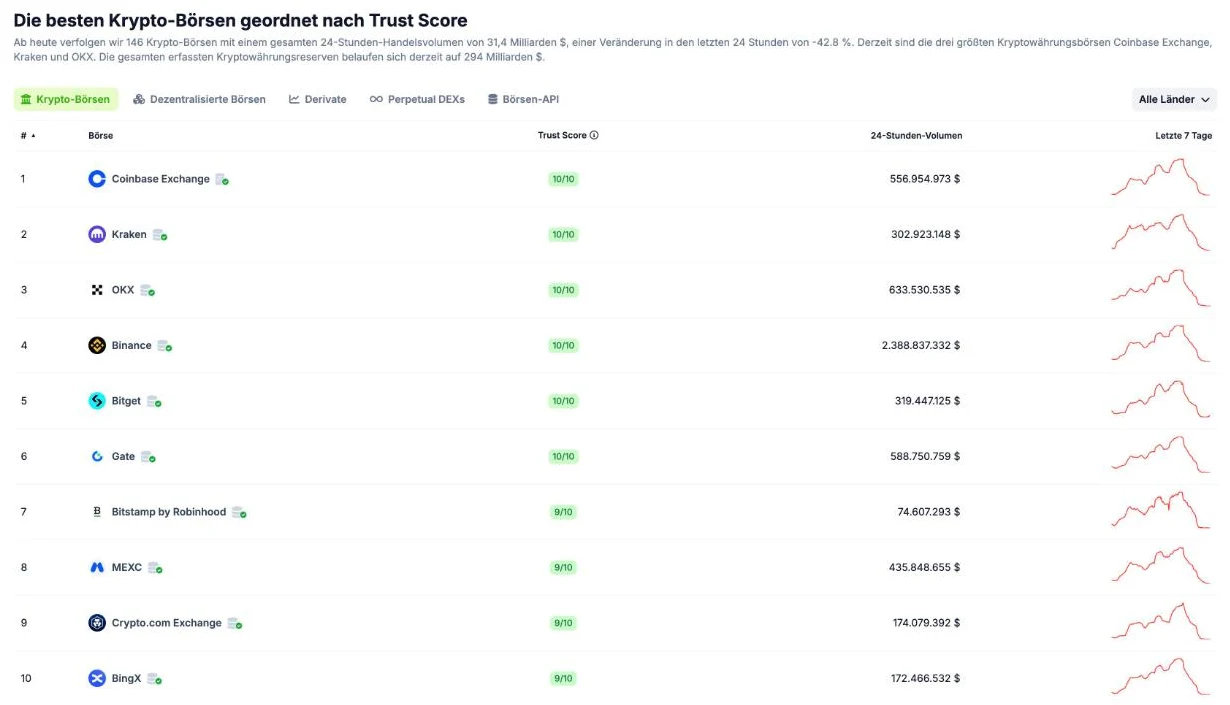
The grade is relative, and liquidity counts most. According to the Trust Score methodology, liquidity weighs 50%, cybersecurity 20%, regulation 15%, incidents 10% and proof of reserves 5%. The result is graded on a curve against all other exchanges and recalculated weekly. A 10 therefore means: far ahead of the field. CoinGecko keeps its thresholds secret on purpose, and derivatives exchanges get no grade. The screenshot below shows the ranking.
 Click to enlarge
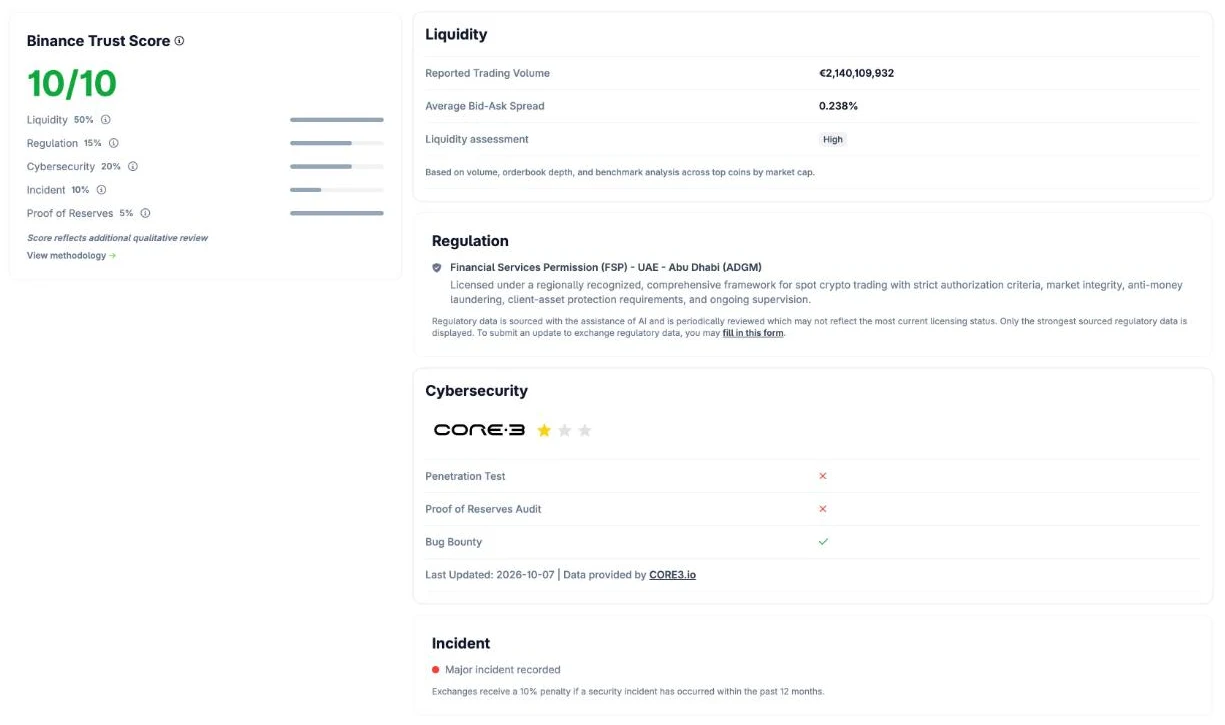
A 10 does not mean your balance is safe. Binance stands at 10 out of 10 on November 8. On the same page CoinGecko notes “Major incident recorded”, and in its own statement Binance put the assets affected by the incident of October 29 at about $6.34 billion. For cybersecurity, the embedded CORE3 rating shows one out of three stars, dated October 7. The page adds: “Score reflects additional qualitative review”. The image shows the breakdown.
 Click to enlarge
Source: CoinGecko, Binance exchange page.
For the regulation part, CoinGecko counts the verified credential with the highest rank for spot trading. At Binance it lists a permission from Abu Dhabi and notes that the data is collected with the help of AI. The methodology explicitly says the grade is no compliance certification. Whether an exchange may serve customers in your country is a separate question; check its terms and your regulator. The distribution of grades is wide: among the first 250 entries of the API, 6 have a 10, but 115 only a 2.
The text above the list does not quite match the numbers. It calls Coinbase, Kraken and OKX the “three largest” exchanges, while the table below shows the largest volume for Binance, at $2.39 billion. The list is sorted by grade, not by size. If you want to filter by volume or trend yourself, a screener does that better.
How accurate is the data? CoinGecko and CoinMarketCap compared
On November 8 we put the 100 largest coins of both sites side by side. We matched them by ticker, and the two downloads ran 24 seconds apart. 80 coins appeared on both lists. This is a snapshot without an exact common data point, and it does not tell you which site is right in a given case.
On price the two sites almost agree. The price gap against the CoinMarketCap data had a median of 0.06% and a maximum of 0.41%. The reported trading volume looks different: the median gap is 13%, and for seven coins it is more than 50%. All percentages are absolute gaps relative to the CoinMarketCap value. Volume is the softer figure.
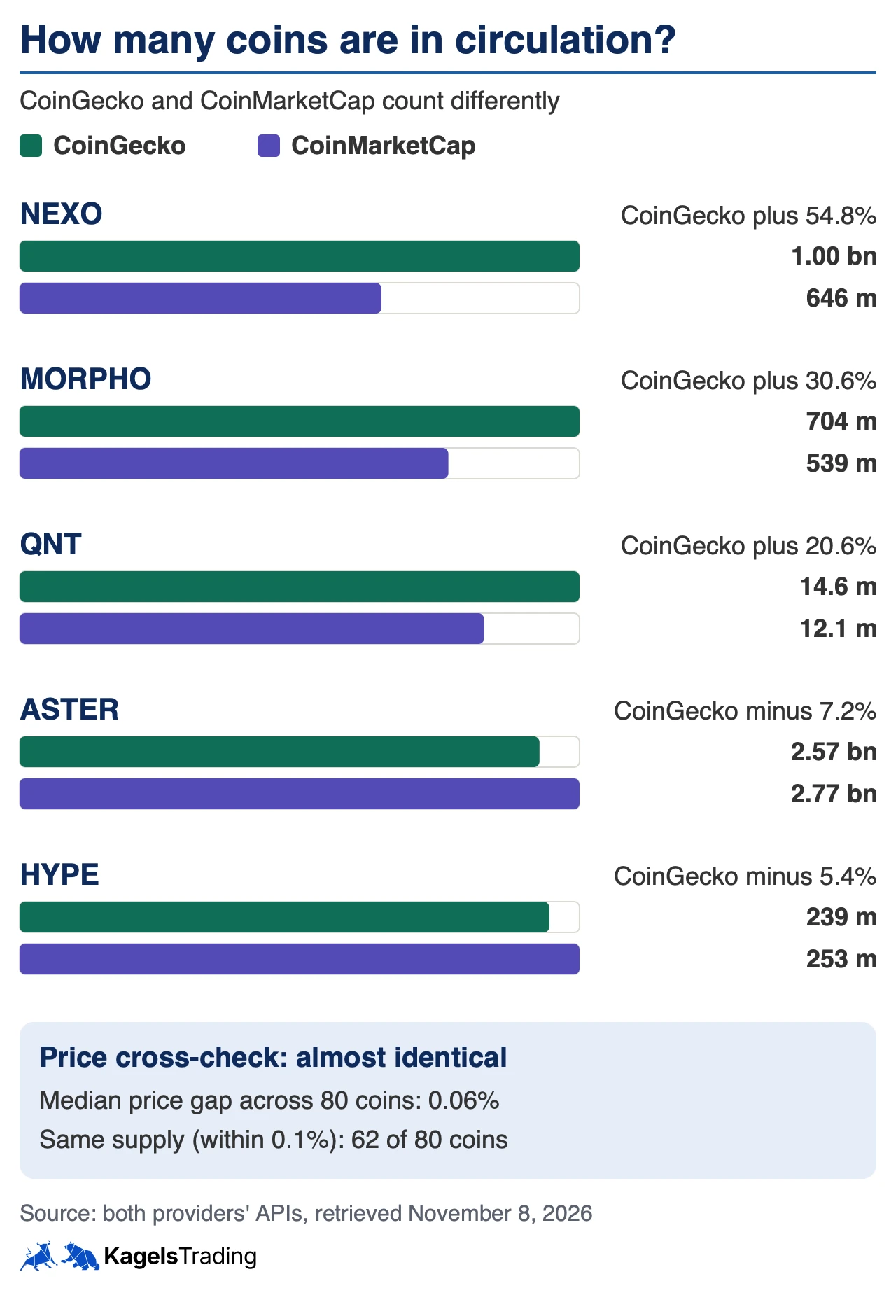
Circulating supply differs the most. For 62 of the 80 coins both sites were within 0.1% of each other. 14 coins were more than 1% apart, 7 more than 5% and 3 more than 20%. The graphic below shows five examples with large gaps, each coin on its own scale, and the table after it gives the numbers (CMC = CoinMarketCap, bn = billion, m = million). The two sites partly work with different assumptions, and then market capitalization shifts too.
 Click to enlarge
| Coin | CoinGecko | CMC |
|---|---|---|
| NEXO | 1.00 bn | 646 m |
| MORPHO | 704 m | 539 m |
| QNT | 14.6 m | 12.1 m |
| ASTER | 2.57 bn | 2.77 bn |
| HYPE | 239 m | 253 m |
The market overview differs as well. The coverage figures are provider figures that count differently, so they do not show who covers more. The key numbers in a direct comparison (CMC = CoinMarketCap, sentiment = fear and greed reading):
| Figure | CoinGecko | CMC |
|---|---|---|
| Market | $2.61 tn | $2.54 tn |
| Coins | 22,865 | 8,024 active (40,128 total) |
| Exchanges | 1,522 | 987 active (13,343 total) |
| Sentiment | 39 | 32 |
| Owner | independent (own claim) | Binance |
Our tip: use both sites as a cross-check. If the numbers differ clearly, look at the source of the circulating supply, which CoinGecko shows with one click. The sentiment gauge is only a helper too, as our guide to the Fear and Greed Index explains. The trend question belongs on the chart, not in a ranking.
How independent is CoinGecko really?
CoinGecko calls itself the “largest independent” crypto data aggregator and its data “neutral”. We found no complete ownership list to go with that. Its competitor CoinMarketCap, by contrast, has belonged to Binance since 2020. Ownership aside, CoinGecko lives on advertising and commissions from the same industry it lists.
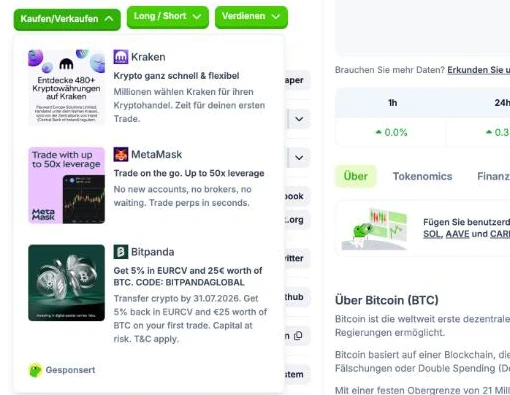
The trading buttons are ad slots. On the Bitcoin page, “Buy/Sell” opened sponsored cards from Kraken, MetaMask and Bitpanda on November 8. MetaMask advertised leverage of up to 50 times there. The Bitpanda offer still carried a deadline of July 31, 2026. The cards are marked “Sponsored”, as the screenshot shows. It is not a comparison of the best terms.
 Click to enlarge
Source: CoinGecko, Bitcoin page.
The terms of use also mention money that can flow without a click. Some links are affiliate links, meaning paid partner links, explicitly including Binance. Compensation may be paid “even if you do not click”. According to the terms, version of August 12, 2025, such links carry an icon. Whether and how much is being paid at the moment, we did not check. CoinGecko’s exchange pages, including Binance, show a Start Trading button with an affiliate disclosure next to it.
According to its own rules, CoinGecko is not liable for the content of ads. The ad policy distinguishes self-serve and managed campaigns and says some self-serve ads are approved automatically. Legal compliance is the advertiser’s job. Scams are banned in ads, but the terms disclaim liability for them. On the plus side: a listing is free according to the methodology, and anyone who asks for a listing fee does not speak for CoinGecko.
A sale was reported. In January 2026, media reports citing CoinDesk said CoinGecko was exploring a possible sale at a valuation of about $500 million. According to DL News, Bobby Ong spoke of “strategic opportunities” and called the company profitable. The reports we reviewed show no completed deal, and our web search on November 8 found none either.
What does CoinGecko cost?
Normal use of CoinGecko costs nothing. Prices, lists, exchange pages and the portfolio are free, and you see ads in return. Only two products cost money: Premium for private users and the API, the programming interface for your own applications. The pricing page advertises 14 free days; the screenshot shows the details.
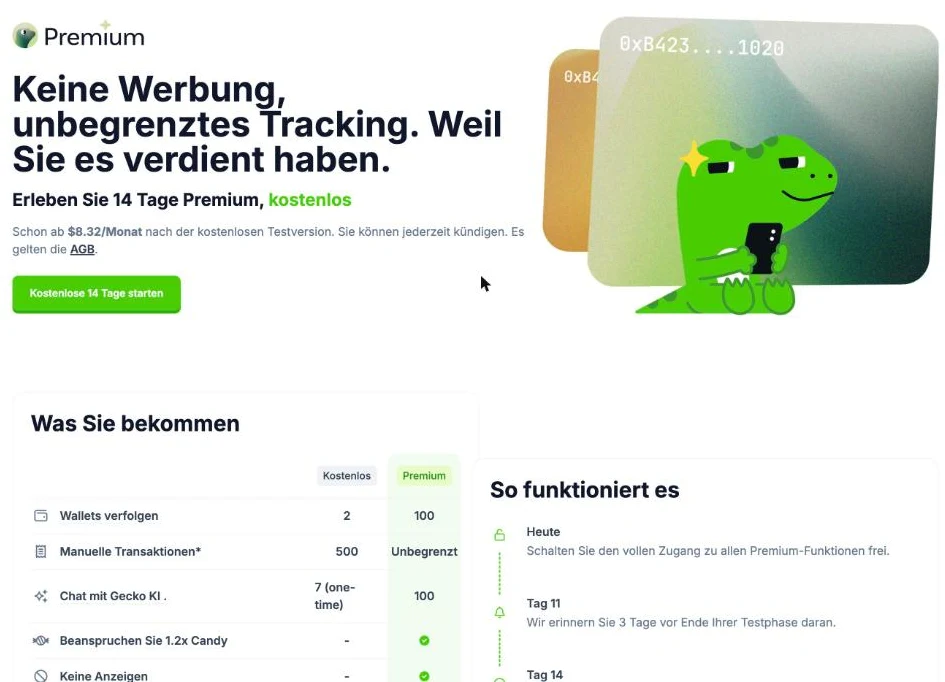 Click to enlarge
Source: CoinGecko, Premium pricing.
| Feature | Free | Premium |
|---|---|---|
| Price | $0 | €10 a month, €99.90 a year (German page) |
| Tracked wallets | 2 | 100 |
| Manual transactions | 500 | unlimited |
| Gecko AI | 7 questions, one time | 100 questions |
| Ads | yes | no |
The Premium page mixes currencies (prices checked November 8, 2026). Viewed from Germany, the offer showed $8.32 a month at the top and €10 and €99.90 further down, all before taxes. We did not check checkout or US prices. For the trial you enter payment details, and without cancellation it turns into a paid plan that renews automatically. The page promises a reminder three days before the trial ends and seven days before a renewal. On the web you cancel under “Manage Subscription”, for app purchases in the app store. According to CoinGecko, subscriptions are not refundable, and for Apple or Google purchases the store decides.
| API plan | per month, billed yearly | per year |
|---|---|---|
| Demo | $0 | $0 |
| Basic | $29 | $348 |
| Analyst | $103.20 | $1,238 |
| Lite | $399.20 | $4,790 |
| Pro | $799.20 | $9,590 |
You only need the API if you write code. The Demo plan includes 10,000 credits a month, the allowance for data calls, and requires attribution. For Basic billed yearly, the page shows $348 instead of a struck-through list price of $420; we did not record monthly prices. Prices exclude taxes. The FAQ still promises to keep providing a “free API”, which today only describes the entry level.
Portfolio, app and Gecko AI: are the extras worth it?
The portfolio works without access to your money. You enter holdings by hand or add a wallet address, according to CoinGecko without a signature. A signature is an approval from your wallet, and you should never give one there. For tax reporting the portfolio is not enough.
The app mainly delivers price alerts. On Google Play it showed 4.6 points from 236,000 reviews and more than 5 million downloads; the last update was on October 23, 2026. The store page lists ads and in-app purchases. Some reviewers complain about crashes. We did not test the app.
Gecko AI, Candy and GeckoTerminal are add-ons. Gecko AI is a chat we did not test, so check its answers at the source. Candy are reward points for using the site, which you trade for rewards. Many rewards are partner offers, such as a bonus for a $200 deposit. GeckoTerminal shows prices directly from decentralized exchanges, including coins that CoinGecko itself does not list. The risk there is higher accordingly.
The settings are behind the gear icon at the top right. There you switch language and currency, without an account. The German version has noticeable translation errors, so English is the better choice anyway. On the first visit CoinGecko asks for consent for up to 219 third parties; you can reject all of them and the site still works.
Is CoinGecko legit?
Yes, as a data site CoinGecko is an established service with a named company. Operator, governing law and rules are on the site, and the service has run since 2014. The terms choose the law of Singapore; how that applies to you as a consumer we did not check. In its disclaimer CoinGecko gives no warranty for accuracy or timeliness and says its content is not financial advice.
There was a data incident. On June 5, 2024, according to CoinGecko’s notice, an attacker exported 1,916,596 contacts through the email provider GetResponse and sent 23,723 phishing emails. The breach happened at the provider. Passwords were not affected according to CoinGecko. The open account speaks for the company, but you should read emails in CoinGecko’s name with caution.
Ratings vary a lot by platform. On Trustpilot CoinGecko had 2.1 out of 5 from 167 reviews, 78% of them with one star, and the profile is unclaimed. Google Play shows 4.6 from 236,000. The two are not directly comparable, because Trustpilot rates the company and Google Play the app. The Trustpilot reviews we looked at were unprompted, some are years old, and we did not evaluate all topics.
Be careful with “CoinGecko tokens” and airdrops. In the official coin list we found no token by CoinGecko itself on November 8, only unrelated projects with similar names. People still search for “CoinGecko airdrop”, which is exactly where you should check offers very carefully. The SEC’s investor.gov explains the main crypto risks and common frauds.
What are the alternatives to CoinGecko?
Which site fits depends on your question. The main alternatives at a glance:
| Service | Strength and limit |
|---|---|
| CoinMarketCap | large coverage, but owned by Binance |
| LiveCoinWatch | lean price site in English |
| TradingView | charts and screener instead of master data |
Keep research separate from trading. CoinGecko answers what a coin is and where it trades. The trade itself happens at a regulated exchange, with your own stop and a fixed position size, as our guide to position sizing shows.
Pros and cons of CoinGecko
After checking the public pages and running our measurement, the picture is clear: the data base is broad, the trading buttons are ads, and the grade for exchanges needs explaining.
Pros
- Free to use: prices, exchanges and portfolio without an account or with a free one.
- Wide coverage: 22,865 cryptocurrencies and 1,522 exchanges according to the provider.
- Openly described methodology: price calculation and criteria are on the site, thresholds are not.
- Exchange data per pair: spread and market depth are visible directly.
- Free listing: according to the methodology, a listing costs nothing.
Cons
- Ads as trading buttons: “Buy/Sell” shows sponsored cards.
- Trust Score needs explaining: Binance gets 10 out of 10 despite a recorded major incident.
- Affiliate pay possible: the terms explicitly name Binance.
- Weak translations: the German version has errors and English leftovers.
- Ownership not fully checked: we found no complete ownership list on the pages we reviewed.
Conclusion: who CoinGecko is for
For research, CoinGecko is one of the best free sources. The prices of large coins were very close to CoinMarketCap in our snapshot. You quickly see trading venues, circulating supply and spreads. For small coins, still compare both sites, because the figures can differ a lot.
As a buying guide the site is not suitable. The buttons are ads, and the Trust Score is a relative grade, not a guarantee for your balance. Choose your exchange separately and make the entry decision on the chart, not on the price site.
Premium is only worth it for a few. It makes sense if you track many wallets or do not want to see ads. The feature list mainly names no ads, more wallets and a newsletter; it says nothing about faster prices. Day traders need exchange data in real time anyway, and CoinGecko’s free offer does not provide it.
Frequently asked questions about CoinGecko
What is CoinGecko used for?
CoinGecko is a free data site for cryptocurrencies. It shows prices, volume and market capitalization from many exchanges. The operator is Gecko Labs Pte. Ltd. in Singapore. It does not hold your money.
Is CoinGecko legit?
As a data site yes; it has run since 2014 under a named company. Keep in mind that the trading buttons are ads and that the terms mention affiliate compensation. In June 2024 there was also a data incident at an email provider.
Can you buy CoinGecko or deposit money on it?
You cannot deposit money, and we found no CoinGecko token. The FAQ explicitly rules out deposits, and on November 8, 2026 the official coin list contained no token by CoinGecko itself. Buy buttons lead to third parties.
How much does CoinGecko Premium cost?
Basic CoinGecko use is free. The German pricing page showed €10 a month or €99.90 a year for Premium, before taxes. The API has a free Demo plan, and paid plans start at $29 a month with yearly billing.
What does the CoinGecko Trust Score mean?
It is CoinGecko’s relative grade for exchanges, and liquidity counts for half of it. Cybersecurity, regulation, incidents and proof of reserves are added. It is no guarantee: Binance had a grade of 10 on November 8, 2026, although the page records a major incident.
Which is better, CoinGecko or CoinMarketCap?
That depends on the features you need. For the prices of the 80 coins on both lists, the two were very close in our snapshot. CoinGecko describes itself as independent, CoinMarketCap belongs to Binance. The safest way is to use both as a cross-check.
This US edition is based on our German edition on kagels-trading.de and has been adapted for US readers.
More Crypto guides
- Choose an exchange
Crypto Exchanges in Europe: 5 MiCA Platforms Compared
Bitvavo, Bitpanda, Kraken, Coinbase and Bitstamp: licence, fees and the published charges on a 1,000 euro bitcoin buy.
- Check one provider in depth
Bitpanda Review 2026: Fees, MiCA Licences and Who It Suits
Bitpanda: two MiCA licences, the 2026 FMA fine, fees per coin, Fusion, margin costs and who can open an account.
- Check one provider in depth
Kraken Review 2026: Fees and Safety in the US and EU
Kraken for US and EU customers: which company you deal with, Kraken Pro fees from 0.40 percent, the app fee, licences and the SEC history.
- Check if an exchange is safe
Coinbase Review 2026: Is It Safe? Fees and Licences
Coinbase for US and EU customers: licences, custody, insurance, the 2025 data theft, fees and Coinbase One.
- Check if you can use an exchange
MEXC Review 2026: Who Can Use It? Restrictions and Fees
MEXC: where it is prohibited or winding down, what regulators say, fees, identity checks and the limits of its reserve data.