
Meme Coins: What They Are and Who Loses in the End


Contents
- Meme coins in 30 seconds
- What are meme coins?
- How a meme coin is born: pump.fun and Solana
- Where the price comes from: unit price, market cap and liquidity
- Pump and dump, rug pull and a normal decline
- Case study: Hawk Tuah
- Who earns on a new meme coin
- Are meme coins legal? SEC, MiCA and the courts
- Can you make money with meme coins? My view as a trader
- Warning signs: how to check a meme coin before you buy
- Conclusion: meme coins are bets on attention
- Frequently asked questions about meme coins
- About the author
In December 2024, a coin named after a viral street interview reached a market value of about $491 million within hours. Shortly afterwards it was more than 90% lower, and many fans who bought near the top were left with losses.
This guide explains what meme coins are, where their price comes from and who earns first on a new coin. You learn the difference between a pump and dump, a rug pull and a normal price decline, and which warning signs you can check yourself. This article follows our editorial policy and is for education, not investment advice.
Meme coins in 30 seconds
- What they are: cryptocurrencies that start from an internet joke and mostly have little use beyond trading. Their price depends mainly on attention and demand.
- How big the market is: all meme coins together had a market value of $19.61 billion on 21 November 2026, according to CoinGecko.
- What the big ones show: on that day Dogecoin was 92% below its record, Shiba Inu 96% and Pepe 88%.
- Who earns first: whoever gets tokens early and cheaply, that is creators, insiders and paid promoters. Late buyers are their exit.
- The key question: who is selling you this coin, and why should you buy it right now?
What are meme coins?
A meme coin is a cryptocurrency that starts from an internet joke, image or viral trend and usually has little use beyond trading, so its price depends mainly on attention and demand.
The first meme coin was Dogecoin. According to the Dogecoin project, Billy Markus and Jackson Palmer launched it on 6 December 2013 as a joke, with the Shiba Inu dog from the “Doge” meme as its logo.
Most newer meme coins have no blockchain of their own. They are tokens, entries in someone else’s public ledger such as Solana or Ethereum. Creating a token there takes minutes and costs very little.
What separates them from bitcoin is their origin. Bitcoin started as a payment network with a fixed maximum supply, while a meme coin starts from a punchline and is mostly bought as a speculative bet. Some meme coins do have a use: Dogecoin is also used for payments and tips. The slang term shitcoin means a coin without value or use and is often applied to meme coins too.
Staff of the SEC’s Division of Corporation Finance compare typical meme coins to collectibles. In their staff statement on meme coins of 27 February 2025, they write that typical meme coins have limited or no use and that their value is driven primarily by market demand and speculation.
| Coin | Market value | Record high | Below high |
|---|---|---|---|
| DOGE | $8.67 bn | 7 May 2021 | 92% |
| SHIB | $2.13 bn | 27 Oct 2021 | 96% |
| PEPE | $1.43 bn | 9 Dec 2024 | 88% |
Even the three best-known meme coins trade far below their records. The figures for Dogecoin (DOGE), Shiba Inu (SHIB) and Pepe (PEPE) come from the CoinGecko meme category on 21 November 2026, and the list is not a recommendation. How CoinGecko collects its data is covered in our CoinGecko review.
How a meme coin is born: pump.fun and Solana
The best-known launchpad is pump.fun, live on Solana since 19 January 2024. To create a new token you only need a connected wallet, a name, a ticker and an image.
Every new token there starts on a so-called bonding curve, where the price rises with each purchase according to a fixed formula. Only when enough money has come in does the token move to a decentralized exchange. According to a CoinGecko study from June 2026, only about 1% of tokens get that far.
The same study counts more than 19 million tokens created on the platform, 18.67 million of them traded at least once. Of those, 68.67% were only traded on their first day on pump.fun, and only 4.55% for longer than 90 days. The study only measured trades on the bonding curve, not later trading on external exchanges, so it can understate how long graduated tokens keep trading.
pump.fun is run by Baton Corporation Ltd, a UK company. After the UK regulator FCA warned about the platform in December 2024, pump.fun blocked users in the UK.
Solana is popular for meme coins because transactions settle in seconds and usually cost a fraction of a cent. That makes fast trading cheap, also for automated buying programs that grab new tokens in the first seconds after launch.
Where the price comes from: unit price, market cap and liquidity
A meme coin has no earnings from which a fair price could be derived. Its price is simply the price of the last trade. When demand rises, the price rises, and when it stops, the price falls.
Market capitalization is the unit price times the number of tokens in circulation. It is neither money paid in nor an amount that all holders together could actually cash out. Price sites show this number at the top of every coin page.
A tiny unit price says nothing either. A coin at $0.0001 with one trillion tokens is worth $100 million on paper and can fall to zero like any other.
Worked example: $500 million market cap, $4.55 million proceeds
Take an invented coin with one billion tokens. Trading runs through a pool holding 10 million tokens and $5 million, so the price is $0.50. Price sites show a market cap of $500 million.
Now an early holder sells 100 million tokens into the pool, worth $50 million on paper. Many pools use a constant product formula: before fees, the token reserve multiplied by the dollar reserve stays the same. Selling adds tokens to the pool and takes dollars out, so the seller receives about $4.55 million, and the price falls to roughly $0.0041, a loss of 99%.
What matters is how much real money sits in the pool, not the market cap. The example is simplified and ignores fees, but it shows why large holdings destroy the price when they are sold.
Pump and dump, rug pull and a normal decline
Not every crash is fraud. The three terms describe different processes, and only two of them require intent.
In a pump and dump, insiders buy cheaply, push the price up with promotion and hype and sell to latecomers. How the scheme works in stocks and crypto and where it is illegal is explained in our guide to pump and dump schemes.
In a rug pull, the creators pull the rug from under the buyers. They remove the money from the trading pool, sell their large holding in one go or have built sell restrictions for everyone else into the code.
A normal decline happens when interest fades and new buyers stay away. Nobody has to plan it. With meme coins it is even the usual case, because attention is the only driver.
| Type | What happens | Intent |
|---|---|---|
| Pump and dump | Insiders hype the coin, then sell to late buyers | Yes |
| Rug pull | Creators empty the pool or dump their holding | Yes |
| Normal decline | Interest fades and buyers stay away | No |
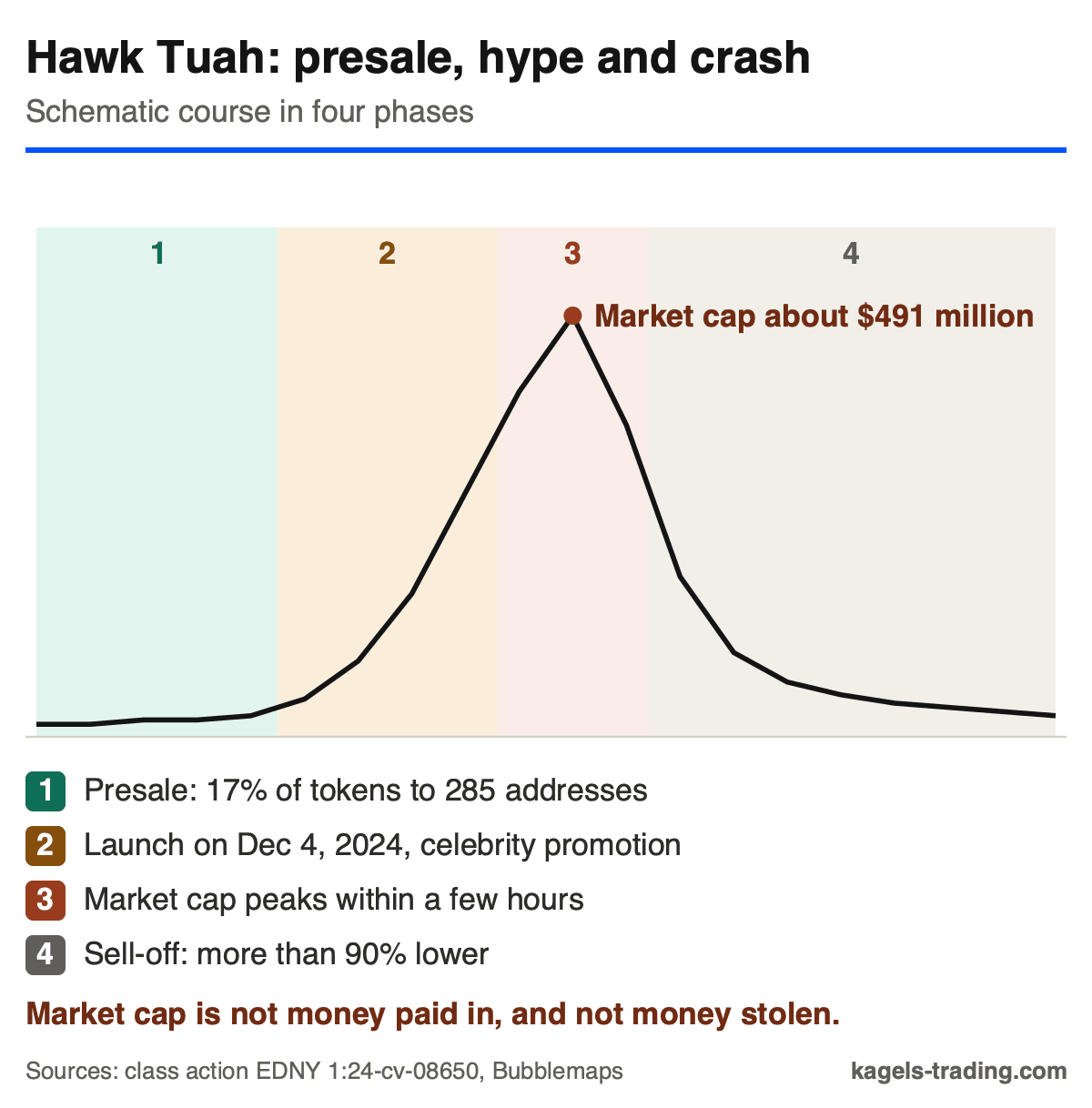
The graphic shows how fast the Hawk Tuah case unfolded, using figures from the next section. It is a schematic, not a price chart, and the peak is labelled as market cap. Whether a coordinated manipulation took place has not been established; the plaintiffs allege it.
 Click to enlarge
Source: Bubblemaps, HAWK analysis.
A crash alone does not prove fraud. Only someone who shows who sold when and what was promised beforehand can speak of manipulation.
Case study: Hawk Tuah
The $HAWK token launched on Solana on 4 December 2024, with Haliey Welch from a viral street interview as its face. According to the class action in federal court in New York, the issuer was the Tuah The Moon Foundation, which the complaint describes as a company in the Cayman Islands.
According to the complaint, the market cap rose from $16.69 million to $491 million within hours and then fell by more than 90%. The analytics firm Bubblemaps found that 17% of the tokens went to 285 presale addresses and could be sold at launch. 155 of these addresses sold at least part of their holding.
The plaintiffs accuse the creators of selling unregistered securities, and there is no judgment. According to her lawyer, the SEC closed its inquiry into Welch in March 2025 without findings. In November 2025 the plaintiffs asked to add Welch as a defendant, as Decrypt reported.
The case shows the core of the problem. The $491 million was a market cap, not money paid in, and the first who could sell were those who had received tokens before the launch.
Who earns on a new meme coin
A meme coin pays out nothing, and no money comes in from outside. Whoever sells at a profit gets the money of a later buyer. Fees for the platform, the exchange and the network come on top.
- Creators and insiders: they often hold a large share of the tokens from the start, for free or from a presale.
- Fast buying programs: so-called sniper bots buy in the first seconds after launch and sell into the first wave.
- Paid promoters: influencers do not always disclose that they are paid or hold the coin themselves.
- Platforms and exchanges: they earn on every transaction, whichever way the price moves.
A study by Solidus Labs found signs of a pump and dump or rug pull in 98.6% of more than 7 million pump.fun tokens. The report from May 2025 counted tokens whose liquidity fell below $1,000. That is an approximation, not proof of fraud for a single token.
None of this means that every meme coin is fraud. It does mean that as a late buyer you stand at the very back of the queue.
Are meme coins legal? SEC, MiCA and the courts
In the US, the SEC’s Division of Corporation Finance does not treat typical meme coins as securities. Its staff statement of 27 February 2025 says that buyers and holders are therefore not protected by the federal securities laws. Fraud can still be pursued by other federal or state agencies.
The statement is a staff view, not a law. The SEC itself says it has no legal force, and a court can judge a particular coin differently, for example when its sellers promise profits from their own work.
In the EU, the crypto regulation MiCA has applied in full since 30 December 2024. Under Article 4 of MiCA, anyone who offers a crypto asset to the public must be a legal person and publish a white paper. For offers to fewer than 150 persons per member state acting on their own account, or offers not exceeding 1 million euros in twelve months, individual white paper and publication duties fall away, but the legal person requirement stays. The exemptions no longer apply once the offeror announces an intention to seek admission to trading.
MiCA’s bans on insider dealing and market manipulation only cover crypto assets that are admitted to trading or for which admission was requested. For those assets, Article 86 applies the bans to all transactions, whether or not they take place on a trading platform. A token that only trades on a decentralized platform and is admitted nowhere is not automatically covered, and MiCA is no quality seal either.
In the US, class actions are running against creators and platforms. In the case against pump.fun, a federal court in New York dismissed the securities claims and all claims against Solana Labs in August 2026, according to Protos. Claims of illegal gambling against the operators continue.
Can you make money with meme coins? My view as a trader
Yes, some buyers have made a lot of money with meme coins. That says as little about your odds as a lottery winner says about your ticket. I have traded since 1980 and know no pattern that reliably spots the winners in advance.
What I take from the hype applies to every market. The most important point is execution: a profit only counts once you can sell at a price the market actually gives you. In a thin pool, your own sale eats the profit.
The second point is the fear of missing out. With meme coins it is created on purpose, with countdowns, screenshots of gains and the line that tomorrow will be too late.
The third point is position size. If you want to take part at all, use only money whose total loss you can carry, and plan your exit before your entry. Our guide to position sizing shows how to work it out.
What draws buyers to meme coins
- Small stake: a few dollars are enough to start.
- Extreme swings: some coins have multiplied within days.
- Community: for many, joining the joke matters more than the return.
What speaks against meme coins
- No anchor: without revenue or payouts there is no floor under the price.
- Information edge: creators and promoters know more and sell earlier.
- Thin liquidity: a profit on the chart often cannot be sold at the displayed price.
- Total loss: when demand disappears, the coin can fall to close to zero.
Warning signs: how to check a meme coin before you buy
The checks below lower the risk but do not remove it. Each point therefore says where its limit lies, because no single check makes a coin safe.
- Distribution: on a blockchain explorer such as Solscan you can see how much the largest addresses hold. Limit: a team can spread its holding over many addresses.
- Rights in the contract: can anyone create new tokens or freeze accounts? Limit: without these rights, the team can still sell its holding.
- Locked liquidity: is the money in the pool locked for a period? Limit: the lock expires, and it does not stop the sale of large holdings.
- Contract address: buy only through the address the project itself names. Limit: copies with the same name and logo almost always exist.
- Promotion: who promotes the coin, and do they disclose whether they are paid or hold it? Limit: missing disclosure often shows only afterwards.
- Time pressure and anonymity: be careful with return promises, anonymous issuers and a missing legal notice on the website. Limit: a named company does not make a coin valuable.
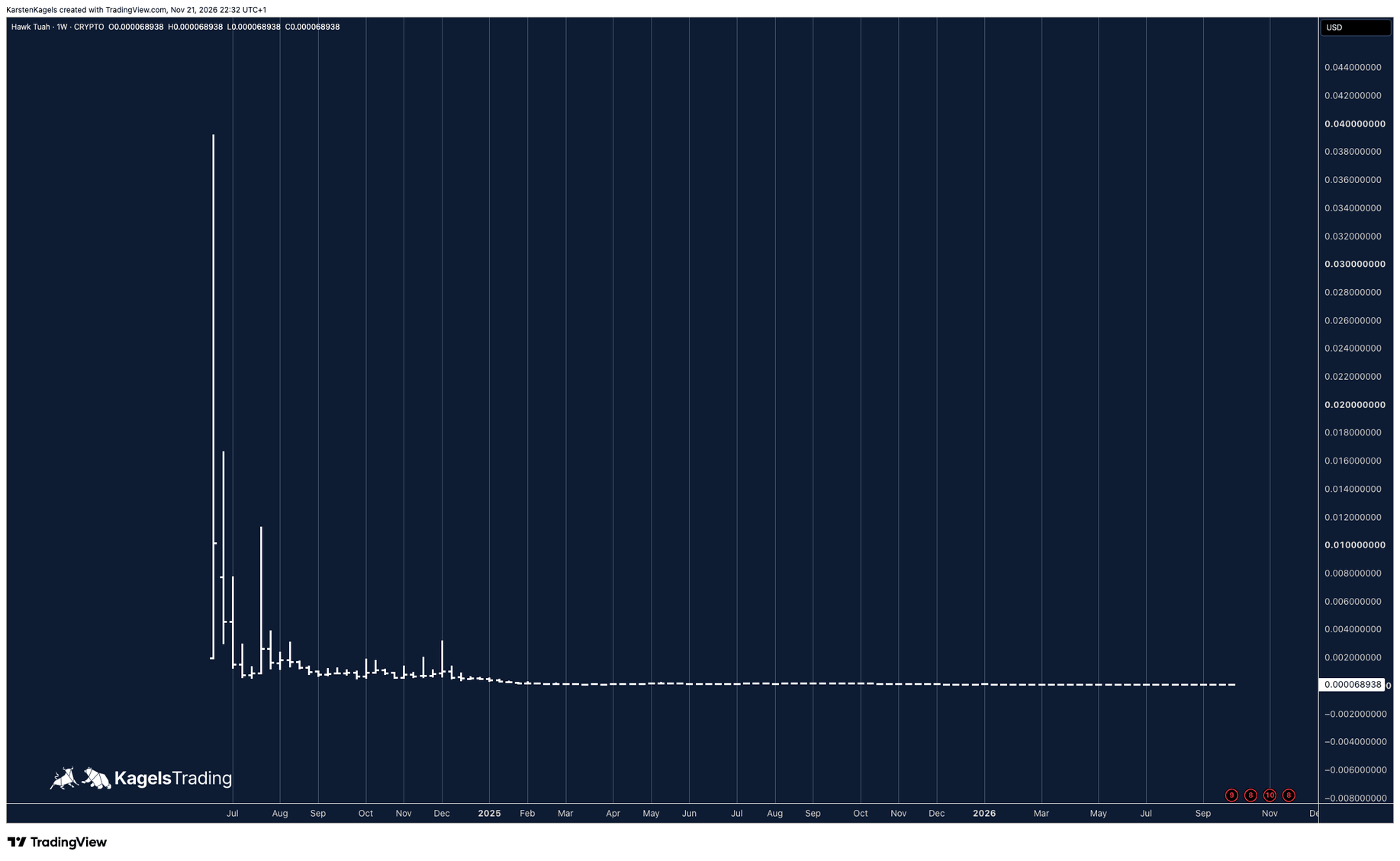
How easy it is to pick the wrong coin by name shows in the weekly chart below. TradingView lists a token as Hawk Tuah that was created on pump.fun in June 2024, half a year before the official $HAWK.
According to CoinGecko, this copycat was more than 99% below its record of 23 June 2024 on 21 November 2026. Anyone who searches by name instead of contract address can easily buy the wrong coin.
 Click to enlarge
Source: CoinGecko, Hawk Tuah (copycat).
Two popular arguments are worthless. A low unit price is no advantage, and a large community can partly consist of bought accounts. A code audit checks the contract, not the intentions of the creators.
Conclusion: meme coins are bets on attention
Meme coins are not fraud as such, but a market whose rules favour the early. Without revenue or payouts, demand alone sets the price, and whoever got tokens cheaply and early can sell to everyone who comes later.
Before you buy, answer the question from the summary at the top. Who is selling you this coin, and why right now? If you have no good answer, staying out is the best decision.
Frequently asked questions about meme coins
What are meme coins in simple terms?
Meme coins are cryptocurrencies that start from an internet joke and usually have little use beyond trading. Their price depends mainly on how many people want to buy them right now. The first and best known is Dogecoin from 2013.
Can you make a lot of money with meme coins?
Some buyers have made a lot, but the risk of loss is high. Because a meme coin pays out nothing, every profit comes from the money of later buyers. Early insiders and promoters have the advantage.
Are meme coins legal?
Buying and holding meme coins is legal in the US and the EU, but fraud and market manipulation are not. The SEC’s Division of Corporation Finance does not see typical meme coins as securities, so buyers lack that protection. In the EU, MiCA has generally required a white paper for public offers since 30 December 2024.
Do meme coins have a future?
As a category probably yes, for the single coin usually not. New coins appear every day, yet even Dogecoin, Shiba Inu and Pepe were between 88% and 96% below their records on 21 November 2026.
What is the difference between a pump and dump and a rug pull?
In a pump and dump, insiders push the price and sell to latecomers, in a rug pull the creators themselves pull the money out. Typical signs of a rug pull are an emptied pool, a large holding sold in one go or sell restrictions in the code.
Does locked liquidity protect against a rug pull?
No, it only stops the money in the pool from being withdrawn during the lock. The lock expires at some point, and creators can still sell large token holdings into the pool at any time.
How do you buy meme coins?
Through a crypto exchange or with your own wallet on a decentralized exchange. Check the contract address, the distribution and the liquidity first. Only use money whose total loss you can afford.
This English edition is based on our German edition on kagels-trading.de and has been adapted for international readers.
More Crypto guides
- Choose an exchange
Crypto Exchanges in Europe: 5 MiCA Platforms Compared
Bitvavo, Bitpanda, Kraken, Coinbase and Bitstamp: licence, fees and the published charges on a 1,000 euro bitcoin buy.
- Check one provider in depth
Bitpanda Review 2026: Fees, MiCA Licences and Who It Suits
Bitpanda: two MiCA licences, the 2026 FMA fine, fees per coin, Fusion, margin costs and who can open an account.
- Check one provider in depth
Kraken Review 2026: Fees and Safety in the US and EU
Kraken for US and EU customers: which company you deal with, Kraken Pro fees from 0.40 percent, the app fee, licences and the SEC history.
- Check if an exchange is safe
Coinbase Review 2026: Is It Safe? Fees and Licences
Coinbase for US and EU customers: licences, custody, insurance, the 2025 data theft, fees and Coinbase One.
- Check if you can use an exchange
MEXC Review 2026: Who Can Use It? Restrictions and Fees
MEXC: where it is prohibited or winding down, what regulators say, fees, identity checks and the limits of its reserve data.
- Check prices and market data
CoinGecko Review 2026: Data Accuracy, Trust Score, Cost
CoinGecko: how accurate its data is against CoinMarketCap, what the Trust Score measures, where the sponsored buttons are and what Premium costs.
- Check CoinTracking
CoinTracking Review 2026: Prices, Free Plan and Tax Reports
The crypto tax and portfolio tool: plan prices by transaction limit checked 21 November 2026, the free view-only plan, trial, refund and why a tax professional still checks the report.
- Learn from exchange hacks
Crypto Exchange Hacks: 11 Major Cases Since Mt. Gox
Eleven major crypto exchange hacks from Mt. Gox to Binance in 2026: how attackers got in, what customers got back and how to protect your coins.
- Spot a pump and dump
Pump and Dump: How the Scheme Works and How to Spot It
How organizers inflate a stock or coin and sell into the hype, real cases from Stratton Oakmont to SQUID, the warning signs and the law.