
Bitpanda Review 2026: Fees, MiCA Licences and Who It Suits


Contents
- Bitpanda review in 30 seconds
- Is Bitpanda right for you? A decision guide
- Pros and cons of Bitpanda at a glance
- What is Bitpanda?
- Is Bitpanda safe? Regulation and custody
- What can you trade on Bitpanda?
- Bitpanda fees: a fixed percentage per coin
- The Bitpanda app: what it does and what it does not
- Bitpanda customer service
- Alternatives to Bitpanda
- Conclusion: is a Bitpanda account worth it?
- Frequently asked questions about Bitpanda
- Sources
- About the author
Bitpanda is a Vienna-based investment app with MiCA licences in Austria and Germany under the EU’s crypto law. Germany’s BaFin licensed its Berlin subsidiary on January 24, 2025, and Austria’s FMA licensed Bitpanda GmbH in Vienna on April 9, 2025. With an authorisation under MiCA, a provider can serve customers across the EU, and Bitpanda’s helpdesk lists more than 40 countries, including the UK through a separate company.
The same regulation has already caught up with Bitpanda. On August 14, 2026, the FMA published a fine of 70,000 euros against Bitpanda GmbH for breaches of MiCA in its marketing, and since October 1, 2026 the authority is reviewing, at Bitpanda’s request, whether that publication was lawful. Both belong in a fair review, so you find both here with sources. We also check the fees, the range of assets, the limits and margin trading with up to 20x leverage. This review follows our editorial policy.
Bitpanda review in 30 seconds
- Regulation: MiCA licences from BaFin (January 24, 2025) and the FMA (April 9, 2025). By default you contract with Bitpanda GmbH in Vienna.
- Fees in the app: a fixed fee per coin of 0.99 percent for bitcoin, 1.49 percent for most other coins and 2.49 percent for small coins, on every buy and every sell.
- Cheaper route: Bitpanda Fusion, the advanced platform, starts at 0.25 percent and falls to 0.02 percent with volume.
- More than crypto: stocks, ETFs and precious metals in the same app; stocks and ETFs cost 1 euro per trade.
- Leverage: up to 10x on crypto and 20x on stocks and ETFs through margin trading, with a daily fee of 0.18 percent of the borrowed amount for the first 60 days.
- Who can join: residents of the EU and more than 40 countries in total, the UK through Bitpanda Broker UK Ltd; the US is not on the list.
Is Bitpanda right for you? A decision guide
What do you want to do first?
- Buy bitcoin now and then with a simple appThe broker app and its fees
- Trade crypto often or in larger amountsBitpanda Fusion
- Hold crypto, stocks and ETFs in one placeWhat you can trade
- Trade with leverageMargin trading and its costs
- Compare Bitpanda with other EU exchangesOur exchange comparison
A starting point, not a ranking. Check the fee in the trade preview before every order.
Pros and cons of Bitpanda at a glance
Here are the points that matter before you open an account; the sections below explain each one. The overview is based on Bitpanda’s own documents and on the notices of the regulators, checked on October 7 and 8, 2026.
Pros
- MiCA licences: from BaFin and the FMA, valid across the EU.
- Several asset classes in one app: crypto, stocks, ETFs and precious metals.
- Small amounts: the minimum per buy is 1 euro.
- Free euro transfers: Bitpanda does not charge for SEPA transfers in euros.
- Cheaper advanced mode: Fusion starts at 0.25 percent per trade.
- Support around the clock: live chat 24/7, according to Bitpanda.
Cons
- High fees in the app: 0.99 percent for bitcoin on every buy and sell, up to 2.49 percent for small coins.
- No deposit protection: crypto-assets are not covered by deposit guarantee schemes.
- A MiCA fine: 70,000 euros from the FMA in 2026 for marketing breaches.
- Fees on both sides: the app fee applies to the buy and again to the sale.
- Expensive leverage: 0.18 percent of the borrowed amount per day for the first 60 days of a margin trade.
What is Bitpanda?
Bitpanda was founded in Vienna in 2014 by Eric Demuth, Paul Klanschek and Christian Trummer. According to the company, it now has more than 7 million users and over 800 team members from more than 50 nationalities. It is run by the co-CEOs Lukas Enzersdorfer-Konrad and Christian Trummer; Eric Demuth is executive chairman.
| Company you contract with | Bitpanda GmbH, Vienna (default under the user agreement) |
| Founded | 2014 in Vienna |
| Founders | Eric Demuth, Paul Klanschek, Christian Trummer |
| Users | more than 7 million, according to Bitpanda |
| Team | more than 800 people |
| Assets | crypto, stocks, ETFs, precious metals, crypto indices |
| MiCA licences | FMA (Bitpanda GmbH), BaFin (Bitpanda Asset Management GmbH); see below for a Malta entry |
Sources: Bitpanda Group “About us” page and Bitpanda’s legal notice, checked October 8, 2026.
Who can open a Bitpanda account?
Bitpanda’s helpdesk lists more than 40 countries where you can verify an account. Besides the EU countries, the list includes Norway, Iceland, Liechtenstein, Switzerland, Serbia and Turkey. The United States is not on it.
UK residents can register again, through a separate company called Bitpanda Broker UK Ltd. It is registered with the Financial Conduct Authority (FCA) as a cryptoasset business, but only for anti-money-laundering supervision; the FCA register lists it under number 925234. That is not the same as an authorisation, and the Financial Ombudsman Service and the FSCS do not apply to its crypto services. The UK website offers crypto, crypto indices and staking, and UK rules require a 24-hour cooling-off period before your first trade. The fees and products in this review refer to Bitpanda’s EU documents, so check the UK terms if you live there.
Is Bitpanda a good choice for beginners?
Bitpanda is built for people who want to buy with a few taps. In the broker app you choose a coin and an amount, see a firm price and a separate fee, and confirm. You do not need to understand an order book. If you buy crypto for the first time and want a provider licensed in the EU, this is the core of what Bitpanda offers; the costs section shows what that convenience costs.
Is Bitpanda suitable for day trading?
The broker app is not made for day trading. You buy at a price quoted by Bitpanda, not in an order book, and the 0.99 percent fee for bitcoin applies to every buy and every sell. If you trade several times a day, you pay that each time.
For active traders, Bitpanda now has two separate products. Bitpanda Fusion lowers the trading fee with volume to as little as 0.02 percent, offers an API and has TradingView charts with drawing tools and indicators built in. Margin trading adds leverage. So Bitpanda is no longer unsuitable for active trading in general, but the route goes through these products, not through the standard app.
Is Bitpanda safe? Regulation and custody
With a crypto provider, custody and supervision matter more than the design of the app. This section covers the licences, the fine, what happens to your coins if the provider fails, and how you protect your account.
Is Bitpanda regulated?
Yes: Bitpanda holds licences in Germany and Austria under MiCA, the EU’s Markets in Crypto-Assets Regulation. Germany’s BaFin granted the first one on January 24, 2025, to the Berlin subsidiary Bitpanda Asset Management GmbH, for custody, exchanging crypto for money and for other crypto, and transfers. Austria’s FMA licensed Bitpanda GmbH in Vienna on April 9, 2025. According to the user agreement of July 8, 2026, Bitpanda GmbH is the company you contract with, unless the terms of a product say otherwise. ESMA’s register file of October 7, 2026 also lists a third entry under the brand name Bitpanda: BP23 CA Limited, authorised by Malta’s MFSA on January 27, 2025; the register lists Malta as its only country of activity.
A MiCA licence from one country works across the EU. The provider notifies its home regulator of the other countries it wants to serve and can then offer its services there, under common rules for custody, capital and complaints. Next to MiCA, Bitpanda says its group holds MiFID II licences for securities and e-money and PSD2 licences for payments. Stocks and ETFs are handled by Bitpanda Financial Services GmbH.
Bitpanda also points to two security certifications. It is certified to ISO 27001, the international standard for information security, and it has a SOC 2 Type 2 report, an audit of its security controls over time. You can look up the German licence yourself in the BaFin company database and the Austrian one in ESMA’s MiCA register.
Has Bitpanda been fined by a regulator?
Yes: on August 14, 2026, the FMA published a fine of 70,000 euros against Bitpanda GmbH. According to the FMA, it was the first final MiCA penalty it has published. The FMA closed the case in an expedited procedure and stated that the decision is final.
The breaches were about marketing, not about client money. The FMA named three points: Bitpanda did not send a crypto white paper to the FMA at least 20 working days before publishing it, it spread a marketing communication before the white paper was published, and one marketing communication lacked required content. That content was the statement that no authority has reviewed or approved it, plus a phone number and an e-mail address.
On October 1, 2026, the FMA added an update to its notice. At Bitpanda’s request, the FMA has opened a procedure to review whether publishing the notice was lawful. The fine itself is described as final; the review concerns the publication. You can read the full notice in German on the FMA website.
How to read this: the published notice concerns white papers and marketing. It does not report findings about customer losses or a security incident; the breaches it names are about advertising and disclosure rules. At the same time, it shows that MiCA is not only a seal of approval but an obligation that regulators enforce. The FMA itself wrote that being the first published case does not single out the company.
| Date | Event |
|---|---|
| 2014 | Bitpanda founded in Vienna |
| January 24, 2025 | MiCA licence from BaFin for Bitpanda Asset Management GmbH |
| April 9, 2025 | MiCA licence from the FMA for Bitpanda GmbH |
| July 16, 2025 | BEST and PAN tokens merged into Vision (VSN) |
| August 14, 2026 | FMA publishes a fine of 70,000 euros |
| October 1, 2026 | FMA reviews the publication at Bitpanda’s request |
Sources: Bitpanda, BaFin company database, ESMA MiCA register, FMA notice of August 14, 2026 with its update of October 1, 2026.
Is my money protected if Bitpanda fails?
There is no deposit guarantee for crypto-assets at Bitpanda or at any other crypto provider. The statutory deposit guarantee of up to 100,000 euros covers bank deposits, not crypto. Bitpanda says it holds client crypto 1:1 as a trustee, separate from its own assets, in “warm and cold wallets”.
Under MiCA, separating client assets is required, and it improves your position compared with an unregulated provider. Bitpanda says that in an insolvency you would have a right of separation under Austrian law. It adds in the same place that the final assessment lies with the insolvency administrator and the courts, and that there remains a risk the setup is judged differently. If you want full control, move your coins to your own wallet after buying.
How do you protect your Bitpanda account?
Every account goes through an identity check before you can trade. Bitpanda calls this KYC (know your customer), and it is required under EU anti-money-laundering rules. After that, switch on two-factor authentication right away; Bitpanda recommends it strongly but leaves it to you. In the settings you also see which devices are logged in to your account.
No central provider can promise that nothing will ever go wrong. As long as your coins stay with Bitpanda, you have a claim against the company, not your own private key. The collapse of the exchange FTX in 2022 showed why that matters.
What can you trade on Bitpanda?
Bitpanda started with bitcoin and has grown into an app for several asset classes. Next to crypto, it offers stocks, ETFs, precious metals and its own crypto indices. New coins are added through its “Spotlight” programme, and these carry the highest fee tier.
Bitpanda crypto indices
The crypto indices buy a basket of coins for you and rebalance it once a month. They are calculated by MarketVector Indexes, part of the asset manager VanEck. You own the single coins, not a fund share. The product overview showed nine indices when we checked:
- By size: BCI5, BCI10 and BCI25, the largest coins by market value and liquidity.
- By theme: Smart Contract, Infrastructure, DeFi, Media and Entertainment, Meme Coin and American Crypto Leaders.
The convenience has a price: 1.99 percent on every buy, sell or swap. At the monthly rebalancing, the same 1.99 percent applies to the amount that is moved, not to the whole portfolio. There is no custody fee.
Stocks, ETFs and precious metals
Bitpanda advertises more than 10,000 stocks and ETFs for a flat 1 euro per trade. You can buy fractions of a share. Bitpanda points out that fractions generally carry no voting rights, and that spreads, currency costs and product costs may come on top. Trades in stocks and ETFs are execution only, through Bitpanda Financial Services GmbH. Which products you see can depend on your country.
Gold, silver, platinum and palladium are also available. Having crypto, stocks and metals in one account is what sets Bitpanda apart from a pure crypto exchange.
Leverage on Bitpanda: tokens and margin trading
Bitpanda has two separate leverage products, and they work in different ways. The older one, Bitpanda Leverage, uses leveraged tokens such as “Bitcoin/EUR 2x Long” or “1x Short”. Bitpanda describes them as a contract for difference (CFD) with daily re-leveraging, capped at 2x. According to the token terms, Bitpanda GmbH is the issuer and your only counterparty; Bitpanda Financial Services receives and passes on the orders.
Margin trading lets you buy the real asset with borrowed money, with much higher leverage. For crypto, Bitpanda lists more than 120 assets with leverage of 2x, 3x, 5x or 10x, depending on the liquidity and volatility of each coin. For stocks and ETFs, it lists more than 875 instruments with up to 20x.
Margin trading: up to 10x on crypto and 20x on stocks
The cost of margin trading lies in how long you hold the position, not in the buy. For crypto, the cost document lists a buy fee of 0 percent, a daily fee charged every four hours, a closing fee of 0.3 percent and an extra 1 percent if you are liquidated. For stocks and ETFs, buys are free, a sale costs 1 euro and the same daily fee applies. There, the stock trades are executed by Bitpanda Financial Services, while Bitpanda calls the lending behind them, provided by Bitpanda GmbH, an unregulated service.
| Days since the trade was opened | Daily fee |
|---|---|
| Day 1 to 60 | 0.18% |
| Day 61 to 100 | 0.12% |
| Day 101 to 180 | 0.06% |
| From day 181 | 0.0312% |
Source: Bitpanda cost document, version 4.0.0 of July 8, 2026. The fee is charged in parts every four hours.
The daily fee is charged on the amount you borrow, and in the first two months it adds up quickly. That is what Bitpanda’s crypto margin terms of July 8, 2026 say. If you borrow crypto worth 4,000 euros (for example the euro stablecoin EURCV) and the amount and its euro value stay the same, four weeks at 0.18 percent a day cost about 201.60 euros, and 60 days about 432 euros. The rate then falls in steps, so multiplying 0.18 percent by 365 days overstates the yearly cost.
Bitpanda states the risk clearly itself. Small price moves can lead to a margin call or liquidation, and you can lose your entire capital. For stocks and ETFs, Bitpanda warns that losses can exceed your investment, because you may still owe the borrowed amount and the fees. If you have not used leverage before, do not start here; our guide to risk management explains how to limit the risk per trade.
How to open a Bitpanda account
Opening the account takes a few minutes, according to Bitpanda; the identity check can take longer. You need a phone number and an ID document. The steps are:
- Sign up on the website or in the app with your name, e-mail address and a password.
- Choose your country of residence and accept the terms.
- Confirm your e-mail address and your phone number.
- Verify your identity with an ID card, passport or driving licence.
- Deposit money and place your first trade (in the UK, after the 24-hour cooling-off period).
How long the verification takes varies, according to Bitpanda. It depends on the quality of your documents and other factors. Which documents are accepted depends on your country.
Bitpanda fees: a fixed percentage per coin
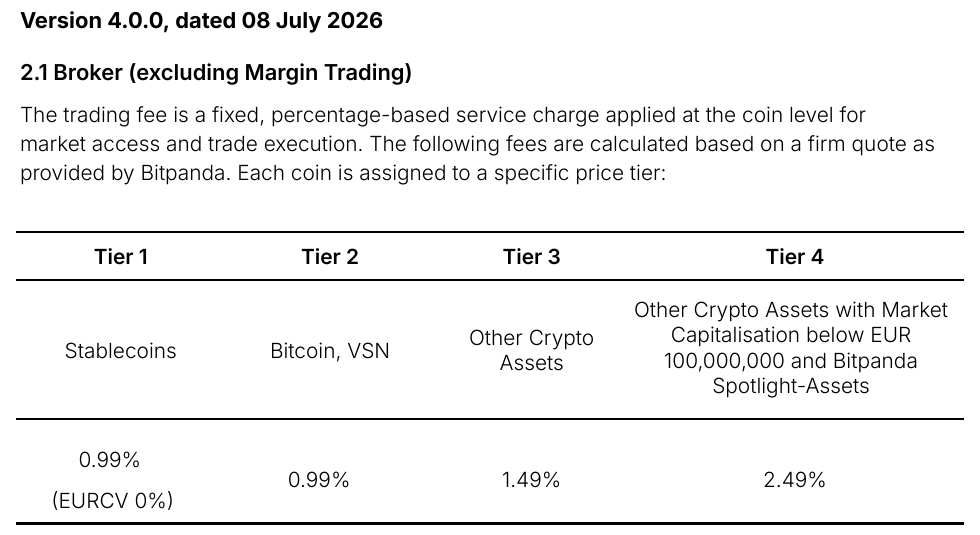
In the broker app, Bitpanda charges a fixed percentage fee per coin, on every buy and every sell. According to its cost document of July 8, 2026, the fee is calculated on a firm price quoted by Bitpanda. The trade summary shows the offer price and the fee separately before you confirm.
 Click to enlarge
Source: Bitpanda cost document.
The fee depends on the coin, not on your volume. Bitcoin, Vision (VSN) and most stablecoins cost 0.99 percent (the euro stablecoin EURCV costs nothing), most other coins 1.49 percent, and coins worth less than 100 million euros and Spotlight coins 2.49 percent.
Published fees on a trade value of 1,000 euros before fees, as of October 8, 2026, from Bitpanda's cost document version 4.0.0. The same percentage applies when you sell.
The same percentage fee applies when you sell. If you buy bitcoin worth 1,000 euros in the app and later sell it for the same value, you pay 9.90 euros on the buy and 9.90 euros on the sale, so 19.80 euros in total. For a small coin at 2.49 percent, it is 24.90 euros on each side. Through Fusion, the same bitcoin buy costs 2.50 euros.
Bitpanda Fusion: the cheaper route for active traders
Fusion is Bitpanda’s advanced trading platform, with a fee that falls as your volume rises. The fee tier is based on your trading volume over the last 30 days, in seven levels:
| Level | 30-day volume | Fee |
|---|---|---|
| 1 | up to 100,000 euros | 0.25% |
| 2 | 100,000 to 500,000 euros | 0.21% |
| 3 | 500,000 to 2.5 million euros | 0.17% |
| 4 | 2.5 to 10 million euros | 0.13% |
| 5 | 10 to 50 million euros | 0.08% |
| 6 | 50 to 250 million euros | 0.05% |
| 7 | more than 250 million euros | 0.02% |
Source: Bitpanda Fusion, checked October 8, 2026.
Fusion is not an exchange in the usual sense. Bitpanda pools prices from more than 12 venues but is your only counterparty on every trade and says it “does not operate a multilateral trading system”. Fusion offers more than 2,000 trading pairs, an API and charts from TradingView; our TradingView guide explains the charting tools. In our comparison of crypto exchanges in Europe, Fusion’s entry fee is among the lowest published charges for a bitcoin market buy.
Vision (VSN): the token that replaced BEST
Bitpanda no longer offers its old BEST token. On July 16, 2025, it ended trading in BEST and the Pantos token PAN and began converting both into a new token called Vision (VSN), at fixed rates of 4.91 VSN per BEST and 0.89 VSN per PAN. If an older review mentions BEST cashback, it is out of date.
If you pay trading fees in VSN, Bitpanda grants a 20 percent discount. VSN is issued by the VISION web3 Foundation, with a total supply of 4.2 billion tokens at launch. Like any crypto-asset, it can lose value, so a fee discount alone is no reason to buy the token.
Deposits and withdrawals
Euro bank transfers by SEPA are free at Bitpanda. Card and online payment methods are also available, with their own limits. For PayPal, Bitpanda’s pages give no clear answer: a help article lists 1.49 percent among “third-party fees”, while the Fusion page says there are “no Bitpanda-charged fees” for all methods including PayPal, with third-party fees excepted. Check the fee in the app before you pay.
For crypto transfers, the network decides most of the cost. Bitpanda publishes a withdrawal fee for each coin on its limits page and says it adjusts these fees regularly to the load on each blockchain. A bitcoin transfer can take several hours.
The minimum for a buy or sell is 1 euro; the daily limits depend on the payment method. These are the limits for verified accounts in euros:
| Method | Deposits per day | Withdrawals per day |
|---|---|---|
| Bank transfer (SEPA) | 10,000,000 euros | 5,000,000 euros |
| Credit card | 20,000 euros | not possible |
| Online payments | 10,000 euros | 100,000 euros |
Source: Bitpanda payment methods and limits, checked October 8, 2026. Monthly and total limits apply as well.
The Bitpanda app: what it does and what it does not
The Bitpanda app is built around simple buying at a quoted price. It covers your portfolio, prices, buys, swaps, staking, limit orders and savings plans. We did not open an account for this English edition, so this description follows Bitpanda’s own product pages.
Bitpanda advertises its advanced tools for Fusion, not for the broker app. On Fusion, Bitpanda lists an order book view, TradingView charts with more than 100 indicators and an API. If chart analysis matters to you, look at Fusion or a separate charting platform.
The Bitpanda Visa card
With the Bitpanda Visa debit card, you pay directly from your crypto, metals or euro balance. The card is free, has no monthly costs and no foreign exchange fee from Bitpanda (Visa’s own mark-up can apply). Payments with eligible crypto earn 1 percent cashback; euros, stablecoins, stocks and metals are excluded.
Two things to know before you order it. The card is only available to residents of the euro area. And each card payment with crypto is a trade into euros; Bitpanda notes that this is usually a taxable event.
Bitpanda customer service
Bitpanda offers support around the clock in several channels. According to its support page, there is a live chat 24/7, where an AI answers first and you can switch to a person with one tap. There is also support through WhatsApp, and you can book a call on weekdays from 9 to 5 in English, German, French or Italian (Bitpanda does not name the time zone).
The helpdesk explains common questions in writing. It covers fees, limits and verification. Bitpanda also warns that it never asks for your password, seed phrase or 2FA codes and never contacts you first in private messages.
Alternatives to Bitpanda
Under MiCA, the first question for any alternative is the licence. These four exchanges are listed in the MiCA register of ESMA; we compare their fees in detail in our guide to crypto exchanges in Europe:
- Bitvavo: a Dutch exchange licensed by the AFM, with low published fees on euro markets.
- Kraken: serves the EU through an Irish company; fees fall at higher volumes (see our Kraken review).
- Coinbase: serves the EU from Luxembourg and shows the fee in the trade preview; see our Coinbase review.
- Bitstamp: a Luxembourg exchange with a fully published price list.
Conclusion: is a Bitpanda account worth it?
With Bitpanda you pay for convenience and regulation, not for low costs. For beginners who buy crypto for the first time, it is one of the simplest apps with an EU licence. Its MiCA licences are its strongest argument, because they apply across the EU and set common rules for custody and capital.
Its second strength is breadth. Crypto, stocks, ETFs and precious metals sit in one account, and you can start with 1 euro per buy. If you do not want a separate account for every asset class, that saves effort.
Against Bitpanda speaks the price in the app. At 0.99 percent per side for bitcoin, a buy and sale cost about 2 percent of the amount. That is why the picture depends on how you use it: rare buyers can accept the fee, while active traders should look at Fusion, where the same trade starts at 0.25 percent. Margin trading is a tool for short holding periods because of the daily fee. If you trade bitcoin, our bitcoin forecast shows the price levels we watch.
Frequently asked questions about Bitpanda
How high are Bitpanda’s fees?
In the broker app, Bitpanda charges a fixed fee per coin on every buy and every sell. It is 0.99 percent for bitcoin, 1.49 percent for most other coins and 2.49 percent for small coins and Spotlight coins. On Fusion, the fee starts at 0.25 percent and falls with volume. SEPA transfers in euros are free.
Is Bitpanda available in the UK?
Yes: UK residents can register again through Bitpanda Broker UK Ltd. The company is registered with the FCA for anti-money-laundering purposes only, so the Financial Ombudsman Service and the FSCS do not cover its crypto services. UK customers get crypto, crypto indices and staking, and a 24-hour cooling-off period applies before the first trade.
Is Bitpanda available in the US?
No: the United States is not on Bitpanda’s list of supported countries. The list covers the EU and the European Economic Area, Switzerland, the UK and a few other countries in and around Europe.
What are the disadvantages of Bitpanda?
The main disadvantage is the cost in the app: 0.99 percent per side for bitcoin. Advanced charts and an order book view are Fusion features, and crypto is not covered by deposit protection. In margin trading, the daily fee is 0.18 percent of the borrowed amount for the first 60 days.
Is my money safe at Bitpanda?
Bitpanda holds client crypto as a trustee, separate from its own assets; MiCA requires that separation. That improves your position if the provider fails, but it is not a deposit guarantee, and Bitpanda itself says the legal setup could be judged differently in an insolvency. For full control, move your coins to your own wallet.
Why was Bitpanda fined?
The FMA fined Bitpanda GmbH 70,000 euros for breaking MiCA rules on white papers and marketing. The white paper was not sent to the FMA in time, marketing started before it was published, and required disclosures were missing. Since October 1, 2026, the FMA is reviewing, at Bitpanda’s request, whether publishing the notice was lawful.
What leverage does Bitpanda offer?
The leveraged tokens are capped at 2x, while margin trading goes up to 10x on crypto and 20x on stocks. The tokens are CFDs with daily re-leveraging. Margin trading buys the real asset with borrowed money, on more than 120 crypto-assets and over 875 stocks and ETFs.
What is the Bitpanda token Vision (VSN)?
Vision (VSN) replaced Bitpanda’s BEST and PAN tokens on July 16, 2025. The conversion rate was 4.91 VSN per BEST. If you pay trading fees in VSN, Bitpanda grants a 20 percent discount.
Sources
Every figure in this review comes from these pages, checked on October 7 and 8, 2026. Fees and products change, so check the current version and the trade preview before you buy.
- Licences and regulators: BaFin company database, ESMA interim MiCA register, FMA notice of August 14, 2026, FMA on its first MiCA penalty, FCA register.
- Bitpanda documents: cost document, version 4.0.0, user agreement, version 2.0.1, legal notice.
- Bitpanda pages: about us, security, supported countries, UK website, limits, Fusion, margin trading, crypto margin terms, version 1.0.2, leverage token terms, margin trading on stocks, stocks, crypto indices, Vision token, BEST and PAN merger, card, support, fees and premiums.
This review was written by Karsten Kagels. It is based on Bitpanda’s own documents and the registers and notices of BaFin, the FMA, ESMA and the FCA, checked on October 7 and 8, 2026. We did not open an account for this English edition. Crypto-assets can lose value sharply, and leverage can cost more than you invest. This is not investment advice.
This English edition is based on our German edition on kagels-trading.de and has been adapted for international readers.
More Crypto guides
- Choose an exchange
Crypto Exchanges in Europe: 5 MiCA Platforms Compared
Bitvavo, Bitpanda, Kraken, Coinbase and Bitstamp: licence, fees and the published charges on a 1,000 euro bitcoin buy.
- Check one provider in depth
Kraken Review 2026: Fees and Safety in the US and EU
Kraken for US and EU customers: which company you deal with, Kraken Pro fees from 0.40 percent, the app fee, licences and the SEC history.
- Check if an exchange is safe
Coinbase Review 2026: Is It Safe? Fees and Licences
Coinbase for US and EU customers: licences, custody, insurance, the 2025 data theft, fees and Coinbase One.