
Trading Signals: How to Judge a Signal Service


Contents
A trading signal is a concrete trade idea: what to trade, in which direction, where to enter, where to place the stop-loss and where to take profit. Signal services sell these ideas by app, email or chat. Some are run by experienced traders with documented results; many are not. This guide shows how to tell the difference before you pay, and what regulators warn about in social media signal groups.
Disclosure: Kagels Trading sells its own signal services on its German website, in German. This guide does not describe, compare or rank them, and it does not compare other providers either. Its aim is to give you the checks that apply to any service, including ours. How we research and write is described on our editorial policy page.
This guide is educational information, not investment advice. Trading with leverage, such as CFDs, futures, forex or crypto, carries a high risk of losing money. Only trade with money you can afford to lose.
Trading signals in 30 seconds
- What they are: a trade idea with entry, stop-loss and target, from a person or an algorithm. You decide whether to place the trade.
- What to check: a full track record with losses, real names, a stop-loss on every signal, a trial and no profit promises.
- Key numbers: win rate alone is not enough; compare the average win with the average loss.
- A key risk: unregulated groups on Telegram or WhatsApp that promise high returns. US and UK regulators warn about them.
What is a trading signal?
A trading signal names an instrument, a direction, an entry price, a stop-loss and a target. That gives you a clear basis for a decision: what to trade, which way, and your planned risk if the idea fails. In real trading, gaps and slippage can make the loss larger than the stop-loss suggests. The trade itself stays in your hands; you place the order at your own broker.
Signals differ from copy trading. With signals, you place each trade yourself. With copy trading, the trades of another trader are mirrored in your account automatically, so you give up control over each single trade.
Manual and automated signals
Manual signals come from a person’s analysis; automated signals come from an algorithm. A human analyst can weigh news and context, but may be slower and less consistent. An algorithm reacts fast and follows its rules every time, but only as well as those rules fit the market.
Technical and fundamental signals
Technical signals follow price patterns and indicators; fundamental signals react to economic data or company figures. Both try to find a good timing for a trade. Most short-term services work with technical analysis, because it gives exact entry and exit levels.
How to judge a signal service
Check six points before you pay for any signal service. None of them guarantees good results, and they apply whatever the price or channel; each one that fails is a warning sign.
- A full track record: every signal with result, losses included, over a long period. Selected winners prove nothing.
- Real people: names and experience behind the signals, not anonymous channel admins.
- A stop-loss on every signal: without a defined risk, a signal cannot be sized.
- A trial: a useful check, because you can watch the signals before you commit; it is not proof of future results.
- No profit promises: nobody can guarantee returns. A promise of guaranteed gains is a red flag.
- Independent checks: registration with a regulator where required, and reviews on independent platforms.
Read the numbers correctly
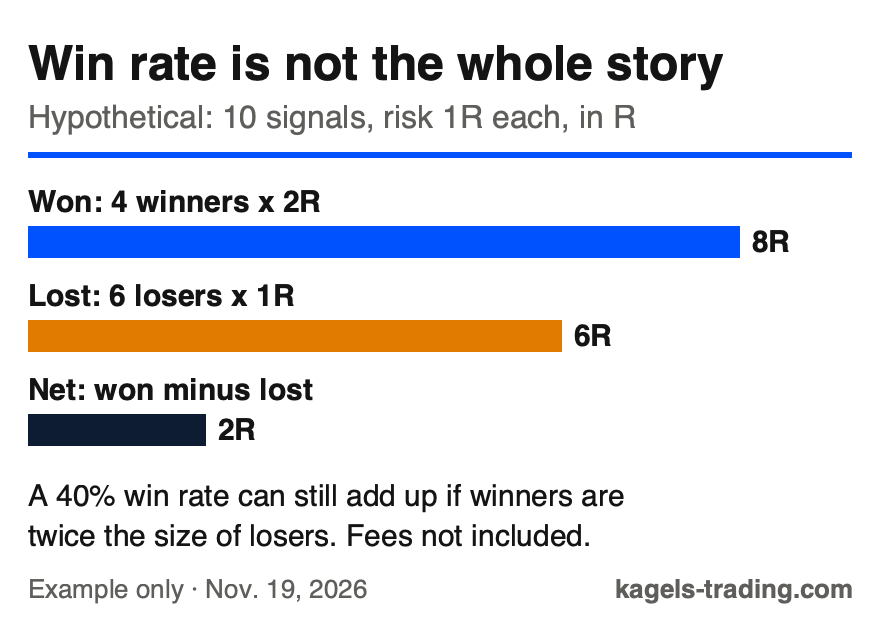
A win rate alone says little about a signal service. What matters is how much the winners make compared with what the losers cost. Traders measure this in R, the amount risked on one trade.
 Click to enlarge
Source: Kagels Trading, own example.
A worked example shows why. Suppose a service sends 10 signals, each risking 1R. Four win 2R each, six lose 1R each. The win rate is only 40%, but the result is 8R won minus 6R lost: +2R before fees. A service with a 70% win rate can still lose money if its few losers are much larger than its winners. Our guide to the risk-reward ratio explains the maths.
Ask whether the track record shows what you would really get. Check whether results include fees and spreads, whether entries were reachable in time, and whether the period covers both calm and volatile markets. Keeping your own trading journal during a trial is the most honest test.
What regulators warn about
US and UK regulators warn about investment and signal groups on social media and messaging apps. According to these alerts, schemes can start with an ad on Instagram or Facebook, then move people into a group chat on WhatsApp or Telegram, where “experts” post tips and other members post screenshots of gains.
The SEC describes group chats as a gateway to investment scams. In its investor alert of December 22, 2025, it names cases with fake trading platforms and supposed investment clubs, some using deepfake videos of well-known professionals. It also warns that “the promise of high returns with little or no risk is a classic sign” of investment fraud.
FINRA reports a sharp rise in complaints about fake investment groups. According to its investor alert, bad actors pose as registered professionals, advertise “stock investment groups” on social media and then switch to encrypted apps. Many such groups end in pump-and-dump or “ramp-and-dump” schemes; see our guide to pump and dump.
The CFTC warns that scammers add random phone numbers to WhatsApp and Telegram groups. Its advisory on messaging apps tells you to be suspicious of messages promising guaranteed returns and reminds readers that “all trades involve a risk of loss”.
In the UK, the FCA acts against unauthorised signal providers and influencers. It lists unauthorised signal providers on its warning list, for example Signals2Trades (first published March 9, 2026), and in February 2026 seven social media influencers were sentenced for promoting an unauthorised foreign exchange trading scheme, according to an FCA press release. Check a UK provider on the FCA register before you pay.
Free and paid signals
Free signals are offered by brokers, finance portals and Telegram groups. Apply the same checks as for a paid service: a documented track record, a stop-loss on every signal and real support. Some free channels can be a funnel into paid “VIP” groups or into a broker account; ask how the channel earns its money.
Paid services should earn their price with transparency. Look for a clear price, a trial, simple cancellation and a full record of past signals. A subscription is a fixed cost, so with a small account it can eat most of your gains.
Do trading signals work?
Signals can help if they rest on a solid method and you follow them with discipline. They are a decision aid, not a shortcut. Results depend on the provider, on your execution and on your position size.
Copying blindly rarely pays. If you do not understand why a signal was given, you cannot judge when it stopped working. Combine signals with your own risk management and a fixed position size for every trade.
Beginners can learn from good signals, but only if they study them. Read the reasoning behind each trade idea, note it in a journal, and test the service on a demo account before you use real money.
Conclusion: check before you trust
A good signal service shows its full record, names its people and puts a stop-loss on every signal. A trial helps you check it, and it makes no promises of profit. A failed check is a reason to walk away.
Be especially careful with offers through social media and messaging apps. US and UK regulators warn about group chats that promise high returns. Check registration, test with a demo account and never send money to an unknown trading platform.
Frequently asked questions about trading signals
What are trading signals?
Trading signals are concrete trade ideas with entry, stop-loss and target. They come from analysts or algorithms. You decide whether to place the trade at your own broker.
Are trading signals legal?
Whether a signal service is legal depends on the jurisdiction and on what the service does. Some services need a licence or registration, for example when they give personal advice or promote investments. Check the provider’s identity and whether it has the permission it needs from your regulator.
How can I tell if a signal service is serious?
Look for a full track record with losses, real names and a stop-loss on every signal. A trial and independent reviews are good signs. Promises of guaranteed returns are a red flag.
Are free trading signals any good?
A free signal is only as good as its documented record. Free channels can lead to paid VIP groups or to a broker account. Check a free service as strictly as a paid one.
What is the difference between signals and copy trading?
With signals you place each trade yourself; with copy trading it happens automatically. Copy trading mirrors another trader’s positions in your account, so you give up control over each trade.
Do trading signals work?
They can, but there is no guarantee of profit. Results depend on the quality of the method, on your execution and on strict risk management.
This English edition is based on our German edition on kagels-trading.de and has been adapted for international readers.
More Trading Education guides
- Choose a learning path
Trading Education: How to Choose Your Learning Path
Self-study, online courses, live classes and mentoring compared on practice, feedback, flexibility and limits, with a seven-point check before you pay.
- Follow a learning sequence
Learn Trading: A Practical Beginner's Roadmap
What to learn first and what to practise next: market basics, risk and position size, one written approach, simulation with a journal and a small live test.
- Judge a market expert
Stock Market Experts: Who to Follow and How to Judge Advice
Five types of expert, what Buffett, Damodaran, Sonders, McLean and Raschke can teach and where it stops, plus a seven-point credibility check and US registration tools.
- Learn valuation from a professor
Aswath Damodaran: Valuation, Equity Risk Premium and Books
Aswath Damodaran of NYU: how he values companies, what his implied equity risk premium says, his free data and classes, and which book to read first.
- Compare a paid course
Trading Courses: How to Compare Your Options
Syllabus, exercises, feedback, instructor evidence, total cost, access period, cancellation and refund terms, with real examples of how course terms differ.
- Check a licence or certificate
Trading Certifications: Exams, Costs and What They Prove
FINRA exams, UK rules, exchange trader exams, CMT, CFTe, CFA, FRM and CAIA with current fees, and what each does and does not do for your own trading.
- Check a free forex school
BabyPips Review: What Is Free and What Premium Costs
BabyPips reviewed: which School of Pipsology courses are free, what Premium costs and includes, and why there is no refund for unused time.
- Compare day trading courses
Day Trading Courses Compared: Cost, Refunds and Proof
Free courses, prices from $297 to $10,000, refund terms, FTC cases and what providers can prove, compared from our reviews without a ranking.
- Learn from free live calls
Tom Hougaard: Best Loser Wins, Telegram and Track Record
Tom Hougaard (TraderTom): Best Loser Wins, the free Telegram channels, why he sells no courses, and the limits of his track record.
- Check Market Rebellion
Market Rebellion Review: The Najarians, Services, Cost, Terms
Jon and Pete Najarian, unusual options activity services, prices that need a phone call, the $99 club and the refund rules.
- Check Larry Connors
Larry Connors Review: RSI(2), Books, Courses and Cost
RSI(2), ConnorsRSI and Street Smarts, books at about $30, courses and $20,000 mentoring, the return policy and what test results can show.
- Check Tradeciety
Tradeciety Review 2026: The Tradecademy Course, Cost and Terms
The $177 Tradecademy video course, the dropped mentoring programs, the German company behind it, the withdrawal terms and how old the Trustpilot reviews are.
- Check SMB Capital
SMB Capital Review: SMB Training Programs, Cost and Terms
The New York prop desk behind SMB Training: programs from $297 to $10,000, the no-refund policy and how rare a seat on the desk is.
- Check Warrior Trading
Warrior Trading Review: Ross Cameron, Cost and the FTC Case
Ross Cameron's examined track record, memberships from $797 to $3,997, refund and arbitration terms, customer reviews and the 2022 FTC case with its $3 million order.
- Check Miles Deutscher
Miles Deutscher Review: Free AI Guides and a $199 Club
The AI guides and altcoin videos, the $199 Miles High Club, what the 224 Whop reviews show, the partner links and the refund terms.
- Check MCO Global
MCO Global Review: More Crypto Online, Prices and Terms
More Crypto Online is now MCO Global: Elliott wave memberships from £25 to £110 a month, the company behind it, no trial, the refund terms and the scam warning.
- Check TJR and the free Boot Camp
TJR Trading Review: Boot Camp, Blueprint and Disclosures
The free YouTube Boot Camp, the Blueprint mentorship without a public price, what the disclosures say about results, and the contract terms.
- Check Unger Academy
Unger Academy Review: Andrea Unger, Cost and Terms
Andrea Unger's four World Cup titles, what AlgoTrader Fast includes, the missing public price, refund and arbitration terms in Italy, and 352 Trustpilot reviews.
- Check Online Trading Academy
Online Trading Academy Review: Cost, FTC Case, New Owner
Now Trading Academy: the free class, how pricing works, the Core Strategy, the 2020 FTC settlement and what changed under new ownership.
- Check Rockwell Trading
Rockwell Trading Review: PowerX Optimizer, Cost and Terms
Markus Heitkoetter, the PowerX Optimizer at $1,997 a year, the PowerX and Wheel strategies, refund and arbitration terms, reviews and the lawsuit with a critic.
- Judge a trading education provider
Verified Investing Review: Gareth Soloway and the Free Daily Shows
Gareth Soloway and Verified Investing: the free daily YouTube shows, the paid trading room and alerts with prices, and what "verified" really means.
- Check Thraxx Trades
Thraxx Trades Review: Orderflow Bootcamp, Price and Refunds
Christopher Creamer's orderflow method, his July 2026 monthly contest win, the bootcamp sold on a sales call without a public price, and the no-refund terms.
- Judge a YouTube trading course
Tori Trades Review: Trend Line Method, Program and Costs
Tori Trades: her free YouTube channel and trend line method, the free masterclass, the paid program with its unclear price, refunds and member reviews.
- Check a YouTube strategy channel
Data Trader Review: Strategies, Telegram and Premium
Data Trader: the anonymous channel behind viral strategy guides, its Telegram gold plans, the Premium signal prices and our backtest of its volume profile setups.