
Aswath Damodaran: Valuation, Equity Risk Premium and Books


Contents
- Aswath Damodaran in 30 seconds
- Who is Aswath Damodaran?
- How does Damodaran value a company?
- What is the Damodaran equity risk premium?
- Damodaran’s data, classes and blog: what is free
- Damodaran and Nvidia: valuation against price
- Aswath Damodaran books: which one to read first
- What traders can learn from Damodaran and what they cannot
- Conclusion: the valuation teacher who shows his work
- Frequently asked questions about Aswath Damodaran
- About the author
Aswath Damodaran makes his whole valuation toolkit freely available online. The NYU professor publishes valuation models, industry data and complete valuation classes, and his website has been online since 1998. If you want to know whether a stock is worth its price, you end up on his site sooner or later.
For traders, he is worth reading for a different reason. Damodaran himself says his valuations are a tool for investors, not for traders. Here you learn how he values a company, what his equity risk premium tells you, how he sold his Nvidia shares and which parts you can still use. This article follows our editorial policy. It is for education, not investment advice.
Aswath Damodaran in 30 seconds
- NYU professor since 1986: he teaches valuation and corporate finance at the Stern School of Business, after two years as a visiting lecturer at Berkeley.
- Data for everyone: his data page with figures by industry and region is updated every January, most recently on January 9, 2026.
- Known for the equity risk premium: the implied premium of the S&P 500 was 4.41% on November 1, 2026, according to his home page.
- Nvidia, openly documented: bought in 2018, half sold in summer 2023, another quarter sold in summer 2024.
- Not a trading teacher: for trading, he points to other measures himself, namely mood and momentum.
Who is Aswath Damodaran?
Aswath Damodaran is a professor of finance at New York University’s Stern School of Business, where he has taught valuation and corporate finance since 1986 and publishes his data, classes and valuation models for free.
His academic background spans accounting, management and finance. He studied accounting at the University of Madras in India and management at the Indian Institute of Management. At UCLA, he completed his MBA in 1981 and his PhD in finance in 1985.
His teaching career began at Berkeley. He was a visiting lecturer there from 1984 to 1986 and has taught at NYU ever since, where he now holds the Kerschner Family Chair in Finance Education. In his own biography, he calls himself the youngest winner of the university-wide Distinguished Teaching Award, which he received in 1990.
He sees himself as a teacher first, not an authority. That is how his short biography puts it, along with the note that he runs his website on his own. Apart from slides for instructors, he says, almost all of it is open.
How does Damodaran value a company?
At its core, Damodaran uses discounted cash flow valuation. His models link expected cash flows with a discount rate that reflects risk.
The discounted cash flow method (DCF) values a company from its expected future free cash flows, discounted back to today at a rate that reflects their risk.
He keeps his models deliberately lean. In his Nvidia analysis of September 2024, he names three levers: revenue growth, profit margins and reinvestment, meaning how much a company has to spend to grow. The risk sits in the discount rate, which professionals call the cost of capital.
A valuation starts with a story for him. In his book Narrative and Numbers (2017), he describes how the story about a company turns into assumptions about revenue and margins. If you believe a company will conquer a large market, you have to put that into numbers. Only then do you see whether the story supports the price.
You can download his spreadsheets and change them. He writes that you should tell your own story and arrive at a different value. Even a small change in growth often moves the result a lot. For the investing side of this approach, see our guide to value investing.
What is the Damodaran equity risk premium?
The equity risk premium is the extra annual return investors expect from stocks above a risk-free rate, and Damodaran derives it for the S&P 500 from the current index level and expected cash payouts.
He does not use historical averages for this. He looks for the discount rate at which expected dividends and buybacks add up to exactly today’s index level. Subtract the risk-free rate, and what remains is the implied equity risk premium.
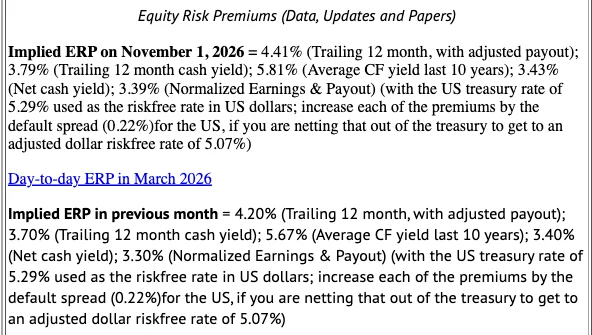
On November 1, 2026, it stood at 4.41%, according to his home page. He measured it against a US Treasury rate of 5.29%. If you net out the US default spread, the risk-free dollar rate is 5.07% and the premium rises by 0.22 points to 4.63%. One month earlier, the headline value was 4.20%.
 Click to enlarge
Source: Damodaran Online, NYU Stern.
The screenshot shows several versions of his calculation. He leads with the first figure, which uses trailing 12-month payouts. The other values show how much the premium depends on the assumption about payouts.
| Date | Implied equity risk premium | Market backdrop |
|---|---|---|
| End of 1999 | 2.05% | Late stage of the dot-com bubble |
| End of 2008 | 6.43% | Financial crisis |
| End of 2025 | 4.23% | Latest annual data |
| November 1, 2026 | 4.41% | Current monthly value |
Source: Damodaran, historical implied equity risk premiums for the S&P 500 (January 2026) and his home page (November 1, 2026).
 Click to enlarge
Source: Damodaran, NYU Stern.
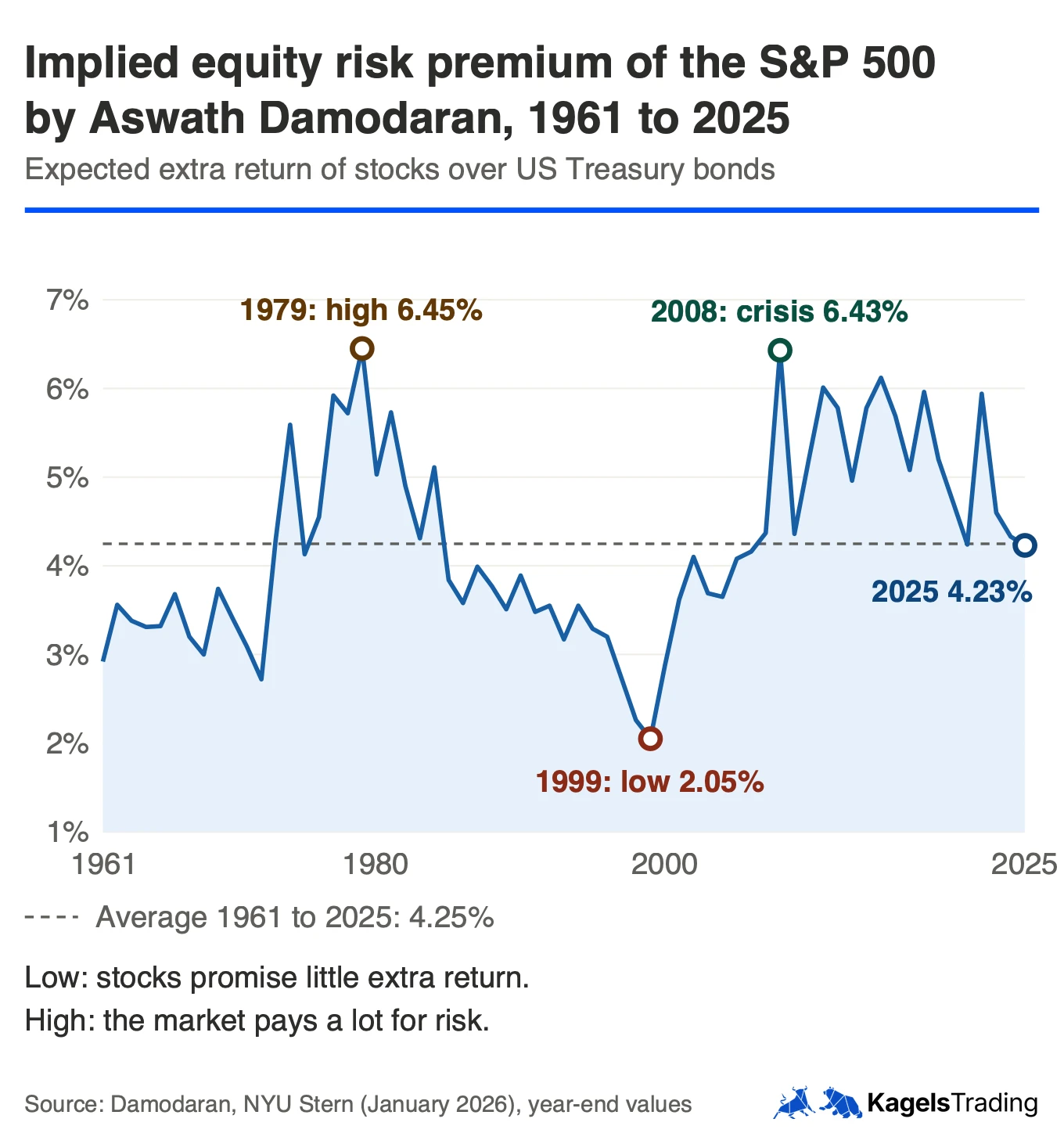
The chart shows the full history since 1961. By our calculation from his year-end values, the premium averaged 4.25%, and at the end of 2025 it stood almost exactly there at 4.23%. Its high came at the end of 1979 with 6.45%.
A low premium means the model expects only a small markup over bonds. At the end of 1999, shortly before the dot-com bubble burst, it was only 2.05%, and at the end of 2008, in the middle of the financial crisis, 6.43%. Whether stocks are too expensive also depends on the payout assumptions. The number does not tell you when to buy or sell.
For other countries, he adds a premium based on the sovereign rating. His country risk table uses ratings and default spreads to scale the premium for each market. Analysts use these values in the cost of capital of a DCF valuation. Where the S&P 500 stands on the chart is covered in our S&P 500 forecast.
Damodaran’s data, classes and blog: what is free
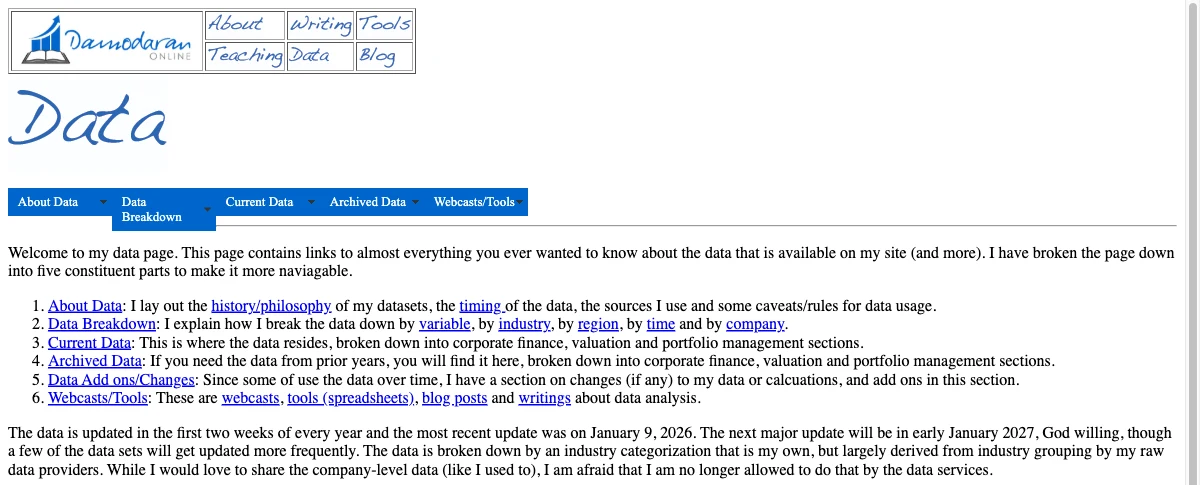
His data page collects figures by industry and region. It runs from margins and tax rates to valuation multiples. He updates it in the first two weeks of January, most recently on January 9, 2026, as the screenshot below shows.
 Click to enlarge
Source: Damodaran Online, NYU Stern.
The next major update is announced for early January 2027. Company-level data, he writes, he is no longer allowed to share because of his data providers. You find everything on his data page.
His classes on valuation, corporate finance and investment philosophies are online for free. They run on his website and on YouTube. The online valuation class uses sessions of 15 to 20 minutes with tests afterwards. On November 11, 2026, his YouTube channel had about 1.02 million subscribers and 1,418 videos.
NYU Stern also sells paid online programs with a certificate. With Damodaran, these are Advanced Valuation, Corporate Finance and Investment Philosophies through NYU Stern Executive Education. The overview page does not list a price.
Since 2008 he has written the blog Musings on Markets. There he works through current cases and shares the spreadsheets, most recently in November 2026 on the AI trade. You can read it at Musings on Markets.
Damodaran and Nvidia: valuation against price
Damodaran shows his own positions and names his mistakes. By his own account, he bought Nvidia in 2018, after the stock had lost more than half its market value. He had owned Microsoft since 2014.
He did not see the AI boom coming when he bought. In June 2023, he wrote that he had simply been in the right place at the right time. His summary: “being lucky often beats being smart”, at least in markets.
In summer 2023, he sold half of his Nvidia shares. Even his upbeat valuation came out well below the price. He kept the other half for the chance that Nvidia would find new markets. In summer 2024, another quarter followed, according to his January 2025 post.
In September 2024, he valued Nvidia at about $87 per share. The stock traded at $106 on September 5. Looking back, he wrote that he left money on the table with the half he sold but was richly compensated for the half he kept. He counted that as a win.
There is a practical lesson in this for you. Damodaran sells in steps when value and price drift too far apart, instead of betting everything on one decision. For traders, he names other measures in the same post: mood and momentum.
Aswath Damodaran books: which one to read first
Damodaran has written more than ten books, most of them textbooks. The table shows a selection with our assessment of who each one suits. Several have newer editions, as his home page notes.
| Book | Edition | Best for |
|---|---|---|
| The Little Book of Valuation | Revised edition 2024 | Getting started |
| Narrative and Numbers | 2017 | Linking story and numbers |
| Investment Valuation | 4th edition | Full reference |
| The Dark Side of Valuation | 3rd edition 2018 | Hard-to-value companies |
| Investment Philosophies | 3rd edition announced | Comparing investing styles |
| The Corporate Life Cycle | 2024 | Companies through their life cycle |
Source: Damodaran’s biography, home page and Little Book companion page (November 11, 2026). The “Best for” column is our assessment.
A book does not make anyone a successful investor or trader. It gives you the terms and basics, and the learning happens in practice. If you want to get to know Damodaran, a free class is a fine place to start. Our overview of trading books covers the trading side.
What traders can learn from Damodaran and what they cannot
Damodaran is an investor, not a trader. Some of his principles carry over to trading, but his models do not give you entry signals.
What traders can take from Damodaran
- Valuation as a cross-check: a look at revenue growth and margins shows what expectation is built into the price.
- The risk premium as a market thermometer: it shows how much extra return stocks currently promise over bonds in his model.
- Selling in steps: as with Nvidia, you can reduce a position in parts instead of betting everything on one decision.
- Writing down your reasons: if you record your reasons beforehand, you can review hits and misses honestly later.
Where his method stops for traders
- No timing signal: a valuation does not say when a price turns. By his numbers, Nvidia traded above its value for a long time and still kept rising.
- Different time frames: his models look years ahead, while a trade often lasts hours or days.
- Assumptions, not facts: small changes in growth or the cost of capital move the value a lot.
- In trading, price rules: Damodaran himself points to mood and momentum here.
One way to combine both: valuation helps you choose, the chart helps with entry and stop. How other big investors work is shown in our portrait of Warren Buffett. For more voices and how to judge them, see our guide to stock market experts.
Conclusion: the valuation teacher who shows his work
Aswath Damodaran makes company valuation open to everyone. His data, classes and risk premiums are free, updated regularly and easy to rebuild in your own spreadsheets.
For traders, he is a cross-check, not a signal provider. His valuation shows what expectation is built into a price. When a price turns, it does not say, and he stresses that himself.
The Nvidia case shows his approach most clearly. He bought after a crash, sold in parts when price ran far above value, and said openly where he left money on the table.
My assessment: if you hold stocks for longer, you should know his data page. If you trade short term, the main thing to take away is the discipline to write down your assumptions and review your mistakes openly.
Frequently asked questions about Aswath Damodaran
What is Aswath Damodaran known for?
Aswath Damodaran is a professor of finance at NYU’s Stern School of Business. He has taught valuation and corporate finance there since 1986. He is best known for his free data, classes and valuation models.
What is Damodaran’s equity risk premium?
It is the implied premium of the S&P 500 over the risk-free rate. He derives it from the index level and expected dividends and buybacks. On November 1, 2026, it was 4.41% against the US Treasury rate, according to his home page.
Where can I find Damodaran’s data?
The data is free on his data page at NYU. He updates it every year in the first two weeks of January, most recently on January 9, 2026. The next major update is announced for early January 2027.
Are Damodaran’s classes free?
Yes, his online classes are free on his website and on YouTube. They cover valuation, corporate finance and investment philosophies. The certificate programs of NYU Stern Executive Education, such as Advanced Valuation and Corporate Finance, are paid.
Which Damodaran book should I read first?
For a start, The Little Book of Valuation is the easiest choice. A revised edition came out in 2024. His larger works such as Investment Valuation are textbooks and reference books.
Does Aswath Damodaran own Nvidia stock?
He bought Nvidia in 2018, by his own account. He sold half in summer 2023 and another quarter in summer 2024. We do not state a current holding, because we have no newer statement from him.
This US edition is based on our German edition on kagels-trading.de and has been adapted for US readers.
More Trading Education guides
- Choose a learning path
Trading Education: How to Choose Your Learning Path
Self-study, online courses, live classes and mentoring compared on practice, feedback, flexibility and limits, with a seven-point check before you pay.
- Follow a learning sequence
Learn Trading: A Practical Beginner's Roadmap
What to learn first and what to practise next: market basics, risk and position size, one written approach, simulation with a journal and a small live test.
- Judge a market expert
Stock Market Experts: Who to Follow and How to Judge Advice
Five types of expert, what Buffett, Damodaran, Sonders, McLean and Raschke can teach and where it stops, plus a seven-point credibility check and US registration tools.
- Compare a paid course
Trading Courses: How to Compare Your Options
Syllabus, exercises, feedback, instructor evidence, total cost, access period, cancellation and refund terms, with real examples of how course terms differ.
- Compare day trading courses
Day Trading Courses Compared: Cost, Refunds and Proof
Free courses, prices from $297 to $10,000, refund terms, FTC cases and what providers can prove, compared from our reviews without a ranking.
- Learn from free live calls
Tom Hougaard: Best Loser Wins, Telegram and Track Record
Tom Hougaard (TraderTom): Best Loser Wins, the free Telegram channels, why he sells no courses, and the limits of his track record.
- Check Market Rebellion
Market Rebellion Review: The Najarians, Services, Cost, Terms
Jon and Pete Najarian, unusual options activity services, prices that need a phone call, the $99 club and the refund rules.
- Check Larry Connors
Larry Connors Review: RSI(2), Books, Courses and Cost
RSI(2), ConnorsRSI and Street Smarts, books at about $30, courses and $20,000 mentoring, the return policy and what test results can show.
- Check SMB Capital
SMB Capital Review: SMB Training Programs, Cost and Terms
The New York prop desk behind SMB Training: programs from $297 to $10,000, the no-refund policy and how rare a seat on the desk is.
- Check Warrior Trading
Warrior Trading Review: Ross Cameron, Cost and the FTC Case
Ross Cameron's examined track record, memberships from $797 to $3,997, refund and arbitration terms, customer reviews and the 2022 FTC case with its $3 million order.
- Check Miles Deutscher
Miles Deutscher Review: Free AI Guides and a $199 Club
The AI guides and altcoin videos, the $199 Miles High Club, what the 224 Whop reviews show, the partner links and the refund terms.
- Check TJR and the free Boot Camp
TJR Trading Review: Boot Camp, Blueprint and Disclosures
The free YouTube Boot Camp, the Blueprint mentorship without a public price, what the disclosures say about results, and the contract terms.
- Check Unger Academy
Unger Academy Review: Andrea Unger, Cost and Terms
Andrea Unger's four World Cup titles, what AlgoTrader Fast includes, the missing public price, refund and arbitration terms in Italy, and 352 Trustpilot reviews.
- Check Online Trading Academy
Online Trading Academy Review: Cost, FTC Case, New Owner
Now Trading Academy: the free class, how pricing works, the Core Strategy, the 2020 FTC settlement and what changed under new ownership.
- Check Rockwell Trading
Rockwell Trading Review: PowerX Optimizer, Cost and Terms
Markus Heitkoetter, the PowerX Optimizer at $1,997 a year, the PowerX and Wheel strategies, refund and arbitration terms, reviews and the lawsuit with a critic.
- Judge a trading education provider
Verified Investing Review: Gareth Soloway and the Free Daily Shows
Gareth Soloway and Verified Investing: the free daily YouTube shows, the paid trading room and alerts with prices, and what "verified" really means.